Feeds:
Posts
Comments

Archive for December 16th, 2008

The fossil fuel industry should get a lump of coal this holiday but I’m sure they’d be happy with that. Scientists at the annual meeting of the American Geophysical Union in San Francisco this week are giving us some alarming news about polar ice cap melt, glacier loss, and other threats from climate change.

Global warming is causing massive ice melting at the poles of over 2 trillion tons of ice this year. This creates even more warming as less of the sun’s rays are reflected off the white ice cap and are absorbed by the dark ocean. Scientists are incredibly alarmed at this rate. This amount of arctic warming and ice loss was predicted to occur decades from now, meaning we are warming much faster than scientists had expected. One article in the UK Times this morning even asked Has Arctic Melt Passed the Point of No Return?

There isn’t much good news to be had, but at least melting arctic sea ice doesn’t add significantly to sea level rise. Melting ice from Greenland’s glaciers, however, does– and they lost a piece of ice last year more than twice the size of Manhattan. Scientists are concerned because Greenland lost three times more ice this year than only a few years ago, showing the speed at which warming is accelerating.

NOAA has shown just how bad this ice melt has been in the last few years:

[youtube=http://www.youtube.com/watch?v=bXhcKyYOb9Y]

And why is this bad news for Mr. Claus? Continued ice melt like this, will, most likely, put Santa’s workshop underwater, which I guess will look something like this:

[youtube=http://www.youtube.com/watch?v=JHgYYc20Pws]

So what do we do? The most recent climate conference in Posnan left a lot of people hoping for more. We need to plot a course that will keep climate change from under 2 degrees worldwide, which probably means stabilizing CO2 at 350 parts per million or less. That would require strong federal legislation in this next year which will cut our emissions by at least 80% by mid century and 25% by 2020.

~~Citizen Andy
Read Full Post »

An investigative report by USAToday brought me to tears this morning.

Granted, I am a particularly emotional person at a period of transition in my life. I just started a new job (here, with Public Citizen!) in a new town (loving Austin already), and am living out of a suitcase. Things are rather in flux, and my emotional state may have followed suit. But I think that even beyond all that, USA Today’s recent report finally made air toxics issues hit home.

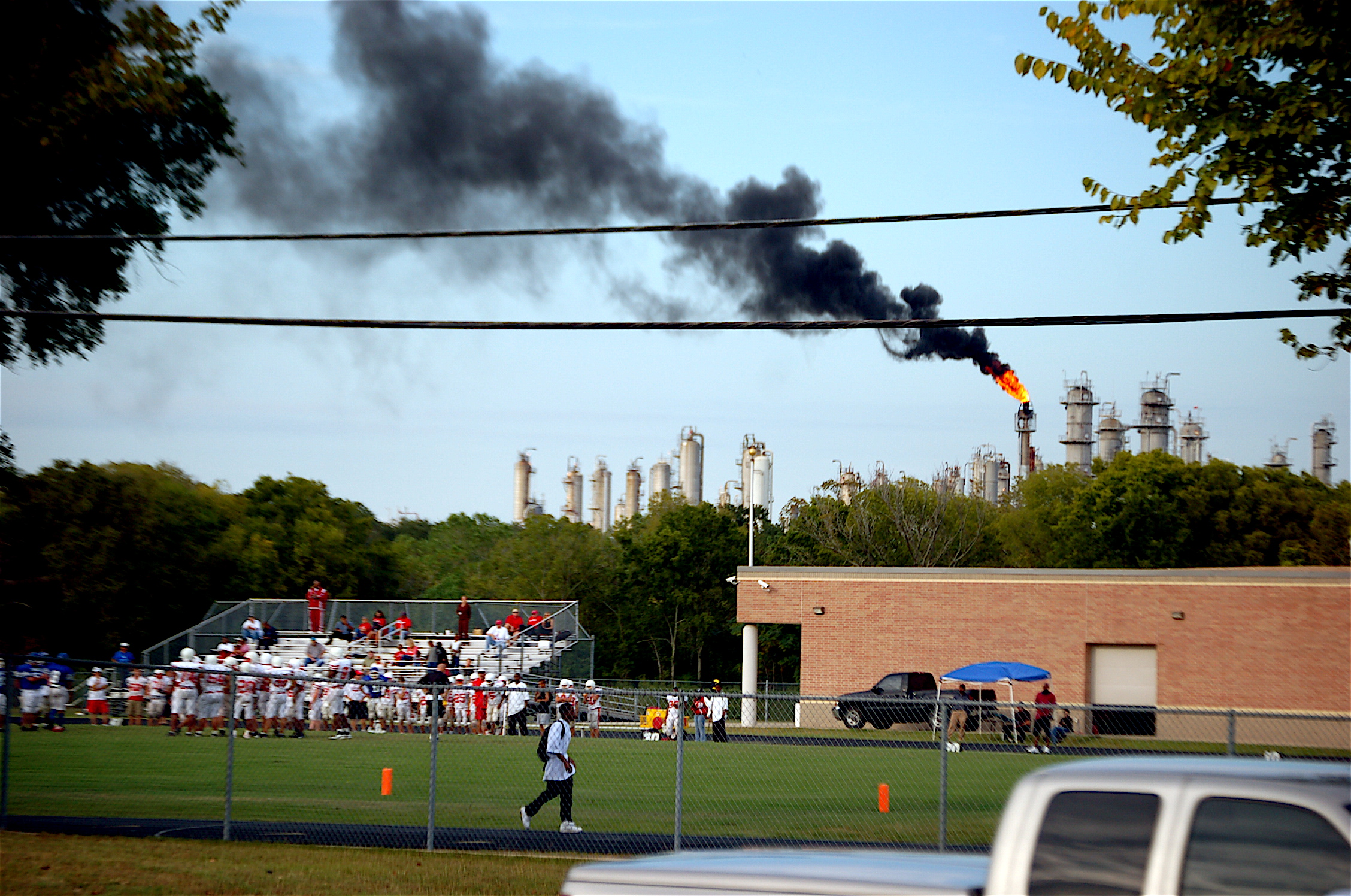
Cesar Chavez High School In Houston, TX

USAToday’s report, entitled “The Smokestack Effect: Toxic Air and America’s Schools”, ranks 127,800 schools nationwide based upon the concentrations and health hazards of the chemicals likely to be in the surrounding air.

The report was initiated after Meredith Hitchens Elementary School in Addyston, Ohio was closed due to the danger posed by the surrounding air. Air monitors placed near the school recorded extremely high levels of toxics coming from the plastics plant across the street. When the Ohio EPA determined that students were being exposed to cancer at levels 50 times higher than what the state deems an acceptable risk, the school was shut down.

Following this story, USAToday spent 8 months examining the extent and danger of schools located in toxic hot spots. Using the EPA’s own models for tracking toxic industrial chemicals, USAToday found 435 schools across the country with air quality worse than that which caused the closure of Hitchens Elementary School. Though the Environmental Protection Agency has a special office dedicated to protecting children’s health, the agency has never used their own data or models to look at potential problems surrounding schools. Nor does the office set health and safety standards for children in schools, as they do for adults in the workplace.

Philip Landrigan, a physician who heads Mount Sinai School of Medicine’s children’s health and the environment unit, comments on this problem in the article:

“The mere fact that kids are being exposed ought to be enough to force people to pay attention. The problem here is, by and large, there’s no cop on the beat. Nobody’s paying attention.”

Children are particularly susceptible to the health risks associated with toxic chemical exposure. Because or their small size, children breathe in more air in relation to their weight than adults. Their bodies are also still in a formative state, making early exposure all the more dangerous. And since kids are required to spend so many childhood hours in school, toxins are likely to accumulate in their bodies and not cause problems until years later.

Unfortunately, the names of several Texas schools peppered this national article. The first was San Jacinto Elementary School in Deer Park:

“At San Jacinto Elementary School in Deer Park, Texas, data indicated carcinogens at levels even higher than the readings that prompted the shutdown of Hitchens. A recent University of Texas study showed an “association” between an increased risk of childhood cancer and proximity to the Houston Ship Channel, about 2 miles from the school.”

The USAToday report’s findings were based upon EPA data and industry estimates. That means, unfortunately, that even what they’ve reported “may be a gross underestimate”, because industries only estimate their emissions. For the most part, dangerous chemical carcinogens such as benzene and butadiene are not monitored because they are not regulated by the EPA. USAToday’s report suggested that Deer Park might be a hot spot particularly worthy of such monitoring because students are exposed to very high levels of carcinogens at area elementary, middle, and high schools – that is, throughout every level of their education and development.

Port Neches-Groves High School in Port Neches, Texas, was featured as a major part of the report. That’s because 27 graduates of Port Neches schools have sued the chemical plants there or there former owners after being diagnosed with cancer… (more…)

Read Full Post »
