Feeds:
Posts
Comments

Archive for October 7th, 2009

Statement from Tom “Smitty” Smith, Director, Public Citizen’s Texas Office

Duncan_R_0_2Roger Duncan announced his retirement today. Although it is sad to see a dedicated public servant move on, Public Citizen congratulates him on a fine career as general manager of Austin Energy, a municipal power company.

Austin is a national and world leader in fighting climate change due in large part to Duncan’s leadership.

Roger is a true genius who has developed world-class energy efficiency, renewable energy and distributed generation programs that save Austin citizens money every month on their electric bills. He understands the value of plug-in hybrid cars and trucks as a way to reduce air pollution and save consumers money while creating a new source of revenue for the city’s utility. He created a coalition of governments that gave so many “soft” orders for the vehicles that they were able to convince major auto manufacturers to build them.

He is probably the only utility executive in the country who takes a vacation to sit under a tree by the beach to think about how his utility can solve global warming. Such dedication is rare in his line of work.

As Austin conducts its national search for a new director, it should look for someone who will continue the city’s vision of sustainability. The new director also should have a solid commitment to public power and public process – hallmarks of what has made Austin’s city-owned utility one of the best in the country and so famous worldwide.

Duncan retires as Austin faces many energy challenges. The 2020 generation resource plan currently under review puts the city on a path toward eventual divestiture from the Fayette coal plant. It remains to be seen how quickly Austin can do this.

Whether Roger’s future entails continuing to fight climate change or just sitting on a beach under a tree to relax, we wish him the very best.
Read Full Post »

GetAttachment.aspx

Yesterday marked the end of a State-Wide “Roll Beyond Coal” press tour of Texas coal plants. This tour has seen representatives from Public Citizen of Texas and Sierra Club travel across the state visiting communities which would be impacted by proposed coal plants and meeting with local organizations. This was all in a bid to support recent bold action from the Environmental Protection Agency (EPA) concerning the coal plant permitting process of the Texas Commission on Environmental Quality (TCEQ) and to request that the EPA take further steps to create a moratorium on the permitting or operation of any new coal-powered plant (Texas currently has 11 in either the pending, permitted or under-construction phase).

The crux of the matter is the discrepancy between the TCEQ permitting standards and the Federal Clean Air Act. The TCEQ is responsible for the permitting process of coal plants in Texas. For some time now the TCEQ has been issuing what it calls ‘flex permits,’ which essentially allow individual polluters to emit over the limits of the Federal Clean Air Act, as long as the aggregate pollution of an umbrella of regional sources is below the allowed level. In summation: “EPA ruling claims Texas’ air permitting standards are so flexible and record keeping so vague that plants can circumvent federal clean air requirements [emphasis added].” I suppose these ‘flex’ permits are aptly named.

Here are some of the steps the EPA should take as it reviews the relevant TCEQ policies over the coming months (taken from the Texas Sierra Club web site, where you can take action and contact the EPA):

3

1) Halt any new air pollution permits from being issued by the TCEQ utilizing the TCEQ’s current illegal policy.

2) Create a moratorium on the operations of any new coal fired power plants in Texas until the TCEQ cleans up its act by operating under the Federal Clean Air Act.

3) Require companies to clean up their old, dirty plants – no exemptions, no bailouts, and no special treatment by reviewing all permits issued since the TCEQ adopted its illegal policies and require that these entities resubmit their application in accordance with the Federal Clean Air Act.

(Read this blog concerning plans to “grandfather” Texas coal plants, where you can also contact Texas senators about these issues)

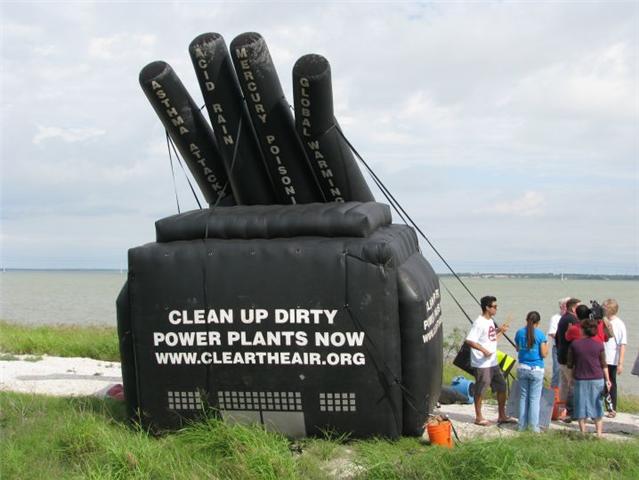
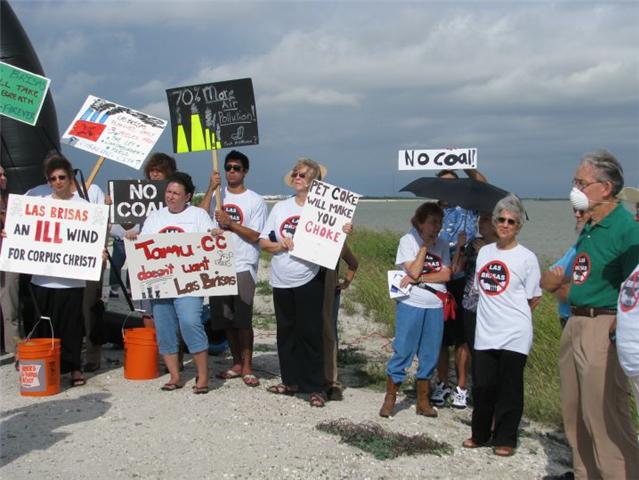
The tour visited communities in Waco, Dallas, Abilene, College Station, Corpus Christi, Bay City, Houston, and concluded today in Austin. The travelers included a giant coal plant float and local protestors at each site, attracting much local media attention. I’ve included some of the media links below:

9/23: WFAA (Dallas)

9/29: Corpus Christi Caller Times

9/29: KRIS-TV (Corpus Christi)

09/30: KIII-TV (South Texas)

09/30: Houston Press

10/01: TheFacts.com (Brazoria County)

This is a long-overdue first step taken by the EPA, and it now needs to be followed by some decisive and bold action in the coming months.

J Baker.

Read Full Post »

Great news from the Edmunds.com Green Car Blog:

Southern California Port Pollution Drops Dramatically Under Clean-Truck Program

port-of-los-angeles.jpgA clean-trucks program at the ports of Los Angeles and Long Beach in California has shown quick progress, with an 80 percent decline in diesel emissions expected by the end of 2010 — a year ahead of schedule.

“This is the most successful effort to clean a port in the world,” said Los Angeles Mayor Antonio Villaraigosa. “I mean, think about it. Nobody thought it was possible to retrofit 5,000 trucks in a year, and we’re at 5,500 and growing.”

So far, the program has reduced diesel truck emissions at the Los Angeles port (pictured) by 70 percent compared with 2007 levels, Villaraigosa said. Long Beach has seen similar results, according to Mayor Bob Foster.

The program is part of a larger effort to reduce diesel emissions at the port complex, one of the major sources of pollution in Southern California. Increased rates of cancer, asthma and other serious health ailments for area residents have been attributed to port pollution.

Villaraigosa and Foster unveiled the promising figures during a briefing at the Port of Long Beach on Thursday, when U.S. EPA Administrator Lisa Jackson announced $26.5 million in federal grants for clean-air programs throughout Southern California.

This is really great news for our port cities, whose dirty air is tied at least partially to the pollution from the ports.  Diesel emissions also contain black carbon particles, which can have a much greater effect on the climate than CO2, methane, or any of the other greenhouse gases.  Also, as a particulate, it can get lodged in your lungs and cause all sorts of respiratory ailments.  Cutting black carbon should be a major goal, and one which the Ports of LA and Long Beach seem to be tackling very well.

Farbeit from me to advocate that Texas ever in any way should try to be like California, (*smirk*) but this shows that specific programs designed to tackle specific problems can be very effective.

LA and Long Beach Together– Now You Know You’re In Trouble…”

Read Full Post »
