Feeds:
Posts
Comments

Archive for November 5th, 2009

Environmental Groups Applaud EPA Choice

New Regional Administrator could signal change in direction for polluted state

DALLAS – Environmental advocates across several states are applauding the Obama Administration’s choice of Dr. Al Armendariz to lead Region 6 of the Environmental Protection Agency, which includes Texas, Louisiana, New Mexico, Oklahoma and Arkansas. Armendariz, an engineering professor at Southern Methodist University, has worked with diverse constituencies ranging from corporations to citizens groups and has published dozens of studies on myriad environmental issues throughout his career. His appointment garnered high praise from the environmental community.

“Our region has typically provided a haven for some of the worst polluters in the country, and has paid a steep price,” said Tom “Smitty” Smith, Texas Director for Public Citizen. “I believe the appointment of Dr. Al Armendariz signifies a new direction for Region 6.”

In an effort to make sure EPA Administrator Lisa Jackson and the White House chose a strong environmental leader for Region 6, about twenty prominent advocates signed on to a list of principles that they hoped would guide the appointment. Dr. Armendariz was one of two candidates the groups endorsed for the position. Their list of qualities for an ideal administrator included a commitment to environmental justice and science-based policy, minimal ties to industries regulated by EPA and a strict adherence to the President’s Executive Order on Ethics, which was intended to prevent conflicts of interest between lobbyists and government agencies.

“Al Armendariz demonstrates the kind of vision, integrity and grassroots approach to enforcing environmental law this region needs if we’re truly going to clean up our act,” said Jeffrey Jacoby, Program Director at the Texas Campaign for the Environment (TCE). “He embodies the ‘Principles for Environmental Leadership and Real Change’ we believed should guide this appointment.”

Indeed, many within the environmental community see appointment of Armendariz as indicative of a new approach for the regional EPA.

“We are thrilled with Dr. Armendariz’s appointment,” said Luke Metzger, Director of Environment Texas. “After eight years of the Bush EPA, it’s a new day for Texas’ environment. Move over polluter lobbyists, science and human health are in charge now.”

In addition to environmentalists, some within the business community were also pleased with Obama’s choice. Former Austin City Councilmember Brigid Shea, now principal and co-founder of an environmental consulting firm, stated, “As a businessperson who’s concerned about the environment, it’s time this region got someone who understands that we can have both a healthy environment and a strong economy, that the two are not at odds.”

Dr. Armendariz will take over for Acting Region 6 Administrator Larry Starfield. During his tenure, he will face a number of pressing environmental challenges, including potentially overseeing the implementation of federal climate change legislation, bringing metropolitan areas in Texas into compliance with the Clean Air Act and working to clean up toxic “hot spots” along the Gulf Coast.

“Texas needs a tough air enforcement chief at EPA 6 Dallas like Dr. Armendariz who’s willing to tackle head on the state’s serious air quality challenges with large urban areas like Dallas and Houston failing to meet new ozone standards, and who is willing to require Texas to clean up its large dirty coal plants and refineries,” stated Dr. Neil Carman of the Sierra Club’s Lone Star Chapter.

Environmental justice activists from communities across the state are also hopeful that the appointment of Dr. Armendariz will benefit Texans living directly adjacent to polluting facilities

“The Executive Order 12898 on Environmental Justice is a document that looks good on paper, but in the real world EPA’s office of Environmental Justice has at times sided with industry over our communities; and pollution problems in poor communities have gotten worse, not better,” said Suzie Canales, Executive Director of Corpus Christi-based Citizens for Environmental Justice. “Now under Armendariz, we have real hope that environmental justice issues will be a serious priority to the agency.”

Many environmental justice groups endorsed Armendariz from the beginning of the Regional Administrator selection process, citing his commitment to science, his understanding of the issues and his dedication to enforcing the spirit of environmental laws such as the Clean Air and Clean Water Acts.

“Dr. Armendariz is exactly the kind of person you’d want to have this job, but seemingly never gets it,” said Jim Schermbeck, long-time Field Organizer with Downwinders at Risk. “Because of what’s at stake and the fact that Texas is the belly of the polluter beast, this may be one of the most important, far-reaching appointments the Obama Administration makes. Downwinders at Risk is proud to have been the group that first utilized Dr. Armendariz’s expertise for our cause of cleaning up the Midlothian cement kilns back in 2005. That work lead directly to his becoming the premier ‘citizen’s scientist’ in Texas on air pollution, and paved the way for his much larger influence on the state scene. Congratulations to both Dr. Armendariz and the EPA.”

As enthusiastic as environmentalists are about the appointment, they also promised to hold Dr. Armendariz accountable to the people affected by pollution issues in the five-state region. “As outstanding as Dr. Armendariz has been on paper and in interviews, we’ll be watching to make sure he walks the walk,” says Jacoby, who works in TCE’s Dallas office, “Remember, Al, my office is right down the street.”

# # # #
By promoting cleaner energy, cleaner government, cleaner cars, and cleaner air for all Texans, we hope to provide for a healthy place to live and prosper. We are Public Citizen Texas.

Read Full Post »

Coal has been used by man for several centuries as a means of warmth, transportation (via Watt’s steam engine) and most recently electric power. It is currently used nearly exclusively for the generation of electricity in the US (in 2001: 86% of total US coal production). It has always been claimed that coal makes good economic sense because it is both cheap and abundant (both economic variables).  As for factors that fall outside of this – how do we measure these in an economic sense? Perhaps we should just leave them by the wayside, or dust them under the carpet? Out of sight, out of mind? In this blog, let’s consider some of the external costs of coal.

A report was recently released by the National Academy of Sciences examining the externalities of energy – the hidden costs of the energy we use. It was requested by Congress in the Energy Policy Act of 2005. This little statement, found in the executive summary, gets at the heart of what an external cost is:

Modern civilization is heavily dependent on energy from sources such as coal, petroleum, and natural gas. Yet, despite energy’s many benefits, most of which are reflected in energy market prices, the production, distribution, and use of energy also cause negative effects. Beneficial or negative effects that are not reflected in energy market prices are termed “external effects” by economists. In the absence of government intervention, external effects associated with energy production and use are generally not taken into account in decision making.

Interesting, and perhaps even a bit understated. The point is that externalities exist within our energy-economic system, and by keeping them external they can have fairly serious consequences.

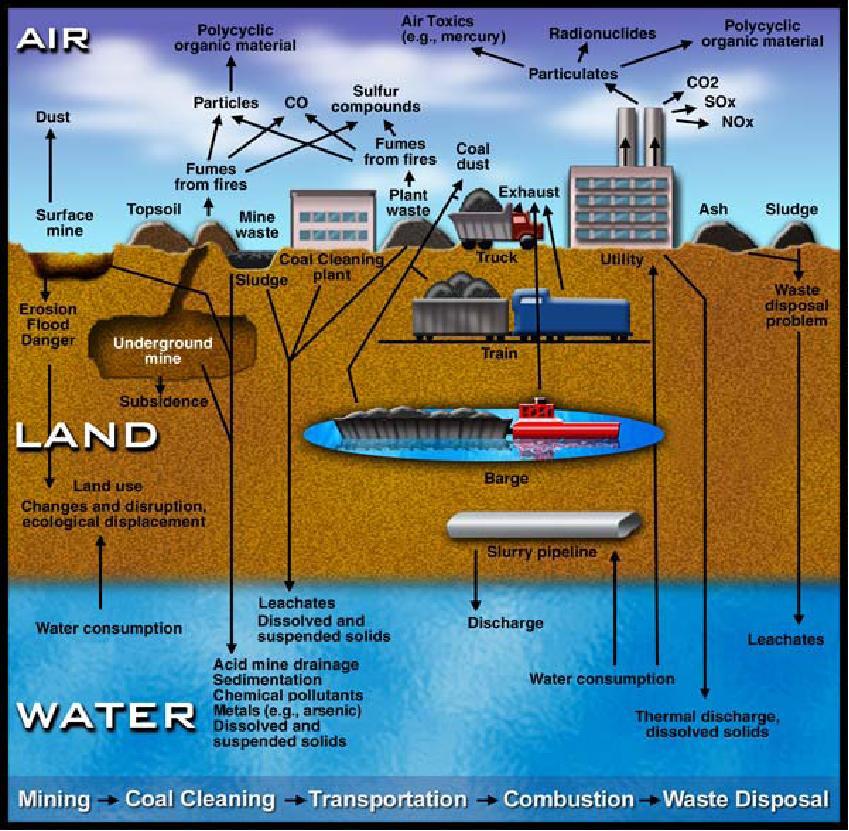
Here are some of the more grave externalities of coal-power, with an illustration to help:

1

Effects of Coal, Alan Morin, taken from "Cradle to Grave: The Environmental Impacts from Coal," Clean Air Task Force: http://www.catf.us/publications/reports/Cradle_to_Grave.pdf

(1) Classical Pollutants: Particulate Matter (PM), SO2, NOx, as well as other pollutants such as O3, CO, Benzene, Benzo-[a]-pyrene, and a host of other tongue-twisting compounds. These have negative effects on health through cancers, respiratory disorders, and a general decrease in life expectancy. They can also have a negative effect on building materials (acid damage), crops (yield reduction, acid deposition), and ecosystems (eutrophication).

(2) Greenhouse Gas emissions: CO2, CH4, N2O, and others. Contributes to climate change.

(3) Direct Environmental Damage: Mountain-top removal mining (MTR), Strip mining, etc. Mining causes irreparable damage to the local land and water resources, and can lead to chemical spills as a consequence of the mining.

(This information was taken from a similar European Report, published in 2003).

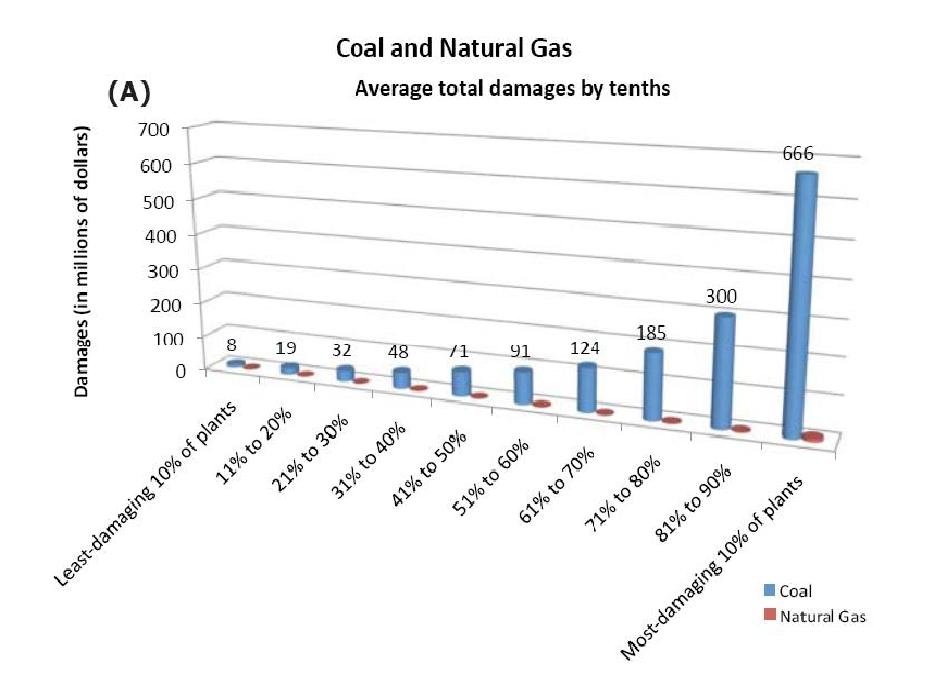
The grand total in external coal-induced damages put forward by the report is $62 billion (for 2005). That said; keep in mind the fact that not all coal-fired power plants are created equal. Researchers took data from 406 coal-fired power plants from across the US (excluding Hawaii and Alaska) and produced some notable results. The top 5% in terms of pollution caused damages of over 12 cents (per kWh), whereas the lowest-emitting 5% of the plants caused less than 0.5 cents (per kWh) of damage. That is quite a difference. This diagram illustrates the extreme variation in damages:

3

Damages of Coal and Natural Gas Plants, taken from "Hidden Costs of Energy," report in brief: http://dels.nas.edu/dels/rpt_briefs/hidden_costs_of_energy_Final.pdf

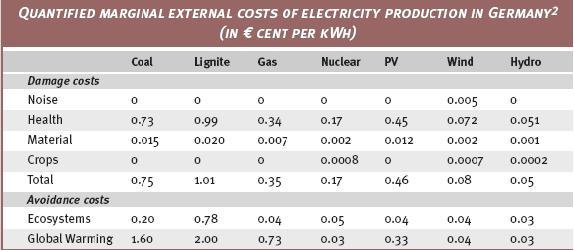
These numbers take into account neither possible climate change effects, ecosystem damage (such as MTR), nor mercury emissions. The study done by the European Commission did try to include all factors, and as expected found significant costs related to climate change and ecosystem damages. Here is a summary of the external costs produced throughout the energy sector in Germany:

4

Taken from "External Costs," European Commission: http://ec.europa.eu/research/energy/pdf/externe_en.pdf

Looking at the same data, we can see the relative little external costs of wind or hydro power (renewable energy sources).

There is quite a lot of crying these days about subsidies for renewable energy, and how these forms of energy are too costly to be feasible. However, as this report points out, if we were to look at all of the costs of conventional coal power (internal and external) at least we would have a more level playing field. Perhaps then wind, solar and other renewable energy sources would be better able to compete? (This discussion ignores both the fact that coal is a finite resource and that there are huge subsidies given to coal companies each year – other matters altogether).

But the past is behind; let’s see this in light of the future. The US Department of Energy, in their International Energy Outlook of 2009, has predicted that world coal consumption would increase by 49 percent from 2006 to 2030, saying that “coal’s share of world energy consumption increases from 27 percent in 2006 to 28 percent in 2030.”

By continuing to allow the torrid growth of coal in the next two decades, how much more damage will be left out of the equation? You can work out the economics of that one.

J Baker.


###

By promoting cleaner energy, cleaner government, cleaner cars, and cleaner air for all Texans, we hope to provide for a healthy place to live and prosper. We are Public Citizen Texas.

Read Full Post »