Feeds:
Posts
Comments

Archive for November 25th, 2009

By Kirsten Bokenkamp

The chance that Congress will pass a US climate change bill before the global summit in Copenhagen is looking increasingly slim, but that does not stop us from individually minimizing our own impact on the earth. Green-up Your Life! is all about reminding us that as individuals, we can, and should, do our part to protect our planet and combat climate change – even when our policy makers are not quite there. Reducing, Reusing, and Recycling are a big part of the things we all can do. Today’s blog is going to focus on the first two (and most important) parts of this well-known mantra: Reduce and Reuse.

In our society, where we covet big houses and new cars, where we are impressed with shiny toys and with the newest fashions, not everybody likes to hear this, but simply reducing what we buy is one of the best things we can do for the planet. In his New York Times blog Dot Earth, Andrew Revkin asks if being a “green consumer” is good enough: after all, even when corporations are selling environmentally sustainable products, they are still selling consumerism, and their primary goal is not to save the planet, but instead to get you to buy more new things.

And, generally, the more we buy – the more we waste. Think about all of the packaging and the transport associated with everything we buy! According to the EPA, between 1960 and 2007 the amount of waste each person creates has almost doubled from 2.7 to 4.6 pounds per day. Reversing this trend is crucial to the future of the earth.

If you have never seen Annie Leonard’s Story of Stuff, I highly recommend that you spend 20 minutes watching it to learn more about the processes of production and consumption within our society. By the end of the short, fun, and interactive film, you most likely will have a different view on buying things. Do you love to give gifts? Rethink how you give, and how it impacts the earth. Good alternative ideas include a gift certificate to a massage or yoga classes; tickets to a concert or football game; a batch of fresh baked cookies; a dinner out at an environmentally sustainable restaurant; renting a kayak for a day out on the water; or simply spending some time together, cooking or playing games. A study about happiness during the Christmas season, published in the peer-reviewed Journal of Happiness Studies, has shown that:

Lower well-being occurred when spending money and receiving gifts predominated. Engaging in environmentally conscious consumption practices also predicted a happier holiday, as did being older and male. In sum, the materialistic aspects of modern Christmas celebrations may undermine well-being, while family and spiritual activities may help people to feel more satisfied.

tommy_sheep_0

Tommy Sheep

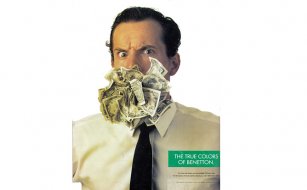
If all this talk about reducing sounds good to you, use the day after Thanksgiving, historically the largest shopping day in the US, to make a point. In 65 countries around the world, millions of people participate in Buy Nothing Day to demonstrate that we don’t have to buy all the newest fashions and the brightest toys just because they are endlessly marketed to us. It is actually pretty empowering to decide to ignore all the marketing schemes. Check out these spoof ads by Adbusters, and imagine how much less we would collectively buy if all ads were as honest as these. (There are more funny ones on their website).nike_1

bennetton_1

True Colors of Bennetton

Buying less does not mean not buying anything at all. Just try to keep your impact low, and reuse items when you can. Have you checked out your neighborhood thrift store or consignment shop? Most have clothes, toys, household items, shoes, and books. Check it out – you may be surprised. There are about 6,000 reuse centers around the US, ranging from specialty stores to Goodwill. Another alternative is to buy lightly used items on Craiglist or ebay. You can’t really go wrong when you are saving money and helping to preserve the earth’s resources.

Even if we cut down on what we buy, of course we will all still buy many things. Reducing and reusing isn’t just about less consumerism and buying used items. It is also about bringing reusable bags to a store, drinking from a reusable coffee cup or water bottle, not using the mini-bottles of shampoo at hotels; reducing the amount of packaging you use by buying food in bulk, and reducing paper by printing on both sides, paying bills online and getting yourself off of unwanted mailing lists. Do you wonder what kind of impact this could have?

• If every Starbucks customer used a reusable coffee thermos, we could save 1,181,600 tons of wood, 2,040,061,237 pounds of carbon dioxide, and 4,441,093,624 gallons of water every year.
• The production of plastic water bottles in the US generates more than 2.5 million tons of carbon dioxide, and uses 17 million barrels of oil per year! And that is not even taking into account what happens to all those bottles once they reach the landfill. (In the U.S. more than 30 billion plastic water bottles are discarded each year. Only 15% are recycled; the rest end up in landfills, or as litter – 66 million every day.)
• According to the World Watch Institute, each year Americans throw away some 100 billion polyethylene plastic bags. (Only 0.6 percent of plastic bags are recycled.) If every shopper took just one less bag each month, this could eliminate the waste of hundreds of millions of bags each year.
• Producing one ton of paper requires 2-3 times its weight in trees. If the entire U.S. catalog industry switched its publications to just 10-percent recycled content paper, the savings in wood alone would be enough to stretch a 1.8-meter-high fence across the United States seven times.

These facts clearly show that we can all make a difference by changing our habits – even just a bit. It is unrealistic to think that we will all stop buying things, but if we reduce what we do buy, buy used items when we can, and try to reduce the negative side effects of consumerism by choosing products with less packaging and bringing our own shopping bags, it is a step in the right direction. We need to start thinking before we make purchases and stop buying things we don’t need, which is a tough thing to do in a society where people living in cities are exposed up to 5000 advertisements a day. It is time to show those companies that in order to protect our planet, we will not give in so easy!

###

By promoting cleaner energy, cleaner government, cleaner cars, and cleaner air for all Texans, we hope to provide for a healthy place to live and prosper. We are Public Citizen Texas.
Read Full Post »

UPDATED!!!!

After receiving communications from the office of Senator Carlos Uresti, we realize that there was an inaccuracy in the original form of this post. Senator Uresti has apparently never taken a charter flight from Austin to San Antonio, rather, he has taken flights from Austin to other areas in his sizeable district, and then flew back to San Antonio. We apologize for any misinformation and hope that this clarification sheds further light on the matter.

DOUBLE UPDATED!!!!

According to the Dallas Morning News, Rick Perry was living it up in Vegas, and once again taxpayers picked up the tab for his security detail. The rest of the party was paid for by political donations and private contributions:

They say that what happens in Las Vegas stays there, but for Rick Perry, not all of it has.

The governor’s Oct. 24 political trip to Las Vegas to meet with Brian Sandoval, a Republican candidate for Nevada governor, included a bachelor party for Perry’s son, Griffin, spokesman Mark Miner conceded Thursday.

He initially declined to call it a bachelor’s party, saying he would describe it more as a dinner. He confirmed, though, that it was a celebration of Griffin Perry’s upcoming nuptials joined by a number of his male friends.

The governor used a combination of money from his political donors and the Republican Governors Association to pay for his Vegas trip. It’s illegal to use campaign funds for personal travel, but Perry has a history of combining business with pleasure trips so that political entities will pick up the tab.

…Taxpayers do not pay for such travel by the governor or his family, but his security detail is funded by the state. Department of Public Safety officials would not say Wednesday how much that cost.

The Las Vegas meeting with Sandoval might not have been that pressing, as it turned out. The former U.S. district judge and Nevada attorney general came to Austin a little more than three weeks later to attend a Republican Governors Association meeting hosted by Perry.

Perry has been a leader of the RGA, which raises millions of dollars to boost the campaigns of Republican governor candidates.

On the Saturday of the Vegas trip, Perry stayed at the ritzy Palazzo casino and resort where the cheapest rooms go for $239.

Original post:

Texas Representatives, Senators, and other statewide elected officials, both locally and nationally, receive reimbursements for their on-the-job travels. They travel quite frequently to conduct business that benefits their constituents. Or at least that is what we hope they do.

Some representatives take advantage of the tax-payers’ money by choosing to stay in fancy hotels while traveling and use charter or private planes to get to their destination. Several representatives use campaign money and funding from other sources to pay for their trips across the country and around the world. But reports obtained by Texas Watchdog show the details of travel expenses that Senators billed to the state, and the report reveals spending that is, if not unnecessary, definately unnerving in some cases.  They report:

A $3,000, seven-day junket in Maui, staying at a resort boasting a spa that “sets a new standard for head-to-toe pampering in paradise.”

Overnight stays at a Ritz-Carlton in New York, a luxury hotel on Manhattan’s waterfront.

Charter plane trips within Texas for as much as $5,100 a pop.

State senators spent taxpayer money on these travel expenses. And they’re all perfectly within the rules regulating Senate travel — rules the senators write themselves.

The bills range from daily stipend claims and car mileage reimbursement to flights and hotel stays for conferences in Chicago, Washington and New Orleans. The expense reports, receipts and bills from Jan. 1, 2008 to May 1, 2009 also reveal the extent to which senators used private and charter planes to get around. Click here to see a searchable database of all the expenses, which was requested under the Texas Public Information Act.

Senator Mario Gallegos from Houston spent tax-payers’ money to pay for a trip to Hawaii for a conference at which he was a presenter. Gallegos brought his wife and son and stayed in a hotel that boasted of their opulance and ability to pamper: a portion of a hotel bill (paid for by private money, not by the state) attests to the fact that someone  . Although he did not ask for reimbursements for his family’s travel expenses, he requested the amount of $1,679.58 for the hotel room expenses. The total hotel bill was $1,919.27. This begs the question of whether this was 100% state business or at least partially family outing, and to make matters worse in Gallegos’ case, he was the only legislator attending the conference that traveled and stayed there on the expense of tax payers, while Troy Fraser, Joe Driver, Larry Taylor and Burt Solomons all had the trip paid for by private donations from those putting on the conference as speakers’ honoraria, or used campaign funds.

In addition, some senators use private planes, state planes, and charter planes to conduct business. Texas senators – in large part Senator Robert Duncan, Senator Carlos Uresti and Senator John Carona – spent over $86,000 using these methods to travel over the period of a year and a half.

A spokesperson for Uresti claims that the size of his district and the lack of airline services in specific areas require him to use non-commercial flights (a reasonable explanation). However, Senator Uresti also used charter flights to travel from Austin to other areas in his district and back to San Antonio, and Senator Carona used his private plane to fly between Austin, Dallas, El Paso and Houston. All these cities have frequent commercial flights for a much cheaper reimbursement price than private or charter planes.

The expensive travel arrangements by Texas Elected Officials translate to the national level as well. Texas representatives and senators spend more taxpayer’s money on travel than any other state representatives. The Texas representatives in DC have used $91,000 in past 12 months on travel expenses, including travels to foreign countries. All in all, the whole House spent 7000 days over the period of 9 months on domestic and international travel. The cost of this travel? An estimated total of 9 million dollars.

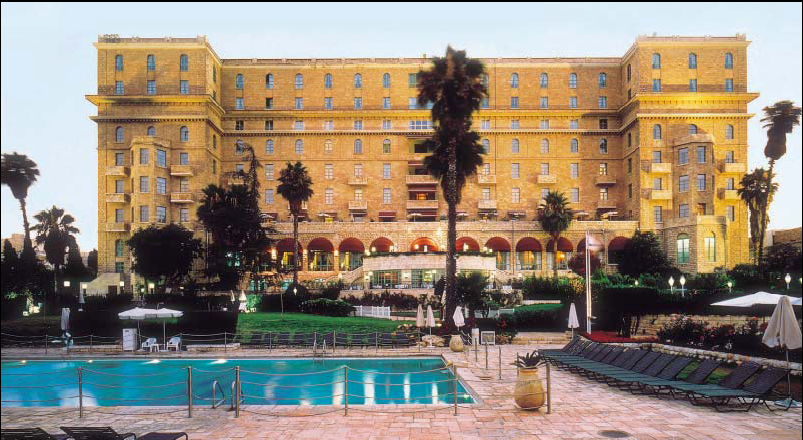
Governor Rick Perry also billed the tax-payers for thousands of dollars for an August trip to Israel with his wife, friends and public officials.

The King David Hotel in Israel

"Nice hotel, guv'nuh!"

While Governor Perry’s stay at one of the most posh hotels in the world, King David, was covered by the Doheny Global Group, a private donor, (raising eyebrows on its own) he billed the state for the cost of his bodyguards’ stay.  And the cost of just the hotel stay for security? $17,000. In addition to the stay, security costs included expenses for the flight, food, and overtime. All in all, the total sum spent on security for this one trip to Israel was over $60,000.  While we certainly understand that Israel is not the safest place in the world and see the need for security, taxpayers have the right to come to their own conclusions about the cost/benefit analysis of such a big pricetag.

The rules on reimbursement for travel expenses are pretty loose (and, we should emphasize, are written by the Legislature themselves), but each Senator must provide a legitimate reason for using private or charter planes. These reasons include a time-crunches, a cheaper option than commercial travel expenses, and the lack of commercial flights to their destination. However, since time-crunch is not easily defined, Senators sometimes choose to use charter or private planes to maximize their time efficiency instead of maximizing the utility of taxpayers’ money. Perhaps each Senator’s expenses are not outrageous, but all unnecessary spending adds up over the span of a year. This money can be used in the communities of their constituents, or for local programs.

So why do they get away with this superfluous spending? Most citizens do not look into reports of each Congressman’s travel expenses, but trust them to spend tax payer’s money appropriately. Congressmen admit they hardly ever receive questions from their constituency about travel expenses.

It is understood, of course, that our Representatives and Senators, etc must travel to conduct business and to form diplomatic relations and push policy agendas. The issue at hand is whether they are eschewing nice amenities at their destination and the methods of transportation on the tax payer’s dime. We are by no means saying that our Representatives have to stay at econo motels and take red-eye flights in order to conduct public business. Further muddying the waters are the different standards and methods in place. Some trips are paid for out of personal and campaign funds, but some spend more taxpayers’ money.

By Harrison

###

By promoting cleaner energy, cleaner government, cleaner cars, and cleaner air for all Texans, we hope to provide for a healthy place to live and prosper. We are Public Citizen Texas.

Read Full Post »