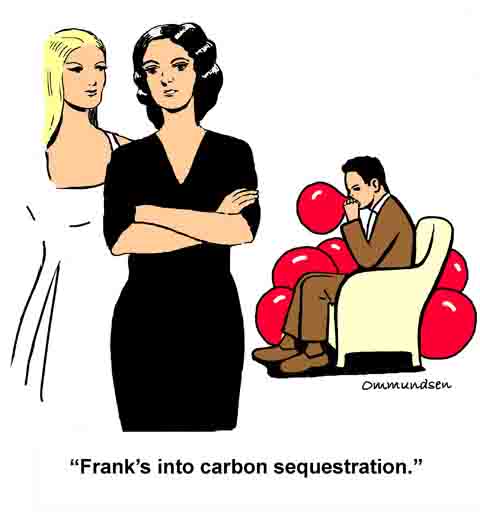
 The United States Department of Energy has sunk $154 million into a carbon capture and sequestration project in Texas proposed by NRG Energy near Houston. The “demonstration” project will be built on their existing Parish Generating Station in Thompsons, TX (one of the biggest and dirtiest coal plants in Texas and the United States). The project will only be capturing 60 megawatts worth of CO2 from the plant – or 400,000 metric tons of CO2 annually. In comparison the Parish plant currently generates 2,697 megawatts of power and releases over 21 million tons of CO2 every year. Also keep in mind that the CO2 from this “capture” process will be used in what’s called “Enhanced Oil Recovery” meaning that the CO2 being sequestered will be partially offset by the CO2 released when the resulting oil is burned. And even industry analysts have said that between 35-50% of the CO2 solution used in EOR comes back up during the oil recovery process, with this carbon being released back into the atmosphere. (more…)
Archive for March 11th, 2010
DOE Throws $154 Million Down A Texas Hole
Posted in Coal, Global Warming, tagged carbon capture, carbon capture and sequestration, CCS, clean coal, climate change, Coal, coal plant, Department of Energy, doe, Energy, NRG, Texas on March 11, 2010 |
FACTCHECK: Governor Perry sends a letter to Congress about the EPA- More hot air?
Posted in Coal, Energy, Global Warming, tagged EPA, governor perry, governor rick perry, Massachusetts v EPA, Texas on March 11, 2010 |
Governor Perry sent a letter to Congressional leadership and the Texas delegation asking them to strip the EPA of the authority to regulate greenhouse gases, which they were told to do by the Supreme Court in 2007’s Massachusetts v. EPA.
Governor Perry needs to check his facts a little more carefully.
He stated in the letter “Texas is aggressively seeking its future in in alternative energy through incentives and innovation, not mandates and overreaching regulation.” Gov Perry is correct, in one sense– we have cut our CO2 emissions as a state, but the primary driver of those cuts was the expansion of wind energy that created thousands of new jobs. And how did we accomplish that? Through a Renewable Portfolio Standard, or, a fancy term meaning a government mandate.
What Perry should be doing is begging the Federal government to impose a nationwide RPS, which would mean renewable resource poor states would come to Texas to buy our renewable energy the same way they’ve counted on us for our oil and gas in the past.
Further, Perry tries to induce fear by saying EPA regulation would affect “every small business, farm, rancher and family” when the EPA earlier this week said they would only begin regulating tailpipe emissions this year, moving on to power plants which emit more than 100,000 tons of CO2 within the next 2-3 years, then on to other facilities which emit more than 75,000 tons (large facilities like cement kilns or refineries). This would never affect any small business or church or school…. unless, of course, you go to Carbon Burnin’ High, home of the Flaming Smokestacks!
Governor Perry needs to focus more on bringing these clean energy jobs to Texas and a little less to railing against “the Man” in DC.
Drop by Drop: 7 Ways Texas Cities Can Conserve Water
Posted in Global Warming, tagged Austin, climate change, Drop by Drop, ken kramer, mona avalos, National Wildlife Federation, outdoor water ordinances, population increase, San Antonio, Sierra Club, Texas, Texas Water Development Board, water, water conservation, water efficiency, water supplies on March 11, 2010 |
The National Wildlife Federation and the Lone Star Chapter of the Sierra Club have created a splash with their latest report: Drop by Drop: 7 Ways Texas Cities Can Conserve Water.
Austin should be proud. Out of 19 cities studied in this report, our capital city was highly ranked on outdoor water ordinances and has an aggressive toilet replacement program. San Antonio has also set the bar high for effective and diverse water efficiency programs across the country. The cities surveyed were measured on: water pricing structure, water saving goals, toilet replacement, conservation funding, and outdoor watering. Though many cities and towns across the nation have made great strides to reduce water use, the report’s conclusion is that most cities are not doing as much as they could to efficiently use existing water supplies. (more…)
Support our work!

 ">spousal
Subscribe by Email
Categories
Popular Tags
air pollution Air Quality Austin Austin Energy Barnett shale Carbon Dioxide clean air act Clean Energy climate change Coal coal plant CPS Energy Energy Energy Efficiency Environmental Protection Agency EPA eye on williamson Global Warming green jobs houston Keystone Pipeline natural gas Nuclear Nuclear Power Nuclear Regulatory Commission Public Citizen public citizen texas radioactive waste renewable energy Renewables Rick Perry San Antonio SEED Coalition Sierra Club solar solar power south texas chisme South Texas Project TCEQ Texas Texas Commission on Environmental Quality Texas Legislature texas progressive alliance Tom "Smitty" Smith United States Environmental Protection Agency Citizen Vox Blog
-
350 Challenge

Pages
June 2026 M T W T F S S 1 2 3 4 5 6 7 8 9 10 11 12 13 14 15 16 17 18 19 20 21 22 23 24 25 26 27 28 29 30 Archives
Meta