Local energy storage company Xtream Power inks a deal to supply the Tres Amigas project with their technology. CH2M, another firm with central Texas connections (who has been hiring some of Austins finest green talent) lands the construction contract. Will local green engineers Kurt Lyell (one of the original founders of Austin Bio-fuels) or John Hoffner (KOOP radio Shades of Green) be working on this gem?
CH2M Hill lands contract for managing construction on the project. Will one grid rule them all?
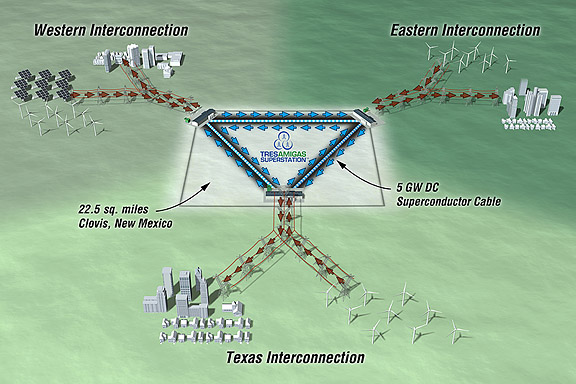
A 22.5-sq.-mile site in the small town of Clovis, New Mexico is the only place in the United States where the three grids that service the western states, some eastern states, and the entire state of Texas all meet.
TresAmigas Superstation
Sort of. The three grids come close to each other, but they aren’t connected. This prevents electricity from being transferred between the Eastern Interconnection (which services states like New York), the Western Interconnection (which services states like California), and the Texas Interconnection (well, this one is obvious). In that sense, it’s like the nation’s fragmented roads in the 1950s, before the Interstate Highway System linked the country.
With Tres Amigas, California conceivably will be able to siphon off excess wind capacity from Texas. At the current juncture, that is physically impossible. The transmission structure doesn’t exist and energy storage technologies — flow batteries, compressed air, sodium batteries — aren’t yet economical enough to start planting them en masse in the desert.
CH2M Hill is overseeing the construction of Tres Amigas SuperStation, a project that will change all that. The project will connect the entire power grid across America for the first time. The initial phase of the project will cost $600 million, but the hub is expected to make money by buying and selling electricity to utilities (and could make some $4 billion in revenue every year).
In the last 20 years, blackouts have increased to 124 percent in the United States. Smart grids could predict a potential outage and send electricity to the places where it is needed. (more…)


