It’s time to demand that U.S. Attorney General Robert Mueller release the full, unredacted Mueller Report to the American public.
That’s why Public Citizen and others are participating in peaceful
street/sidewalk protests in major Texas cities and around the nation on Thursday
to insist that Trump’s hand-picked attorney general release the full report. Barr
missed a congressional deadline to release the report on Tuesday night.
We deserve the full report and congressional leaders and the American people expect it now.
Here are the Texas events. We hope to see you out there!
AUSTIN
WHEN: Thursday, April 4 at noon to 7 p.m.
WHERE: 6th St and Lamar Blvd or your neighborhood!
We will be there ALL day, 12 noon to 7p so people can come
when their schedule permits. We are taking our message to the streets. Fill the
sidewalks with our DEMAND that the Mueller Report be released in full and
unredacted form. Bring your signs. We will be in a very busy area and able to
impact THOUSANDS. Numbers Matter. Let our Legislators see that this matters to
us!!!!!
DALLAS
WHEN: Thursday, April 4 at 5 p.m.
WHERE: Dallas City Hall Plaza, 1500 Marilla Street
FORT WORTH
WHEN: Thursday, April 4 at 5 p.m.
WHERE:Mahon U.S.
Courthouse (Burnett Park), 501 W. 10th Street
HOUSTON
Thursday, April 4 at 5 p.m.
WHERE: Houston City Hall, 901 Bagby Street
GALVESTON
WHEN: Thursday, April 4 at 5 p.m.
WHERE: Federal Building, 601 25th Street (sidewalk in front)
Hurricane Harvey in 2017 was one of the mostly costly natural disasters in history, with damage in Texas estimated at more than $100 billion.
Since the storm, Public Citizen has repeatedly asked the question: Who Pays for Harvey? The answer remains elusive.
HB 274 sponsored by Rep. Giovanni Capriglione provides one solution to this problem, creating the disaster reinvestment and infrastructure planning revolving fund and making a one-time appropriation of $1 billion from the economic stabilization fund.
Public Citizen supports the creation of this fund and the appropriation as one means to pay for Harvey recovery and for that of future storms.
KMCO fire again blackens the skies in Crosby, TX – Photo by KHOU
Note: Today, an explosion and fire erupted at the KMCO chemical plant in Crosby, Texas, near Houston. One person is dead, one person is missing and multiple people have suffered injuries. The incident follows recent chemical fires in Texas that have led to public health and safety concerns.
Statement of Stephanie Thomas, Public Citizen’s Houston Researcher and Organizer.
Enough is enough.
Today’s incident in Crosby is the third chemical fire in recent weeks, highlighting the insidious nature of corporate pollution in the Houston area and many other areas in the country. We no longer can accept a culture that places profits before people.
The Texas state government has a record of lax enforcement, and the Trump administration is rolling back necessary protections for workers and people living and working in the shadow of chemical plants.
These sequential disasters highlight the dire need for more and better protections for these fence line communities. Polluters should not get a free pass to pollute our communities and harm our neighbors.
How many disasters must our communities endure before our elected officials wake up to the need for better protections? How many people need to fear for their health and safety? How many workers must be injured or killed for government to act?
The time to act is now.
The House Environmental Regulation, and Homeland Security & Public Safety Committees are holding a joint hearing on Friday at the Capitol on the #ITCDisaster (they call it the ITC incident). This hearing will be for invited testimony only but you can stream it live – https://house.texas.gov/video-audio/
Don’t think an “invited testimony only” hearing is good enough? Contact your Texas Representative and Senator and tell them they should hold a public hearing in Houston to allow those impacted by these disastrous accidents to testify.#TxLege
A pair of bills under consideration in the Texas Legislature would diminish some free speech protections for Texans, and today Public Citizen joined other First Amendment champions to speak out on the legislation.
In essence, Public Citizen’s fears that HB 2730, sponsored by Republican Rep. Jeff Leach of Plano, would seriously undermine critical free speech safeguards for Texans who participate in public discussions about businesses and political issues.
Such speech is currently protected by the Texas Citizens Participation Act – commonly known as TCPA, and also known as the Texas anti-SLAPP law. Adrian Shelley, Public Citizen’s Texas office director, and Public Citizen attorney Paul Levy submitted written testimony to the committee today that elaborates on our position. Shelley also testified in person during today’s hearing.
Michelle L., a Florida woman who raised health alarms about a medical study she had participated in before becoming wary of the program also spoke out on the bill today. Michelle was sued in Houston (where her LLC was located) for raising public concerns about the medical study. Public Citizen’s lawyers took on her case pro bono and prevailed in part by using the TCPA law that Leach and others want to modify.
“The TCPA (law) is ultimately what helped,” Lanham told the House Judiciary Committee. “People are scared to talk and this is very important.”
You can read the official Public Citizen testimony in opposition to HB 2730 below.
On Monday, the committee substitute for House Bill 2860, was up for a public hearing in the Texas House Committee on State Affairs. We delivered testimony in support of the bill, while also asking for a significant change.
This bill would set standards that residential and small commercial customers in many parts of Texas can rely on when considering the use of distributed generation. A growing number of Texas residents and businesses are utilizing distributed solar energy systems to reduce their electric bills. This is improving affordability for residents, reducing operating costs for businesses, and creating local jobs.
But, the lack of statewide standards has led to frustration and bad practices in some cases. This bill would start the process of standardizing what should be included in a solar lease, where and how customers have a right to utilize distributed solar energy, and how electric utilities should treat customers who use or wish to use solar.
Change Needed to Avoid Safety and Environmental Hazards
Section 6 of this bill would add Section 39.1015(a) to the Utilities Code to define “distributed generation.” It expands the definition of “distributed renewable generation” found in Section 39.916(a)(1) of the Utilities Code, to all energy sources. This expanded term is referenced throughout this bill and would limit the ability of HOAs, municipalities and electric utilities from regulating the use of fossil fuel generators if they were connected behind the meter. While it is unlikely that many residential or small commercial customers would utilize such generators because of the relatively high cost, we don’t think this is a wise change.
As the Association of Electric Companies of Texas (AECT) pointed out in its letter to the House Committee on State Affairs, there are “safety and environmental risks associated with generators that use fossil fuel.” This is the one statement in that letter that we agree with. Fossil fuel generators, are noisy, polluting, often include exposed elements that get very hot and include moving parts. These are not characteristics that many would welcome into their residential or mixed-use neighborhoods.
This problem can be remedied by simply using the definition of “distributed renewable generation” everywhere that you currently find the new definition of “distributed generation” referenced. The remainder of this testimony is written assuming this change was made.
Standards for Solar Leases
Solar leases are a common tool that can allow certain customers to access distributed solar energy systems that may not otherwise be able to do so. They are especially helpful for nonprofits and other customers who don’t have tax liability, as a way to access the benefits of the federal solar investment tax credit. They are also attractive for customers who don’t want to be responsible for maintenance.
While they can be beneficial, they are also often quite complicated and customers can sometimes find themselves trapped in a bad agreement that wasn’t what they expected. Every industry has its good actors and bad actors and the solar industry is the same. Most companies that offer solar leases already comply with the provisions proposed in Section 1 of this bill. This short list of requirements will simply establish a standard that all companies offering solar leases must abide by, in order to protect the customer. In addition to information about equipment, costs, maintenance and warranties, terms regarding the transfer of the lease to a future property owner would need to be clearly stated in writing.
Homeowner Association and Municipal Regulation of Distributed Solar
In most Texas towns and cities, residents and business are able to install distributed solar energy systems on their property. As with any electrical work a permit and inspection may be required. That represents a fair and smart balance between allowing property owners to benefit from this valuable resource and protecting the city and other residents and businesses from harm.
In the past, some homeowners associations would ban or severely restrict distributed solar installations, but the Texas Legislature acted in 2011 and 2015 to set standards for how HOAs can and cannot regulate the use of solar energy systems. Section 4 of this bill would clarify the allowable inspection and interconnection process that an HOA can impose on a property owner. Section 2 would apply some of the same standards set for HOAs to municipalities.
Fair Utility Rates and Practices for Customers with Solar
Section 6 of this bill would set minimum standards for how investor owned utilities should treat customers wishing to utilize distributed generation and energy storage. Numerous studies have shown that distributed solar energy provides greater financial benefit than is accounted for even through full net metering. Texas is one of only 5 states that have no net metering requirement and this bill would not change that. It would only prohibit investor owned utilities from unfairly punishing customers who wish to use solar and or energy storage at their homes and businesses. Utilities would be required to provide timely interconnection of distributed generation and would not be allowed to charge customers punitive rates simply because they chose to utilize distributed generation or energy storage.
Recommendation
We encourage Texas House Committee on State Affairs to amend CSHB 2860 to utilize the existing definition of “distributed renewable generation” and then pass it out of committee.
Representatives of Public Citizen’s Texas office will testify in a state House Committee today against legislation that would allow a major nuclear company to pay less to dump more contaminated waste.
Rep. Brooks Landgraf’s HB 2269 is scheduled for a hearing late this afternoon in the Texas House Committee on Environmental Regulation.
This bad bill would allow the expansion of Waste Control Specialists’ radioactive waste dump in West Texas and would eliminate the fee that the company pays to the state.
A companion bill, SB 1021, sponsored by Sen. Kel Seliger, is scheduled for a 9 a.m. hearing of the Senate Committee on Natural Resources & Economic Development on Wednesday.
If you oppose state policies that allow nuke waste operators to dump more while paying less for the privilege, please consider showing up at either – or both – hearings to register your opposition. Texas oil industry representatives are also expected to testify against the bills because they fear nuclear waste could contaminate the oil-rich Permian Basin.
Meanwhile, read testimony from Adrian Shelley, director of Public Citizen’s Texas office, against Landgraf’s House bill here: HB 2269.
Public Citizen testified in the House State Affairs Committee this month about three important government ethics bills pending in the chamber.
All three bills are sponsored by Rep. Sarah Davis, a Houston Republican.
The first of Davis’s bills Public Citizen lent its public support for is HB 1297. This legislation would bar those who have been fired or have resigned from a state agency position due to malfeasance from serving as the executive or on the executive staff of a state agency. Malfeasance is defined in the bill as “intentional misconduct or the knowingly improper performance of any act, duty, or responsibility, including unethical or criminal conduct, financial misconduct, or fraud.”
Public Citizen also testified in support of HB 1876, which reflects the recommendations of the Texas Ethics Commission. This bill would, among other things, address the “revolving door” of legislators-turned-lobbyists by barring a former lawmaker from registering as a lobbyist for one year, beginning with the first regular legislative session to convene. It would also ban political contributions during special legislative sessions.
We also spoke in favor of HB 1877, which would enact eight different ethics-related bills that passed the House in the 85th Session of the Legislature but not the Senate.
Read all three letters from Public Citizen’s Texas office director, Adrian Shelley, to members of the Texas Legislature on these important bills:
HOUSTON – A chemical fire that erupted early Sunday morning
at the Intercontinental Terminals Company (ITC) plant in La Porte, Texas, and
is expected to continue to burn through Wednesday shows the dire need for
tougher regulation and enforcement, Public Citizen said today. In addition, the
disaster underscores the need for more public information from both the Texas
Commission on Environmental Quality (TCEQ) and the U.S. Environmental
Protection Agency (EPA) about chemical risks and disaster response efforts.
The fire, which so far involves seven petrochemical storage
tanks, sent a thick plume of smoke over the Houston region, forcing local
officials to urge residents to shelter in place and cancel classes in both the
Deer Park and La Porte Independent School Districts. At least three toxic
chemicals involved in the blaze – naphtha, xylene and toluene – pose a danger
to public safety. Short-term exposure can cause headaches, dizziness,
confusion, breathing irritation, weakness and memory loss – with potentially
fatal effects from longer-term exposure.
The ITC fire comes on the heels of a separate, unrelated
fire at ExxonMobil’s Baytown refinery on Saturday, which has been contained. A
2016 Houston Chronicle investigation found that chemical incidents occur once
every six weeks in the Houston area.
“The ITC chemical fire demonstrates how chemical
disasters happen far too often in our region, often due to lax regulatory
oversight and enforcement,” said Stephanie Thomas, researcher for Public
Citizen’s Texas office. “While this fire rages on for days, the Trump
administration is trying to slash the budgets of the EPA and the Chemical
Safety Board, and is rolling back the 2017 Risk Management Plan amendments,
which sought to bring greater safety to communities like Deer Park that are
surrounded by the petrochemical industry. We need more protections for our
communities and a serious investment in our health and safety.”
Public Citizen has called for restoring chemical
right-to-know standards, so that first responders and residents who live near
industrial facilities can fully understand the potential hazards of plants’
chemical inventories. The TCEQ needs additional staff and tools – such as a
mobile monitoring unit for full-time use in Houston – to be able to adequately
respond to pollution disasters, and needs to be more forthcoming with
information about serious health-related incidents, Public Citizen maintains.
As of 1 p.m. CDT on Monday, the agency still had not posted any information
about the Houston fire on its website or social media accounts.
“Industrial disasters are the natural and inevitable
outcome of administration policy to let corporate wrongdoers off the hook,
slash regulatory and enforcement budgets, and not update regulations to deal
with serious health, safety and environmental risks,” added Robert
Weissman, president of Public Citizen.
Public Citizen’s Texas office wrote to state lawmakers today urging them to vote in support of HB1.
The letter calls on lawmakers to support funding specifically for the Texas Emissions Reduction Plan, or TERP.
“TERP is the most cost-effective way to reduce nitrogen oxides (NOx) pollution in Texas,” the letter says. “Reducing NOx pollution improves public health and reduces ozone pollution in our federal ozone non-attainment areas of Houston, DFW, and San Antonio. Despite this, the 2018-19 biennial allocation to TERP was down 22.3 percent from 2016-17 spending levels.[1]
Our letter also aims to address some misconceptions about the Light Duty Purchase or Lease Incentive Program.
“We would…like to correct a misperception about the Light Duty Purchase or Lease Incentive Program (LDPLIP), which provides grants for the purchase of passenger electric vehicles,” we wrote. “This program has been characterized as providing funds for “rich environmentalists to buy electric vehicles.” While we would love to meet some of these rich environmentalists, we aren’t aware of too many of them, and we note that the two most popular vehicles in the LDPLIP program are the Nissan Leaf, with a 2018 MSRP of $29,990 and the Chevy Volt, with a 2018 MSRP of $33,220.[4]”
Read Public Citizen Texas Office Director Adrian Shelley’s complete letter to lawmakers below.
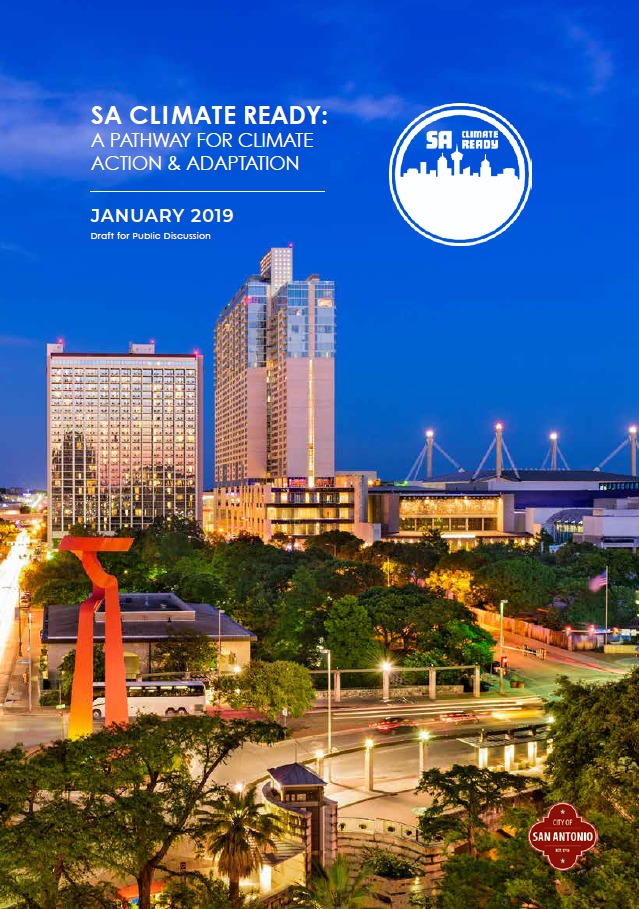
San Antonio’s draft climate plan – SA Climate Ready – is out for public comment until March 26 and is expected to be up for a vote at City Council in May. We hope that city staff will take the next several weeks to strengthen the plan, and that the City Council will then adopt it without further delay. You can weigh in here.
Climate change is already wreaking havoc on communities around the world, with the loss of life and damage to ecosystems, public infrastructure and private property already at unacceptable levels, and worse to come. So the most important thing is to avoid further delay in acting to reduce greenhouse gas emissions that are fueling climate change, and subsequently extreme weather, including droughts, wildfires, floods, and stronger hurricanes, as well as rising sea levels and melting permafrost
Greenhouse gas emissions actually increased in 2018, demonstrating why every city in the U.S. needs a climate plan and needs to implement those plans with a real sense of urgency. There is no time to waste and our federal government isn’t helping.
How does SA Climate Ready stack up? In short: it needs work.
At the most fundamental level, the plan doesn’t set goals that align with the scientific consensus on how quickly emissions must be reduced to keep global warming to 1.5°C (a level that will result in more disasters than we are currently experiencing, but will hopefully avoid ecological collapse). Likewise, it fails to recognize that U.S. cities, including San Antonio, have a responsibility to reduce emissions more quickly than cities in poorer countries with lower emissions. The reality of what is needed from U.S. cities (ending our addiction to fossil fuels over the coming decade) may seem daunting, but the least we can do is recognize the fact, even if we don’t have a clear plan to achieve the goal.
What the World’s Climate Scientists Say
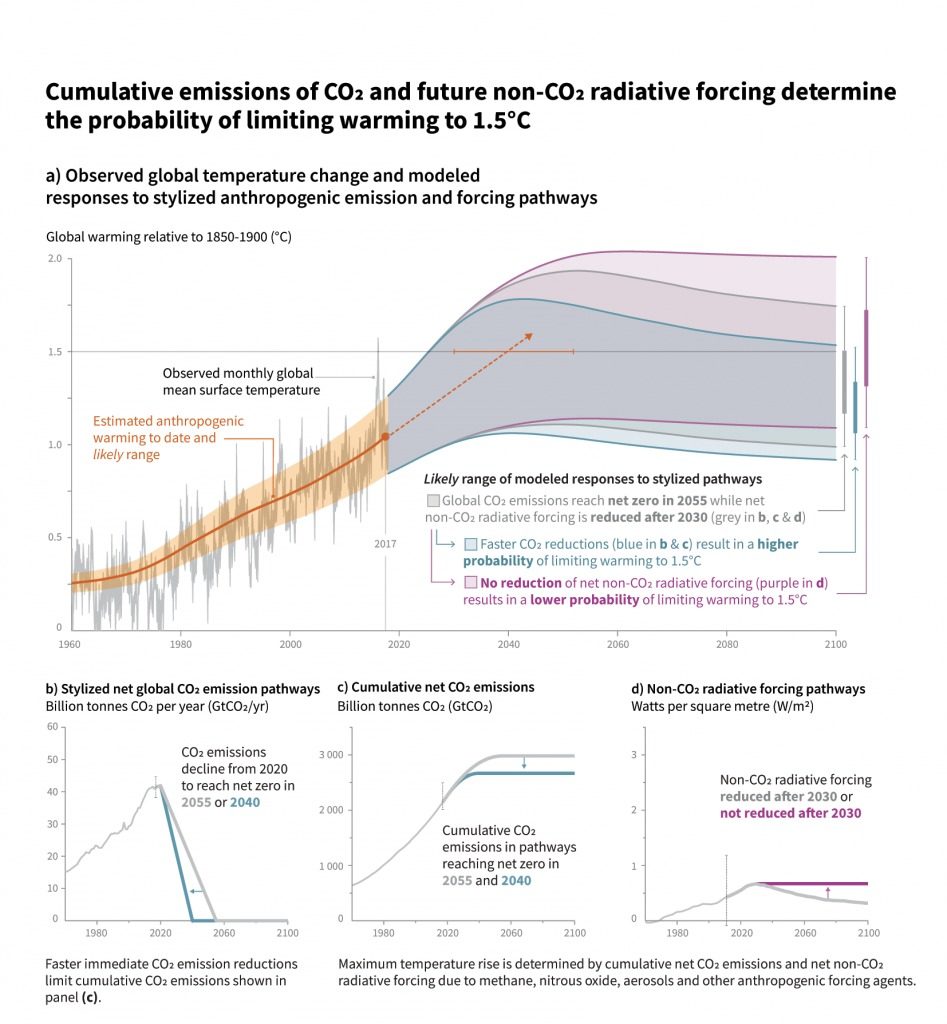
Last year, the Intergovernmental Panel on Climate Change (IPCC) issued its “Special Report on Global Warming of 1.5°C,” which made it clear that the window of opportunity to avoid catastrophic climate change that is irreversible on the human time scale is closing. We need big changes now. We will have the best chance of keeping global warming to 1.5°C if we can achieve net zero greenhouse gas emissions on a global level by 2040. Postponing significant emissions reductions until after 2030, as is implied by the SA Climate Ready plan, won’t land us in a world we want to live in.
From IPCC “Special Report on Global Warming of 1.5°C”
Listen to the Experts on City Climate Planning
C40 Cities – the leading organization that works with cities in the U.S. and internationally to take on climate change has developed a very helpful guidance document called “Deadline 2020” to help cities develop climate plans that align with meeting the goals of the Paris Climate Agreement. The name of the report comes from the fact that global greenhouse gas emissions need to peak by 2020 to give us a decent shot of limiting warming to 1.5°C, but the report describes emissions reduction paths for cities through mid-century.
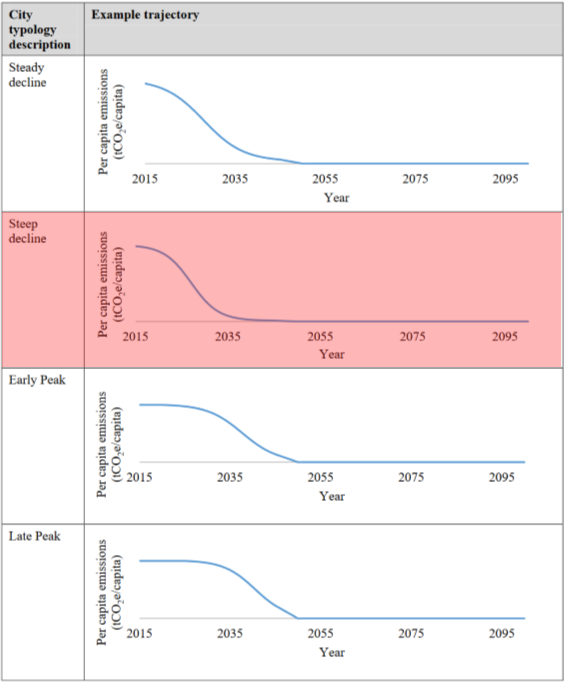
As an organization that works with the world’s largest cities, C40 Cities is intimately aware of the fact that not all cities can reduce emissions at the same rate and that it’s not fair to expect all cities to be on the same path. Cities in wealthy countries with high emissions – like the U.S. – have the responsibility and the ability to reduce emissions much quicker than average. According to the C40 Cities methodology, San Antonio should be on the “steep decline” emissions reduction path.
From C40 Cities “Deadline 2020” report
Big, but Achievable, Emissions Reductions Needed in San Antonio
The “Deadline 2020” methodology was developed before the IPCC released its latest and most dire report, so we think that, taken together, the IPCC and C40 Cities reports point to U.S. cities needing to reduce emissions by around 80% by 2030. That’s a big drop, but fully transitioning to renewable energy (which is possible and can be done affordably with planning) and electrifying transportation (which is already a growing trend), would achieve this goal for a city like San Antonio. It’s cities that are home to more polluting industries that will have a bigger challenge.
CPS Energy Must Take Responsibility
San Antonio, along with the rest of the world, needs to stop burning coal and natural gas to make electricity. Cheap wind and solar, paired with now cost-competitive energy storage, along with energy efficiency, can replace fossil fuel power plants that pollute the community and are the city’s largest sources of greenhouse gas emissions. CPS Energy made a big deal about funding the development of the climate plan, but the utility failed to provide any analysis of options for phasing out it’s use of fossil fuels during the planning process. The city-owned utility is holding firm on waiting until 2050 to stop burning coal and natural gas. This simply isn’t compatible with climate action. That’s why we’re calling on CPS Energy to shut down the Spruce coal-burning power plant by 2025 and phase out it’s natural gas power plants by 2030
Our message to the city is this: Be straight about the facts and set goals that give the city a decent chance of meeting the challenge at hand. Do your fair share to preserve a livable planet.
In the week since we learned from news reports that state and federal regulators inexplicably rejected NASA’s offer to monitor air quality in Houston after Hurricane Harvey, Public Citizen Texas has asked the Texas Legislature to investigate this “willful negligence.”
“Both EPA and TCEQ officials must be held accountable for this inexplicable decision in the face of a grave public health threat,” Adrian Shelley, director of Public Citizen’s Texas Office said in a statement.
Public Citizen continues to discuss this with state lawmakers to ensure that they are aware of the issue and responding accordingly. Of course, we weren’t the only ones appalled that the EPA and the Texas Commission on Environmental Quality’s decided to rebuff NASA’s offer to help in those environmentally hazardous days after Harvey.
Harris County (Houston) Judge Lina Hidalgo took to Twitter to voice her dismay.
“This is disturbing,” Hidaldo tweeted about the news. “By rejecting NASA’s plan to measure pollution post-Harvey, EPA & TCEQ missed a critical opportunity. Air quality is vital to the health of Harris County residents. We need more assessments not less of potential environmental hazards.”
The Houston Chronicle Editorial Board published an editorial asking “Why would Texas officials refuse NASA’s help?”
“Harvey knocked down smokestacks, damaged pipelines, broke chemical storage tanks, and flooded hazardous waste sites, causing poisonous runoff to spill into nearby streams,” the newspaper noted. “All hands were needed to assess the 2017 storm’s environmental impact and figure out what immediate steps should be taken to protect the public. Yet when NASA extended its hand, it was refused.”
Congress also wants answers. The U.S. House Science Committee last week wrote letters to EPA Administrator Andrew Wheeler and Michael Honeycutt, chief toxicologist at TCEQ, demanding an explanation. The letter called the decision to reject NASA’s help “deeply troubling.”
This story isn’t over. We’re joining others in a call to Reps. Morgan Meyer, a Dallas Republican who chairs the House General Investigating Committee, and J.M. Lozano of Austin, who chairs the House Environmental Regulation Committee, to investigate the matter. Advocates have also requested that Sen. Brian Birdwell, a Granbury Republican who chairs the Senate Committee on Natural Resources and Economic Development, open an inquiry.
We hope you’ll click the links on their names above for telephone numbers and join us in calling their offices and asking them to hold TCEQ accountable. The public deserves more information about why TCEQ rejected some of the world’s most sophisticated air quality monitoring equipment in the midst of an epic natural disaster.
By Adrian Shelley, Director of the Texas office of Public Citizen
Today, Public Citizen supported, in the Texas House State Affairs Committee hearing, HB 935. A bill that would designate certain election days as state holidays. We are supportive because this bill would offer Texas voters more opportunity to vote and participate in elections.
Texas has the worst voter turnout in the nation.[1] I have personally experienced the difficulty of encouraging civic participation in Texas through my participation in the Houston in Action Coalition, which works to increase participation in voting and civic life in Harris County. Voter apathy and barriers to participation depress voter turnout in Texas. Texas’ population is increasingly young and diverse. The legislature should do everything possible to encourage civic participation among all Texans. When more Texans participate in elections, and in turn become more civically active, the democratic process benefits. Making election day a state holiday will surely increase voter turnout and participation in elections. And it comes with no fiscal impact to the state.
Public Citizen Texas today filed testimony in the legislature supporting a bill requiring landlords to notify renters if the dwelling they’re renting is in a flood plain or has been damaged by flooding in the past 20 years.
A FEMA representative looks at a house which shows the effect of flooding. Photo by Patsy Lynch/FEMA
Home buyers already receive such notice. Renters also deserve to know all of the risks that they are assuming when they rent. The bill has no fiscal implication to the state.
Texans should be informed if their residence is prone to flooding and we urge state lawmakers to support this common sense legislation.
Read Public Citizen’s letter to members of the House Committee on Business and Industry, which has jurisdiction over the bill, below.
HBPublic Citizen Director Adrian Shelley wrote to members of the House Committee on Homeland Security & Public Safety today asking them to support HB 91, which would establish a disaster identification system for a declared state of disaster.
You can read the letter below.
HB 91 creates a standard system to convey that message: an illuminated display that uses a standard color scheme to communicate to first responders the needs of people and domestic animals.
————————————–
House Committee on Homeland Security & Public Safety. P.O. Box 2910 Austin, TX 78768
February 27, 2019
Re: HB 91, supporting testimony by Public Citizen
Dear Chairman Nevárez and members of the committee:
Public Citizen appreciates the opportunity to testify in favor of HB 91, relating to establishment of the disaster identification system for a declared state of disaster.
We support this bill because it will provide a means for emergency responders to locate victims in need of assistance during a disaster. Public Citizen has advocated for many years on behalf of communities and their needs during disasters.
We participated in two meetings called by the Texas Commission on Environmental Quality with public health and environmental advocates to discuss the response to Hurricane Harvey. These meetings, held on September 12, 2017 and December 11, 2017, consisted of wide ranging discussions about Texas’ response to the public health and safety emergencies presented by Harvey. Through these meetings and our advocacy on this issue, we are well acquainted with the emergency response to Harvey, including areas where it could have been improved. In the midst of the Hurricane Harvey response, Texas Emergency
Management Chief Nim Kidd implored Texans in need of assistance “to make sure you put a signal out there, that you are still there, and you still need help, convey that message to first responders.” HB 91 creates a standard system to convey that message: an illuminated display that uses a standard color scheme to communicate to first responders the needs of people and domestic animals.
Because we want first responders to have every available tool to respond to people in need, and because we believe that HB 91 provides one such tool, we support the bill.
Thank you for the opportunity to provide this testimony, if you wish to discuss our position further, I can be reached by email at ashelley@citizen.org or by phone at 512-477-1155.
Respectfully,
Adrian Shelley, Texas Office Director, Public Citizen
Do you follow the Texas Commission on Environmental Quality (TCEQ) on Twitter? How about Facebook? Did you know they have an Instagram page? LinkedIn? YouTube?
The TCEQ has about 18,000 followers across those platforms, with 10,000 of those on LinkedIn and 6,000 on Twitter. They also maintain the website and social media for “Take Care of Texas,” the less-successful younger brother of TxDOT’s “Don’t Mess with Texas” campaign.
Last week, at the first meeting of the House Environmental Regulations Committee during the 86th legislature, TCEQ Executive Director Toby Baker told committee members that he hoped the TCEQ could use social media more effectively in the future. We agreed at the time, and now we’d like to take this opportunity to identify three things the TCEQ does well on social media and three things it could do better.
1. Air Quality Forecasts
The Texas Commission on Environmental Quality uses its Twitter page to post daily air quality forecasts. The air quality forecasts might look familiar to you if you know of the U.S. Environmental Protection Agency’s Air Quality Index and AirNow.gov website. Many people use these tools to get information about air quality and air pollution near them, including people who suffer from asthma and people who work outdoors. When elevated ozone levels are the difference between a safe run or an asthma attack, you can imagine why some people rely on these resources. The TCEQ provides an email option for air quality forecasts, but posting them on social media is a great way to build the audience.
TCEQ began posting air quality forecasts back to 2015, when they were still using the @TCEQNews twitter handle. This happened in response to criticism from Air Alliance Houston (where I worked at the time), which had been calling attention to TCEQ’s total lack of an online presence. TCEQ never directly acknowledged our criticism, but to their credit, they did start posting daily air quality forecasts. In my research for this post, I found an archived Air Alliance Houston blog post from 2015 in which I (immodestly) took credit for prompting TCEQ to action.
2. Drought Maps
Some time after the TCEQ started posting daily air quality forecasts on Twitter, they added regularly updated drought maps. This is another example of actionable content about environmental quality. People across Texas can use the drought maps to adjust their water use or decide which of Texas’ many lakes, rivers, and streams to visit. Seeing periodic drought maps is also a good reminder that Texas often faces water shortages. We hope that this fact will prompt people to speak up about the need to use water more wisely in Texas by, for example, limiting the use of water in hydraulic fracturing or investing in urban water infrastructure to minimize transmission losses.
3. Notice of Public Hearings
This is another example where public criticism caused TCEQ to respond and change its practices for the better. Perhaps three years ago, the old @TCEQNews Twitter account posted to announce the close of a public comment period with no comments received. I responded (again from the Air Alliance Houston Twitter account) that receiving zero public comments was nothing to celebrate, and that perhaps TCEQ should post notice of public opportunities when they begin, not when they end without participation. Again I didn’t get a direct acknowledgement of my criticism, but again TCEQ responded, this time by beginning to post notice of public hearings. The public hearing is an essential opportunity for members of the public to weigh on permits and other decisions that affect our environment, so TCEQ should do everything it can to encourage public involvement.
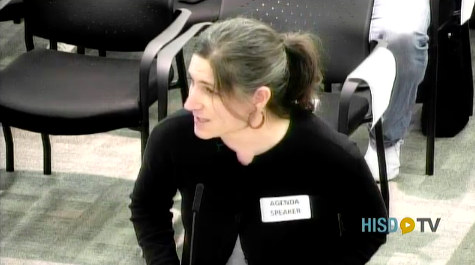
A recent public meeting in Houston.
Pointing out these past exchanges with TCEQ isn’t about any desire for credit, but rather to show that the TCEQ does sometimes respond to publicly raised concerns. These may be a few modest changes by the agency, but they are typical of what we see from TCEQ. There are many, many hardworking, conscientious staffers at the Commission. Much of the good work that TCEQ does happens among these staffers, quietly and by degrees. These are the people who are listening when we make recommendations to the TCEQ. They may not announce changes with fanfare, but they can often nudge the Commission in the right direction. With that in mind, here are three things the TCEQ could do better on social media.
1. Focus on the Public
Do you know who TCEQ’s customers are? You might think it’s the 28 million Texans who breathe air, drink water, and enjoy unspoiled natural land. In fact, in TCEQ parlance, a “customer” is a company that has a permit with the Commission. What we might call a “polluter.”
This focus of attention on polluters is evident in TCEQ’s messaging on their website, social media, and elsewhere. So, for example, you will find social media announcements for the Environmental Trade Fair and Conference, but you aren’t likely to see any announcements for a workshop about, say, filing an environmental complaint. (As an aside, if you want to know how un-user friendly TCEQ’s complaint process is, consider that the actual email address they use is CMPLAINT@tceq.texas.gov.)
2. Post permit notices and information Online
The TCEQ could promote public engagement by making more information available online. There is actually a bill filed in this legislative session by Rep. Jessica Farrar of Houston, HB 245, that would require TCEQ to post certain environmental and water use permit applications online.
The TCEQ could do this by choice if it wanted to. If online posting required more resources, the TCEQ could request those resources in its budget proposal to the legislature. Furthermore, posting permits online would free TCEQ resources in the filing rooms across the state, where records are required to be kept for public viewing. Online posting wouldn’t eliminate the need for public maintenance of records, but it would drastically reduce the number of members of the public who came to view records, thus relieving an administrative burden on TCEQ. Details aside, there is little question that moving toward storing information online will save resources in the long run. TCEQ has, to its credit, done a lot of work in recent years to combine and update its online databases. Posting permits online is a next logical step.
3. Engage!
To recap, much of the story I have told here is one of advocates such as myself calling out TCEQ, and TCEQ quietly responding. At times the Commission seems singleminded about not engaging with the people. Perhaps they are concerned about creating liability or upsetting their customers. Whatever the reason, probably the biggest flaw in TCEQ’s social media strategy is the unwillingness to engage people where they are. To enter into frank exchanges about the hazards Texans face and what they can do about them. Nowhere is this more evident than during a natural disaster or an accident such as a fire or chemical release. These incidents often lead to robust discussions on social media, including people looking for information about risks and how to avoid them. In these up-to-the-minute conversations, the TCEQ is nowhere to be found. I suspect we could get an answer from some lawyers about why TCEQ cannot weigh in on a disaster as it is unfolding, but from our perspective that answer will simply be a justification to continue to not engage a willing public.
If the Commission is serious about improving its social media presence, our last suggestion is to loosen up, engage with people, and pull back the veil a bit. If people see the Texas Commission on Environmental Quality willing to engage with them, then perhaps they will be more willing to make that complaint, attend that workshop, or file those public comments. We have to believe that this is what TCEQ actually wants from average Texans, and social media is one way to encourage it.
Honorable Mention: TCEQ Executive Director Toby Baker
In conclusion, we have to applaud TCEQ’s Executive Director Toby Baker for having his own twitter account, @ctobybaker, since 2012. Mr. Baker has shared some fun tweets over the years, though at some point there was an addition to his twitter profile that is quite revelatory about the TCEQ’s current approach to social media. It reads, “Due to TX laws, I can’t receive certain communications– all ‘mentions’ are screened”