Feeds:
Posts
Comments

Archive for February, 2016

If you’ve used a taxi or similar transportation service in a major U.S. city recently, you’ve probably heard of Uber or Lyft. Uber and Lyft are two mobile ride hailing companies that were both founded in San Francisco, California. Uber was founded in March 2009 and Lyft was founded in summer 2012. They facilitate peer-to-peer ridesharing and operate under the transportation network company (TNC) label. By summer 2015, Uber’s net worth was valued at $50 billion and Lyft’s net value was $2.5 billion.

Council Member Ann Kitchen Getting Fingerprinted - Photo by Jay Janner, Austin American Statesman

Council Member Ann Kitchen Getting Fingerprinted – Photo by Jay Janner, Austin American Statesman

Uber and Lyft are great options for carpooling, for not having to deal with parking your car downtown, or for worrying about drinking and driving. They also provide convenience by simply using your smartphone to order and pay for a ride. So what’s all the fuss with them about? This past December, the Austin City Council passed an ordinance that, among other things, required all transportation network companies (TNCs), which includes Lyft and Uber, to fingerprint their drivers for background checks. The December ordinance set benchmark goals of having 25% of drivers fingerprinted by May 2016, with gradual increases, and then 99% compliance by February 2017.

South Congress Capitol View – Photo from Wikimedia

South Congress Capitol View – Photo from Wikimedia

Public safety officials support of the fingerprinting ordinance as necessary for safety. Without fingerprinting, drivers could slip through the background check using false identities.  Lyft and Uber are opposed to fingerprinting their “contractors” because they think their background checks are sufficient and that the ordinance opens the door to future regulation that they believe hampers innovation. Taxi drivers, pedicab operators and horse carriage operators are already subject to the same regulations though.
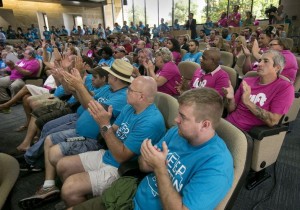
City Council Committee Meeting – Photo by Laura Skelding, Austin American Statesman

City Council Committee Meeting – Photo by Laura Skelding, Austin American Statesman

Lyft and Uber say that if fingerprinting happens, they’re leaving town. They don’t want to be subjected to regulations they think might stifle future business decisions or that defines them as taxi-like companies. If they’re associated with taxi services, they’ll be subjected to an array of additional rules. This is ironic because Uber and Lyft are in fact very similar to taxis: they provide transportation for passengers and receive payment in exchange. They are “taxi-like” and thus should be subjected to the additional regulations they want to avoid.

What about who the actual drivers are? According to Ben Wear (Austin American Statesman February 15, 2016, pg. B3):

At least ten Austin women filed complaints last year about sexual assaults – seven against ride-hailing drivers, three involving taxis. While the two companies use background checks that look at all 50 states, and they bar applicants with crimes of violence or theft, those background checks only look back seven years. So, someone could have committed a rape or even a homicide 10 or 20 years ago, even in Texas, and the ride-hailing companies likely would not find out about it.

In an undercover investigation, NBC Chicago hired several drivers and ran their own personal background checks on them. They found numerous tickets and questionable driving history. One driver had 26 tickets and one driver was an ex-con who had priors going back two decades including burglary, drugs, and assault. There are clearly people getting through their background check system that shouldn’t be driving for hire. Having the fingerprint submissions that the City Council proposed would make it easier for law enforcement to identify lawbreakers.

A political action committee (PAC) called Ridesharing Works for Austin formed in response to the fingerprinting mandate. The PAC made a petition to fight back against the City Council’s new TNC rules, and they gathered three times more signatures than they needed. The City Council could then either overturn the fingerprinting ordinance passed in December, or place it on the ballot of the next available election for the voters to decide. They went with the latter, so it’s up to Austin voters to decide on May 7.

The Uber and Lyft situation in Austin is a local example of a problem America is experiencing at a federal level – big money in government. The reason Uber and Lyft were able to gather so much support for their petition is because they contributed at least $50,000 in cash and services to the Ridesharing Works PAC. The PAC had canvassers go out, knock on Austin residents’ doors, and gather signatures. Many rideshare drivers also had the petition available in their vehicles for passengers to sign during their rides. Many inaccurately explained the issue to Austin residents as simply “Uber/Lyft vs. the city of Austin”. They told residents that the City Council is forcing Uber and Lyft to leave town, when in reality, if the two companies do leave, it’ll be on their own accord.

The money behind the petition against the fingerprinting ordinance is from big corporations. And those corporations are essentially funding Lyft and Uber’s campaign against safety regulations in Austin. This is exactly what we want to avoid in politics, and it’s happening right here in our city. Corporations coming up with their own rules and going to city hall to demand them is not the way government is supposed to work. It’s a government by the people and for the people, not by corporations and for corporations. If Uber and Lyft succeed in getting the fingerprint mandate overturned, it sets a dangerous precedent for the future. As citizens of the United States of America, we need to question how money from big corporations like Uber and Lyft is influencing our local legislation. Austin voters should consider this when they head to the polls on May 7th.

Read Full Post »

Monsanto has a bad track record when it comes to the safety of its products. From saccharin, to Agent Orange, to DDT, Monsanto has a history of producing and distributing chemicals that have serious health consequences. Most recently, the company has come under pressure for its herbicide, Roundup. After years of consumer concern, world-leading scientists at the International Agency for Research on Cancer (IARC) released a study in March 2015, stating they believed glyphosate, Roundup’s active ingredient, is “probably carcinogenic”. These findings have been echoed by the World Health Organization.

Chafer Sentry Herbicide Application

Chafer Sentry Herbicide Application

This news should bring shockwaves in regulatory policy, as glyphosate is by far the most used herbicide in the world. The use of this carcinogenic herbicide has become essential for thousands of farmers who are under contract with Monsanto to use Roundup Ready genetically modified (GM) seeds. Roundup Ready crops are most heavily applied with glyphosate and these include soy, corn, canola, alfalfa, cotton, sorghum, and wheat.

Countries such as Sri Lanka, and Bermuda have banned the use and importation of glyphosate, while Germany’s health ministers are spearheading a campaign to have the herbicide banned all across the European Union. For the US, the first instance of this can be seen in the California Environmental Protection Agency’s plan to begin labeling Roundup and other products containing the chemical as carcinogenic. Dr. Nathan Donley, a scientist at the Center for Biological Diversity, stated,

“As far as I’m aware, this is the first regulatory agency in the U.S. to determine that glyphosate is a carcinogen. So this is a very big deal.”

Glyphosate’s carcinogenic potential has been known to Monsanto and the U.S. Environmental Protection Agency (EPA) from long term animal experiments since the early 1980s, but the company has repeatedly dismissed such claims and refused to disclose the studies, buy claiming they contain “trade secrets”. After petitioning the EPA, Dr. Anthony Samsel, a research expert who has worked for the EPA, and as a hazardous materials expert, the United States Army Corps of Engineers (USACE), and the United States Coast Guard (USCG), received the lab documents.

One study shows how mice exposed to glyphosate produced renal tubular adenomas, which are tumors in kidney cancer, along with developing hepatocyte hypertrophy, which is a sign of liver cancer. In addition, lab findings show how glyphosate glyphosate stops the body from absorbing selenium, which leads to thyroid cancer growth. As a result, the EPA labeled glyphosate a Class C carcinogen in a March 4, 1985 EPA review. The Class C carcinogen label means there is suggestive evidence of carcinogenic potential. This classification was changed by the EPA just six years later to a Class E category which suggests “evidence of non-carcinogenicity for humans”. Is it a coincidence that this change in glyphosate’s classification transpired during the same period that Monsanto was producing its first Roundup-Ready GM Crops?

(more…)

Read Full Post »

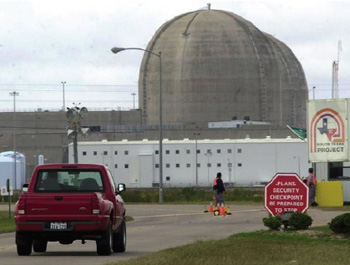
Wednesday, CPS Energy of San Antonio announced that they are writing off the nearly $400 million already spent to develop two new proposed South Texas Project nuclear reactor units.

south-texas1.jpg“The NRC can license these reactors, but they won’t get built,” said Karen Hadden of the Sustainable Energy and Economic Development (SEED) Coalition. “Renewable energy is cheaper these days and much safer. Nuclear power creates radioactive waste that remains deadly for hundreds of thousands of years.”

“CPS’ decision shows that proposed nuclear reactors are worthless. There’s no market for their rate raising, high-cost, high-risk power,” said Tom “Smitty” Smith of Public Citizen’s Texas office.  “The proposed reactor price tag rose from $5.9 billion to $18.2 billion, even before a license was ever issued.  Delays, construction problems and lawsuits are the norm for nuclear reactors. They cost so much that even with all the federal subsidies, no bank will loan money to build them. CPS did the smart thing and wrote off this worthless investment”

You can read about this fiscal decision on their blog by clicking here. You can read the excerpt regarding the financial write-off from the post below:

In FY 2015-16, we also made the decision to financially write-off our investment in the proposed South Texas Project Units 3 & 4. The decision to write-off the investment should be seen solely as an “accounting decision.” CPS Energy will retain a legal interest in the project, which aligns to our perspective that   nuclear is a significant part of our local and the broader national energy portfolio and will continue to be an important, carbon free and economic fuel type, as well as a good alternative to help counter volatile fuel prices.

We continue to argue that, for a variety of reasons – stated briefly above, nuclear energy should not be considered the future of the nation’s broader energy portfolio. CPS’s financial decision is one such indicator, in spite of the caveat in their statement.

Read Full Post »

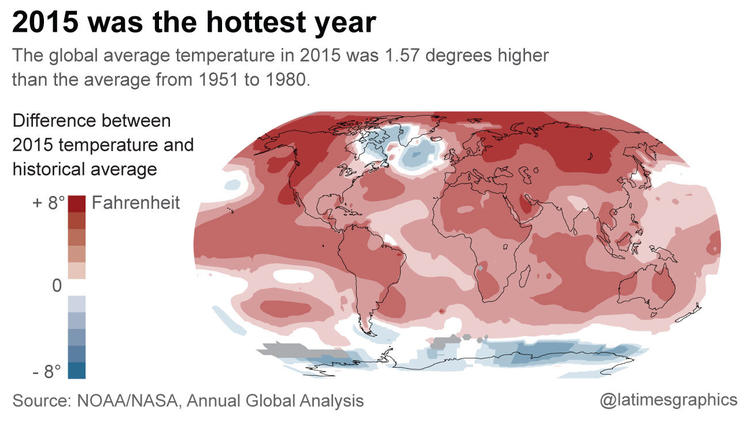
If you felt like 2015 was exceptionally warmer than usual, you weren’t alone. Last month, scientists declared 2015 the hottest year on record. Some of this heat can be attributed to the El Niño weather pattern releasing heat from the Pacific Ocean into the atmosphere, but most of the record-breaking heat is from climate changes caused by human-related greenhouse gas emissions.

NASA, the National Aeronautics Space Administration, and NOAA, the National Oceanic and Atmospheric Administration, both collected data that showed that 2015 was between 0.23-0.29 degrees Fahrenheit hotter than 2014. This number may seem small and insignificant, but in terms of global temperature, it’s a big deal.  Thomas Karl, director of NOAA’s National Centers for Environmental Information emphasized that point:

This record, we literally smashed. It was over a quarter of a degree Fahrenheit, and that’s a lot for the global temperature.

In comparison to average temperatures in the 20th century, and not just 2014, 2015 was 1.62 degrees Fahrenheit higher.

2015 Hottest Year

Heat StrokeThe severe heat last year was felt around the world. There were record-high temperatures in the triple digits across Europe in June and July in Spain, Portugal, France, the U.K., Germany, and Poland. In May, India experienced 120 degree days that melted the asphalt, killing 2,500 people. In June, 1,200 people died in Pakistan after temperatures reached 113 degrees. When the atmosphere is warmer, it can hold more water vapor, which can cause an increase in heavy rains. The recent catastrophic floods in the eastern U.S. are evidence of this. El Niño is also disturbing atmosphere circulation which is causing some worldwide weather extremes like the drought in southern Africa.

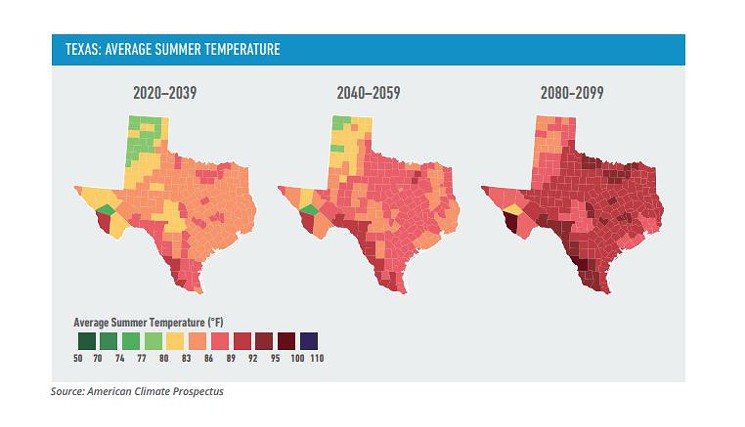
So how will Texas be affected by this global climate change? With its location and vast size, Texas has a wide range of vulnerabilities to the effects of climate change. A study done by the Risky Business Project found that Texas will be one of the states that is most negatively affected by climate change.

Texas by 2050:

  • Decrease in worker productivity and crop yields.
  • Sea level rise of 2 feet in Galveston.
  • The number of extremely hot days per year (temperatures exceeding 95 degrees) will more than double from 43 to 106 days per year.
  • About 4,500 additional heat-related deaths per year.
  • A $650 million per year increase in storm-related losses along the coast, bringing the state’s annual damages to more than $3.9 billion.

Texas Climate

The Risky Business Project’s mission is to convince business leaders in Texas that climate change is a true risk. This will not be easy since Texas lawmakers routinely dismiss climate change. Regarding the news that 2015 was the hottest year, NASA head Charles Bolden said, “This announcement is a key data point that should make policymakers stand up and take notice – now is the time to act.” That it is, Bolden.

Read Full Post »

Republicans have been waging a war against public health regulations in the United States for longer than I’ve been alive. One of the latest worrisome developments in this trend is the push-back from many conservative states, Texas among them, against the Environmental Protection Agency’s (EPA) new standards regarding ground-level ozone, otherwise known as smog.

When the last revision of ozone standards was completed in 2008, the standard, at 75 parts per billion (ppb), was set to allow much higher levels of pollution than many environmental and public safety groups felt was necessary to protect the public well-being. The panel in charge of advising the EPA on the new standard, the Clean Air Scientific Advisory Committee (CASAC), unanimously recommended a standard between 60 and 70 ppb. However, the Administrator of the EPA at the time was appointed by President Bush, served conservative interests, and chose to adopt 75 ppb instead.

Now, thankfully, under the new regulations finalized in October of 2015, states will have to meet a standard of 70 ppb after the CASAC again recommended a standard between 60 and 70 ppb. With the difficult political climate right now, it’s clear the EPA believed that adopting the least aggressive option while still improving public health would meet with the least resistance. However, it has met considerable resistance from the current Congress, as 10 bills have been introduced attempting to delay the implementation of these standards, with some bills even attempting to prohibit funding the EPA.

The estimated cost of implementing the new 70 ppb standard is $1.4 billion, whereas choosing a standard of 65 ppb would have raised the cost of implementation to $16 billion. States have until 2020 to reach 70 ppb, with the most polluted areas allowed as long until 2037 to reach attainment. This should be a win for Republicans, so it’s difficult to understand the current rhetoric being thrown around by those who are objecting to the new standard. Texas Attorney General Ken Paxton claimed in a press release “The EPA’s new ozone rule is not supported by scientific data” and then went on to complain that it will require “costly new regulations that will harm our economy and kill jobs.”

These are ridiculous assertions. Here’s why:

Firstly, a brief outline of the process for reviewing Ozone NAAQS (standards) should be enough to refute the claim that there is no science behind the rule: Federal EPA scientists reviewed 2,300 scientific studies to complete the preliminary Integrated Science Assessment. After the EPA prepared a Risk and Exposure Assessment to identify at-risk populations and health impacts, a Policy Assessment summarized the information in the previous two documents and provide the EPA Administrator with policy options.

Then, as required under the Clean Air Act, an independent scientific advisory panel, the CASAC, was formed to review the entire process. The panel members are generally from academia and private research institutions. Leading experts on health and environmental effects of specific pollutants are then regularly called in to supplement the panel’s considerable scientific knowledge.
Secondly, the health benefits were estimated between $2.9 billion and $5.9 billion, clearly outweighing the $1.4 billion cost. The projected health benefits come in the form of less heart and lung diseases and a reduction in premature deaths. Most notably, 320 to 660 premature deaths could be avoided with adoption of these new regulations, which account for 94 to 98 percent of the EPA’s total monetized benefits of the new standards.

child_inhalerUnder the new standards we can prevent:
• 11,000 cases of upper and lower respiratory symptoms
• 230,000 cases of exacerbated asthma
• 188,000 days when people miss school or work from illness related to smog
• 340 cases of acute bronchitis
• 960 hospital admissions and emergency room visits

To say that these costly regulations will not be worth the benefits is to say that one does not care about or value human life or quality of human life.

Republicans have been fighting for the right to disregard human life, environmental health and EPA regulations for a long time. Most recently, the 112th Congress attempted to pass legislation that would have required the EPA to take costs into consideration when setting standards. As it is now, the EPA is supposed to place public and environmental health above economic costs. The current Congress has again introduced legislation requiring the EPA to take costs into account when setting future standards.

In their 2015 brief on the new Ozone NAAQs, the Congressional Research Service highlights eight of the ten plus bills that have been introduced by the current Congress that attempt to delay or prevent implementation of the new standards. Texas is spearheading the effort to subvert the EPA, with four of the highlighted bills coming from Texas Representatives. All the eight bills are backed by Republicans. North Texas Representative Sam Johnson, introduced legislation that would “provide no funds made available under any act may be used by EPA to implement any ozone standard.” On top of that, Texas is suing the EPA, in an attempt to overturn the new ozone standards.  It is clear that this lawsuit and these many legislative attacks are acts of Republican disbelief in science and disregard for public health.

Read Full Post »

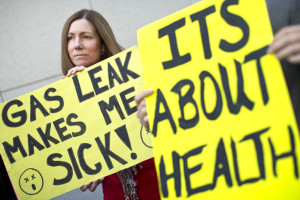
Porter Ranch - photo by Maya Sugarman KPCC

Porter Ranch – photo by Maya Sugarman KPCC

The massive natural gas leak in Porter Ranch, CA, just outside of Los Angeles, has been temporarily capped. That’s the good news. The bad news is that the leak isn’t yet permanently stopped and that it has already done incredible damage over the 111 days it spewed methane and toxic chemicals into the air.

The state of emergency called by Governor Jerry Brown is still in effect for what is being named the largest environmental disaster since the BP oil spill. Over 94,700 metric tons of methane has escaped since October 23, which is one of the largest leaks ever recorded. This incident has taken California two steps back in its progress towards greenhouse gas emissions reductions especially since methane is 87 times more potent of a greenhouse gas than carbon dioxide. For perspective, the amount of methane released so far from the natural gas leak will have the same impact on climate over the next twenty years as emissions from seven coal power plants. Despite these environmental crimes, not one person has been arrested, although this past week, the citizens of Los Angeles County have begun taking legal action.

Southern California Gas Co (SoCal Gas), a subsidiary of Sempra Energy, is the responsible company for the Aliso Canyon Methane Leak, and is finally facing charges for this disaster. District Attorney Jackie Lacey announced the criminal charges filed against SoCal Gas for failing to immediately report the gas leak at its Aliso Canyon facility to the proper state authorities. The site leaked for three days before SoCal Gas officials contacted the city’s fire department.

Major public health concerns are also leading to lawsuits. Residents across the county are reporting health issues such as nose bleeds, female health problems (excessive bleeding), rashes, vomiting, headaches, and dizziness, and have packed town hall meetings voicing their concerns. One Porter Rach resident, Christine Katz, stated, “Even though you can’t see the gas, it’s there. And that’s the saddest part — people don’t understand it. Because it’s not a mudslide, it’s not an earthquake. You just don’t see the devastation, but it’s there.”

SoCal Gas has yet to release a full listing of the chemicals being emitted from the leak, furthering distrust and anxiety from the community. Local law firms have organized a website (www.porterranchlawsuit.com) for citizens to reach out if they have been impacted. More than 25 lawsuits have been filed pursuing damages from the SoCal Gas and Sempra Energy. For example, a family of an elderly woman has filed a wrongful death lawsuit against the gas company, claiming that the leaking chemicals led to the worsening of her health and untimely death this past January.

Legal actions will certainly hurt these gas companies financially, but is this an effective way of enforcing the law? History says no. Time and time again, environmental crimes are punished with fines, and these disasters continue to happen putting the public at risk. New regulations, transparency, and stricter criminal enforcement on the individuals responsible very well could bring justice in these incidents.

Crimes committed under a corporate veil are still crimes and should be treated as such. No amount of money will ever reverse the harsh health and environmental effects the Aliso Canyon Methane Leak is having on the region. But we can put into place policies that make corporations take the environmental risks of their operations much more seriously. A proactive justice process would be exponentially more effective means of dealing with environmental crimes than merely reacting after the fact.

Read Full Post »

A Texas-scale nuclear boondoggle

south-texas1.jpgSouth Texas Nuclear Reactors Can’t Compete With Renewables and Risk Financial Meltdown
Consumers Will Bear the Costs of New Reactors

Public Citizen, the SEED Coalition and the South Texas Association for Responsible Energy are opposing a decision by the U.S. Nuclear Regulatory Commission (NRC) to approve construction of two new nuclear reactors at the South Texas Project nuclear plant southwest of Houston. Market conditions, currently dominated by low natural gas prices, make the economics of nuclear power challenging, the groups said.

Reacting to the NRC’s move, even the former CEO of NRG Energy admitted markets have little interest in new nuclear power plants. But the prospect of billions in public subsidies can shelter shareholders from the financial albatross that is nuclear power, while exposing taxpayers to all of the risk.

“At a time when market-fueled wind power in Texas has pushed power prices at times close to nothing, it makes no sense whatsoever to continue to approve permits for another financial disaster-in-waiting,” said Tom “Smitty” Smith, director of Public Citizen’s Texas office. “The proposed nuclear reactors would produce energy that is too costly to consume. The most recent price tag of over $18 billion is three times the original estimate. The power that the reactors would produce would cost three to four times more than wind, solar or natural gas in today’s market, so it can’t compete.”

“We simply cannot build our energy future around an industry plagued by soaring and uncertain costs, project delays and an unmanageable lethal bi-product,” said Tyson Slocum, director of Public Citizen’s Energy Program. “The Vogtle nuclear facility in Georgia and the Summer nuclear facility in South Carolina are both three years behind schedule, and each is expected to come in billions over its original budget. These poor performances are indicative not only of the current state of the nuclear industry, but of its past. The costs of building 75 of the existing nuclear power plants in the U.S. exceeded industry quoted estimates by more than 300 percent, and there is nothing to suggest these new reactors will be any different.”

Under current plans, Toshiba America Nuclear Energy Corporation (TANE) will assume exclusive, principal funding authority for the project. But the Atomic Energy Act prohibits the licensing of reactors that are owned, controlled or dominated by a foreign corporation or foreign government. Opponents have contended that because TANE is a wholly owned subsidiary of Toshiba America, Inc., a Japanese corporation, the company is ineligible for licensing.

“The reactors will be 93 percent owned by a Japanese company,” said Susan Dancer, president of the South Texas Association for Responsible Energy. “If the proposed reactors ever get licensed and built, orders for operation will come from foreign owners. Federal law prohibits foreign companies from owning nuclear plants because today’s friends may be tomorrow’s enemy. And what if they are focused on cost-cutting and not safety? Japanese investors want us to trust them, but little protection was afforded to the Japanese people following the Fukushima disaster.”

“The NRC is pushing the interests of corporations, not citizens or ratepayers in moving toward licensing two proposed nuclear reactors in Bay City, Texas,” said Karen Hadden, executive director of the SEED Coalition, a group that has led intervention in the licensing process. SEED plans to appeal the NRC’s decision.

Read Full Post »

Note: Late Tuesday, the U.S. Supreme Court halted implementation of the U.S. Environmental Protection Agency’s (EPA) Clean Power Plan until legal challenges are resolved. Below are two statements from Public Citizen experts.

Statement of David Arkush, managing director, Public Citizen’s Climate Program:
We are extremely disappointed by the Supreme Court’s stay of the Clean Power Plan. The stay will delay progress on climate change at a time when we need much more assertive action. We urge states to continue writing their implementation plans under the rule while the litigation is pending, which they are free to do. State plans can benefit consumers tremendously by lowering electricity bills and boosting public health. Electric utilities are increasingly saying that the Clean Power Plan is workable. We cannot afford to lose any time working to stop climate change from devastating our economy and our planet.

Statement of Tom “Smitty” Smith, director, Public Citizen’s Texas office:
The Supreme Court yesterday stayed implementation of the EPA’s plan to control carbon pollution. But it can’t suspend the rules of nature, and nature will prevail.

A delay in implementing the EPA’s clean power plan will be very harmful to Texans.

Texas’ leadership has its head in the sand, but Texas will get burned because our state is likely to suffer devastating consequences from climate change – heat waves, drought, agricultural losses, dried-up lakes and rivers, higher utility and insurance bills, increased early deaths and increased spending on health care.

No state emits more carbon dioxide from its power plants than Texas, and Texas would benefit tremendously from a shift in energy sources because of our vast renewable resources and our potential to reduce energy use through efficiency, both of which are lower-cost options than retrofitting coal plants, and both of which would put money into Texans’ pockets. We could export our clean renewable resources to neighboring states. We could save the $1 billion we send to Wyoming to buy coal each year and reinvest it in homegrown Texas energy resources, reducing our bills and creating jobs.

The energy sector is changing. As Texas Attorney General Ken Paxton said today, the changes in the energy sector will require planning. The challenge now shifts to the interim committees of the Texas Legislature to begin to develop plans to build new power lines and dispatch systems needed to meet the needs of the new energy sector that is developing, with or without new clean power rules.

Read Full Post »

Join Public Citizen at Earth Day Texas in April

APRIL 22-24 10AM – 6 PM FAIR PARK, DALLAS, TX FREE ADMISSION

EDTx-2016-Logo


Read Full Post »

The hunt is on. The City of Austin is searching for a new general manager for Austin Energy. It should take this opportunity to find a visionary leader who can prepare our city-owned utility to remain prosperous as the electricity market changes.

This is a transformational time for electric utilities. The business model that served utilities so well throughout the 20th century – buy or produce energy at large, centralized facilities and profit by selling that energy to customers – won’t keep utilities afloat throughout the 21st century.

As solar prices continue to drop, more and more customers will choose to use solar at their homes and businesses, reducing the amount of energy that utilities, including Austin Energy, can sell. Declining battery prices will only add to the effect and will give customers an affordable off-grid option. And as energy prices and limits on carbon emissions increase, energy efficiency improvements will become even more attractive, further reducing the need for centrally produced energy.

The next leader of Austin Energy needs to recognize this new reality and be fully committed to reform Austin Energy’s business model to enable the utility to not only survive these changes, but to flourish in new energy markets they transform and develop. In addition to prioritizing a rapid transition to 100% renewable energy, she should be committed to innovating to incorporate energy efficiency, distributed energy (including solar), energy storage, and demand response into the utility’s business model. Austin Energy must find ways to provide and profit from a wide range of energy services that are compatible with a carbon-free future.

The new Austin Energy general manager will need to be someone who is capable of gaining the respect of the workforce and harnessing their collective abilities to provide excellent customer service, even as the definition of those services is changing. And she will need to ensure that all staff have the necessary technical skills to meet the utility’s needs and avoid costly mistakes, such as the billing system fiasco.

Navigating these changes while keeping the utility prosperous will require excellent financial acumen and experience setting transparent operating and capital budgets. Austin Energy is an important source of revenue for the city, so a strong commitment to public power will be critical. The general manager will need the knowledge and political savvy to continually convince the Texas Legislature that the utility is acting in the best interests of its customers in order to stave off deregulation.

The needed utility transformation will only occur with the blessing of the Austin City Council and the support of the community, so the next general manager must be willing and able to work collaboratively and respectfully with all parties, including public interest groups, citizen commissions, chambers of commerce, and research organizations. Concise, timely, and honest communication with the City Council and the public will be required.

The next Austin Energy general manager must have the ability to bring together diverse community interest groups and contentious parties to garner support for needed changes. As Austin continues to struggle with affordability, she must have experience and empathy in working with low and moderate income customers and be committed to reducing electric bills for this group with energy efficiency and distributed solar programs.

We’re looking for a talented, visionary leader who is committed to working for the public good. If that’s you, please apply.

Read Full Post »

Wind has become a pillar of economic development

Dallas-based Tri Global Energy leads in wind energy projects under construction in Texas, developing nearly half of current projects, according to a fourth quarter 2015 market report from the American Wind Energy Association (AWEA).

Tri Global Energy projects make up 2,100 megawatts (MW) out of a total 4,600 megawatts (MW) of wind power projects under construction statewide, the report shows. And Texas wind projects make up nearly half of the 9,400 MW of wind under construction nationwide.

“For many communities in Texas, especially those in the Panhandle where wind projects dominate the landscape, wind has become a key pillar of economic development – and I expect this to remain for some time to come,” Tri Global Chairman and CEO John Billingsley said in a statement highlighting the renewable energy company’s contribution.

Texas is the world’s sixth-largest producer of wind-powered electricity, just behind India and just ahead of the United Kingdom, according to Tri Global, which has also designed, constructed and operated more than 1,000 solar projects for utilities, corporations, schools, municipalities and residences.

By Polly Ross Hughes


Reprinted from the Texas Energy Report

Copyright January 29, 2016, Harvey Kronberg, www.texasenergyreport.com, All righs are reserved

Read Full Post »