Feeds:
Posts
Comments

Archive for the ‘Global Warming’ Category

NRC Japan Task Force Report CoverThe Nuclear Regulatory Commission’s Japan Task Force has proposed improvements in areas ranging from loss of power to earthquakes, flooding, spent fuel pools, venting and preparedness, and said a “patchwork of regulatory requirements” developed “piece-by-piece over the decades” should be replaced with a “logical, systematic and coherent regulatory framework” to further bolster reactor safety in the United States.

The report has been given to the five members of the Nuclear Regulatory Commission, who are responsible for making decisions regarding the Task Force’s recommendations.

While declaring that “a sequence of events like the Fukushima accident is unlikely to occur in the United States” and that plants can be operated safely, the Task Force also recognized that “an accident involving core damage and uncontrolled release of radioactivity to the environment, even one without significant health consequences, is inherently unacceptable and proposed a comprehensive set of 12 recommendations to increase safety and redefine what level of protection of public health is regarded as adequate. It also recommended additional study of some issues.

The recommendations looked at ensuring protection, enhancing accident mitigation, strengthening emergency preparedness and improving the efficiency of NRC programs.

The report noted that the current NRC approach to regulation includes requirements for protection and responses for events that the facilities were originally designed to stand up to, such as earthquakes of the largest magnitude, or the highest flood level, or the strongest hurricane that had been experienced in the area at the time the permit was approved.  These are referred to as “design-basis” events.  There are also modest requirements for some “beyond-design-basis” events as well as voluntary initiatives by individual plant operators to address severe accident issues that are part of the NRC’s current framework for protection against what happened at Chernobyl, Three Mile Island or Fukushima.  But as noted by the task force, the current approach is piecemeal.

The report recommends a more coherent regulatory framework that balances defense-in-depth (layered security mechanisms that increase security of the system as a whole) and risk considerations that includes, but is not limited to:

  • Requiring plants to reevaluate and upgrade as necessary their seismic and flooding protections and reconfirm every 10 years;
  • Strengthening Station Black Out (SBO) systems so that plants could cope with offsite or onsite power outages for a minimum of 8 hours; establishing equipment, procedures and training to keep the core and spent fuel pool cool at least 72 hours; and developing plans for offsite resources to be delivered to the site to support uninterrupted core and pool cooling;
  • Requiring that emergency plans address prolonged station blackouts and events involving multiple reactors;
  • Requiring additional instrumentation and seismically protected systems to provide additional cooling water to spent fuel pools if necessary;
  • Reviewing vent designs and identifying, as part of the longer term review, insights about hydrogen control and mitigation inside containment or in other buildings.

We now wait to see if and how the NRC will incorporate these recommendations into their licensing and regulatory authority over the U.S.’s nuclear fleet.  It is doubtful that this will slow the rush to relicense that is occurring around the country as plants near the end of their planned life.

Click here to read the full 79-page report.

Read Full Post »

Exelon’s  Dresden Nuclear Power Plant located in Morris, Ill., roughly 60 miles southwest of Chicago declared an alert at 10:16 a.m. CT today after a chemical leak restricted access to a vital area that houses plant cooling water pumps.  The leaking chemical is sodium hypochlorite, which is similar to bleach, and is routinely used in plant operations to treat water.

NRC says there is currently no impact to the public health and safety and the environment.

The leak has been stopped and clean up by plant workers is underway.  The utility reported about 330 gallons of the chemical leaked and two plant workers who were working in the area were taken offsite for treatment due to possible inhalation of the chemical fumes

Read Full Post »

Texas Green Network Networking Event at Austin Energy

A Panel Discussion on Zero Waste and How to Get There

Thursday, July 21st 5:30pm-8:30pm

Sponsored by Texas Green Network
Hosted by: Austin Energy

721 Barton Springs, Austin, TX 78704

Please R.S.V.P. to rsvpaustin@texasgreennetwork.org

Austin Energy hosts Texas Green Network’s July event in Austin with a panel discussion on Zero Waste, how you can achieve Zero Waste and how the City can get there with your help!  The panel will consist of:

Melanie McAfee
•Owner at Barr Mansion
•Member at City of Austin Sustainable Food Policy Board

Brandi Clark Burton
Founder & Chief Inspiration Officer at Austin EcoNetwork
•Steering Committee at Austin Climate Protection Plan – Community Outreach

Stacy Guidry
Austin Program Director at Texas Campaign for the Environment
•Board Member, Central Texas Zero Waste Alliance

Gerry Acuna
•Chair at City of Austin Solid Waste Commission
•Boardmember at State of Texas Capitol Area Council of Governments
•Board Member at USGBC Central Texas
•President at Tri Recycling Inc.

Join Texas Green Network (TGN)  for the panel discussion,  a “TGN Open Mike” and snacks and beverages, including teas provided by Zhi Tea.

TGN is an ongoing active connecting point for green business leaders in Central Texas.

Read Full Post »

The U.S. Environmental Protection Agency (EPA) announced that all `flexible permit’ companies in Texas have agreed to apply for approved air permits, helping to achieve clean air in the state and providing for regulatory certainty.

Under the Texas flexible permit rule, certain industries were allowed an exemption from having to disclose pollution for each individual smokestack at a facility which enabled them to aggregate all emissions from the plant together in spite of the fact that the EPA under President George W. Bush had warned the Texas Commission on Environmental Quality (TCEQ) that the processes did not meet federal standards and should be reformed.

The Clean Air Act ensures that businesses across the country operate efficiently and cleanly to safeguard public health from harmful levels of air pollution.  Under the act, the EPA had authorized the TCEQ as the Clean Air Act permitting authority in Texas.   TCEQ operates the largest air permitting program for major and minor sources in the U.S.  with over 1500 major air permit holders in Texas.  Less than 150 companies had applied for and received non-EPA-approved flexible permits from the TCEQ creating uncertainty about their compliance status with the Clean Air Act.   Starting in 2007, EPA wrote to all flexible permit holders telling them of their need to ensure compliance with federal requirements.

On May 25, 2010, the EPA barred the TCEQ from issuing a permit to a refinery in Corpus Christi. EPA said that the process used to justify that permit violated the Clean Air Act.  EPA’s Region 6 Administrator, Al Armendariz, also stated that the EPA would block future permits and force polluters to comply with EPA standards if the TCEQ did not change its rules.  TCEQ and Texas Attorney General, Greg Abbott, filed lawsuits against the EPA defending Texas’ flexible permit program.  In September 2010,  EPA notified all of the 136 `flexible permit’ companies that they needed to seek Clean Air Act compliant permits from the state.

This move by industry to come into compliance with federal standards flies in the face of Texas’ position that the state’s flexible permitting rules met those standards and probably doesn’t help their lawsuit much either.

More about activities in EPA Region 6 is available at http://www.epa.gov/aboutepa/region6.html

Read Full Post »

Data on Dangerous TXU-Luminant Pollution Underscores Need for Strengthened Environmental Safeguards

The Sierra Club released new reports indicating that three large, North East Texas coal-fired power plants owned by Luminant, formerly TXU, are single-handedly causing violations of federal air quality standards.  The three East Texas coal plants addressed in the reports — Big Brown, located in Freestone County, Monticello, located in Titus County, and Martin Lake, located in Rusk County, have a history of environmental problems.  The new reports indicate that sulfur dioxide emissions from the troubled coal plants are causing air pollution in nearby areas that exceeds the federal air quality standard for sulfur dioxide (SO2).  The reports come a week after the Environmental Protection Agency (EPA) issued a rule that requires coal-fired power plants in 28 states, including Texas, to cut dangerous SO2 emissions.

“TXU-Luminant’s coal plants have been a problem for public health and the environment for a long time now.  Big Brown, Monticello, and Martin Lake top the list of the nation’s worst polluters,” said Neil Carman, Sierra Club’s Clean Air Program Director.  “These reports reveal that the TXU-Luminant coal plants’ emissions of dangerous SO2 pollution are more than double the allowable amount of that pollutant.  

The new EPA safeguard is designed to protect public health by setting a maximum amount of SO2 considered to be safe for Americans to breathe. The reports by Khanh T. Tran of AMI Environmental, show that the three coal plants are each modeled to emit SO2 pollution at levels that are predicted to far exceed the federal standard – even without taking into account other background sources.

SO2 is linked to asthma, other respiratory illnesses, and heart disease.  SO2  is especially harmful to those with existing conditions, such as asthma, and is associated with increased emergency room visits, according to the EPA.

In 2010, TXU-Luminant’s three coal plants emitted the following tonnage of SO2 into the air:

Martin Lake                ~76,000 tons of SO2
Big Brown                    ~63,000 tons of SO2
Monticello                   ~58,000 tons of SO2

TOTAL in 2010      ~ 197,000 tons of SO2

Ilan Levin, attorney with Environmental Integrity Project, said “Despite lots of promises, TXU-Luminant continues to be the poster child for dirty coal-fired power plants.  The levels of dangerous contaminants being put into the air and water from just these three coal plants is staggering.”   

Highlights From the Reports:

  • Big Brown, Monticello, and Martin Lake are the top three emitters of sulfur dioxide emissions in Texas
  • Martin Lake coal plant was modeled to exceed safe limits by over 189%, and the area of exceedances is up to 10 miles away from the coal plant.
  • The report’s modeling shows that each coal plant is causing exceedances of sulfur dioxide air quality standards independently, without taking into account other sources of SO2 pollution.

TXU-LUMINANT OPTIONS

“A series of additional EPA environmental safeguards  are pending that will require  coal plants to install a series of retrofits to meet toughening clean air and water  standards. We estimate these retrofits  could cost  as much as $3.6 billlion for all three of the plants,” said Tom ‘Smitty’ Smith of Public Citizen’s Texas Office.  “TXU-Luminant should consider retiring these aging coal plants and replacing them with cleaner energy options such as energy efficiency and renewable energy including geothermal, wind, and solar power. TXU-Luminant has already made some clean energy steps, however they could create many more jobs by transitioning away from dirty coal toward clean energy.”

An earlier report released in March 2011 by the Sierra Club, The Case to Retire Big Brown, Monticello and Martin Lake Coal Plants details financial issues at the North East Texas TXU-Luminant coal plants which are the subject of today’s air modeling reports.  The financial report’s author Tom Sanzillo found, “The bottom line investment decision: should $3.6 billion, and possibly more be invested into plants that are nearing the end of their useful life (usually fifty years) in a regional economy that is not conducive to coal plants. Throughout the United States coal plants are being retired because the market in mid and late stage plants are no longer profitable.”

Neil Carman, Clean Air Program Director with the Sierra Club’s Lone Star Chapter summed it up this way, “TXU-Luminant should begin phasing out and retiring the dirtiest coal plants – these plants are public health hazards and that is not acceptable — nor financially viable.  TXU-Luminant would do much better to strongly transition to clean energy.”

Read Full Post »

We’ve blogged numerous times about the persistent heat and drought plaguing the Southern Plains (particularly Texas) this year. Much of Texas is off a June that ranks among the top five hottest in history. According to the National Climatic Data Center, Texas had their hottest June on record and of the six record hottest June cities, 5 were in Texas.

  • Record hottest June in Texas, surpassing June 1953!
  • Record hottest June cities: Lubbock, Midland, San Angelo, Houston, Galveston, Wichita Falls, and Columbus, Ga.

There has been no letup in July so far and the number of days with 100-degree temperatures continues to climb. Since the beginning of June to the beginning of July, Texas has seen the highest levels of drought — rated as “exceptional” — jump from  50.65 percent of the state to 72 percent of the state.

Dallas, Texas

  • 16 100-degree days through July 10 —the annual average is 18 days;
  • Most 100-degree days in a year: 69 in 1980.

Austin, Texas

  • 27 100-degree days through July 10 —more than double the annual average of 12 days;
  • Most 100-degree days in a year: 69 in 1925.

Even if you don’t believe in anthropogenic climate change, the last 10 years have been the hottest in the last 440,000 years, at least if the Vostok and Greenland ice cores are any indication.  And whether or not you think we can mitigate global warming, here in Texas we need to carefully consider one of our state’s most precious resources, WATER!

So when industries, like coal-fired power plants, nuclear plants, natural gas fracking – to name a few that use large amounts of water, are about to sign contracts with the water districts, or river authorities, we should all show up and demand that they show us we indeed will have water available for the people who live in the area.

Read Full Post »

An unnamed Republican campaign veteran told the Washington Post that Texas Governor Rick Perry has decided to run for President, though the official word from the Perry camp is still a definite maybe, stating that Mr. Perry has surveyed the field and decided to get in the race later this summer.  The thinking from republican sources  is that apparent front-runner Mitt Romney “does not reflect the Republican Party” and is therefore vulnerable to a credible challenge from the right, especially after Mr. Romney’s recent squishy remarks on global warming.  So the Texas governor is running as a climate change denier.

In a Stanford University report researches have found that “candidates running for office can gain votes by taking green positions and might lose votes by expressing skepticism about climate change.” A study entitled “The Impact of Candidates’ Statements about Climate Change on Electoral Success in 2010: Experimental Evidences,” reveals that taking a “green” position on global warming attracts votes from Democrats and Independents, while expressing skepticism about the warmist theory alienates those same voters. On the Republican side there was no significant impact either way, so it looks like Perry intends to look to his base.

Read Full Post »

Today was the last day for the Texas Public Utility Commission (PUC) to pass the 500 Mw non-wind RPS rule.  After 6 years they failed to implement a provision by passed by the legislature setting aside a portion of the state’s Renewable Portfolio Standard for renewable technologies other than wind (like solar, geothermal, or storage).  Citing cost concerns, the PUC once again failed to provide guidance and support for a group of emerging industries that needs strong government policy to get them kicked off, much like the wind energy received back in 2005, during a time when Texas currently is experiencing some of the lowest price electricity in decades.

The PUC has consistently dragged its feet, sided with the large corporate interests, offered overly complicated rules and then fail to act.   So while our leadership is yelling foul at new EPA rules that will help clean up our air, and may force us to finally shut down dirty polluting 50-year old power plants that were grand fathered in under the clean air act and expected to close decades ago, the state has failed to encourage cleaner, renewable sources of power for Texans.  Other concerns that have been expressed were whether the industry would be able to supply the needed capacity to meet this tiny goal.  This concern was being aired at the same time municipal utilities like San Antonio and Austin and electric co-ops like the PEC were committing to build projects that combined exceed the states still unleashed goal.

Traditional Generators and other vested interests are trying to keep their antiquated highly polluting fleets running and are fighting new clean energy resources.  In this instance they appear to have gained an upper hand with this commission. With Chairman Smitherman’s resignation from the PUC to take a position at the Railroad Commission (which oversees the oil and gas industry) there is an opportunity for new leadership.  Will the new commissioner be able to get anything done, only time will tell?

In the meantime, the new energy economy is finding homes in China and India (and not because they are concerned about the environment, but because it makes economic sense, while Texas rides into the 21st century on the back of a fracking gold rush that continues to feed the same industries with billion dollar tax breaks.

The price of solar is sliding down at a rapid pace and annual job growth in all sectors of this emerging industry are being reported at over 26% per year.  So where is the leadership when we need it?  Where are those whose mantra has been “Jobs, baby jobs?”  Down in San Antonio  they are making things happen while the rest of the state goes on playing the same old song of “drill, baby, drill” as we listen to our children “wheeze, baby,wheeze” and our Governor whines “Why’s the EPA always Pickin’ on me“.

As I was reminded today by one of our coworkers it was here in Texas that JFK spoke the words,  “we do these not because they are easy, but because they are hard, because that goal will serve to organize and measure the best of our energies and skills, because that challenge is one that we are willing to accept, one we are unwilling to postpone, and one which we intend to win…”

In a state that made a name in energy as big as Texas through its intrepid vision,  we should be leaders.  This new era brought us the largest wind industry in the country, but its potential to disrupt the status quo is sending Texas sliding back from being in the energy “bidness” to going back to being in the oil and gas “bidness”.

So we start the dance all over again and hope that the PUC opens a new rule making – while time, the world and the opportunities for jobs and new industries pass us by us by.  We now look to our cities and co-ops for leadership and innovation.   PUC Project # 35792, I bid you adieu.  May we we meet again, somewhere, sometime.  And now the sun slowly sets on our bright Texas sky.

Read Full Post »

New EPA Safeguard will Improve Health & Lives of Millions of Americans

Earlier today, the US Environmental Protection Agency (EPA)  announced a new Cross State Air Pollution Rule designed to protect Americans from dangerous air pollution from coal-fired power plants. The new protections will reduce power plant emissions of sulfur dioxide (SO2) and nitrogen oxides (NOx) in 27 states including Texas. SO2 and NOx form soot and ground-level ozone smog which contributes to poor air quality days and respiratory illnesses affecting millions of Americans.   Texas environmental groups Sierra Club, Public Citizen, and Environmental Integrity Project welcomed the EPA’s announcement.

Dr. Neil Carman, Sierra Club’s Clean Air Program Director in Texas, a chemist and former Air Control Board investigator celebrated the announcement:

The Sierra Club applauds EPA Administrator Lisa Jackson’s landmark Cross State Air Pollution safeguard announcement today.  EPA’s actions today will help save lives and reduce dangerous air pollutants from coal-fired power plants.  Air pollution does not respect state boundaries.  As a result, air pollution created in one state can burden surrounding states with harmful pollution.  Texas coal plants are known to produce pollution that has negative consequences for the health of people both in Texas and surrounding states, particularly in eastern Oklahoma and western Arkansas.  We are especially pleased with EPA’s decision to include Texas in its proposal and to include sulfur dioxide, as Texas coal plants are at the top of the list of worst polluters in the nation.

According to the EPA, in 2005, 17 Texas coal plants emitted 531,059 tons of SO2 and 134,234 tons of NOx. By 2014, the new safeguard will reduce from 2005 levels — 303,467 tons of SO2 or 57% of SO2 and 49,814 tons of NOx or 29% of NOx.  90% of these reductions will occur at Texas coal plants.  EPA Chief Administrator Lisa Jackson today said that this rule will prevent 670-1000 premature deaths in Texas beginning in 2014.

Carman concluded, “This will result in a leap forward in reducing ozone in Texas non-attainment areas where urban areas have been struggling to clean up the air.  People living near the coal plants will definitely enjoy living with cleaner and safer air.”

TEXAS ENERGY NEEDS COVERED & COST BENEFITS

Tom ‘Smitty’ Smith, Director of Public Citizen’s Texas office spoke about the economic implications of the new EPA safeguard saying,

Concerns about meeting Texas energy needs are unfounded.  ERCOT’s most recent state of the market report along with its 2011 Report on the Capacity, Demand, and Reserves in the ERCOT Region show that we have sufficient generating capacity to meet summer peaks.  With cost effective energy efficiency measures, we can meet the electrical demand and clean the air.  Concerns about costs of this protective measure are also unfounded.  EPA found that this protection will result in a less than 1% increase on electricity bills.

We believe – and, the Texas PUC’s own Itron report, the “Assessment of the Feasible and Achievable Levels of Electricity Savings from Investor Owned Utilities in Texas: 2009-2018” shows that we can cost effectively reduce the energy needed in Texas by 23% using energy efficiency measures that are far cheaper than the cost of burning coal.   Today Texans are paying almost $6 billion a year in health care costs resulting from power plant pollution, and the insignificant cost increases that might result to consumers will be more than made up in lowered medical costs for all.  It’s time the utilities do their fair share to clean the air. The emissions controls that the utilities will be required to use are very similar to those put on every new car since the 1970s. Besides health benefits, the EPA’s safeguard supports Texas transition to a clean energy economy and green jobs.

Texas officials should convene a panel to analyze the cost of pollution upgrades at the coal plants and look at whether there are more cost-effective ways to meet our energy needs in the future.

TEXAS TRANSITION TO CLEAN ENERGY JOBS

San Antonio’s public utility, City Public Service recently announced the phase-out of its dirty old coal plant, Deely in favor of clean energy solutions and just yesterday announced a call for bids for a 400 Megawatt solar power plant.

Smith concluded, “The costs of solar are plummeting as this clean renewable energy source comes to scale.  San Antonio is leading the way to Texas clean energy future and the rest of the State should get with the clean energy program.”

A recent report published in March of 2011 by the American Council for an Energy Efficient Economy found that a significant investment in energy efficiency in homes and businesses and investments in new combined heat and power capacity within the industrial sector found that some 98,600 jobs would be created over the next 20 years in Texas. An American Center for Progress Report study found that a 25% renewable energy standard by 2025 coupled with increased spending in energy efficiency through the monies earmarked for Texas through the ARRA would produce some 150,000 jobs in Texas by 2030, while a 2009 Blue-Green Alliance study found that a nationwide Renewable Energy Standard would create 60,000 new jobs in Texas over the next 10 years, including 20,000 in solar energy.

Next week, Texas environmental groups will release new data that details pollution problems at existing coal plants and underscores the importance EPA’s inclusion of Texas in this new Cross State Air Pollution rule.. 

Read Full Post »

A dream deferred

The Southwestern U.S. has dominated the world of utility-scale solar projects over the past few years, with news of deals being signed for solar-power plants as large as 1 gigawatt or more.  But now the Southeastern U.S. looks like it will soon be home to one of the world’s largest solar projects, a 400-megawatt photovoltaic farm being built by National Solar Power, LLC.

The next question is where.  The company has vetted a total of seven sites in three states, Florida, Georgia and North Carolina, as potential hosts for the ambitious project.  They say the sites must meet certain criteria:

1

Having enough undeveloped land to put this farm in (ideally 4,000 acres contiguously) but because the Southeast doesn’t have the same relatively unused land resources as the Southwest, the company is looking at a different approach.  Creating the world’s largest solar farm that could be made up of as many as 20 different fields.  

2

Appropriate economic development strategies, such as tax incentives that could include federal, state and local incentives, and financial partners.  

3

Community support, and  

4

A qualified work force.  

The five-year build out project is projected to cost roughly $1.5 billion.

The 1,000 megawatt Blythe Solar Power Project in California that broke ground last month is projected to create 1,000 direct jobs during construction phases and 200 permanent positions. It will also create 7,500 indirect jobs throughout the country.

So many of these opportunities are passing Texas by because the state had failed to provide incentives for them to come here.  Fortunately, Texas has some large cities with municipally owned utilities that are seeing the advantages to their communities both in terms of jobs, the ability to lure other associated industries (like PV manufacturing) to their cities, and the stablelization of their peak electric demand by investing in rooftop and utility scale solar and other renewable sources of power.

Read Full Post »

NOT THIS YEAR!

No oohs and aahs this Independence Day holiday in many Texas communities as months of severe drought have led to restrictions on fireworks across much of the state.

Not only are dozens of counties imposing restrictions on small pyrotechnics like firecrackers and bottle rockets, (even sparklers in some places), but cities like Austin, San Antonio, Amarillo, Lubbock, San Marcos, The Woodlands, Magnolia, Tomball, Rosenberg, Plainview, and Round Rock – to name a few – have canceled municipal Fourth of July displays because of the tinderbox conditions.

In Lubbock, temperatures remain in the triple digits without any sign of relief and wildfires this spring have already reached into the city limits and destroyed three homes.  Months without significant rain have left grasslands brown and dry, looking like the dead of winter (for our readers in the northern climes, Texas has a brown  Christmas rather than white).

Canceling the fireworks shows is causing a little bit of a stir in these communities, but it’s an extreme measure in the midst of an “exceptional” drought for the protection of the residents. One errant spark and there could be a major grass fire, as many of these communities have already experienced first hand.

Wildfires have scorched nearly 3.3 million acres of Texas since November, an area larger than the state of Connecticut. Authorities have banned outdoor fires in a record setting 235 of the state’s 254 counties.

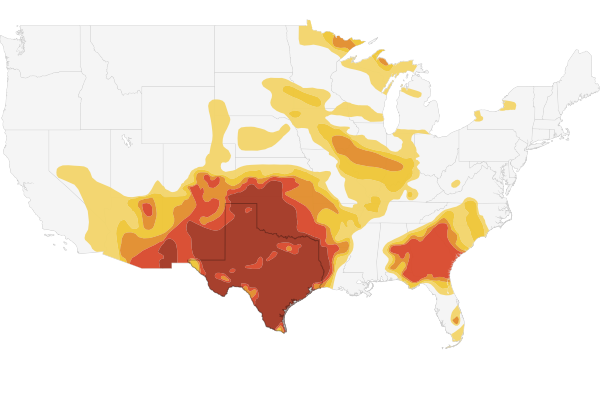
Texas is the worst-hit of several states in a band of severe drought that stretches from Arizona to Florida. More than 90% of the state is suffering from “extreme” or “exceptional” drought conditions, according to the U.S. Drought Monitor.

The “exceptional” category — the most severe — covers 72% of the state, according to figures published Thursday. Only a small patch of northeast Texas, from roughly Fort Worth to the Oklahoma state line, has seen anything close to normal rainfall.

The U.S. Department of Agriculture on Wednesday declared disasters in 213 Texas counties due to the drought. The move comes after a loss of pasture, grain and forage crops of more than 30% in the affected district and opens the door to federal support for farmers.

The Texas agricultural extension service estimates that state farmers have suffered $62 million in losses to fires that includes buildings, crops, livestock — and more than 4,100 miles of fences, which can cost $10,000 per mile to build.

In the West Texas oil towns of Midland and Odessa, water is getting to be as valuable as crude oil. Reservoirs managed by the Colorado River Municipal Water District are running dry, forcing the cities to impose new restrictions on water use.  The district has cut Midland’s water allocation by 20% this year, and the city’s biggest water source, the O.H. Ivie Reservoir, is projected to run dry by December 2012 unless conditions change drastically

Suffering its worst drought in more than 50 years, the Llano River is perilously close to running dry. It is the sole source of drinking water for Llano, just 75 miles north of Austin.  As I drove through the town last weekend, the Llano river was a wide, shallow shining pool on the west side of the bridge where a small dam creates the Llano City Lake, and dry river bed on the east side of the bridge, vividly demonstrating the extend of the drought.  Scattered throughout the town were signs posted showing they had moved to Stage 4 water restrictions, which in Llano means no outdoor watering at all – no lawn sprinklers, landscaping, filling of pools, even washing cars. If conditions don’t improve, Llano will more than likely move to Stage 5 restrictions soon. In Stage 5 restrictions, residential customers are limited to half of their normal water consumption and a surcharge is applied to any over usage.

In April, Gov. Rick Perry called on “Texans of all faiths and traditions” to pray for rain. But the state remains parched.

So, throughout the state, this drought has been taking its toll, but as Stephen Colbert decried on his show last week, banning fireworks on the 4th of July is unpatriotic – after all, there’s nothing more American than losing a finger and setting your neighbor’s yard on fire with one bottle rocket. 

No fireworks withstanding, hope everyone has a safe and happy 4th of July.

Read Full Post »

According to the National Oceanic Atmospheric Administration (NOAA), we’ve already seen eight billion-dollar weather disasters since January!   Before 2011, the most billion-dollar weather disasters recorded in one full year (since 1980) is nine in 2008. This was from a wide variety of weather events including tornadoes, floods, drought, wildfires and three hurricanes.

With half the year and the peak of the hurricane season ahead of us, it’s not out of the question that this undesirable record could be reached in 2011.

From 1980 to 2010 there has been a total of 99 billion-dollar weather disasters.

Use the link below to find out what disasters in 2011 have caused damages of more than a billion dollars. It all started with a colossal winter storm.

2011 billion-dollar weather disasters

Read Full Post »

Bashing Tokyo Electric Power Co. (Tepco), has become a regular habit in Japan over the past three months. While Tepco managers certainly bungled the response to the crisis at the company’s Fukushima Daiichi nuclear plant following the March 11 earthquake and tsunami, Tepco wasn’t operating in a vacuum.  Indications are that failures of corporate governance policies and the regulatory entity’s cozy relationship with industry contributed to the environment that left the Japanese public angered at both the Fukushima Daiichi operators and their government in the wake of the nuclear disaster that befell their country.   Japanese policy makers still are pretending Tepco is simply one bad apple, while ignoring systemic problems and the Japanese public is intent on going after Tepco.

Protests outside TEPCO shareholder meeting

Protests outside TEPCO shareholder meeting

Angry shareholders of Japan’s Tepco slammed the company for its handling of the nation’s worst ever atomic accident after the March quake-tsunami, amid calls for the firm to abandon nuclear power.  Protests were held outside the shareholder meeting on June 28th.

In the meantime, here in the US policy makers are still debating the future of nuclear power while Mother Nature keeps sending gentle reminders of the risks. Flood waters from the Missouri River breeched a damaged berm around Nebraska’s Fort Calhoun reactor  over the weekend inundating the site under several feet of water. Meanwhile, at Los Alamos, the birthplace of the atomic bomb and home to 20,000 barrels of nuclear waste, wildfires are still raging.

But back at Nuclear Regulatory Commission (NRC), Gregory B. Jaczko, chairman of the NRC keeps telling Congress and the media that the probability of a nuclear disaster on U.S. soil similar to Japan’s Fukushima Daiichi meltdown is “very, very small.”  And the rest of the agency falls into line with federal regulators insisting that U.S. nuclear power plants are operating safely while they move forward with 12 applications for new nuclear power plans and five different reactor designs, as well as more and more applications for re-licensing of the 104 aging nuclear plants now operating. 

“At this time the agency considers that the existing emergency preparedness framework and regulations provide reasonable assurance of adequate protection of public health and safety in the event of a radiological  emergency at a US power reactor facility,” Jaczko submitted in written testimony to Congress on June 16.  But the results of a  special inspection of U.S. nuclear plants after the Fukushima disaster in Japan revealed problems with emergency equipment and disaster procedures that are far more pervasive than publicly described by the Nuclear Regulatory Commission. 

The NRC ordered the inspection to conduct a fast check on the equipment and procedures that U.S. plants are required to have in place in the event of a catastrophic natural disaster or a terrorist attack in response to the March earthquake and tsunami that crippled Fukushima’s reactors. 

Agency officials unveiled the results in May, stating  “out of 65 operating reactor sites, 12 had issues with one or more of the requirements during the inspections.”  But an closer examination of the reports from those inspections by ProPublica found that 60 plant sites had deficiencies that ranged from broken machinery, missing equipment and poor training to things like blocked drains or a lack of preventive maintenance. Some of the more serious findings include:

While the deficiencies don’t pose an immediate risk and are relatively easy to fix, critics say they could complicate the response to a major disaster and point to a weakness in NRC oversight.

In a summary attached to the inspection findings even the NRC expressed some concern.

“While individually, none of these observations posed a significant safety issue, they indicate a potential industry trend of failure to maintain equipment and strategies required to mitigate some design and beyond design-basis events,” the summary says.

The special inspection covered equipment and procedures for use in disasters that are beyond the scope of the plant’s design — major earthquakes, tornadoes, floods, hurricanes and terrorist attacks.

The Fukushima accident has focused the NRC’s attention on the risk that a natural disaster or attack could knock out a plant’s safety systems for an extended period and lead to a radiation release.

Although all plants are designed to withstand natural disasters, U.S. nuclear facilities are aging. Recent studies have shown that earthquake risks are actually higher than they were predicted when some plants were built, although the NRC says reactors can still withstand the highest expected quake (but that’s what Japan thought). Now historic flooding on the Missouri River is testing design limits at two Nebraska plants.

So keep this in mind, like the reports coming from Tepco and the Japanese government after the problems started at the Fukushima Daiichi plant, NRC’s jargon-laden communiques freqently reflect what the operator has reported, and do little to shed light on any issues or events occurring at nuclear power plants throughout our country.  When the agency says that America’s 104 operating nuclear power plants are being inspected to deal with power loss or damage that might follow an “extreme” event, keep in mind the NRC’s loosening of standards over the years at the industry’s urging and the other policies put in place because of the agency’s cozy relationship with the industry.  The nuclear industry here in the US is not so different from Japan’s.  Whose heads will we want if there is some catastrophic failure at one of our own plants?

The full report of lessons learned from the Fukushima incident will arrive on July 19. For now, the world’s other 336 other radioactive reactors are also being pushed by the U.N.’s International Atomic Energy Agency (IAEA) to launch a series of national safety tests backed by international inspections.

Read Full Post »

In a series of investigative stories, the Associated Press (AP) has been reporting on the state of the US nuclear industry in the wake of the Fukushima disaster in Japan.  In this recent report, the AP found that as America’s nuclear power plants have aged, the once-rural areas around them have become far more crowded and much more difficult to evacuate.

Even as nuclear plants run at higher power, posing more danger in the event of an accident, populations around the facilities have swelled as much as 4½ times since 1980.  At the same time estimates of evacuation times have not been updated in decades.  Emergency plans would direct residents to flee on antiquated, two-lane roads that clog hopelessly at rush hour. And evacuation zones have remained frozen at a 10-mile radius from each plant since they were set in 1978.

With about 120 million people, almost 40 percent of all Americans, living within 50 miles of a nuclear plant (using 2010 Census data) this scenario smacks of human tragedy, for any nuclear accident in this country.

Click here to read this segment of AP’s investigative study of Nuclear Power in America.

Read Full Post »

Check out this two-minute film from Public Citizen’s Global Trade Watch about the job-killing NAFTA-style Korea trade deal.

[youtube=http://www.youtube.com/watch?v=YMyQ4OR44pg]

Or, if film isn’t your thing, read the script below. It is replete with links to images and underlying documents. And, if this makes you mad, do something about it. Click here to go to our action page.

Script:

It is heartbreaking, but true: After campaigning against more job-killing NAFTA-style trade agreement, President Obama has adopted Bush’s Korea trade deal.

It is opposed by labor, consumer, environmental and family farm organizations. The Chamber of Commerce and multinational corporations love it.

NAFTA with Korea is projected to cost 159,000 more American jobs and increase our trade deficit. Losers under this deal: the jobs of the future; solar and wind energy; mass transit equipment and more.

NAFTA with Korea is celebrated by the Wall Street firms who wrecked our economy. No doubt, it limits financial regulation.

NAFTA with Korea is opposed by many in Korea because of its financial deregulation and because it would allow up to 65% Chinese parts to go into “Korean” exports to the US–killing Korean jobs.

The Korea deal has the outrageous NAFTA-style provisions that empower multinational corporations to skirt our court systems and directly attack our state and federal laws before World Bank and UN tribunals to demand compensation from us taxpayers for any policies they say undermine their future expected profits. Under trade deals, this system has been used to attack toxics bans, forestry and mining laws, land use and zoning rules — even domestic court rulings.

NAFTA with Korea could also undermine our national security. The sanctions we have to keep the North Korea dictatorship from obtaining hard currency to build up its weapons systems would be undermined. A loophole in the deal would deliver billions to the North Korean regime. It allows goods assembled in South Korea but comprised of parts from the notorious Kaesong North Korea sweatshop zone to obtain special access to our market.

We can stop NAFTA with Korea by ensuring a majority in Congress vote against it. Opposition to more NAFTAs is one of the few issues that unite Americans across the political spectrum. You can make the difference visit www.citizen.org/korea to learn how you can take action to stop the Korea Trade Deal.

 
 Follow Lori Wallach on Twitter: www.twitter.com/PCGTW

Read Full Post »

« Newer Posts - Older Posts »