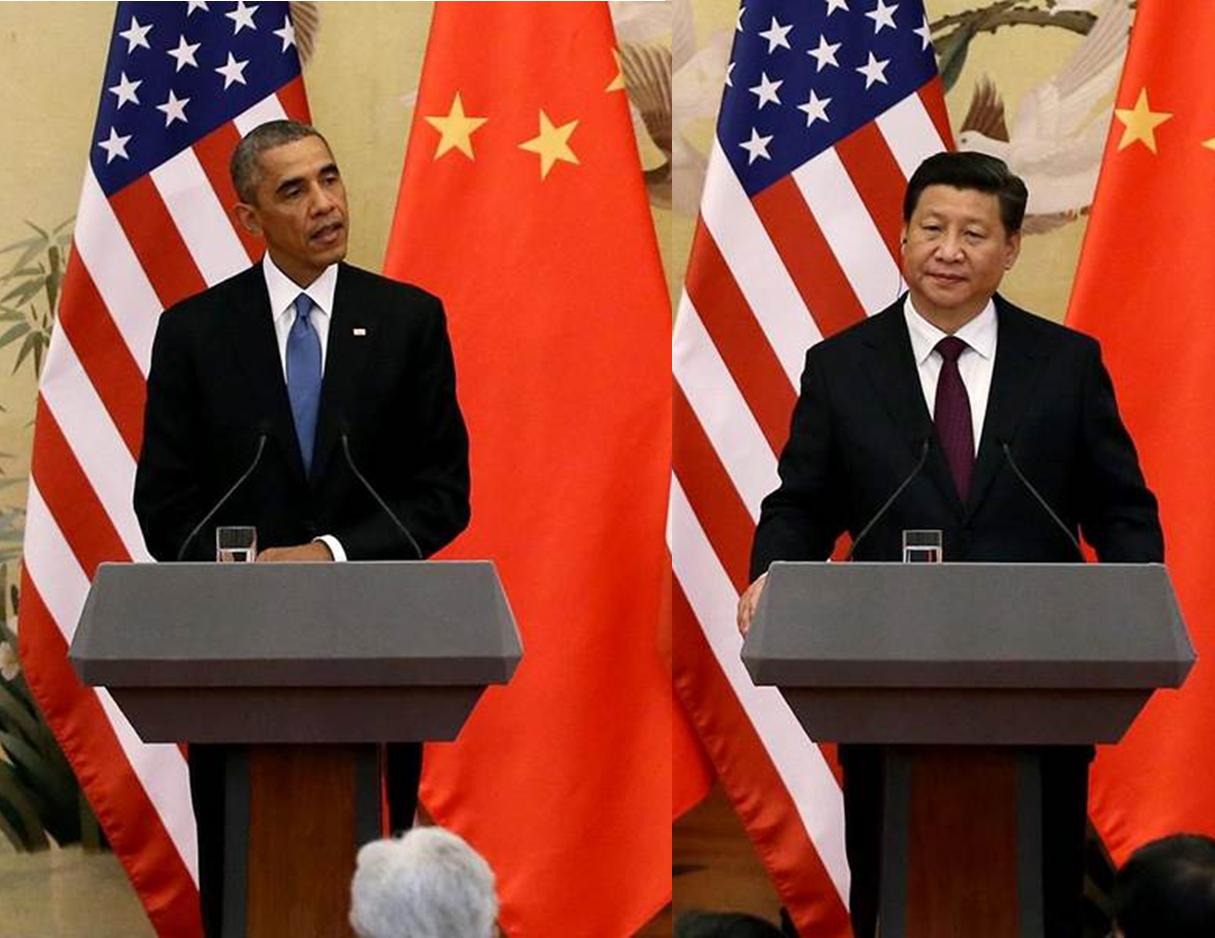
U.S. President Barack Obama and Chinese President Xi Jinping just announced a joint plan to reduce the carbon emissions that threaten our world with catastrophic climate change.
Now we have an opportunity to turn this historic announcement into real action.
Step one is making sure the U.S. Environmental Protection Agency (EPA) knows the American people demand strong limits on climate-disrupting carbon pollution.
The United States and China are the two countries with the highest carbon emissions.
This is the first time China has ever committed to reducing emissions. People worldwide are watching to see what the U.S. and China will do to back up this announcement and aggressively reduce emissions from power plants — the largest source of the carbon pollution that could doom our planet.
Here at home, the EPA’s proposed rule on carbon emissions is not strong enough, but the agency is giving everyday Americans a chance to weigh in before it finalizes the rules.
All eyes are on us. This announcement must be the catalyst for immediate, achievable action to prevent climate catastrophe.
Here’s the good news: Air quality in Houston is improving. 2014 will be the best ozone season in Houston since our city claimed the title of worst air in the nation nearly 20 years ago.
To be sure, this is cause for celebration. Ozone pollution, or smog, is a public health menace, causing everything from childhood asthma attacks to increased hospitalizations, cardiac arrest and premature death. Fewer ozone days mean fewer days when the health of Houstonians — especially our children — is at risk.
But recent improvements in air quality shouldn’t overshadow the work that still needs to be done. The oil and gas industry is using a good ozone season to tout a problematic message: There are no more air pollution problems in Houston, so we should all stop worrying about it.
In fact, we need to tighten federal standards and continue to improve our air quality. The Environmental Protection Agency is expected to do just that in December, but some Texas lawmakers see this as the work of an activist agency intent on killing jobs and crippling our nation’s mighty petrochemical industry. How else to explain recent bills by U.S. Reps. Randy Weber, R-Pearland, and Pete Olson, R-Sugar Land, that would gut the Clean Air Act and undo recent efforts to combat air pollution?
This legislation misunderstands how the Clean Air Act was intended to operate. The federal government sets air pollution standards that are necessary to protect public health. Considerations of cost, feasibility and impact on industry come later, when the states implement the standards.
Naturally, Texas lawmakers defer to the oil and gas industry when implementing federal standards. This may be why Houston has never met an ozone pollution standard. Low ozone this year has more to do with mild temperatures than any recent industry efforts. And one mild year cannot distract from the larger trend of gradually increasing temperatures.
If we can’t count on lower temperatures, we also can’t count on Texas industry to continue reducing pollution emissions. Although there’s been a downward trend over the last several decades, emissions of ozone precursor pollutants in Texas have been flat for the last five years. Additional gains will come only from state lawmakers working with the EPA to meet new standards.
More can and should be done in Texas. As Harris County’s population explodes, so does the number of cars on our roads. President Obama and the federal government have developed new vehicle emissions and fuel standards that will take effect in 2017. The state can do its part by fully funding state programs — like the Texas Emissions Reduction Plan and the Low Income Vehicle Repair and Assistance Program — that replace old, dirty automobiles. Together, these programs have left more than 1 billion unspent taxpayer dollars in state coffers. Texas must put this money to its intended use of reducing air pollution and protecting our health.
This is also not the time for Houston’s industry to bury its head in the sand. Our business leaders must do more than celebrate recent pollution reductions to which they contributed little. Low temperatures won’t protect our health forever. In addition to ozone, particulate matter, sulfur dioxide and hazardous air pollutants also plague Houston. The specter of climate change promises to complicate matters. The Obama administration is doubling down on natural gas and hydraulic fracturing, but recent evidence suggests these won’t provide any climate change benefits over coal.
Only aggressive efforts from industry to reduce air pollution and modernize our nation’s energy infrastructure will sustain our recent air quality gains. So while this year’s low ozone has us at Air Alliance Houston breathing a sigh of relief, we’re mindful of the work that still needs to be done. It’s our responsibility to continue to cut emissions and keep air pollution within federal standards. We must maintain the quality of our air to ensure our quality of life.
graduate from Texas State University, Max has focused his love of film and environmental advocacy on his home state and is currently editing his first documentary film about grassroots resistance in Texas against the southern leg of the Keystone XL pipeline (Gulf Coast Project).
Photo Credit: Tar Sands Blockade
Last month a major pipeline oil spill near Mooringsport, Louisiana sent oil into a tributary of Caddo Lake, which straddles the border between Texas and Louisiana. Despite assurances from officials that oil has not reached Caddo Lake, the findings from an investigation by a community organization contradicts officials’ statements.
Photo Credit: KSLA News
Sunoco Logistics Partners’ Mid-Valley Pipeline ruptured on October 13th and sent thousands of barrels of crude oil onto acres of private property and into Tete Bayou, a waterway that feeds into Caddo Lake. The oil spill prompted the evacuation of three households. Officials say the oil sheen stretches 4.2 miles and stops less than a mile away from the mouth of Caddo Lake, which is the largest natural lake in Texas and a major source of drinking water for thousands that live in the surrounding area.
Sunoco Logistics initially estimated that about 4,000 barrels, or 168,000 gallons, of oil leaked from the 20-inch pipeline, but earlier this week Sunoco revised the amount of oil spilled to 4,500 barrels, or 189,000 gallons. The Mid-Valley Pipeline is 65-years-old and stretches 1,000 miles from Longview, TX to refiners in Ohio and Michigan.
On Monday evening , Sunoco’s spokesperson Jeff Shields put out a statement that doubled-down on the companies position that oil had not reached the lake.
“The US Environmental Protection Agency and Sunoco Logistics today inspected absorbent booms that were placed in Caddo Lake as a protective measure against the spread of oil into the lake. Inspection of the booms by the EPA has found that the absorbent material was stained naturally from lake water but there was no oil in, on or around the booms.”
Photo Credit: Tar Sands Blockade
This statement was a response to allegations by Tar Sands Blockade, an anti-Keystone XL community organization, who visited the area last week and posted photos and video on there website of what appears to be oil stained boom where Tete Bayou feeds into Caddo Lake.
Kathy DaSilva, a member of Tar Sands Blockade, and a colleague canoed to the site last Wednesday to see if Sunoco’s claims about oil not reaching the lake were true, and they were surprised by what they found.
“We paddled in a canoe for 30 minutes to the mouth of Tete Bayou,” said DaSilva. “When we were crossing the lake we didn’t smell oil, but when we got out to cross some boom and walked around in the muck we started smelling it really bad. It was burning our nostrils.”
At the entrance of Caddo Lake, along the tree line, DaSilva documented absorbent booms tied to trees, but she says water was still able to go underneath some of the booms.
Photo Credit: Tar Sands Blockade
“Whether oil is at the top or the bottom, it’s in the lake,” said DaSilva. “The area we were in there were no water bugs, turtles, frogs, nothing. For four hours.”
Sunoco reports that nearly 500 dead animals have been collected. Most of which are fish, reptiles and crawfish. At least 41 animals have been cleaned and released.
“For them to say 500 dead animals, that’s only the one’s they’ve found,” said DaSilva. “The numbers are wildly inaccurate. The animals are not just dying in front of workers.”
One of the main concerns for DaSilva are catfish, because they are bottom feeders and a popular fish among anglers. If oil gets submerged and stuck on the bottom of the lake it could prove deadly for a variety of wildlife. So far, Sunoco has recovered about 3,500 barrels of oil from the bayou, but that number fluctuates because the oil is mixed with water.
The pair also brought a UV light with them that can detect hydrocarbons, DaSilva said, “and we saw bright purplish, blue dots that look like the oil has been broken up. Everything we are seeing is consistent with the use of dispersants.”
Photo Credit: Tar Sands Blockade
I emailed Sunoco’s spokesperson Jeff Shields about whether or not chemical dispersants were used in the clean up process, but he still has yet to reply.
Remediation and restoration of the spill is expected to take months, if not years. Although the majority of the oil has been collected, there’s no doubt that some of the oil has sunk into the mud and crawfish holes, making it extremely difficult to clean.
This is the second major oil spill from the Mid-Valley Pipeline this year alone. A 20,000 gallon oil spill happened near Cincinnati, Ohio earlier this March in a nature preserve. Sunoco is still in the process of remediation for that spill.
Despite the fact that the cause of the spill remains unknown, the Pipeline and Hazardous Material Safety Administration, PHMSA, the federal agency that regulates pipelines, allowed Sunoco to restart the pipeline and resume operation at 80 percent of maximum operating pressure.
For DaSilva, Caddo Lake is special. She has been going there since the 1970’s when she was attending college at Stephen F. Austin University, and she says it is her favorite place to canoe.
“They’ve already restarted the pipeline although they don’t know how it leaked,” said DaSilva. “It’s frustrating because regular people like us shouldn’t have to be doing this. We don’t have an agenda other than not seeing a place we love destroyed.”
Click here to see some of the footage Max shot of the spill.
The Texas Board of Education is scheduled to meet from November 18-21, 2014 to vote on the approval of the textbooks proposed by publishers for Texas schools. These Texas textbooks have drawn national criticism for providing blatantly incorrect information about climate change and environmental issues. This isn’t a first for the Texas Board of Education, which has come into the national spotlight multiple times in the past due to internal disagreements about creationism and the causes of the civil war, among others.
Several of the textbooks say that “scientists disagree on what is causing climate change”. The NCSE responds that, “Scientists do not disagree about what is causing climate change, the vast majority (97% of climate papers and actively publishing climatologists (again 97%) agree that human activity is responsible.”
In one instance the position of the Intergovernmental Panel on Climate Change (IPCC) that climate change is due to human activities is contrasted with the opposing opinion of two employees of The Heartland Institute, neither of whom are scientists, who claim that scientists disagree on the cause. The Heartland Institute is a conservative think tank that denies climate change, is funded in part by the Koch brothers, and is considered a shill for the oil industries.
The IPCC is a highly regarded international science organization that won a Nobel Peace Prize in 2007 “for their efforts to build up and disseminate greater knowledge about man-made climate change, and to lay the foundations for the measures that are needed to counteract such change”. The IPCC recently released a comprehensive report linking climate change to greenhouse gas emissions, saying that it is “extremely likely” that anthropogenic greenhouse gas emissions and other anthropogenic drivers are the dominant cause of the observed warming.
A spokesperson for the textbook company, McGraw-Hill Publishing, said that they were simply fulfilling the state education requirements. The errors stem from curriculum standards set in 2010, meaning that they’re unlikely to be corrected. But we should expect more from our Board of Education.
Fellow Texans, please contact your respective Board of Education member and ask them not to teach Texas children misinformation on climate change, as well as the many other inaccuracies in other issue areas. To get involved, the Texas Freedom Network has a campaign to reform the State Board of Education.
SHALL AN ORDINANCE BE ENACTED PROHIBITING, WITHIN THE CORPORATE LIMITS OF THE CITY OF DENTON, TEXAS, HYDRAULIC FRACTURING, A WELL STIMULATION PROCESS INVOLVING THE USE OF WATER, SAND AND/OR CHEMICAL ADDITIVES PUMPED UNDER HIGH PRESSURE TO FRACTURE SUBSURFACE NON-POROUS ROCK FORMATIONS SUCH AS SHALE TO IMPROVE THE FLOW OF NATURAL GAS, OIL, OR OTHER HYDROCARBONS INTO THE WELL, WITH SUBSEQUENT HIGH RATE, EXTENDED FLOWBACK TO EXPEL FRACTURE FLUIDS AND SOLIDS?
Clearly, the people of Denton were convinced that this is the best way to protect their health, safety and quality of life. The science strongly supports this view. The environmental and health impacts of fracking are numerous, severe and some are long lasting. Releases of toxic pollutants into the air are making people sick in the short term and causing long-term health impacts. Water pollution from fracking operations poses health risks and hardship on people whose water supply is destroyed. Billions of gallons of water are removed from the hydrological cycle when Texas is already struggling to meet its water needs. Ejection wells in some areas are causing earthquakes. On top of all that, methane leakage from fracking, natural gas processing, and transportation of natural gas is contributing to climate change.
There will be legal challenges to the Denton fracking ban, and possibly legislative action to try to roll it back. That’s where the rest of us who care about protecting human health and the environment come in. We can’t leave Denton residents to fight alone. This is not a problem that is unique to them, and it’s one that we all contribute to by using natural gas. Our individual and community decisions are impacting real people in serious ways. Natural gas is not a clean or harmless energy choice. Its use should be minimized as much as possible. That includes moving away from natural gas-fired power plants, not building more of them.
Even if Denton’s fracking ban stands up to legal challenges and avoids legislative destruction, many communities in Texas will continue to suffer the impacts of fracking. Denton has the benefit of being an urban area with a significant student population. The Eagle Ford area, on the other hand, is largely rural and less affluent and residents find themselves powerless against the rampant fracking around them. The community advocates who worked to pass the fracking ban in Denton deserve an incredible amount of credit for their work, as do Denton residents for making the smart decision to protect themselves. Now we must not forget about those left on the front lines of fracking who are less able to organize to protect their health, their land, our shared water resources, and the climate. We need a Sharon Wilson for every fracked community.
This election has broad implications for Texas, regardless of the outcomes. With almost all of the statewide races expected to turn over due to the state’s governor stepping down after 12 years in that office, all of the statewide offices had incumbents and new candidates vying to move up the chain. But some cities also have races and other measures on their ballots that will dramatically change things.
Austin, is moving from a 7 member council (including the mayor) with all members elected at large to a 10 member council with members elected within a geographical district and a mayor elected at large. This means the entire governing body of the City of Austin will be changing after today and their voters are facing a slate of 78 candidates on their ballot.
Update on Denton Fracking Ban measure -in yesterday’s election the ban passed with nearly 60 percent of the vote. The ban’s passage will almost certainly trigger litigation, with energy companies and royalty owners arguing that state drilling regulations trump Denton’s rights and that the city was confiscating mineral rights, which have long been dominant in Texas law.
Just as important is a measure on the Denton ballot. In 2010, Denton citizens got the city to adopt an ordinance that required a minimum of 1,000 feet between a gas well and schools, homes, churches, parks and other “protected” land uses, but just before passing the ordinance, the council added an amendment that allows new homes to be built within 250 feet of land platted for drilling, where companies can re-drill and re-frack existing wells. Since the passage of the ordinance, Denton residents realized that increasing setback requirements wouldn’t be enough and started collecting signatures to force the City Council to vote on a fracking ban which then got kicked to the voters. The referendum required 596 signatures from registered voters—or one-quarter of the number of people who voted in the last local election, nearly 2,000 verified signatures were collected a full month before the deadline. If this measure passes today, Denton will be the first city in Texas to ban fracking. This ballot measure will not only have major implications for the city of Denton is poised to have ripple effects throughout Texas and beyond the state’s borders. This is one to watch.
The chief toxicologist of the Texas Commission on Environmental Quality (TCEQ), Michael Honeycutt, is leading the charge against the Environmental Protection Agency’s (EPA) expected future regulations on smog, also known as ozone. The EPA is expected to lower the acceptable ozone standard from 75 parts per billion to 60 parts per billion by December 1st.
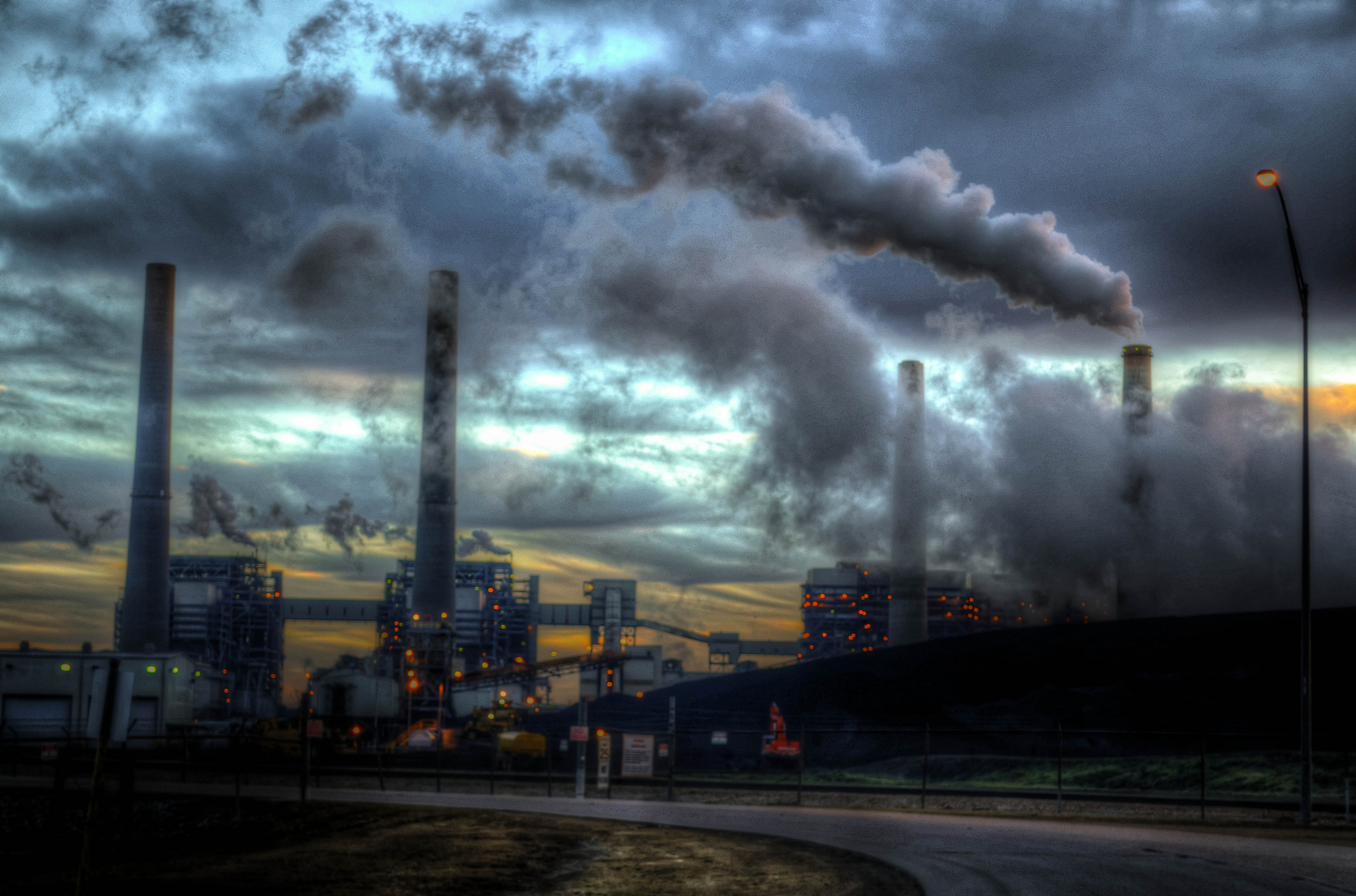
Parish Coal Plant – Photo by Nathan Woodruff
The Clean Air Scientific Advisory Committee (CASAC) Ozone Review Panel consisting of doctors and scientists has unanimously advised the EPA that ozone levels are too high and need to be lowered. Their research shows that ozone is responsible for a variety of health effects: “lung function decrements, pulmonary inflammation, respiratory symptoms, respiratory morbidity and respiratory mortality”. According to the EPA, ozone concentrations aggravate diseases such as asthma, emphysema, chronic bronchitis, and heart disease; ozone is also associated with higher mortality rates, especially in older adults. However, Republicans in Congress and Texas are acting to protect American jobs and job-creators against the EPA’s “agenda”.
Michael Honeycutt, Chief Toxicologist at the TCEQ
In an article arguing against proposed new ozone standards David Honeycutt writes, “after an in-depth review of the EPA’s analysis, as well as a thorough study of the relevant scientific literature, the TCEQ has concluded that there will be little to no public health benefit from lowering the current standard”. Honeycutt explains that because ozone is an outdoor air pollutant and “since most people spend more than 90 percent of their time indoors”, then they are rarely exposed to significant levels of ozone. He claims that “Environmental regulations should be based on sound science. If they are not, then it opens the door for regulations that are based on politics”.
Major Texas cities such as Houston, San Antonio, and Dallas, home to over four and a half million people combined, already have ozone levels above permitted levels. According to the American Lung Association, Houston is 7th in the country for highest ozone levels and Dallas ranks 8th. If the EPA lowers the acceptable ozone standard to 60 parts per billion as proposed, then the cities of Austin and El Paso, with a combined million and a half residents, will also fail to meet federal standards. But the debate concerns more than just federal regulations. Though many Texas cities fail to comply with the current ozone standard, most scientists still think it is too lenient and the public’s health remains at risk at these levels.
That is of course, with the exception of scientists like David Honeycutt of the TCEQ who argues that stricter ozone regulations will provide no substantial health benefits. As he explained, Texans needn’t worry about ozone if we just stay inside.
Around the country, citizens are demanding action on climate change policies. Recently, Florida’s Clean Energy Future — a coalition of clean energy, business, Hispanic, faith, community and academic leaders throughout the Sunshine State –worked across the state to raise awareness about the threat of climate change and to urge elected officials like Governor Rick Scott “to develop a strong plan for Florida to meet the requirements of the EPA’s Clean Power Plan.” And, across the state concerned Floridians have responded. On Monday, that response reached a crescendo when they delivered 92,217 petitions to Governor Rick Scott.
The signatures were delivered to the governor’s office by school children pulling little red wagons filled with boxes of signed petitions and college students and parents — about 30 people in all. Holding signs like “Dirty Power Makes Me Sick,” “Protect Kids,” “Our Health is at Risk!” and “Clean Power Plan Saves Money,” the kids, college and adults made their concerns known and their voices heard on climate change.
Jordan Myatt, a young student from Tallahassee, said: “We’re all citizens and we’re all people, and either way, it’s going to be affecting adults and kids, so I think it’s adults’ and kids’ problem. Global warming caused by pollution is something that is a big problem now and needs to be fixed. We’re just going to keep pushing it and pushing it…We need to stop it now. It’s already the glaciers melting and the sea level rising.”
Adi Chauhan, age 9, of Tallahassee, added: “The weather will be affected too. The summers will get warmer and the winters will get colder, so it’s time to fight against [climate change]…Climate change is happening and it’s real — it’s happening right now.”
Daniel Corbett, a 21-year-old senior majoring in environmental sciences at Florida State University said: “Today’s action, delivering these petitions to our state capitol and legislature made clear to our elected leaders that climate change and energy policy is no longer just an issue for tomorrow. It is an issue for today.” Corbett added: “It doesn’t matter whether you identify as a Republican, a Democrat, an Independent, what faith you follow, where you call home, what language you speak or how much money you make, because climate change, pollution, whether our energy is dirty or clean, that is all of us.”
Susan McLeod, a mother and pharmacist from Tallahassee, said: “We have now over 91,000 signatures from folks all around Florida who also see the effects of climate change in our state. We ask the governor today to jump on board and help Florida to develop a plan to reduce carbon pollution.”
Clearly, the folks, both young and not so young, quoted above “get it” on what the problem is and what needs to be done.
Make your voice heard, tell the EPA that you support a strong Carbon-Cutting Standard – The EPA recently announced the first-ever standard to limit carbon pollution from existing power plants. Add your voice in support of cutting carbon from our largest source of climate change-causing pollution.
A new investigation shows a strong correlation between the fracking boom and a significant increase in fatal crashes in Texas.
Hydraulic fracturing, or fracking, is known for the environmental dangers it poses: obscene water use, groundwater contamination and the release of greenhouse gasses. An equally dark side to the practice has recently been revealing itself.
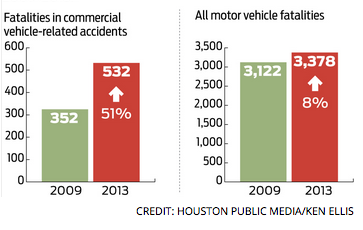
Working together, The Houston Chronicle and Houston Public Media conducted an investigation that found fatalities involving commercial vehicles on Texas roads have increased dramatically since the fracking boom of 2008. In 2009 there were a reported 352 highway fatalities involving commercial vehicles. That number jumped to 532 in 2014; a 51 percent increase.
For decades, Texas’ incidents of auto fatalities were in decline. Improved safety standards, such as seat belts, child seats and airbags made being on the road less deadly. However, Texas saw an 8 percent increase between 2009 and 2013, the same time the fracking boom started. Continue Reading »
EPA Workshop for Communities with Environmental Justice Concerns on Rule to Reduce Carbon Pollution from Existing Power Plants
(online participation available)
October 30, 2014
8:30 am – 5:00 pm ET
7:30 am – 4 pm CT
Crystal Gateway Marriott
1700 Jefferson Davis Highwayz
Arlington, VA 22202
On June 2, 2014, the Environmental Protection Agency issued the proposed Clean Power Plan (CPP) Proposed rule. This rule proposes state-specific goals for reducing carbon dioxide from the power sector; states will then need to make plans to meet the goal. The proposed rule also promotes clean and renewable energy options. This is a federal rule that will have important implications for state air and energy policies. The EPA welcomes stakeholders who have environmental justice concerns to participate and share perspectives about how the rule can be reflective and responsive to the needs of environmentally overburdened, underserved, and economically distressed communities across the country. Most of us cannot travel to Virginia to attend the workshop, but the EPA will make online participation available and registration information is listed below.
If you are interested in learning how you can help your state achieve cleaner air, reduce the impacts of climate change, and promote renewable energy sources, it is important that you understand the Clean Power Plan. You have an opportunity to help shape this rule…come learn how!
We encourage you to take advantage of this 1-day workshop, which will:
Provide an overview of the Clean Power Plan proposed rule.
Prepare participants to engage effectively in the public participation process.
Provide information about the elements of the CPP that are important to communities with environmental justice concerns.
Provide information about how to participate in the public comment process, which is open until December 1, 2014
To register for this event in-person or online via Adobe Connect, click here
Special Notes about Online Participation:
If you plan to participate in this workshop online, you must register in order to receive the information to participate in the workshop
In your registration, you must indicate that you are participating online “via Adobe Connect”
You will receive the information to participate in the workshop by October 29th, 2014
Only a limited number of webinar slots are available (130 slots) if several of you from your community want to participate, we recommend you gather at a single location and register just for your group.
When an elected Republican Texas Court of Criminal Appeals ruled earlier this month that Tom Delay’s flooding of corporate contributions into state elections for the purposes of manipulating Congressional redistricting was “wheeling and dealing (that) was a tad shady, but legal,” it brought to an end an almost decade-long criminal case, but it didn’t end the controversy surrounding the Former Majority Leader.
Prosecutors claimed the ruling undermines the fairness and integrity of Texas elections, while Delay said the verdict gives him fresh impetus to run for elected office again. An October 28th national online screening of the only documentary made about the Delay case will allow viewers to look at the original evidence and make up their own minds.
Filmmakers Mark Birnbaum and Jim Schermbeck are using the court decision to team-up with online screening room 2ndLine.tv to host an October 28th live internet screening of the “The Big Buy,” their 2006 investigation of the scandal that forced Delay to resign from Congress. Viewers will be able to vote via a Google Docs link on whether they think Delay knowingly broke Texas law when his Political Action Committee solicited corporate donations for Republicans running in state House races. Continue Reading »
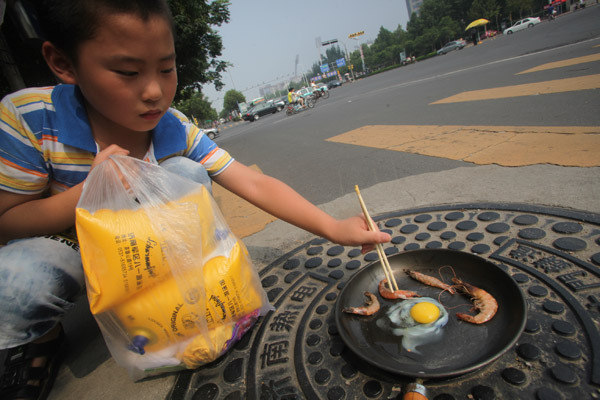
Earth is now on pace to tie for the hottest year ever recorded. The first nine months of 2014 have a global average temperature of 58.72 degrees, tying with 1998 for the warmest first nine months on record, according to NOAA’s National Climatic Data Center in Asheville, N.C. Last month the globe averaged 60.3 degrees Fahrenheit making September the hottest in 135 years of record keeping and the fourth monthly record set this year,that includes May, June and August.
So we are on track for 2014 to break the record for hottest year. Earth hasn’t set a monthly record for cold since December 1916, but all monthly heat records (and there have been a few) have been set after 1997.
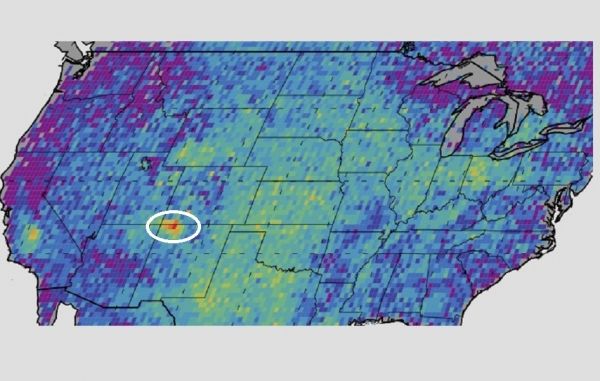
NASA and University of Michigan scientists have discovered a massive cloud of methane that spans 2500 square miles (about the size of Delaware) located above the the Four Corners intersection of Arizona, Colorado, New Mexico, and Utah.
The atmospheric methane concentration of methane in that area is equivalent to 1.3 million pounds of emissions a year, which is 80% higher than EPA estimates. This is the largest concentration of methane in the United States. It was so large in fact that scientists “weren’t sure if it was a true signal or an instrument error,” but they recently verified the levels of methane in the affected area.
Eric Kort of the University of Michigan, Ann Arbor attributed the dramatic methane emissions to leaks in natural gas production and processing equipment in New Mexico’s San Juan Basin. The San Juan Basin is the most active coalbed methane production area in the US. The coalbed methane covers the pores and cracks in coal. As this methane seeps out from underground coal mines, it causes fatal explosions almost yearly.
While the methane concentrations in that area are not an immediate health risk to the local inhabitants, it has significant implications for climate change. As a greenhouse gas, methane is 86 times more potent in its atmospheric effect than carbon dioxide in the first two decades after release. 25% of human-induced global warming is caused by methane emissions in the environment.
As the U.S. considers transitioning from coal to natural gas as a means of reducing greenhouse gas emissions, it is critical that accurate assessments of leaking methane are accounted for in all calculations. If leakage of natural gas isn’t greatly reduced, switching fuels may make little or no difference in combating climate change. This methane hot spot should serve as a warning that other undiscovered leaks are probably out there and having a significant impact.
Australia experienced record-breaking temperatures and many other countries are experiencing uncharacteristically intense heat waves. Whether or not these events are related to climate change has been questioned in the past, but has recently come to light as something that is very probable.
Recently, researchers and scientists come up with the phrase “extreme event attribution” which acts as a unit of measure for the extent to which these weather events are human-caused. For instance, according to extreme event attribution, the heat wave in Korea was 10 times more likely due to human caused climate change. Scientists want extreme event attribution to be in real-time by the end of 2015.
The American Meteorological Society recently released a bulletin based off of 22 case studies. It concluded saying that high temperatures made heat waves more intense and more likely and that the emission of greenhouse gases is causing these extreme weather events. Recent heatwaves in Australia, Korea, Japan, China, and Western Europe are all judged to be due to climate change. The National Climate Assessment also made a connection between climate change and the drought in Australia.
The impact of climate change seems clear, with China experiencing its biggest heat wave in 140 years August of 2013, during which at least 40 people died. Health effects of heat waves range from heat strokes to aggravated chronic diseases. The heat also increases ground-level ozone levels, causing lung injury and increasing the severity of respiratory diseases. Continue Reading »
Texas Tribune will present a daylong symposium, in partnership with the University of Texas at San Antonio, on the impact of the shale boom in Texas. Topics of discussion will include the transformation of the state economy, the energy sector, and physical and social infrastructure in cities and counties across Texas.
8 a.m. – 2:30 p.m.
Various panel times. Schedule to be announced soon.
Confirmed panelists include
State Sen. JUDITH ZAFFIRINI, D-Laredo;
State Sen. CARLOS URESTI, D-San Antonio;
State Rep. JIM KEFFER, R-Eastland;
State Rep. MIKE VILLARREAL, D-San Antonio;
State Rep. MYRA CROWNOVER, R-Denton;
State Rep. PONCHO NEVÁREZ, D-Eagle Pass;
State Rep. JOSÉ MENÉNDEZ, D-San Antonio;
DAVID PORTER, Texas railroad commissioner;
IVY TAYLOR, mayor of San Antonio;
JERRY MORALES, mayor of Midland;
BEN SHEPPERD, president of the Permian Basin Petroleum Association;
LEODORO MARTINEZ, executive director of Middle Rio Grande Development;
SHERYL LYNN ROBERTS, research economist for the Center for Community and Business Research at the University of Texas at San Antonio;
OMAR GARCIA, president of the South Texas Energy & Economic Roundtable;
THOMAS TUNSTALL, research director for the Institute for Economic Development at the University of Texas at San Antonio;
DON TYMRAK, city manager of Karnes City;
JOEL RODRIGUEZ, LaSalle County judge;
DARYL FOWLER, DeWitt County judge; and
Sister ELIZABETH RIEBSCHLAEGER, environmental advocate.
ABOUT THIS EVENT
The day-long symposium will be held at the UTSA Downtown Campus in the Buena Vista Theatre (BV 1.326). Complimentary parking for attendees will be available in UTSA’s Lot D3. A light breakfast and lunch will be provided. The event is free and open to the public.
UTSA Downtown Campus
501 César E. Chávez Boulevard, San Antonio, TX 78207 (map)
This event is generously sponsored by UTSA, CPS Energy, Blue Cross and Blue Shield of Texas, The University of Texas at Austin, Permian Basin Petroleum Association, Texas A&M University and Methodist Healthcare Ministries of South Texas.