Feeds:
Posts
Comments

Archive for April, 2009

Greg Harman at the San Antonio Current broke this story a few days back and I just feel like we have to comment:

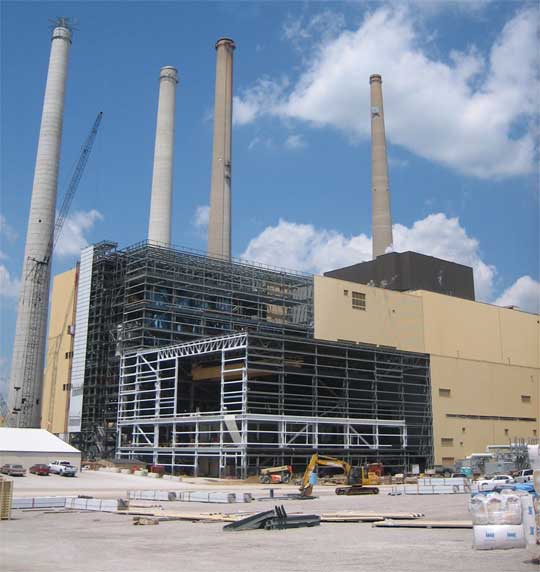
As Washington strains under the weight of industry and environmental lobbyists seeking to influence the outcome of what would be our first national climate bill, CPS Energy has been quietly working the angles on Capitol Hill to keep the coal power the city has come to rely on cheap for consumers in the short term. So-called “cheap” power is the mandate the utility operates under, after all.

Too bad that mandate is now at odds with the survival of the earth as we know it and, quite possibly, our survival as a city and a nation.

Responding to an Open Records request submitted by the Current, a CPS Energy legal staffer wrote that the City-owned utility has spent $91,700 lobbying in the past year “in the attempt to influence U.S. climate policy.”

According to Zandra Pulis, senior legal counsel at CPS, the utility has also spent about $67,657 in membership dues to the Climate Policy Group, an industry group it joined in September of 2006 that lobbies Congress against limiting carbon emissions under cap-and-trade legislation. An effort that, to this point, has been remarkably successful.

All told, CPS has spent $2.56 million on lobbyists (since 1999) working the statehouse and the Capitol, according to Pulis.

That’s right — CPS has spent millions of YOUR dollars on lobbying, much of which has gone to try to argue climate change isn’t happening.

Look, I understand that CPS has a mission to produce inexpensive electricity for San Antonio residents and business.  That’s a good thing.  But the facts are these:

1- Climate change is happening.  But even if it wasn’t, everything we need to do to solve it is something that we would want to be to doing anyway.  We need to start living with the fact that political consensus has developed in Washington.  Sooner or later, we’re going to have to  start paying for our greenhouse gas pollution, so we’d better start figuring out how to get our energy from non-polluting sources. (more…)
Read Full Post »

Original post found on the Coal Block blog.

white-stallionThis past Monday there was a public meeting to give the local community a chance to voice their opinion about the proposed White Stallion Power Plant near Bay City, Texas. The plant would be approximately a mile south of Bay City off of FM 2668, and construction is scheduled to begin next year.

At the meeting the people of the community took advantage of the opportunity to stand up in opposition to the plant.

“The vast majority of questions and comments were stressing concern about emissions from the plant and the effect it will have on the health of the people, the environment and the wildlife of Matagorda County,” said Public Citizen”s own Ryan Rittenhouse. “Many of the closest folks living near the proposed site were there and all were very concerned at the prospect of the plant.”
The health hazards resulting from burning coal are staggering.

“Old, coal-fired power plants are among the biggest industrial contributors to unhealthful air, especially particle pollution in the eastern United States,” said the American Lung Association’s State of the Air 2007 report. “The toll of death, disease and environmental destruction caused by coal-fired power plant pollution continues to mount.”

As of now, nothing will be addressed in regards to the CO2 emissions of the White Stallion plant, which was a top priority of all the opposition at the meeting. The plant would emit approximately 10 million tons of CO2, about 100 pounds of mercury, and about 5,000 tons of sulfur dioxide every year. This undoubtedly would move Matagorda County and Bay City closer to federal air quality non-attainment status, and contribute to the already high levels of mercury in the Gulf Coast region.

Unfortunately though, those concerns were not able to be addressed as thoroughly as we are accustomed to in these public meetings. The questioning was cut short before everyone in the meeting had a chance to have their questions answered. A number of people who gave comments during the official comment period remarked on this and expressed displeasure at not being allowed to ask all their questions.

A request was made by Public Citizen to have another public meeting so that everyone’s questions could be answered. There is no indication as to whether or not this request will be granted.

Read Full Post »

President Obama has voiced that two of his top priorities will be climate change and energy.  Earlier this month he picture-5announced an energy plan that would call for 14% reduction in emissions from the 2005 levels by 2020, and an 83% reduction by 2050.

But House Democrats Henry a. Waxman (California) and Edward J. Markey (Massachussettes) want more!  They drafted a bill with even more gusto to capture greenhouse gases—a 20% reduction in emissions by 2020!

Remember that this power team was also responsible for the bill to put a moratorium on coal plants introduced a year ago.   The new Waxman-Markey bill will require every region of the country to produce 25% from renewable sources such as wind, solar, and geothermal.  This could be a huge factor to increase the demand for sustainable energy to spur wide-range development and adoption of energy technology.

Mr. Waxman, the chairman of the Energy and Commerce committee said regarding his bill:

This legislation will create millions of clean energy jobs, put America on the path to energy independence, and cut global warming pollution.  Our goal is to strengthen our economy by making America the world leader in new clean energy and energy efficiency technologies.

However, the bill also makes some concessions to the states whose economy rests upon coal and energy-related industries, with the hope that it will smooth the transition to cleaner forms of energy.   To read more, check out this press release from Tyson Slocum at our D.C. office.

EDITOR’S NOTE: This bill is a really great start.  Obama started the bid at a 14% cut, the House upped the ante to 20%, but according to the Nobel-prize winning Intergovernmental Panel on Climate Change, the real target we should be shooting for is about 35%.  Unfortunately, none of the bills in the House or Senate is shooting for this target.  The good news is, according to an analysis by McKinsey and Company, almost all of that 35% can be achieved at a net cost savings through things like energy efficiency.  And realistically, that’s only 3.5% per year for the next decade. ~~Citizen Andy

Read Full Post »

« Newer Posts
