Feeds:
Posts
Comments

So far, there are nine candidates for the PUC Commission position that was vacated by PUC Chair, Barry Smitherman, when he resigned after being appointed by Governor Perry to the Texas Railroad Commission.   Included in the slate of candidates are attorneys, elected officials, and civil engineer.

The Public Utility Commission of Texas regulates the state’s electric and telecommunication utilities, implements respective legislation, and offers customer assistance in resolving consumer complaints.

Since the introduction of competition in both the local and long distance telecommunications markets and the wholesale and retail electric markets, the PUC has also played an important role in overseeing the transition to competition and ensuring that customers receive the intended benefits of competition.

The most recent person to throw their hat into the ring is Douglas Carter Davis, a senior policy adviser on redistricting to Lt. Gov. David Dewhurst and a former employee of Gov. Rick Perry.“I believe that my familiarity with the Governor’s philosophy makes me a unique candidate for appointment,” Davis wrote in expressing his interest in either being named a commissioner at the PUC or the Texas Commission on Environmental Quality.  His references include Dewhurst, Texas Agriculture Commissioner Todd Staples, and Sens. Kel Seliger (R-Amarillo) and Tommy Williams (R-The Woodlands)

Douglas Carter Davis

Attorney John Mark McWatters serves on the U.S. Senate’s congressional oversight panel for the $700 billion Troubled Asset Relief Program.  His wife is a vice president and general counsel at Holly Corp. and Holly Energy Partners LP.  His references include U.S. Rep. Jeb Hensarling and former Securities and Exchange Commissioner Paul Atkins.
Evin Lee Caraway III, is president and CEO of Worth Casualty Co., holds a law degree from Texas Tech University and has been named a “Super Lawyer” by Texas Monthlysix times.  His references include Todd Staples and former PUC Chair, Barry Smitherman.

E.L. Caraway

Candidate, attorney Kenneth Bruce Florence Jr. of Center lists among his accomplishments that he a member of the genius society called MENSA, has a pilot’s license and has practiced law in Kenai, Alaska.
Nelson Humberto Balido, president of the tri-national Border Trade Alliance, says he’s happy to fill a post “anywhere the Governor needs me!” Anywhere the Governor might need him included Secretary of State, Transportation Commission and Texas Tech Board of Regents.

Nelson Humberto Balido

Leander Mayor John D. Cowman, a  real estate broker, confessed to being delinquent on his federal taxes in 2006 but also noted that he began mowing yards at age 10 and grew up in California where he enjoyed surfing and playing baseball. His references include U.S. Rep. John Carter and state Rep. John Schwertner, both Republicans from Georgetown.According to the Leander Ledger, the Mayor is is currently under an investigation by Texas Rangers following a complaint filed with the district attorney for allegations of misconduct and corruption of a city official.

John D. Cowman

Sugar Land City Councilwoman Jacqueline Baly Chaumette, who previously was appointed a director of the Brazos River Authority by Perry.

Jacqueline Baly Chaumette

Comal County Commissioner Gregory Parker who authored a book entitled “Global Warming. . . Really?” (obviously a climate change denier, a trait Governor Perry has rewarded handsomely in the past) and speaks frequently about energy issues to Republican and Tea Party organizations.

Gregory Parker

And finally, J. Paul Oxer, a civil engineer and managing director of McDaniel, Hunter & Price, Inc., said he once participated in class action lawsuits against his former employer, Enron, seeking benefits and severance pay. He was also a high school valedictorian who pleaded no contest in 1973 in DeKalb, Ga., to a misdemeanor charge of theft by taking. He noted that his probation included no fine and no reporting requirement.He wrote about this charge on his application that, “Even though it occurred more than 37 years ago, I’m including this information in the interests of completeness and integrity in answering all questions,”

J. Paul Oxer

The information here was gleaned by the Texas Energy Report from 91 pages of records released to them by Perry’s office under the Texas Public Information Act.

Obviously we don’t have the entire file on these folks, but given the important mission the PUC plays in Texas and the little bit of information provided by the Texas Energy Report’s review of the candidate records, we are interested in who you might choose for PUC Commissioner if you were Governor.

[polldaddy poll=5434660]

The Nuclear Regulatory Commission is seeking public comment on proposed revisions to its policy statement on volume reduction of low-level radioactive waste (LLRW).

The proposed revisions would urge licensees to minimize the volume of waste they produce since such a focus will extend the operational lifetime of the existing commercial low-level disposal sites and reduce the number of waste shipments.

The revised policy statement, however, would also recognize that volume reduction is only one aspect of an effective program for managing radioactive waste.
According to the draft policy statement, licensees should consider all means available to manage waste in a manner that is secure, and protects public health and safety. Such means include waste minimization; short-term storage and decay; long-term storage; use of the alternative disposal provision in NRC regulations at 10 CFR 20.2002; use of waste processing technologies; and use of licensed disposal facilities.

About 96 percent of all LLRW is generated by nuclear power plants. The remainder is generated by fuel cycle facilities such as uranium enrichment plants, and materials licensees such as hospitals, research institutes and universities.

Public comments will be accepted through Sept. 14. They may be submitted through the federal government’s rulemaking website at www.regulations.gov, using Docket ID NRC-2011-0183; or by mail to Cindy Bladey, Chief, Rules Announcements, and Directives Branch (RADB), Office of Administration, Mail Stop TWB-05-B01M, U.S. Nuclear Regulatory Commission, Washington, DC 20555-0001.

It is looking like the 2012 election will be dominated by the Super PAC.  If you thought your voice counted for little before, check out this MSNBC story on the new powerhouse super PAC called “Make Us Great Again” which, while claiming it is independent, just launched a website filled with photos of Rick Perry and campaign bullet points about the governor’s record creating jobs and lowering taxes in Texas.  No mention about slashing public education funding or what types of jobs were created in the state.


A licensing hearing for South Texas Project reactors begins today in Austin, Texas.

The hearing is on the application to expand the South Texas Nuclear plant and raises key issues, especially in light of the explosions, fires and meltdowns at Fukushima.

An Atomic Safety and Licensing Board (ASLB) panel–an independent body within the Nuclear Regulatory Commission (NRC)–will hear oral arguments and conduct an evidentiary hearing beginning at 9:30 a.m. in Room 2210, Building F at the Texas Commission on Environmental Quality (TCEQ), 12100 Park 35 Circle in Austin. On the 18th and 19th the hearing will continue in Building E, Room 201 S at TCEQ.

The public is invited to the hearing, but participation is limited to the parties admitted to the proceeding: the Sustainable Energy and Economic Development (SEED) Coalition, the South Texas Association for Responsible Energy, Public Citizen, the applicant, NINA, and NRC staff.

the Sustainable Energy and Economic Development (SEED) Coalition, the South Texas Association for Responsible Energy and Public Citizen will raise the issue of whether it is possible to control multiple reactors after a fire or explosion at one of the units, and question the need for more reactors since new federal energy efficiency laws are in place.

Another major issue the groups hope to raise is the applicant (Nuclear Innovation North America – NINA) doesn’t meet federal requirements prohibiting foreign ownership, control or domination of a U.S. nuclear facility.

The South Texas Project expansion has been hurting for investors.  TEPCO, the owner of the ill-fated Fukushima reactors, will no longer invest in the reactors. Austin Energy has chosen not to invest and City Public Service in San Antonio has reduced its 50% interest to only 7%.  Even NRG, the major force behind the reactor project, is no longer investing.   The nuclear license is still being sought by NINA- a partnership of NRG Energy and Toshiba – but only Toshiba is an investing partner at this time and it is also a foreign company.  Opponents have called for a halt to licensing, especially since a license could be sold in the future.

“Fukushima shows just how dangerous it is to have a lot of reactors in one location. We will raise safety concerns about locating so many nuclear reactors close together,” said Karen Hadden, SEED Coalition’s Executive Director. “We’re raising concerns about the legality of foreign ownership of the proposed reactors.”

“Texas doesn’t need or want more nuclear power,” said Tom “Smitty” Smith of Public Citizen’s Texas office. “We have safer, cleaner and more affordable energy options available today. New federal building codes and appliance standards will improve efficiency, making the two additional nuclear plants unnecessary. San Antonio’s reduced nuclear project share is being replaced through energy efficiency, wind and solar power and natural gas.”

Background

The South Texas Project COL application was submitted to the NRC on Sept. 20, 2007, the first such application in the United States in nearly 30 years. The license would allow construction and operation of South Texas Project reactors 3 & 4 at the existing Bay City, Texas site.

Over the past four years, the proposed nuclear project has experienced:

  • Cost estimates that have skyrocketed from $5.6 billion to over $18 billion.
  • A major pull-back by NRG’s partner, San Antonio’s CPS Energy, from a 50% stake down to 7%, which left a huge investor gap.
  • NRG Energy and TEPCO will no longer invest in the project. Previously anticipated loan guarantees from Japan now appear unlikely. Despite the lack of further investment, NINA  continues to seek a license for the proposed reactors. NRG will give Toshiba $20 million for this purpose.

Individuals or groups not admitted to the proceeding can submit “written limited appearance statements” to the ASLB. Anyone wishing to submit a written statement can email hearingdocket@nrc.gov, or fax to (301) 415-1101, or send mail to: Office of the Secretary, Attn. Rulemaking and Adjudications Staff, U.S. Nuclear Regulatory Commission, Washington, DC 20555-0001. In addition, copies of written statements should be sent to  Michael.Gibson@nrc.gov and Jonathan.Eser@nrc.gov; by fax to (301-415-5599), or by mail to: Administrative Judge Michael M. Gibson, Atomic Safety and Licensing Board Panel, Mail Stop: T-3F23, U.S. Nuclear Regulatory Commission, Washington, DC 20555-0001.

Documents related to the South Texas Project COL application are available on the NRC website. Documents pertaining to the ASLB proceeding are available in the agency’s electronic hearing docket. NOTE: Anyone wishing to take photos or use a camera to record the hearing should contact the NRC Office of Public Affairs beforehand.

Houston hit 100 degrees Fahrenheit yesterday for the 15th consecutive day in a row breaking that city’s previous record of 14 consecutive days of 100+ degree heat set in July of 1980. For the year, Houston has seen a total of twenty-six 100-degree days. On average, the city usually only sees around 5 days with 100-degree heat per year.

While the Houston streak continues, several 100-degree streaks have been snapped in the last few days throughout Texas.

Austin ended a streak of 27 consecutive days with 100-degree heat this past Saturday.  Dallas, Texas ended a run of 40 days with 100-degree heat last Thursday.

But Wichita Falls, Texas had the longest streak of 52 consecutive days with 100-degree heat that ended this past Saturday.  However the temperatures immediately went back up over 100 degrees and  their extended 10 day forecast has them well above 100 degrees going into the weekend of Wichita Falls’ 30th annual Hotter”N Hell 100 mile bike ride (HHH).  This insane biking event, that draws from 8,000 to 10,000 participants from around the country to ride in bike routes up to 100 miles long, has been run before on days that made it into the 100s, but this year the race is in the midst of a record breaking heat wave.

According to Larry Magruder, MD and the 1998 Medical Director for HHH, out of over 120,000 riders only six deaths have occurred in the 29 year race history.  And because high temperatures are part and parcel of this particular bike race, the organizers are well prepared to deal with heat related medical problems with more than 800 local medical personnel volunteering their time to the Hotter’N Hell Hundred. Doctors, nurses, physical therapists, hospital workers, American Red Cross volunteers and staff, and others associated with the medical field work  to assure that no one is ever more than 5 miles from professional medical attention.

These folks are both knowledgeable and well prepared to deal with heat related medical issues, but if you are participating in extensive physical activity in this Texas heat, that is not being monitored and supported by medical professionals, you should learn how to prepare for extreme heat and learn the symptoms and treatments of heat related illnesses.  Click here to go to the Center for Disease Control’s extreme heat emergency preparedness and response page.

Seal of the United States Department of Energy.

Image via Wikipedia

Public Citizen today urged a U.S. Department of Energy (DOE) task force to prioritize the safety of water resources at contamination risk from hydraulic fracturing. Among the solutions Public Citizen proposed is repeal of the various exemptions the natural gas industry has received from federal environmental laws; the denial of drilling companies’ “proprietary” right to keep secret the identity of toxic materials they inject underground and an emphasis on improved outreach to affected communities.

The DOE’s Natural Gas Subcommittee should enact procedures to prevent water contamination around abandoned fracking wells, which has happened as fracking fluid and other contaminants have seeped into the groundwater. The public needs to be protected from chemically compromised water.

Just as worrisome, the hydraulic fracturing industry is exempted from elements of the Safe Drinking Water Act and the Clean Water Act. The subcommittee should persuade Congress to repeal these special exemptions, which limit the federal government’s ability to ensure that protection of water resources is prioritized.

The subcommittee also should make every effort to include the input of the people whose lives will be affected by fracking policies, instead of holding 75 percent of the public meetings in Washington, D.C. The public needs a voice in policies that will have an enormous impact on their homes, their water and their safety.

The DOE subcommittee and Congress should work together to ensure the health and safety of the public and the environment.

To read the comments sent to the DOE, visit: http://www.citizen.org/documents/DOEfrackingComments8.15.2011.pdf.

This is a reprint of a Statement from Tyson Slocum, Director, Public Citizen’s Energy Program

So after years of diminishing water supplies made even worse by the second-most severe drought in state history, some West Texas communities are resorting to a plan to turn sewage into drinking water.

A water-reclamation plant believed to be the first in Texas will supply Big Spring, Midland, Odessa and Stanton and is currently under construction.

Officials have been working to dispel any fears people have that they will soon be drinking their neighbors’ urine.  They are promising the system will yield clean, safe water.

Similar plants have been operating for years in Tucson, Ariz., parts of California and in other countries. Water experts predict other American cities will follow suit as they confront growing populations, drought and other issues.

The Colorado River Municipal Water District in West Texas began considering a wastewater recycling plant back in 2000 and broke ground last month on the facility in Big Spring, about 100 miles southeast of Lubbock. When finished, it should supply 2 million gallons of water a day.

This year’s drought has made this dry region even drier, wreaking havoc on crops, ranch animals, wildlife and fish in the region.  At least one of the three reservoirs in West Texas may dry up if the drought persists through next year, as climatologists have predicted could happen, causing the district’s water supply to be reduced from 65 million gallons a day to 45 million.

The idea to recycle sewage isn’t new. Fort Worth and other cities across the nation have long used treated wastewater to water grass and trees and irrigate crops.

And you can be sure the proposed Tenaska coal plant in Abilene is hoping to cash in on that water after having been turned down by the city of Abilene.  However, after this year, this region might be reluctant to commit to providing that much water even if it is reclaimed from sewage.  Because power plants suck . . . lots and lots of water and they tend to get to do so before crops, livestock and even people.

 The Day When $$$$ Equals Speech

The American public has become increasingly frustrated and angry about the corporate corruption of Congress. With the influence over politics wielded by wealthy corporate interests through their political spending, even modest efforts to curb pollution, ensure clean water and safe food, secure our financial system and more are stymied.

The deluge of more than $30 million spent by outsiders in this week’s Wisconsin recall elections and the sudden appearance and subsequent dissolution of a corporation that gave $1 million to a political action committee backing GOP presidential candidate Mitt Romney are only the latest examples of the stunning sums of money flooding our current campaign finance landscape. The growing influence of corporate interests comes from the U.S. Supreme Court’s ruling in Citizens United v. Federal Election Commission, which gave corporations the “free speech” right to spend unlimited money to influence elections.

In response, a diverse group of more than a dozen organizations are participating today in “The Day When $$$$ Equals Speech.” Instead of words, participants are posting  a string of dollar signs on Twitter, Facebook, Google+ and other social media networks in a vow to reclaim democracy, as seen in this sample tweet:

$$$$$$$$$$$$$$$$$$$$$$$$$$$$$$$$ http://bit.ly/DollarsOrDemocracy #WeThePeople will #reclaim

Participating groups include the Center for Biological Diversity, Campus Progress, the Center for Media and Democracy, Coffee Party USA, Common Cause, Demos, Greenpeace, the Hip Hop Caucus, Move to Amend, North Carolina Center for Voter Education, People for the American Way, Public Campaign, Public Citizen, The Story of Stuff Project, USAction, the We the People Campaign and The Young Turks.

“As corporations increasingly exert their influence over the political process, those of us without millions of dollars to spend on political campaigns are effectively silenced,” said Rick Claypool, online organizer for Public Citizen’s Congress Watch division. “It is as if we have to speak through a kazoo while corporate CEOs speak through megaphones.”

The Website,  www.DollarsOrDemocracy.org,  encourages others to join the online protest and explains the impact of the Citizens United decision.

Corporations flooded the November 2010 midterm elections with a record amount of money. It is predicted that the 2012 presidential elections will see even more corporate money and will cost $7 billion.  We need to stand up now against this ‘$ as speech’ trend that is taking over our government.

At the height of the energy crisis last week, Public Citizen’s Texas director, Tom “Smitty” Smith, told the Austin Chronicle, “Austin Energy was one of the first cities in the United States to really aggressively try to do this kind of load management, and days like this show how effective it is in preventing blackouts,” Smith continued. “It’s working, and it’s demonstrably cheaper than burning coal or gas to make electricity.”

To read the story discussing weather crisis and energy in the Texas deregulated market, click here to go to the Austin Chronicle’s story.

Pearl Brewery San Antonio

Pearl Brewery, San Antonio - home of one of the largest solar roofs in the region

We’re in the midst of a heat wave and drought that are on record to be Texas’ worst in recorded history. (and now imagine if global warming actually kicked in, the way all those scientists say! *wink*)

But we have a few options. Cope, adapt, or conquer. I much prefer the last solution to the first.

First, we can cope. Rep. Joe Barton from here in Texas once famously said in a Congressional hearing that his constituents don’t have to worry about global warming- they’ll just find some shade. Well, we can do that. We can also do what is more likely which is just go sit in our homes and offices and blast the air conditioning as much as we can to make these ever-warming, record-breaking hot, dry summers as tolerable as possible.

The only problem is, all that electricity comes from somewhere. And with record-breaking demand on the ERCOT grid, they have been warning Texans to conserve or risk rolling blackouts. And while blasting the a/c may seem like an affordable luxury for the people who live in the McMansions of West Austin, I don’t know about the rest of you, but most Texas families can’t afford the huge energy bills that would be associated with just setting the thermostat at 70 and letting it go.

We can already see what coping is getting us.

Continue Reading »

According to a new report by Texans for Public Justice (TPJ), a record 1,302 active Texas political action committees (PACs) spent $133 million in the two-year 2010 election cycle, a 12 percent increase from the 2008 cycle.  Over the past decade Texas PACs increased their spending nearly three-fold and the number of active PACs grew by 50%.

Check out TPJ’s latest in-depth analysis of PAC activity – Texas PACs: 2010 Cycle Spending – available at TPJ.ORG.

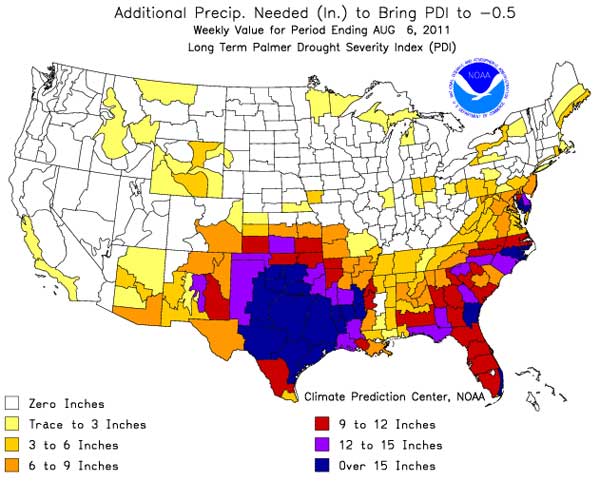
Texas is suffering from an historic drought and one question that looms large is – how much rain will we need to actually end the drought?  And the answer is –  A LOT!

The National Oceanic and Atmospheric Administration (NOAA) indicates 12 to 15+ inches of rain (shades of purple and dark blue) is necessary for most of Texas to end the drought, as shown in the graphic below.

Even those small parts of the state not needing those massive amounts of rainfall to end this drought will require six to twelve inches of rain to recover.  With the Climate Prediction Center now saying there is a 50/50 chance of a return to La Nina conditions this fall which almost always results in drier than normal conditions for Texas and most of the South, the potential for recovery any time soon is pretty slim.

It has taken months for the drought to get to the level it is at now and it will take months or even years to return to normal.  But all indications are that there is no major relief coming soon and if you haven’t already done so, consider taking measures to reduce your water and electricity use for the long haul.  For ideas on how consumers can do this, check out the Texas Is Hot website for tips on how to reduce your energy use, and TCEQ’s Take Care of Texas website for tips on conserving water.


The Electric Reliability Council of Texas (ERCOT) is expecting to keep rolling blackouts at bay this week.  While we came perilously close to having statewide rolling blackouts last week, it turns out, coastal wind power proved helpful in averting an electric crisis then, according to ERCOT’s president.

Unlike wind farms in West Texas, which tend to generate more power at night, coastal wind generation has been better tracking peak daytime demands.

As demand ramps up in the late afternoon hours, coastal wind is also ramping up.  ERCOT President H.B. Trip Doggett, who briefly occupied the hot seat following rolling blackouts that occurred in February due to an unusual cold weather event which took out several coal and gas plants (albeit, once again wind was in there helping to keep the lights on) has a renewed interest in what renewables can do to help stabilize the Texas electric grid during peak power demand under hot weather circumstances.  In fact, he told reporters, “We would love to have more development of coastal wind. The diversity of coastal wind versus West Texas wind is an advantage to us in operating the grid.”

Last week, when the ERCOT grid came extremely close to initiating involuntary rolling blackouts across the state, wind generation kicked into higher production. While wind produced around 1,300 megawatts on Monday, it rose to about 2,000 megawatts on Wednesday with 70 percent of that coming from coastal rather than West Texas wind.  During the February cold weather event, it was West Texas wind that helped keep the lights on, so let’s hear it for wind.

And consider that if we had solar deployed across the state, we could better handle these huge peak demand times without having to increase air pollution.  When the demand rises this high, conventional coal-fired plants are allowed to turn their scrubbers off to increase the efficiency of the plants so they can generate more energy.  Also, old higher polluting plants are sometimes fired up to put more electricity on the grid and you can imagine what they do to the air quality.

If ERCOT is beginning to see the value of wind and solar under these circumstances, perhaps it is time to remind our elected officials that renewables could make Texas’ energy future so bright, we gotta wear shades.

ERCOT officials forecast that triple-digit temperatures will continue at least 14 more days. While they believe this week looks good for meeting electric demands, we are not out of the woods yet, and ERCOT is saying next week remains to be seen.

Public Citizen applauds everyone who is doing their part to reduce electric usage and encourages everyone to continue their efforts.

According to the Fox news station in Salt Lake City, UT, controversy has arisen about EnergySolutions’ plans to dispose of what they call blended radioactive waste at its Clive Facility in the west desert of Utah.

There are three classifications of waste: A, B and C, all radioactive. Only the lowest level, type A, is allowed in Utah, but Energy Solutions says it’s found a way to blend and store the waste safely by mixing higher-level class C waste with low-level waste and labeling it class A – are you buying this, cause I’m pretty skeptical and it just sounds like fiction to me.  This magic would take place at a facility in Tennessee according to EnergySolutions.

EnergySolutions may have found a legal loophole that would allow them to store higher level radioactive waste at the Clive facility, but ultimately, the Utah Division of Radiation Control will decide whether the blended waste can be disposed in Utah.

In the meantime, William Dornsife, executive vice president of WCS, the Texas company building a radioactive waste disposal facility in Andrews County, Texas is telling Utah to bring it on. He wants the waste to go to Texas, not Utah.

Texas is licensed to take class A, B and C waste without the blending alchemy that EnergySolutions is proposing, and there is a lot of money at stake — potentially hundreds of millions of dollars.  WCS and billionaire Harold Simmons are salivating at the opportunity to spend what they probably see as the political capital with which they walked away from the 82nd Texas legislative session earlier this year to rake in the profits at the expense and liability of the Texas taxpayer.

Face it Texas, we are now the radioactive waste capital of the country.

During the Legislative Session, the Texas League of Conservation Voters was at the capitol advancing an environmental  conservation agenda on behalf of Texas Voters.   They have now released their 2011 TLCV scorecard which covers a range of votes and issues, including: renewable energy, green technologies, recycling and waste disposal.  Each vote scored presented a clear choice for Texas elected officials to uphold the conservation values that millions of Texans share.  Click here to see TLCV’s scorecard.

Don’t know who your elected officials are? Find out who represents you here.