The Texas PACE Authority today announced the first PACE project in Texas. The Simon Property Group, Inc. will use Travis County’s PACE program to finance $1.5 million in retrofits at Barton Creek Square, an enclosed mall in southwest Austin built in 1980.
Simon’s water conservation, mechanical and lighting retrofits will lower utility costs and help Travis County conserve water and power. Construction is expected to begin in the first quarter of 2016.
PACE is an innovative financing tool that enables owners of commercial properties to obtain low-cost, long-term loans for water conservation, energy-efficiency and distributed generation retrofits.
Texas adopted a commercial PACE statute in June 2013 and Travis County established Texas’ first PACE program in March 2015, using the PACE in a Box uniform “plug and play” model available at no cost to counties and municipalities throughout Texas. The Texas PACE Authority administers the Travis County program.
“The Travis County program is strong and growing,” said Jonathon Blackburn, Managing Director of the Texas PACE Authority. “There is a solid pipeline of additional PACE projects in development and billions of dollars available from private lenders.”
“Austin is poised to have the best first year of any commercial PACE program in the country to date,” Said Beau Engman, Founder and President, PACE Equity, LLC. “We currently have $20 million of projects under contract with applications submitted and an additional pipeline of $15 million.
“Petros is nearing completion on a number of projects, from nonprofits and churches to retail facilities. We expect to close $30 million in the next few months, representing a wide range of clean energy technologies such as solar PV, energy efficient HVAC, and LED lighting” noted Mansoor Ghori, Co-Founder and Managing Partner, Petros PACE Financing.
“I’m proud to have sponsored a program that promotes economic development and protects the needs of the environmental community, which are both so important to Travis County,” stated Commissioner Gerald Daugherty, Precinct 3.
“My congratulations to Simon Properties and the Texas PACE Authority,” said Commissioner Brigid Shea, Precinct 2. “Travis County’s leadership on PACE is proving how to be better stewards of our water, energy and economy.”
Bruce Elfant, Travis County Tax Assessor-Collector & Voter Registrar, said “PACE offers our community a great opportunity to conserve limited energy and water resources and lower costs for participating businesses. I look forward to approving the first PACE project in Texas.
The Barton Creek project is part of Simon’s $500 million commitment to use PACE to finance improvements to its malls throughout the country. Simon supported the Texas PACE legislation and the open market Texas PACE in a Box program and is a member of Keeping PACE in Texas.
“In addition to Barton Creek Square, a number of other projects are primed to position Texas as one of the most dynamic areas in the country for PACE,” noted Blackburn.
Posted in Efficiency, Energy, Renewables | Tagged Texas |
Last Friday, the Texas office of Public Citizen celebrated the holidays, 30 years of its work in Texas and had an open house at our new offices located at 309 E 11th Street, in Austin, TX. The event was attended by several hundred people. Mayor Adler, Jim Hightower and Representative Elliott Naishtat all spoke about the good work Public Citizen has done in Texas. Mayor Adler’s proclamation says it all. Click here to see the proclamation.
If you wish to make a donation toward the work of the Texas office, click here.
Posted in Air Quality, Ethics, Good Government | Tagged Texas |
The Austin City Council voted today to approve an additional 100 to 150 megawatts of solar energy projects for Austin Energy for 2016 and directed Austin Energy to bring another 150 megawatts online by 2019. Together with the projects approved on October 1, Council has given the go-ahead for between 400 and 450 megawatts of new solar energy to be completed by the end of 2016.
At prices reported around 3.8 cents per kilowatt-hour, these solar energy projects are some of the cheapest ever reported. The prices will be fixed for contract periods of between 15 and 25 years.
This is a huge win for Austin Energy customers and the environment. It comes thanks to the dedicated efforts of many Austin residents and collaboration with our partners at the SEED Coalition, Climate Buddies, Texas Drought Project, Clean Water Action, the Faith Energy Action Team and many others. We no longer have to choose between clean energy and saving money. The Council has made a decision that will keep bills low for years to come.
“When Warren Buffett received record-low solar prices, he proclaimed the victory to the world. Austin Energy received bid that are just as competitive, making this a golden opportunity,” said Karen Hadden of the SEED Coalition. “Mayor Adler and the City Council have taken a financially sound path.”
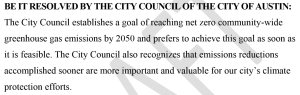
Austin Energy’s solar purchases also represent a significant step toward achieving the climate protection goals adopted by the City Council, which include achieving net-zero greenhouse gas emissions from the entire Austin community by no later than 2050 and eliminating all carbon dioxide emissions from Austin Energy controlled sources by 2030.
“Our best scientists are sounding dire warnings about the imminent possibility that climate change will accelerate in the next few years. We need to do everything possible to head of the possibility of runaway climate change,” said Jere Lock of the Texas Drought Project. “Action taken by City Council today are a step in the right direction.”
“400 megawatts of solar will reduce carbon dioxide emissions by an estimated 620,000 metric tons, which is over 11% of all emissions from Austin Energy. That is significant,” ” said Joep Meijer of Climate Buddies. “Solar will also allow Austin Energy to use its expensive gas plants less, saving customers money and reduce local air pollution.”
Although it runs less than 5% of the time, Austin Energy’s natural gas-fired Decker Creek Power Station is a significant source of location air pollution in Austin and is located right next to neighborhoods and schools in East Austin. Because it is so old and inefficient, that plant is only turned on when high demand for electricity drives up prices. The solar farms approved by the City Council will produce large amounts of energy when electricity demand is high on hot afternoons, so this offers Austin Energy an opportunity to retire the Decker plant. In addition to being a major source of air pollution, the plant loses money most years, according to Austin Energy’s own data.
The increased use of solar energy will also protect and preserve Texas’s limited water resources.
“Austin’s decision to go big on solar is great news for our state’s water resources. Unlike solar, gas and coal plants require massive amounts of water to operate,” said David Foster of Clean Water Action. The extraction of natural gas through fracking has been proven to contaminate groundwater, and coal plants create millions of pounds of toxic coal ash each year, much of which finds its way into our water.”
The Austin City Council have made a great decision that brings Austin Energy closer to meeting the goal of eliminating all greenhouse gas emissions from its power plants by 2030. This process took eight months to complete and required two different Council resolutions before proposals were voted on in October. Both of those resolutions were sponsored by Council Member Delia Garza and co-sponsored by Mayor Pro Tem Kathie Tovo and Council Members Leslie Pool, Greg Casar and Ann Kitchen. The solar contracts approved today were also supported by Mayor Steve Adler and Council Members Sheri Gallo and Ora Houston. Please send the Austin City Council members who voted “yes” an email to thank them for embracing solar energy.
Posted in Austin Energy, solar | Tagged solar energy, Texas |
The Austin City Council voted 9-2 today to authorize Austin Energy to enter into contracts for up to 300 megawatts (MW) of new solar energy. This decision comes as a result of the generation planning process that began in February 2014 and has included numerous studies, briefings, public hearings, and recommendations from citizen advisory groups and Austin Energy. Those voting in support were Mayor Adler, Mayor Pro Tem Tovo and Council Members Garza, Pool, Casar, Kitchen, Gallo, Renteria and Houston.
As consumer advocates, we cheer this wise decision by the Austin City Council because these solar contracts will provide energy at affordable rates for all Austin Energy customers. While the utility will pay slightly more for this energy in the first few years than it would if it just purchased energy from the market, that dynamic will be short-lived and these solar contracts will offer more affordable rates than market purchases for most of the contract periods. Solar contracts can be for up to 25 years and are at a fixed price of less than 4 cents per kilowatt-hour, offering an excellent opportunity to keep prices low and predictable for customers.
This addition of solar energy will bring the city and its electric utility closer to achieving the climate protection goals that Council has adopted. Those goals are to achieve net-zero community-wide greenhouse gas emissions by 2050, or earlier, if possible and to make all Austin Energy-controlled electric generating assets carbon-free by 2030. The later goal will require retirement of the utility’s coal-fired Fayette Power Project and the natural gas-fired generators at the Decker Creek Power Station (Austin’s single largest source of air pollution) and the Sand Hill Energy Center. In order to protect customers against fluctuating prices in the electricity market, Austin Energy will need new carbon-free energy sources to replace those coal and natural gas-fired power plants. These new solar contracts will help enable that transition.
Even before Austin Energy begins retirement of its fossil fuel fleet, these new solar farms will displace dirty energy from the Texas electric grid. Because they have no fuel cost, solar farms will take the place of the most inefficient (and most polluting) natural gas plants that currently provide Texas electric consumers with energy when demand is high in the afternoons and early evenings. By placing solar installations in sunny west Texas, the utility (and its customers) will benefit from high energy production that will continue even as solar intensity is starting to decline in central Texas.
Austin Energy and other utilities have been able to obtain exceptionally low prices for solar contracts recently because solar companies are eager to complete projects before the impending decline of the federal solar investment tax credit from 30% to 10% for commercial projects at the end of 2016. Bloomberg New Energy Finance projects that development of new utility-scale solar projects will decline from a high of over 11 gigawatts (GW) in 2016 to just over 3 GW in 2017. Installations are projected to slowly increase after 2017, but Bloomberg doesn’t project a return to the boom levels we are seeing now and will continue to see through 2016.
This boom is exciting, but it means that some proposed projects won’t be able to be completed by the end of 2016. Several companies, including First Solar are running out of capacity to produce enough solar panels to keep up with demand. That’s great for solar manufacturers to have, but it means that utilities wanting to benefit from low prices need to get contracts signed right away.
The Austin City Council also voted today to postpone authorization for up to another 350 MW of solar energy until October 15 to give Austin Energy staff additional time to negotiate more favorable prices on those contracts. Although the prices for those contracts are already competitive, they are closer to 4.5 cents per kilowatt-hour and can likely be negotiated to closer to the first batch of contracts that was authorized today. That will result in additional savings in the years to come. Just as no savvy consumer walks on to a car lot and pays sticker price, utilities can and should use proposed energy prices as a starting point for negotiations. We applaud the City Council for acting on the most affordable contracts now and for employing this strategy to get the best possible deals on the second batch of solar contracts.
Posted in Austin Energy, solar | Tagged Austin Energy, solar energy, Texas |
In a new study released by George Thurston of New York University’s Langone Medical Center that surveyed more than 500,000 Americans, shows that as air pollution levels rise in the areas where they live, rates of death rise, specially deaths from heart disease.

An example of particulate matter is a diesel particle, which have carbon at their core with toxics and carcinogenic substances attached to their surfaces.
Even with new, stricter standards on emissions, their data adds to a growing body of evidence that particulate matter is really harmful to health, increasing overall mortality, mostly deaths from cardiovascular disease, as well as deaths from respiratory disease in nonsmokers. Specifically the study looked at air pollutants called particulates, in this case tiny particles 2.5 micrometers or less (sometimes referred to as PM 2.5). These particles can settle into the lungs, pass from there into the blood stream, and are not coughed up. They also often contain dangerous heavy metals such as mercury or arsenic.
The team used a survey run by the National Institutes of Health and AARP, looking at more than 500,000 volunteers aged 50 to 71 in six states and two large cities, Atlanta and Detroit. They used Environmental Protection Agency data that breaks down exposure to air pollution by county or city.
Every extra 10 micrograms per cubic meter of air raised the risk of heart death between 2000 and 2009 by 10 percent, they report in the government journal Environmental Health Perspectives. And that increase in air pollution raised the overall risk of death over the decade by 3 percent.
People who are poorer and less educated often live in more polluted areas and also have higher death rates, so the researchers accounted for that, along with age, race, marital status, smoking, weight and alcohol use. The effects held even when those other factors were considered.
This study should be of particular interest to those living in areas that are in non or near non-attainment for Federal air quality standards.
While Houston is currently in attainment for PM 2.5 standards , this new study would indicate that that is no guarantee that Houston residents are not at risk for increased health impacts.
Posted in Air Quality, Diesel, Health, Pollution | Tagged Texas |
The Austin City Council will vote this Thursday (September 17) on a resolution to push Austin Energy one step closer to signing contracts for up to 600 megawatts of solar energy. About 8,000 megawatts worth of proposals have been submitted, some at the lowest solar prices ever seen.
These are exciting times for solar energy – in Texas and around the world. Solar energy is finally cost competitive with fossil fuel-based energy. Utilities that have shown little or no interest in “going green” or being socially responsible are investing in solar. Luminant, Texas’ largest electric generating company, has traditionally invested in coal, but just last week, the company announced its first solar purchase. And in Georgetown, Texas the electric utility has signed contracts for wind and solar energy that it will have a 100% renewable energy portfolio by 2017. In the words of Georgetown Mayor Ross:
No, environmental zealots have not taken over our city council, and we’re not trying to make a statement about fracking or climate change. Our move to wind and solar is chiefly a business decision based on cost and price stability.
It is in this setting that the Austin Council will make its decision. Despite the record low prices, Austin Energy has pushed back against contracting for the 600 megawatts of solar that the Austin Energy Resource, Generation and Climate Protection Plan to 2025 calls for. The plan set a goal of 600 megawatts by 2025, but also states that the utility should contract for up to that amount by 2017, if available and affordable. Clearly it’s available.
The Electric Utility Commission (EUC), whose job it is to oversee Austin Energy, evaluated the impact on rates of contracting for 600 megawatts of solar. The Commission found that it would reduce rates in all but the first couple years and recommended that Austin Energy present its best plan for achieving an additional 600 MW of solar by the end of 2017. So, contracting for 600 megawatts of solar is also affordable.
Austin Energy executives have argued that prices could fall further, but how much they will fall and how fast are unknowns. The 30% federal solar investment tax credit declines to 10% at the end of 2016, so we can count on a price bump after that. As solar prices continue to decline, they will eventually make up for that lost tax credit, but will that be in 18 months, as Austin Energy claims, or longer. Solar companies are especially eager to get contracts right now, so that they can build up their portfolios before the tax credit is reduced. Austin Energy ratepayers could be the beneficiaries of that eagerness, if the Austin City Council decides to take action. If solar is even cheaper in 2018, Austin Energy can contract for more then. Either way, this 600 megawatts of solar, which would supply about 12% of the energy the utility sells, would be an affordable source of energy during times when electricity use, and therefor prices, are highest.
Affordable solar prices should make it easy for the Council to support a big solar buy, especially given that converting to renewable energy is a key strategy in achieving the city’s goal of reducing greenhouse gas emissions to net-zero by 2050, or earlier. Climate change is happening now. For any entity (such as the City of Austin) that claims that addressing the problem of climate change is a priority, passing up opportunities to reduce greenhouse gas emission while also saving money isn’t an acceptable option.
We are asking everyone to wear green to make it easy for the Council members to see how many clean energy supporters are there. We’ll be there starting at 5:30, and will have stickers and talking points for everyone. Parking is free with validation in the garage under City Hall.
Posted in Austin Energy, Climate Change | Tagged Austin Energy, cheapest solar, Texas |
Public Utility Chair was Donna Nelson was reappointed by Governor Greg Abbot to another term today. The new term will expire on September 1, 2021.
Posted in Uncategorized | Tagged Texas |
by Jim Malewitz, The Texas Tribune
September 2, 2015
While filling a cattle trough 15 months ago, Ashley Murray noticed something odd occurring in the shack housing her family’s water pump. High-pressure water was spraying everywhere. She switched off the pump, went into the house and asked her husband to take a look. So out walked Cody Murray with his father Jim.
Ashley stood holding the couple’s four-year-old daughter just outside the wood-and-stone pump house. As Jim Murray flipped on the pump, it let out a “woosh.” Cody, a former oilfield worker, knew the sound signaled danger. He threw his dad backwards — just before a fireball shot from the wellhead and transformed the Murrays’ 160-acre Palo Pinto County ranch into an emergency scene.
Somehow, everyone survived the explosion, detailed in legal filings. But the flames severely burned each of the four.
Now, as the Murrays continue their recovery, the family wants to hold someone accountable for the blast, sparked by a buildup of methane gas. They say blame lies with a pair of companies that drilled and operate two gas wells roughly 1,000 feet away from their water well.
Those gas wells are among thousands that dot the Barnett Shale, which stretches some 5,000 square miles beneath at least 25 North Texas counties.
The wells drilled and operated by Houston-based EOG Resources and Fairway Resources, a partner of Goldman Sachs, “are the only possible sources of the contamination,” the Murrays allege in a lawsuit filed last month.
(Family members were not immediately available for interviews.)
“I have scientific testing showing that Mother Nature did not put this gas in the Murrays’ well,” said Christopher Hamilton, the family’s attorney, who called it “a landmark case in Texas.”
Through a spokeswoman, EOG Resources declined to comment on the litigation, citing company policy. Fairway Resources did not respond to messages left at its Southlake office. As of Tuesday, neither company had responded in court.
Scientifically proving the case, a difficult task, would put pressure on the state’s oil and gas regulator — the Texas Railroad Commission — and could reboot an emotional debate about whether years of frenzied drilling in one of the country’s largest gas fields has put groundwater at risk.
The agency has quietly investigated the Murrays’ case over the past year, its records show.
The agency — which straddles the line between industry champion and watchdog — has not openly linked groundwater contamination to drilling activities, and it frequently repeats a refrain that it has not implicated hydraulic fracturing, in particular — the revolutionary method of blasting apart rock to free up gas.
“To be clear, Commission records do not indicate a single documented water contamination case associated with the process of hydraulic fracturing in Texas,” Ramona Nye, a spokeswoman, said in an email.
Lasts spring, the agency effectively shut the door on a high-profile case dating back to 2010 — once reopened — concerning methane-tainted wells in Parker County. The last agency analysis said evidence was “insufficient” to determine whether the accused driller unlocked deep-resting Barnett gas, or if the methane naturally bubbled up from shallower depths.
A few months later, five universities published peer-reviewed research concluding that oil and gas activities (but not fracking itself) tainted some of the same water wells in Parker County. High levels of methane escaped poorly constructed natural gas wells and migrated into shallow aquifers, the Proceedings of the National Academy of Science paper said. Substandard cementing likely caused the problem, said the researchers, relying on a set of geochemical tracers different than what the Railroad Commission used.
The Parker County gases arrived in the aquifer without undergoing typical geologic changes, data showed, leading researchers to conclude that they came up through a pipe — likely part of a gas well — and didn’t interact with any water or rocks below the surface.
The commission panned that study and declined to reopen its investigation.
Hamilton, the lawyer for the Murrays, said his evidence points to cementing problems similar to what researchers at the five universities identified, implicating the energy companies.
That analysis, he claims, comes from a team of highly recognized scientists who are working for free, save for travel costs.
“This is the first case I’ve ever had where none of my experts will accept compensation,” said Hamilton. “These guys won’t take any money because they’re totally in it for the science and they don’t want anyone to question their credibility.”
However, the attorney said he could not immediately reveal his data, or the names of his experts because of the discovery timeline in his lawsuit.
The family’s complaint details the explosion’s grizzly results, including several first and second degree burns for Cody, Jim and the child. With burns on his arms, upper back, neck forehead and nose, Cody spent a week in a hospital’s intensive care and burn units. With his nerves damaged, the 38-year old cannot drive — because he can’t grip a steering wheel — and cannot work, the document says.
The Murrays are seeking more than $1 million in relief.
So far, the Railroad Commission has documented high methane levels in the Murray well, and others nearby. One family’s well registered methane at more than five times the federal limit. But the data were “inconclusive with respect to specific migration pathways from shallower sources,” that analysis said.
Nye said the agency is looking at records for local oil and gas wells to make sure companies built them correctly.
After examining the Railroad Commission water well analysis, Hugh Daigle, an assistant professor in the University of Texas at Austin’s department of petroleum and geosystems engineering, agreed that the data was inconclusive, and said it looked like the agency was on the right track in investigating the contamination.
“There’s a lot of different places that gas could be coming from,” he said. “They’re doing the right thing to try to figure this out.”
Meanwhile, water concerns extend beyond the Murray ranch.
Rebecca and Larry Norris, a couple living just west of the Murrays, said their water has been turning everything orange — the sinks, the tub — for the past few years, beginning around the time the drilling companies arrived.
They reported the problem to the Railroad Commission shortly after the explosion, but haven’t heard back — “not a peep,” Rebecca, 65, said. (Nye said the agency was looking into why it may not have responded.)
In her house sitting near six wells, Rebecca, said, “you wonder, just wonder” what’s in the water.
Disclosure: The University of Texas at Austin is a corporate sponsor of The Texas Tribune. A complete list of Tribune donors and sponsors can be viewed here.
This article originally appeared in The Texas Tribune at http://www.texastribune.org/2015/09/02/well-explosion-could-put-pressure-texas-regulators/.
What: Rail Safety Community Meeting
When: Monday, August 31 @ 6:30pm
Where: Magnolia Multi-Service Center (7037 Capitol St, Houston, TX, 77011)
Why: Join Congressman Gene Green, Senator Sylvia Garcia, and industry experts for a community meeting to discuss improving rail safety in urban areas.
Posted in Global Warming | Tagged Texas |
Check out this story by Clayton Handleman about the impact that the buildout of transmission lines from the Competitive Renewable Energy Zones (CREZ) has had on wind power in the state. Warning, this is a bit technical and wonky so if you looking for entertainment, this is probably not it.
Upgrades To Texas Transmission Lines Slashes Wind Curtailment
Posted in Renewables, wind | Tagged Texas |
National Oceanic and Atmospheric Administrations says July was Earth’s hottest month on record with an average temperature of 61.86 degrees Fahrenheit, beating the previous global mark set in 1998 and 2010 by about one-seventh of a degree. That’s a large margin for weather records that go back to 1880.
Nine of the 10 hottest months on record have happened since 2005 and it is quite likely that 2015 will end up the hottest year on record, beating last year.
Posted in Climate Change, Global Warming | Tagged Texas |
UPDATE
The Texas electric grid operator, the Electric Reliability Council of Texas (ERCOT) is experiencing extremely high electricity demand. Operating reserves dropped below the target threshold of 2,300 megawatts. This is bad news for consumers on a couple of levels. The ERCOT system has hit several new demand records in recent weeks, most recently reaching 69,783 MW on Monday. During high-demand periods voluntary conservation can help ERCOT reduce the potential for additional measures, such as rotating outages, to ensure reliability throughout the ERCOT grid, but high demand also means the spot market price of electricity recently has risen to two to ten times the average price. For consumers who have fixed rate plans, you won’t see a financial impact other than from your increased use of electricity. For those who don’t you could see significant price increases this time of year.
ERCOT is asking electric consumers to limit or reduce electric use where possible during the 3-7 p.m. peak demand hours Thursday.
Although ERCOT has set new peak demand records without needing to issue a conservation alert during the past week, the high temperatures statewide continue to drive high levels of electricity use.
Consumers can help ensure the system is able to continue serving today’s power needs by taking the following steps to help support system reliability during peak demand:
- Turn thermostat up 2-3 degrees during the peak hours of 3 to 7 p.m.
- Set programmable thermostats to higher temperatures when no one is home.
- If home, use fans to feel 4-6 degrees cooler.
- Schedule pool pumps to run in the early morning or overnight hours; shut off between 4 to 6 p.m.
- Limit use of large appliances (dishwasher, washer, dryer, etc.) to morning or after 7 p.m.
- If you cook indoors from 3 to 7 p.m., use a microwave or slow cooker.
- Close blinds and drapes during late afternoon.
According to the Texas Energy Report, wind generation during peak electric demand today, hovered around 800 megawatts (MW) around 4:30 p.m., and continued moving upwards, according to the ERCOT, while both coal- and natural gas-fired generating units experienced generation outages. In fact, the system had to import power from the eastern United States.
Posted in Efficiency, Energy, Utilities | Tagged Texas |
Republished from the Texas Tribune –
http://www.texastribune.org/2015/08/12/report-deregulated-electric-utilities-narrowing-pr/.
Deregulated Electricity a Mixed Bag for Consumers
by Jim Malewitz
Aug. 12, 2015
More than a decade ago, Texas lawmakers set the state’s power market free. Longstanding rules limiting who sold electricity to whom — and how much they charged for it — were cast aside so private companies could chase customers, competing for business in a free-market bonanza that would supposedly push down prices for consumers across the state.
So did it work?
Texans who take the time to sort through the options are finding decent deals in the state’s deregulated electricity market, a new report says. But the average customer in deregulated Texas — about 85 percent of the state — continues to pay far more for electricity than folks served by monopoly utilities in cities like Austin and San Antonio, according to the most recent data available.
In a report released Wednesday, the Texas Coalition for Affordable Power, which advocates for cities and other local governments, analyzed U.S. Energy Information Administration data on residential prices stretching back to 2002, the first year most Texans were allowed to choose their electricity provider under deregulation.
In 2012 and 2013, the analysis showed, Texans in deregulated areas for the first time paid lower electric bills on average than most Americans.
But from 2002 to 2013, the average household in deregulated areas paid a total of about $4,800 more than residents of cities — like Austin and San Antonio — served by just one municipal utility, or those served by electric cooperatives, the analysis said.
Though pricing data for 2014 and 2015 was not available, the report said, Texans are increasingly finding individual deals on the deregulated market that are cheaper than what regulated utilities offer.
“Texans living in deregulated areas have paid too much for electricity — and the lost savings has been substantial,” Jay Doegey, the coalition’s executive director, said in a statement. “But the deregulated market is improving, and the good news is that if you shop carefully, you can find good deals. These relatively low-cost deals are more common than they were in previous years.”
Nationally, Texas was the 18th cheapest state to power homes between 2002 and 2013, the analysis said. Residents in just nine states saw cheaper prices than Texans in regulated areas during that period. Twenty-six states averaged cheaper prices than Texans in the competitive market.
Why the discrepancy? The coalition and other consumer groups suggest that continued inefficiencies, customer confusion and relatively high prices from legacy electricity providers could be to blame.
A spike in natural gas prices shortly after deregulation, followed by steep decline could have also helped shape the trend, since competitive providers locked into high-cost gas contracts and took years to recover. The coalition acknowledges that factor, but says that it doesn’t account for the trend by itself.
John Fainter, president and CEO of the Association of Electric Companies of Texas, bristles at any suggestion that monopoly utilities offer Texans better deals, but agrees that the competitive market is rapidly evolving and consumers are getting used to it. A state website called Power to Choose allows consumers to compare companies’ prices and complaint history.
“There’s a lot more efficiency. People are better able to manage their electric use,” Fainter said. “The [retail electric providers] are developing more products to take advantage of.”
Wednesday’s report also showed that the steadiest increase in most Texas utility bills isn’t the cost of electricity, it’s the fees charged to deliver it.
Customers can choose whom to buy power from, but monopoly power transmission companies still have to deliver it to homes and businesses. Between 2003 and 2015, the rates of two of Texas’ biggest power line companies — which are regulated by the Public Utility Commission of Texas — rose far higher than inflation, making up an increasing share of consumers’ bills.
CenterPoint, which serves the Houston area, charges nearly $43.94 on the average monthly bill (for those using 1,000 kilowatt-hours of electricity), compared to $24.61 in 2003.
Oncor, which serves the Dallas-Fort Worth area, increased charges to $38.59 from $23.01 during the same period.
One dollar today in 2002 has the buying power of $1.30 today.
Texas rapidly grew during that time frame, Fainter pointed out, embarking on many huge transmission projects, including building new power lines to carry renewable energy and installing millions of “smart meters” to track energy use in hopes of boosting efficiency.
“All of that has to be paid for,” he said.
The world is getting hotter. And for those who work outdoors, climate change could mean very dangerous working conditions. As the heat index increases, stricter regulations and safety practices need to be implemented to ensure the health of our workers. Not doing so could be the difference between life and death.
People working jobs that require time outside, especially those working strenuous jobs outside must protect themselves from heat illness. The body is vulnerable to heat illness when our natural cooling mechanisms are not enough, allowing out body temperatures to rise to dangerous levels if precautions are not taken such as drinking water and resting in shade or air condition. Heat illness can take many forms, such as heat rash, heat cramps, heat exhaustion and heat stroke which requires immediate medical attention, and can result in death. Extreme heat increases the chances of deaths from cardiovascular and respiratory disease as the raised levels of ozone and other pollutants in the air from climate change exacerbate these diseases along with increased pollen and other aeroallergen levels.
Most employers understand the risk of heat illness and prepare by establishing a heat illness prevention programs that provide workers with water, rest, shade and modified schedules for those who need to acclimatize to the hot conditions such as new workers or those who have not been working for a week or more. The danger increases when workers have to wear bulky protective clothing or take part in intensive work tasks; similarly, working in full sunlight can increase the heat index values by 10 degrees Celsius.
Though both employers and employees should understand these risks, there are still cases where heat illness caused death. Between 2008 and 2014, the Occupational Safety & Health Administration (OSHA) had 109 reports of workers’ deaths due to heat illness with 15 of those recorded in Texas. Though employers do not have to legally comply with the OSHA standards for heat illness prevention, they must have some version of such a program to protect their workers.
With recent increases in the global temperature due to climate change, conditions only become more and more dangerous for workers. In the last 100 years, the world has warmed by .75 degrees Celsius with the last 3 decades successively warmer since 1850. These increased temperatures are expected to cause about 250,000 additional deaths per year from malnutrition, malaria and heat stress between 2030-2050. With increased average temperatures, more frequent and more intense heat waves are expected to occur. Throughout the U.S. the number of days with high temperatures above 90F is predicted to increase, especially in the Southeast and Southwest.
If the frequency of heat waves and extreme heat days follows this prediction, then all workers will be at risk for heat illness and even greater measures must be taken in order to protect their health. But more importantly, measures must be taken to prevent the increase of climate change in the first place—this problem that has the power to negatively affect every single aspect of our lives.
Posted in Climate Change, Health | Tagged climate change, health, saftey, Texas |
Rural Texas communities are having to consider preparing for a first responder nightmare scenario, a train derailment involving the ever increasing number of trains carrying crude oil (or bombs on rails). As the amount of crude oil being shipped by rail increases, it is only a matter of time before Texas experiences an accident involving exploding rail cars. This could take place in a rural area on the way to Houston, or right in the midst of the city of Houston.
Read about the firefighter training facility located on the outskirts of the Texas A & M campus. Known as “Disaster City”, firefighters from around Texas and other states are learning techniques for fighting fires and rescuing people when this scenario happens. See Forest Ethics interactive map at http://explosive-crude-by-rail.org/
Posted in Oil by Rail, Safety, Transportation | Tagged Texas |