Feeds:
Posts
Comments

The wildfire season has started in Texas as two large fires rage in Jeff Davis County.  The Texas Forest Service, working with Texas A&M University, has developed a website that can provide some information about your area’s risk of wildfire and also tells you what you can do to diminish your risk.

Click here to get to the Texas Wildfire Risk Assessment site.

While the drought has diminished somewhat in parts of the state, we are not out of the woods yet.  Given the devastation of last year’s wildfires here in Texas, knowing more about your risk can help you plan for this possibility.

By Michael Tahmoressi, St. Edwards student and Public Citizen intern

Texas can be characterized as a pay to play environment.  Politicians bend to their districts business interests and gubernatorial appointees seem to be selected based on the amounts they contribute to the governor.

Contributions Equal Access and Appointments

Rick Perry has taken this to a new extreme with the deal he appears to have struck with Harold Simmons, a billionaire chemical industry mogul whose latest project is a radioactive waste repository in Andrews county Texas. Simmons single handedly pushed his project forward, boasting about it in a rare interview in 2006.  Click here to read D Magazine’s article “Harold Simmons is Dallas’ Most Evil Genius.

State engineers and geologists strongly objected to licensing the dump, expressing concern that radioactive material could contaminate groundwater in the region.  Three staff scientists at the Texas Commission on Environmental Quality resigned rather than sign off on the licenses. Nevertheless, Rick Perry spearheaded the approval of the waste dump, operated by Waste Control Specialists (WCS) and the TCEQ executive director, Glenn Shankle, approved the application, just a few months before he went to work as a lobbyist for WCS.  Click here to read Public Citizen’s report The Repository and the Risk.

The next step of the plan was to open the facility up to allow other states to dump their waste in the site.  That decision lay in the hands of the Texas Low-Level Radioactive Waste Disposal Compact Commission (TLLRWDCC), comprised of six Texas commissioners appointed by Perry.  Two additional commissioners appointed by Vermont fill out the Compact Commission.  In 2010, eleven days after Governor Perry was re-elected, the Compact Commission voted 5-2 to approve rules that would make Texas the radioactive waste disposal site for the country.

The Texas Sunset Advisory Commission flagged this potentially huge liability problem in its report on the Texas Commission on Environmental Quality:

“Texas, and not the Compact Commission nor the disposal facility licensee, holds liability for compact waste brought into the state. Low-level radioactive waste can be radioactive for a long time, and potential future contamination could not only have a severe impact to the environment and human health, but to the State, which bears the ultimate financial responsibility for compact waste disposal facility site.”

A Texas observer article goes on to explain that the state would not only be forced to take care of any potential contamination problems but also the closure of the waste dump. This is clearly illustrates the biggest problem in our state the power does not lie in the hands of the people but in the business sector. Click here to read the article from the Texas Observer.

Double Dipping: An Acceptable Practice?

The case of State Represenative Joe Driver, (R-Garland) is another example.  Driver, who was convicted of felony abuse of official power, admitted in an interview in 2006 that he pocketed taxpayer money for travel expenses that his campaign had already paid. Click here to read the Texas Tribune article.  For years he had been double dipping, submitting the same receipts to his campaign and the state for airline tickets, meals, incidentals; collecting thousands of dollars in state mileage reimbursements for travel in vehicles for which his campaign had already spent more than $100,000 since 2000. This resulted in his campaign covering these travel costs, while he pocketed the profit by reimbursing himself with taxpayer money.

The Attorney general has not done enough to stop criminals like Driver.  Abbott’s ethics probes have been terribly inadequate.  Of the 57 probes he has started since his term in office began in 2002 only half of those resulted in convictions and a majority of those were for only minor infractions.

Abbott is a power broker with a political war-chest of over 8 million dollars.  Ninety nine percent of that can be traced back to business interests, more than $1 million from the business sector with the top contributors Houston homebuilder Bob Perry who gave the attorney general $470,265 in addition to Houston’s John Nau, Kenny Troutt, who made a fortune from his Excel phone company and energy and water investor T. Boone Pickens following close behind.

Texans need a justice agency they can trust to stop this hijacking of our democracy politicians that are either being rented by big business lobbies or are trying to get a cut of the action.

It Was A Gift, Not a Contribution

Legislative power broking has become normal practice in Texas.  Lobbyists’ daily activities in the capital involve massaging the backs of legislative members and their staff with gifts of food and activities, and functional bribes, in the form of monetary campaign promises or the problem State Representative Kino Flores (D-Palmview) in the valley encountered.

Flores had been receiving money from local businesses for years and not properly filing required reports on them. He was indicted for accepting gifts and failure to report them to the state. Overall, he failed to disclose $115,000 to $185,000 of income each year from 2004 to 2009.

Blatant corruption taints our democracy, how can citizens believe in their governments officials to manage the state, when the balance of power has gradually shifted to the moneyed elite. The general population is so removed from policy implementation they usually only show interest in issues that directly affect them; making it appear that they are okay with a level corruption when the reality is that they are unaware of the corruption or feel powerless to do anything about it. This is inherent to our economic system that demands efficiency and results at the expense of ethics.

Politicians for Sale or Rent, Rooms to Let – 50 Cents

Politicians aren’t for sale in Texas, they are for rent.  There was a study done by Larry Bartels professor at the Woodrow Wilson School of Government about economic inequality and congressional response. Bartels found that senators are more likely to respond to concerns brought forward by members of the top ⅓ of their district’s total constituency. Bartels also found that senators never voted or responded to the concerns of the lower economic ⅓.  Click here to read the report.

If the game is rigged towards the top ⅓ of our population because money buys influence, what are the rest of us supposed to do to get our voices heard? 

Tom “Smitty” Smith of Public Citizen and 15 other advocates from legislative watchdog groups had an answer. On April 10th, testifying in front of the Texas Sunset Advisory Committee they urged the committee to make the Texas Ethics Commission (TEC) an enforcement agency and to expand their authority to investigate beyond minor infractions.  In addition, they recommended that a TEC enforcement director be given greater authority to subpoena records, that the legislature expands what is disclosed by candidates each election cycle and that they create a limit on the amount that individuals can contribute.

Public watchdogs speaking out against corruption at the TEC Sunset hearing is tantamount to sustaining what is left of our democracy in Texas. It’s impossible to place personal responsibility on the people for not participating in rooting out corruption because the power is not in their hands and the very folks responsible for representing them are being bought by big business groups.

Public Citizen and other watchdog groups are the vanguard of citizens who are committed to accountability.  We hold those in the government, who believe their positions put them above the law, accountable and demand that there be a reverse in the flow of power back to the people.  Public hearings like the one on April 10th allow us the ability to present our grievances.

The system may be sluggish and cumbersome, but Public Citizen is committed to maintaining and expanding a network of allies who are committed to holding Texas government officials accountable for the misuse and abuses of power.

The Electric Reliability Council of Texas (ERCOT), the state grid operator and manager of the wholesale electric market, hit a new wind record of 7,599 MW on Wednesday, exceeding the previous record set the previous day by almost 200 megawatts (MW).

At the time of Wednesday’s record, wind was supplying 22 percent of the 34,318 MW total system load for the state.

Coastal wind farms supplied 1,018 MW of the new record, along with 6,581 MW from the west and north zones. ERCOT currently has 9,838 MW of installed wind capacity – the highest of any state in the US – including 7,531 MW in the western part of the state, 232 MW in the north, and 2,075 MW in the coastal region.

March is typically a high wind month for Texas, but these new records are also due in part to a new transmission analysis tool that allows the grid operator to move more wind energy from the west zone.

The installed wind capacity that feeds into the Texas grid increased last month by 9 MW with the addition of Harbor Wind in Nueces County. More than 18,000 MW of wind generation projects are currently under review, according to ERCOT’s February system planning update.

And now, the first interconnection agreement for a CREZ (Competitive Renewable Energy Zone – transmission lines that bring renewable energy to the rest of the Texas Grid) substation was completed March 27, 2012, between Wind Energy Transmission Texas and Stephens Ranch Wind Energy.  The Interconnection point is the Long Draw Substation in Borden County.  This wind farm will include 233 turbines for total of 377 MW that is scheduled for commercial operations to begin in November 2013.

As new wind projects come online and transmission lines to bring their electricity to the grid are completed, we can expect to see more wind energy records broken.

According to the Fort Worth Weekly, the Keystone pipeline company wants to run roughshod over Texas landowners – and maybe Texas law.

Fort Worth Weekly Cover 4-11-12

Julia Trigg Crawford on the Cover of Fort Worth Weekly

When someone from the Canandian company, TransCanada, asked the Crawford family in 2008 about an easement to lay pipeline across their farm on the Texas bank of the Red River, the family wasn’t interested.  When they said “no”, as they had for previous pipeline requests, Transcanada surprised them by condemning the land it wanted.  Since then, the Crawfords have been in a legal battle with this multi-national corporation questioning their claim that TransCanada has the right to take, by eminent domain if necessary, any land they want to lay pipe on.

Click here to read the full story from the Fort Worth Weekly about Julia Trigg Crawford’s battle to keep the foreign company TransCanada from siezing part of her land.

Harold Simmons built a West Texas dump for radioactive waste that is bigger than 1,000 football fields, paid out hundreds of thousands of dollars in campaign contributions and got a permit for it in Texas, and is now working to fill it.

To turn it into a profitable enterprise, the Texas billionaire has now hired lobbyists to urge the Obama administration to expand the types of nuclear waste, including depleted uranium, the dump can accept and award his company disposal contracts.

Click here to read the Bloomberg story on the influence of money on this regulatory issue.

Click here  and here and here and here, to read earlier blog posts about Harold Simmons, his Texas political contributions and the WCS radioactive waste dump.

MSNBC reports that a scientific paper published in the peer-reviewed journal Nature on Wednesday concluded that during the end of the last Ice Age (12,000 years ago), global temperatures rose after carbon dioxide levels started to rise.  This provides even more scientific evidence that there is a connection between warming temperatures and rising carbon dioxide.

For this study, which was funded by the National Science Foundation, researchers reconstructed temperature records from ice and soil cores at 79 sites around the world from around the same time period.

Earlier studies postulated that changes in Earth’s orbit may have triggered the warming trend by causing ice sheets to melt, but the new study suggests CO2 played a more important role.

Click here to read the MSNBC story that also includes comments by skeptics.

The New York University School of Law’s Institute for Policy Integrity has released a new reportThe Regulatory Red Herring: The Role of Job Impact Analysis in Environmental Policy Debates. The study finds that claims of jobs that stand to be gained or lost due to environmental regulations require much closer scrutiny than they’re given. Very often these claims are made dramatically out of context, based on economic analyses that may not have been meant to support them.

The report goes on to say there are ways that cost-benefit analysis can more accurately evaluate the effect of environmental regulation on layoffs and hiring. But frequently, the tendency is for jobs impact models to be used in ways that are not helpful in debates over environmental protections. Results are sometimes cited without calling adequate attention to their limitations and assumptions even though different modeling choices can lead to drastically different conclusions.

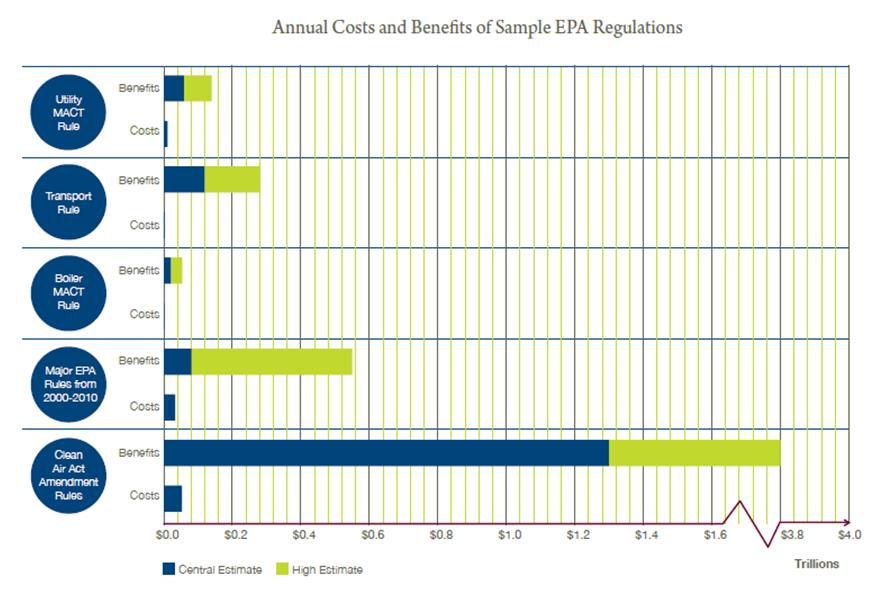
EPA’s recent regulations, which have come under attack for “killing jobs,” have all gone through economic analysis and have been vetted by the White House Office of Information and Regulatory Affairs. For example, the Boiler MACT Rule is estimated to deliver between $22.2 billion and $54.5 billion in benefits per year, including the avoidance of thousands of premature deaths and cardiopulmonary illnesses annually (as well as significant, non-monetized ecosystem and mercury reduction benefits); by comparison, only about $1.9 billion in costs are expected.

Below is a table that shows the analysis for several EPA regulations.

Annual costs and benefits of sample EPA regs

In each instance, the benefits outweigh the costs.  Click here to get the full report.

The Dallas Observer is reporting that there is a good chance that Energy Future Holdings (EFH) (or TXU for most of us) the state’s largest power generator, will go broke – click here to read their story.

The question now becomes – are Texas ratepayers going to have to pay for EHF’s bad bet?  Two weeks ago, in an op-ed by Public Citizen’s Texas director, Tom “Smitty” Smith, and its policy and outreach specialist for coal and renewable energy, Kaiba White, they wrote about this question.  We have published that op-ed below.

Energy Future Holdings is going broke because of coal and it may be time to pull the plug on the old and dirty coal plants that are bankrupting the company.

Utility after utility has looked at the future of coal and made the decision to retire more than 100 coal plants rather than to retrofit them. If we wait for them to go bankrupt, the choice will be made by the courts, who will sell the plants to the highest bidders and you’ll pay the price in higher costs and unrelenting air pollution.

Energy Future Holdings bet on the wrong fuel when it bought the old TXU. The company got smoked.

TXU was worth about $32.3 billion; EFH paid $45 billion at a time when the price of natural gas was high and the cost of coal was lower than it is now. Today, the costs are reversed. Natural gas prices are at a 10-year low and it’s now cheaper to generate electricity with gas or wind than it is with older, inefficient coal plants. EFH’s generating subsidiary Luminant is very dependent on coal and, as a result, EFH is losing money quarter after quarter, and is losing customers as well.

The losses can’t go on much longer. The big Wall Street analysts and even Warren Buffet, a major EFH investor, are predicting that this company will fold unless natural gas prices rise.

We have known for years that pollution from the big coal plants to the south and east of the DFW area affect air quality in North Texas. Pollution from Big Brown, Martin Lake and Monticello, all owned by Luminant, was estimated to cause 136 early deaths; 204 heart attacks and 149 asthma hospitalizations a year, according to an Abt Associates study commissioned by the Clean Air Task Force in 2010. These three plants are the largest sources of sulfur dioxide emissions in Texas and are some of the worst in the country. They also graced the EPA’s top 10 list for nitrogen oxides emissions in Texas.

For more than 20 years the EPA worked on the recently announced rules to reduce pollution from power plants. In order to meet the lower emissions limits, EFH estimates it will have to spend $1.5 billion on pollution controls. The Sierra Club estimates those controls could cost as much as $3.6 billion.

EFH doesn’t have the cash or credit to retrofit these plants. So it has gone on a PR warpath, claiming that the new pollution rules will make the lights go out. Officials are just blowing smoke. We predict they will ask the Texas Legislature to bail them out. Lawmakers shouldn’t rescue these Wall Street slicksters who made a bad investment.

Other Texas coal companies have begun to invest the money and add the pollution control devices needed. CPS of San Antonio looked at the cost to upgrade one of its old coal plants and decided to retire it and invest the money in renewable energy projects, rather than sink the cash into an outdated technology.

Just two weeks ago, GenOn Energy announced it was closing eight coal plants in three states between June 2012 and May 2015 because it would be less expensive to shut them than to fix them up to protect public health.

So what do we do to keep the lights on in Texas? CPS in San Antonio has a plan to replace its old coal plants and create local jobs with energy efficiency, solar and wind energy, and a new natural gas plant. Utilities across the country are doing the same because it’s cheaper than fixing up their old coal plants, reduces healthcare costs and creates local jobs rather than ones at Wyoming coal mines.

The Texas Senate will be studying this issue over the next several months and should develop a plan to reduce air pollution and the risk of bankruptcy while developing new cheaper ways to meet Texas’growing energy needs. But money talks, and EFH has long learned it’s cheaper to invest in politicians and lobbyists than pollution controls. Texans should call their senators and tell them not to let EFH’s smoke get into their eyes. Your tax dollars shouldn’t be used to bail out Wall Street bankers

We’d like to know what you think.            [polldaddy poll=6090363]

With the Texas Low Level Radioactive Waste Disposal Compact Commission (TLLRWDCC) approving rules that open up of the WCS dump site to out of compact waste, we may soon see low level radioactive waste from Nebraska Public Power District’s nuclear facility heading to Texas.

The deal between WCS and Nebraska’s Cooper Nuclear Station still must be finalized, but the waste they are looking to send would include radioactive resins, filters and other equipment.  Currently, low-level waste from Cooper Nuclear Station is stored in on-site pools that also hold used nuclear fuel rods because no other disposal site took either out of compact waste, or did not take the “hotter” C level waste.

With the opening up of the Texas waste site, you can bet other nuclear power plants around the country are looking to free up space in their spent fuel pools as these aging plants near the end of their planned life.  Many of these plants are at a point where they are looking to get relicensed, and with the lack of a national respository for the spent fuel rods, will need to show that they have adequate on site storage for another 20 years of spent fuel.  Removing “low-level” radioactive waste from on site is going to be important to that process, and Texas is looking good to them as an option to making that happen.

While there was concern about there being enough room at the WCS site for Texas and Vermont (the two states in our Compact), the commission set aside space for our two states, however you can be sure other states will be clamoring for what’s left.  Then what – an expansion of the site?

Oh, just another thing to ponder over.  The San Antonio Current reported in their Que Que blog that in 1992, an earthquake measuring 4.7 on the Richter scale struck Lea County, New Mexico, just across the Texas-New Mexico border from the radioactive waste dump operated by Waste Control Specialists in western Andrews County.

Today, the Environmental Protection Agency issued the first limits on greenhouse gas emissions from new power plants.

“Today we’re taking a common-sense step to reduce pollution in our air, protect the planet for our children, and move us into a new era of American energy,” EPA Administrator Lisa P. Jackson said in a statement announcing the limits. “Right now there are no limits to the amount of carbon pollution that future power plants will be able to put into our skies – and the health and economic threats of a changing climate continue to grow.”

This rule has been years in the making and was approved by the White House after months of review.  The rule will require any new power plant to emit no more than 1,000 pounds of carbon dioxide per megawatt of electricity produced. The average U.S. natural gas plant, which emits 800 to 850 pounds of CO2 per megawatt, meets that standard; coal plants emit an average of 1,768 pounds of carbon dioxide per megawatt which could essentially end the construction of conventional coal-fired facilities in the United States.

The rule provides an exception for coal plants that are already permitted and beginning construction within a year. There are about 20 coal plants pursuing permits; two of them would meet the new standard with advanced pollution controls.  The proposal does not cover existing plants.

On Friday, Governor Perry announced he is appointing Toby Baker, a former policy and budget advisor to Perry on energy, natural resources and agriculture, to replace Garcia who continues to serve in a TCEQ commissioner’s spot that officially expired in August 31, 2011.  Mr. Baker’s term will begin April 16 and will expire Aug. 31, 2017.

At the governor’s office, Baker has also served as a liaison between the office and Texas Legislature, Railroad Commission, TCEQ, Texas Parks and Wildlife Department, Texas Department of Agriculture and the Texas Animal Health Commission. Formerly, he also worked as a natural resources policy advisor to Sen. Craig Estes (R-Wichita Falls) and is a former director and clerk of the Texas Senate Subcommittee on Agriculture, Rural Affairs and Coastal Resources.

Statement of Trevor Lovell, Environmental Program Coordinator,  Public Citizen’s Texas Office

It is unfortunate that President Barack Obama has decided to ignore news stories in Business Week, the Wall Street Journal, Bloomberg News and Financial Post, among others, explaining in simple terms how the southern leg of the Keystone XL pipeline will raise gas prices for American consumers.

Public Citizen has long warned about Keystone’s health and safety risks, the environmental devastation associated with tar sands mining and its disproportionate impact on global climate change, and the unconscionable contributions to local air pollution in Port Arthur, Texas. Port Arthur is one of the Environmental Protection Agency’s (EPA) “Environmental Justice Showcase Communities” due to a concentration of environmental health risks that disproportionally burden minority communities.

But Keystone XL also poses another risk – a risk to U.S. consumers and the fragile economic recovery. Analysts and economists agree that building the southern leg of this pipeline will alleviate a glut of oil in Cushing, Okla., and allow more oil products to be exported to other countries, thereby reducing domestic supply and raising gas prices.

The southern leg of this pipeline does not bring oil into the country (a goal our organization does not endorse), but does create a clear path to get oil out to export markets. Since refined oil products are now the largest export commodity in the U.S., it is obvious that pushing more oil to the Gulf Coast will result in more export activity and less supply for Americans.

Today, Public Citizen renews its call for the president and relevant agencies to treat this pipeline as a tar sands pipeline. As construction has not yet begun, it would be imprudent to build the pipeline when we anticipate new findings from a congressionally mandated study on the unique dangers of tar sands pipelines, which may inform new regulations for this industry.

Texas may be an oil and gas state, but the health and safety of our citizens is no less important than it is anywhere else. Our water resources are threatened now more than ever, and this pipeline would cross the Carrizo-Wilcox Aquifer in East Texas, which serves 60 counties and as many as 12 million people. When the presidential permit was denied earlier this year, the inadequate study of threats to Nebraskan water resources was cited as a central concern. Apparently water resources in Texas do not require the same kind of thorough review. Texans deserve protection from our elected and appointed leaders, and today President Obama has shown he is ready to sacrifice that protection for election-year politics.

—————————————————————————————————————————

Below is a statement issued by Independent Texans by Julia Triggs Crawford

Response from Julia Trigg Crawford to President Obama’s support for TransCanada’s Keystone Pipeline Project

Julia Trigg Crawford, a Texas farmer who is challenging TransCanada’s use of eminent domain to take an easement across her property for TransCanada’s Keystone pipeline, issued the following statement in response to President Obama’s Thursday morning press conference in Cushing, OK:

“Today President Obama indicated he’s taking an “All of the Above” strategy to his energy policy, and in doing so will expedite the Cushing to Houston leg of TransCanada’s pipeline. While his decision was not unexpected, it is disappointing that this issue continues to be a political football during this election game.”

“Where I come from you’re only as good as your word, and I am proud to stand by my principles no matter the pressure that’s applied. And there’s no doubt about it, TransCanada’s applying pressure anywhere they can, from Washington D.C. to small towns along the proposed pipeline route, and not everyone can hold up.”

“I stand by my belief that TransCanada illegally asserts that its pipeline is a common carrier and is for the public good. My attorneys tell me we have a strong case and we are eagerly awaiting our day in court. Should we win, and I wouldn’t be in this fight if I didn’t think we would, I hope that our case will give strength to other landowners who are still fighting for their property, and to those being bullied by a company falsely wielding the club of eminent domain.”

“I’m just a farmer caring for a piece of good Texas earth, up against a foreign corporation with the power to bend the will of a President, so I’m under no delusion that this will be easy. I am reaching out to my fellow Americans and anyone who believes in an individual’s right to private property to help me in this fight. You can go to www.standwithjulia.com to take action and to contribute to our legal defense fund so that we can face TransCanada on an even playing field.”

“So here is my “All of the Above“ strategy. Stand by one’s principles, hold onto and protect those property rights afforded to every American by the United States Constitution, and never bow to pressure that runs contrary to the promises you’ve made”.

“Thank you and God bless.”
Julie Triggs Crawford

Native Americans protesting the Keystone XL pipeline will be compelled to stay in enclosure located miles from President’s pro-oil event

Native American’s gathering in Cushing, OK today to protest President Obama’s words of praise for the Keystone XL pipeline were forced by local authorities to hold their event in a cage erected in Memorial Park. The protestors were stunned that their community, so long mistreated, would be insulted in such an open manner instead of being given the same freedom of speech expected by all Americans simply for taking a stance consistent with their values.

“A lot of tribal councils and Indian businesses struggle to find a balance between economic resources and our inherited responsibilities for the earth,” said Indian actor and activist Richard Ray Whitman in a statement. “How will the decisions we make now effect coming generations?”

“President Obama is an adopted member of the Crow Tribe, so his fast-tracking a project that will desecrate known sacred sites and artifacts is a real betrayal and disappointment for his Native relatives everywhere,” said Marty Cobenais of the Indigenous Environmental Network. “Tar sands is devastating First Nations communities in Canada already and now they want to bring that environmental, health, and social devastation to US tribes.”

The President visited Cushing to stand with executives from TransCanada and throw his support behind a plan to build the southern half of the controversial Keystone XL pipeline to move tar sands bitumen and crude oil from Cushing to the Gulf Coast refineries in Texas.

A major concern for Native Americans in Oklahoma, according to spokespeople at the event, is that Keystone XL and the Canadian tar sands mines that would supply it ignore impacts to indigenous communities and their sacred spaces.

“Natives in Canada live downstream from toxic tar sands mines,” said Earl Hatley, “and they are experiencing spikes in colon, liver, blood and rare bile-duct cancers which the Canadian government and oil companies simply ignore. And now they want to pipe these tar sands through the heart of Indian country, bulldozing grave sites and ripping out our heritage.”

The group points to a survey done by the Oklahoma Archeological Survey which found 88 archaeological sites and 34 historic structures that were threatened by Keystone XL. TransCanada was asked to reroute around only a small portion of these, leaving 71 archaeological sites and 22 historic structures at risk. The group says they have asked for a list of these sites and to oversee operations that might threaten sacred burial grounds, but neither request has been honored.

Beyond the threat to their own cultural heritage, the group voiced opposition to the pipeline’s environmental impacts.

“The Ogallala Aquifer is not the only source of water in the plains,” said RoseMary Crawford, Project Manager of the Center for Energy Matters. “Tar sands pipelines have a terrible safety record and leaks are inevitable.”

“We can’t stop global warming with more fossil fuel pipelines,” added Crawford. “The people who voted for this President did so believing he would help us address the global environmental catastrophe that our pollution is creating. He said he would free us from ‘the tyranny of oil.’ Today that campaign promise is being trampled to boost the President’s poll numbers.”

The Texas Commission on Environmental Quality (TCEQ) has a proposal to pardon as many as 3,000 environmental rule breakers.

Tell the TCEQ that pardoning polluters is no way to make the air and water in Texas cleaner.

The TCEQ is changing the rules to allow those with a “poor” record of complying with Texas’ weak environmental laws to be upgraded to “satisfactory” — which means they would get fewer inspections, lower fines and new permits granted more easily.

In addition, the new rules would allow the TCEQ’s executive director to pardon “repeat” violators — without even explaining why.

The TCEQ refuses to tell us which polluters get the break. When we asked, they sent us almost 10,000 pages of unsortable data.

Actions like these tell citizens that the TCEQ would rather dole out favors for polluters than protect the health of Texans.

Tell the TCEQ not to give rule breakers a pass.

The TCEQ is the world’s second largest environmental agency. Taxpayers have a right to expect the agency to enforce a minimum standard of regulatory compliance. Lowering the grading standard does not mean businesses perform better — it just means the TCEQ is slacking on enforcement.

The deadline for voicing your concerns to the TCEQ is this Friday, March 23, so take action right now.

See the press release that went out from several advocates here. 2012-03-21 Press release – Texas Pardons Pollution

You can download an ASCII file of all compliance histories statewide by clicking here.

You can download the TCEQ test report on the current data by clicking here.

You can download a file that Public Compiled from the current compliance history data and compared side by side with the test data by clicking here.

Trucks carrying low-level radioactive waste from 38 states could start rolling down Texas highways bound forburial at a dump in Andrews County on the Texas / New Mexico border as early as April,.

The state’s commission (Texas Low Level Radioactive Waste Disposal Compact Commission) overseeing disposal of low-level waste in Texas may approve the final rule changes needed this Friday, March 23rd. State lawmakers cleared the way with a new law passed late in the 82nd legislative session and state regulators still need to sign off on the burial site’s construction, but it seems inevitable that Texas is going to become the nation’s radioactive dumping ground.

The Compact Commisson meeting is scheduled to begin at 9am on Friday, March 23rd in the Texas Capitol Extension at  1400 North Congress, Austin, Texas in Hearing Rm. E1.024,  We’ve provided the meeting agenda below and encourage any who are interested to attend the hearing.

Agenda

1. Call to Order

2. Roll Call and Determination of Quorum

3. Introduction of

a. Commissioners

b. Elected Officials

c. Press

4. Public Comment (Note: Pursuant to Article IV, Section Two (c) of the Commission¿s Bylaws, the Commission [subject to such time constraints as may be established by the Chair] also will provide an opportunity for members of the public to directly address the Commission on each item on the agenda during the Commission¿s discussion or consideration of the item.

5. Discussion and possible action with regard to the final adoption of amendments to Rule 675.23 (Importation of Waste from a Non-Compact Generator for Disposal) (31 TAC 675.23) with changes from the proposed amendments to the rule as published in the Texas Register on January 20, 2012 (37 Tex. Reg. 184).

A) Receive and discuss the report of the Rules Committee (Mr. Lee [Chair], Mr. Salsman, Mr. Saudek, and Mr. Wilson) with respect to its deliberations after the publication of the proposed amendments to Rule 675.23 (31 TAC 675.23) as published in the Texas Register on January 20, 2012 (37 Tex. Reg.184).

B) Receive and act on the recommendations of the Rules Committee with respect to

(i) the final adoption (with changes) of proposed amendments to Rule 675.23 (31 TAC 675.23) as published in the Texas Register on January 20, 2012 (37 Tex. Reg. 184); and

(ii) the filing and publication of Rule 675.23 (31 TAC 675.23) as finally adopted in the Texas Register.

 6. Discussion and possible action on the following petitions for export: A) South Texas Project B) Vermont Yankee C) Luminant

7. Discussion among Commission members about methods of processing and evaluating applications for Agreements for importation of waste for disposal in accord with Compact Commission Rules and with Texas requirements expressed in Chapter 401 of the Texas Health and Safety Code, including quantities and revenue expectations and including possible action to appoint one or more Committees in connection with the processing of applications for Agreements for importation.

8. Discussion on and possible action on Bionomics Request for Import Agreement.

9. Presentation of Site status report and outlook from Waste Control Specialists Inc.

10. Presentation from Advocates for Responsible Disposal in Texas concerning Compact site use plans and issues.

11. Site status report from the Texas Commission on Environmental Quality including discussion of plans for actions on commingling rule change effort and actions on site licensing and disposal site rate case actions.

12. Receive a report from and possibly take action in response on any recommendations from the Committee on the Commingling Rule (Ms. Morris [Chair], Mr. Saudek and Mr.Wilson)

13. Chairman¿s report on Compact Commission activities including reporting on fiscal matters and on status of filling needs for staffing.

14. Discussion and possible action regarding the provisions of existing Compact Commission Rule 675.21(l) (31 TAC 675.21(l)).

15. Determination of date and location of next meeting.

16 Adjourn.