Yesterday the Texas Attorney General Greg Abbott filed an official injunction against BP Products’s Texas City Refinery for “violating state health, safety and environmental protection laws, including the Texas Clean Air Act, the Texas Water Code, and the Texas Health & Safety Code.” The refinery was cited for 46 separate emissions of unlawful pollutants, a violation of the Clean Air Act. Among these was the emisssion responsible for the March 2005 explosion that killed 15 workers and injured 170.
Between 2000 and 2007, the TCEQ filed 15 enforcement orders to get BP to clean up its act. But it doesn’t look like the authority of the TCEQ was enough to stop the refinery from emitting hundreds of thousands of pounds of unauthorized pollutant emissions, including volatile organic compounds (VOCs), carbon monoxide, hydrogen sulfide, sulfur dioxide and nitrogen oxides.
According to the Attorney General’s press release,
Under Texas law, BP was required to report unlawful emissions to the Texas Commission on Environmental Quality and take corrective action to prevent future emissions. However, BP not only failed to report emissions to environmental regulators within the legally mandated deadlines–but also did not take the necessary measures to prevent additional unlawful emissions in a timely manner.
The injunction requires BP to implement all necessary measures to eliminate future unlawful emissions, which includes installing additional air quality monitors to ensure future compliance. The state is also seeking civil penalties, fines and attorneys’ fees.
It’s really good to see the government stepping in to enforce clean air laws. Kudos to Abbott for stepping in to keep Texans safe and our air clean.
Posted in Global Warming | Tagged Air Quality, bp, bp products, carbon monoxide, clean air, clean air act, emissions, hydrogen sulfide, nitrogen oxide, sulfur dioxide, TCEQ, Texas, texas attorny general, texas city refinery, Texas Commission on Environmental Quality, texas health and safety code, texas water code, unlawful pollutants, volatile organic compounds |
 Action Alert!
Climate change legislation currently being debated in Congress will prove a boon to the coal and oil industries, will fail to protect consumers and may very well not even curb global warming.
Lawmakers have conducted closed door negotiations with polluters.
The result: The bill was radically altered to accommodate the financial interests of big energy corporations while giving nothing new for the environment or for working families. Lawmakers have decided to give away most of the pollution allowances for free for the next two decades – an approach that would hurt working families and households the most. It will deprive the government of the money needed to invest in clean technologies and thwart the very goal of curbing global warming.
This is hardly the transformation this country needs to jump-start its economy and curb climate change. This is more of the same old wait-and-see, special-interest-bailout approach that has gripped Washington, D.C., for ages.
Tell your representatives that climate change legislation should not be weakened by the corrupting influence of big money, and that the people’s business should be done in front of the people.
Posted in Global Warming | Tagged big money, Bill, climate change, coal and oil industries, Congress, Consumers, dc, Global Warming, legislation, polluters, representatives, Tell Congress, Texas, washington |
 If we look at the distribution of the U.S population, we notice there are huge concentrations along the coasts. I was once told that more than half the population lives within 5 miles of the coasts. With so many people living on the coasts, our population is extremely susceptible to destruction from hurricanes. Recent examples of hurricane damage from Katrina, Rita, and Ike loom large in our collective memories.
Recently I came across a study by Jen Irish, an Assistant Professor of Coastal Engineering at Texas A&M, that looked at how Corpus Christi Bay would fare in the event of a hurricane under the conditions describe in the Intergovernmental Panel on Climate Change (IPCC)’s future climate scenarios. The study found that if the Scenarios are realized hurricane flood levels could increase 3 to 27% over the next 20 years. This will cause damage to homes from flooding to increase by 60% to 100% in the event of a hurricane.
Corpus Christi is already on very low ground that has been slowly sinking for many years. Corpus’ barrier islands, Mustang and Padre, are also eroding. This study particularly interests us at Public Citizen Texas because Corpus Christi is the proposed site of The Las Brisas Pet Coke Plant, which is a project we have been fighting at Public Citizen since it was proposed.
Pet-coke is an incredibly dirty fuel source that emits large quantities of pollutants into the air. For this very reason, pet-coke plants are generally not built in highly populated areas like Corpus Christi. There is also no reason why a pet-coke plant should be built in Texas when better energy sources are available.
To top off the list of objections, Las Brisas will be located directly in the path of the storm surges predicted in Dr. Irish’s model. The proposed location is on a dredge island in Nueces Bay which is barely above sea level, though the developers have proposed raising it another 13 ft (a measure that will only have a minimal effect in the event of a major hurricane).
The Hurricane Research Team at Colorado has already predicted a that this hurricane season (which started Monday) there is 28 to 30% chance that we will see another major hurricane make landfall. In the past, Corpus Christi has been a vulnerable to hurricanes, and considering the IPCC’s finding that warming will increase hurricanes, the facility could be at great risk.
I fear for the residents of Corpus Christi, but I also can’t help but note the irony of a pet-coke facility being one of the first victims of global warming.
–The Disappointed Environmentalist
Posted in Coal, Global Warming | Tagged climate change, Coal, Coast, corpus christi, corpus christi bay, Global Warming, Hurricane, hurricane season, jen irish, katrina, las brisas, mustang island, padre island, Petcoke, rita, storm surge, Texas |
For real, we gotta act now before it escalates.
[youtube=http://www.youtube.com/watch?v=08z-Hw7s54E]
Posted in Global Warming | Tagged Carbon Dioxide, Clean Energy, climate change, coal plant, Energy Efficiency, Global Warming, green jobs, renewable energy, solar energy, solar power, take aim, Texas, video, what can I do |

This week from the Texas Progressive Alliance, emission from drilling are more than cars and airports, women are running things in Denton County, Liberty University Democrats lose their recognition, President Obama’s political coalition leaves out the far-right and the poor, and much more on this weeks TPA Roundup.
This week’s roundup was compiled by Teddy from Left of College Station.
John Coby at Bay Area Houston says Governor Perry signed a bill to stop electricity deregulation in East Texas while we poor saps continue to be screwed with high electricity rates.
On Bluedaze: Barnett Shale operators continued to endanger public health and safety by ignoring the peer reviewed study that showed emission from drilling were more than all the cars and airports in the DFW area. Now the TCEQ data supports the findings. Smog forming nitrogen oxides and volatile organic emissions for the entire 19-counties of the Barnett Shale area are approximately 200 tons per day.
Jesus Hussein Christ, PDiddie at Brains and Eggs agrees with John Cornyn.
Castle Hills Democrats proclaims that, in Denton County, “The Women Are Running Things Now”.
CouldBeTrue of South Texas Chisme notes that Republican ambition is messing with Perry, Hutchison and Cornyn. Who cares about Hispanic or female voters?
DosCentavos is not longer a Blogspot blog, we are now at DosCentavos.net, exclusively!.
WCNews at Eye On Williamson points out the important issues that are being neglected as the 81st Legislative Session winds down, Lack of leadership in Texas is painfully obvious.
Teddy at Left of College Station writes about the sexist and racist attacks by the usual conservative voices on President Obama’s Supreme Court nominee Sonia Sotomayor, and on Liberty University’s decision to no longer recognize the College Democrats as an official student organization because of their endorsement of pro-choice and pro-gay rights candidates.
McBlogger takes another look at the dump near Andrews after he finds out it’ll be taking not just radioactive waste, but PCB saturated dirt from the Hudson Valley. In New York.
Off the Kuff takes a look at a wrench in the 2010 GOP gubernatorial primary named Leo Berman.
At Texas Kaos, Lightseeker asks the question, What do the powerful do when reform is eminent? (Hint, there’s a lotta money to be made in fake reforms…)
Neil at Texas Liberal says that President Obama’s political coalition leaves out the far-right and and the most poor. Neil also reports that he will be master of ceremonies at a huge punk rock blast in Cincinnati this upcoming August 15.
BossKitty at TruthHugger is appalled at the short sighted vision of of Texas Politicians. If you donate to their campaign, you are free to destroy the land, air and water of a great state. You can have the blessings of all the state and federal agencies you need to pull off a hazardous trick. Rick Perry and Friends Welcome Toxic Burritos
Posted in Uncategorized | Tagged 81st legislative session, Barnett shale, bay area houston, bluedaze, bosskitty, brains and eggs, castle hill democrats, couldbetrue, denton county, dfw, dos centavos, electricity deregulation, eye on williamson, governor perry, hutchison, john coby, john cornyn, left of college station, leo berman, Liberty University, liberty university democrats, lightseeker, mcblogger, nitrogen oxide, off the kuff, pdiddie, president obama, sonia sotomayor, south texas chisme, TCEQ, Texas, texas kaos, texas liberal, texas progressive alliance, toxic burritos, truthhugger, wcnews |
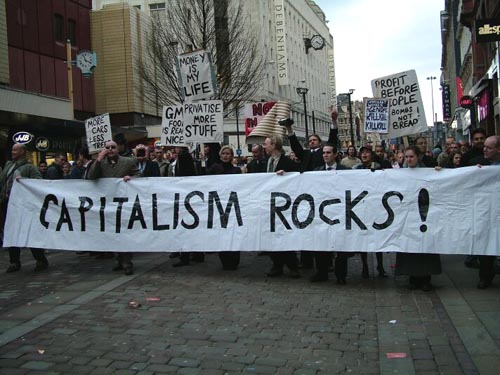 Here at Public Citizen I find that a lot of our detractors espouse a strong dedication to free-market ideologies. I find that this ideology is used to justify a large amount of otherwise irrational behavior, and that its adherents have an unshakable almost religious-like devotion. I find that many espouse the beliefs with a level of certainty which is typically reserved for obvious truths, despite the fact that many of their claims are unsupported as far as I can tell. I would like to look at what I see as some of the flaws in the claims of free market adherents.
Currently there are no countries in the developed world, including the United States, that use anything remotely resembling the minimalist government model these men espouse. Even our politicians who have advocated returning to a freer form of capitalism have been shown to reject this notion in practice. Ronald Reagan, who spoke of minimizing the federal government and getting off of people’s back, did the exact opposite in practice and was at the time of his presidency the most protectionist and most business beholden president we have ever had. If you doubt that, just read this piece (from an extremely free market source).
Today the world’s fastest growing developing countries, including China, India, the four Asian tigers (South Korea, Singapore, Hong Kong, and Taiwan), and much of Western Europe, all explicitly reject the tenets of minimal government intervention in their economies. The United States has maintained a substantial public sector and as well as a high level of government involvement in research and development of new technology through the military and university systems since the Great Depression. Continue Reading »
Posted in Global Warming | Tagged Asian Tigers, Capitalism, Free Mark, Government, Ideology, Intervention, Public Sector, Reagan, Spending, Texas |
Environmental Groups See Clean Energy Groundwork Laid for the Future
(Austin) Senate and House members from both political parties showed unprecedented support for developing more renewable energy and energy efficiency in Texas by filing a large number of clean power, green jobs bills in the 81st Texas State Legislature. A number of major bills passed either the House or the Senate. Ultimately, political disagreements over other issues and over the size and extent of the programs delayed and killed most of these excellent legislative initiatives.
Environmental groups Sierra Club, SEED, Public Citizen, Environmental Defense Fund, and Environment Texas applaud the passage of some clean energy, green jobs legislation and view the Legislature as having laid ample groundwork for the future.
“The fact that both the House and the Senate passed major legislation on energy efficiency and renewable power with bipartisan agreement shows that Texas leaders are willing and able to develop clean power and green jobs for our state,” noted Cyrus Reed, Conservation Director of the Lone Star Chapter of the Sierra Club. “Nevertheless, leaders were distracted by undue influence from industry interests and by the Voter ID debate which hampered passage of clean energy bills and other more vital areas of legislation.”
“Texas is moving more slowly than a melting glacier toward developing global warming policy. Rather than implementing already available energy efficiency and distributed energy solutions, Texas’ response to global warming is to develop futuristic industrial-sized solutions. As a result the state has legislation pending that may develop standards for large scale carbon sequestration projects and provide incentives to get companies to develop the technologies,” said Tom “Smitty” Smith, Director of Public Citizen’s Texas office. “On the positive side, the state has passed a study to develop a series of ‘no regrets’ solutions to global warming that the State can achieve at no cost. Also, the Texas House, especially the House Committee on Environmental Regulation, should be applauded for their more open leadership style this session which lead to far more reasoned and less ideological bills being developed in the committee.”
Clean Power, Green Energy Bills that passed both bodies and will go to the Governor (as this release goes to press):
- Green fleets legislation to promote low emissions and plug-in hybrid vehicles for fleets of major State Agencies (HB 432);
- Legislation allowing cities to create financial districts to loan money for renewable power and energy efficiency (HB 1937).
- Legislation setting a ‘no regrets’ strategy for greenhouse gas reduction in the State; a study of the state’s energy use to find ways to reduce our emissions and save money at the same time (SB 184)
- A coordinated green jobs strategy including funds allocated for child care programs, vocational training initiatives, energy efficiency measures, the Weatherization Assistance Program (WAP), and/or any other recovery funds (passed as a Rider to Article 12).
- Green fee bill passed allowing governing board of public colleges and universities to institute an environmental service fee once approved by student body election.
“This has been a disappointing session,” said Luke Metzger, Director of Environment Texas. “However, with the passage of HB 1937, we can start the ball rolling on developing Texas’ solar future, working with local communities one at a time to start financing solar and energy efficiency projects.”
Groundwork Laid for Next Session
The major Clean Power, Green Jobs bills that passed the House or Senate but did not ultimately make it to the Governor’s Desk include:
- Raising the state’s minimum residential and commercial building codes from 2001 to 2009 standards (passed Senate as SB 16 and HB 2783 in House);
- Raising the utility efficiency goal (SB 546 passed both houses but no agreement was reached between Senator Fraser and Representative Anchia on the size of the goals)
- Adopting appliance efficiency standards for a variety of products, including pool pumps (passed Senate as SB 16)
- Creating a 1,500 MW Emerging Technology Renewable Standard (SB 541 – passed the Senate)
- Creating a $500 million solar incentive program (SB 545 – passed the Senate).
- Creating a Policy requiring utilities and retail electric providers to pay consumers fair buyback rates for excess electricity generation from renewable energy (HB 1243 – passed House and Senate, but was killed in the House through concerns over germaneness and Senate amendments.);
- High performance energy efficiency building standards for state buildings, including universities and public schools (HB 431). The Senate may pass the conference committee report today, on Sine Die.
Factors which prevented bills with bipartisan support from making it across the finish line:
- The issue of Voter ID, which put many major efficiency and renewable bills too far down the calendar for consideration in the House;
- A disagreement over the germaneness and concern over the possible costs to low-income residents of adding the solar incentive bill (SB 545) to the surplus electricity bill (HB 1234), which led Representative Turner to ultimately kill consideration of the bill on the House floor;
- The election of a new Speaker and the naming of new Committee Chairman understandable led to some delays in getting the committees up and running to begin to consider bills;
- Disagreement between House and Senate on size and scope of goals set by solar and energy efficiency bills (SB 545 & 546);
- Disagreement over the potential costs and benefits of the Renewable Portfolio Standard (SB 541);
- Opposition from the Texas Manufacturers Association, the Governor and many utilities against the Renewable Portfolio Standard.
“We were happy to find some new allies this session including certain members of the legislature and some electric utilities that said they supported renewable energy and energy efficiency legislation,” said Jim Marston, Director of Texas Regional Office of Environmental Defense Fund. “Sadly, some of the electric companies talked a good game, but their support evaporated when opposed by their affiliated retail electric providers or others in the industry. In the end, the Association of Electric Companies of Texas reverted to representing the interests of the regressive elements of their membership harming the ability of Texas to participate successfully in the new energy economy.”
“Moreover, the Texas Association of Manufacturers (TAM) while acknowledging that an expanded renewable portfolio standard was the way to bring clean technology jobs to Texas, distributed false cost information about solar legislation that was repudiated by the PUC and others. The bottom line, TAM fought legislation that would have brought new manufacturing jobs to Texas,” said Marston.
Nuclear Bills Blocked
Environmental groups blocked bad bills that would have removed citizen rights to contest permits and would have promoted nuclear power in the State which many view as a financial drain from investment in truly clean energy.
“Nuclear power is expensive, consumes vast quantities of water, comes with serious security and health risks and creates radioactive waste, for which there is no good storage solution. We were happy to block two bad bills this session that were designed to benefit proposed nuclear reactors in Texas,” said Karen Hadden, Director of the Sustainable Energy and Economic Development Coalition.
The nuclear bills that were blocked:
- Fast tracked water permits for nuclear power plants and cut out contested case hearings (HB 2721 was left pending in House Environmental Regulation Committee)
- Subsidies for proposed nuclear power plants in the form of tax rebates (HB 4525 passed the House and was blocked in the Senate.)
“Representative Flynn’s bill would have fast-tracked water permits for nuclear plants, an outrageous attempt in a time of statewide drought,” said Hadden. “It would also have denied citizens an opportunity to contest issuance of the permits through hearings, an assault on democratic process. The other bad bill that we defeated would have given massive subsidies to nuclear power in the form of tax rebates.”
Miscellany
- A good bill to address the Compact Loophole for the Andrews County Low-Level Radioactive Waste Dump bill, HB 3423 Lon Burnam did not get out of Committee.
- Environmental groups blocked a bad provision that would have fast tracked water permits for “clean coal” plants in the final version of HB 469 and added cleaner emissions standards for those plants.
- HB 821 passed, requiring television manufacturers that sell televisions in Texas to make free and convenient recycling available. Texas Campaign for the Environment successfully advocated for this bill.
- Sen. Ellis used a threatened filibuster last night to kill HB 3827 which would have allowed oil companies to evade liability for MTBE water contamination;
- SB 2169 Sets up an interagency working group, co-chaired by the Texas Commission on Environmental Quality, the Texas Department of State Health Services, the Texas Department of Transportation with other agencies to discuss smart growth and make recommendations for developing the state in a sustainable way.
- An amendment to HB 300 creates a certification program for environmental coordinators in Texas Department of Transportation district offices. This bill is still in conference committee as this release goes to press.
“As it concludes, environmentalists can view this legislative session with some hopefulness – the Legislature is definitely involved and interested in clean energy and green jobs and did move these issues forward. But there is also some sadness – an opportunity to move significantly forward on clean energy was lost,” Cyrus Reed added. “Jobs that could have been created, and new sources of clean energy that could have been advanced in Texas were delayed this Session.”
Posted in Global Warming | Tagged 81st Texas Legislative Session, AECT, andrews county, building codes, carbon sequestration, clean coal, Clean Energy, clean power, compact loophole, Cyrus Reed, distributed energy, Energy Efficiency, environment texas, environmental defense fund, environmental groups, fast tracked water permits, flynn, germaneness, Global Warming, green fee bill, green fleets, green jobs, greenhouse gas emissions, house committee on environmental regulation, Karen Hadden, lon burnam, luke metzger, mtbe, no regrets, Nuclear, plug-in hybrids, Public Citizen, PUC, radioactive waste dump, recycling, renewable energy, representative rafael anchia, SEED Coalition, senator ellis, senator troy fraser, Sierra Club, TAM, TCEQ, tdot, Texas, texas association of manufacturers, Texas Campaign for the Environment, Texas Legislature, Tom "Smitty" Smith, txdot, utility efficiency goal, voter id, water contamination, Weatherization |
Well, the sun has just about gone down on the so-called “solar session”. Today is Sine Die — the last day of the legislative session. Friday night, HB 1243 — solar’s last lifeline — was killed on the House floor.
Earlier in the week, Rep. Warren Chisum called for a strict enforcement of the House rules on germaneness. As you may recall, last week we were pretty excited around here that the solar and electric coop reform bills were tacked onto the net metering bill because they were related enough to be considered germane.
But they weren’t germane enough under STRICT enforcement of the rules, so the bill was killed.
I waited to break the news, because we still had a chance to amend SB 545 to the energy efficiency bill, SB 546… but that didn’t work out either. The House and Senate authors of the bill (Anchia and Fraser) simply could not agree over the size and scope of the solar and efficiency goals, so the bill never made it out of conference.
Its all rather depressing. Feel free to join my Tom Waits/ James McMurtry/ Leonard Cohen Pandora radio station and wallow in grief. Leave a comment and I’ll send you an invitation. But no need to worry about Citizen Sarah getting dangerously down in the dumps… I’ve left my Townes Van Zandt CDs in the car, and am headed out to the river tomorrow. Will be back to my chipper self before too long.
Plus… the session wasn’t a total loss. It just wasn’t all that we dared hope for. As of right now, here’s a list of bills that passed both bodies and will go to the Governor:
- Green fleets legislation to promote low emissions and plug-in hybrid vehicles for fleets of major State Agencies (HB 432)
- Legislation allowing cities to create financial districts to loan money for renewable power and energy efficiency (HB 1937)
- Legislation setting a ‘no regrets’ strategy for greenhouse gas reduction in the State; a study of the state’s energy use to find ways to reduce our emissions and save money at the same time (SB 184)
- A coordinated green jobs strategy including funds allocated for child care programs, vocational training initiatives, energy efficiency measures, the Weatherization Assistance Program (WAP), and/or any other recovery funds (passed as a Rider to Article 12)
- Green fee bill passed allowing governing board of public colleges and universities to institute an environmental service fee once approved by student body election
Even now there is still good legislation pending that could maybe possibly potentially pass… but I’m just not at a point where I can get my hopes up anymore. Check in later this week for an update.
For you policy nerds out there, I’m willing to get further into the nitty gritty politics of how all this went down if you’re interested. Leave a note in the comments and let us know what you’d like to hear.
Posted in Energy, Global Warming, Renewables | Tagged anchia, citizen sarah, fraser, Global Warming, green fee bill, green fleets, green jobs, hb 1243, larry mcmurtry, leonard cohen, no regrets, plug-in hybrids, public citizen texas, solar, Texas, Texas Legislature, tom waits, townes van zandt, warren chisum, Weatherization |
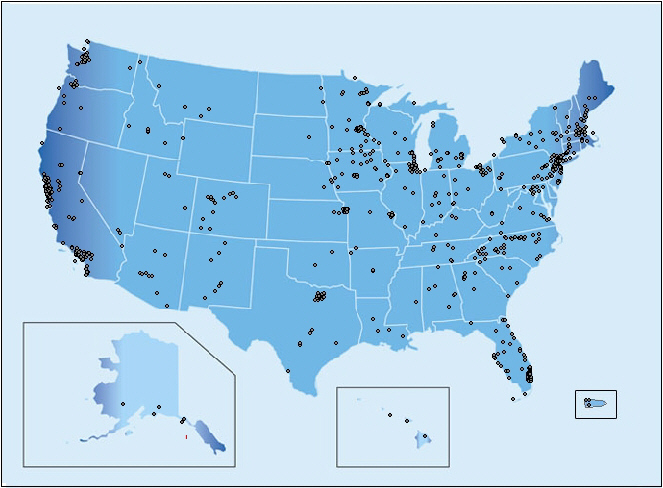 Climate change is clearly an important issue, and there is a lot that needs to be done about it at all levels of society. Fortunately there have been individuals and localities that have made great efforts to reduce their carbon footprint, and this should be applauded. I want to focus on a particular success in the area of local effort to reduce emissions and improve efficiency: The Mayor’s Climate Protection Agreement. This is an agreement between the mayors of several hundred participating cities, across the U.S to reduce their emissions to 7% below 1990 levels.
 The agreement was started on February 16, 2005 by Seattle Mayor Greg Nickels and there are currently 944 participating cities in the United States that have pledged to reduce their emissions below 1990 levels. The agreement was officially endorsed by the Annual U.S Conference of Mayors in 2005, and the conference has actively encouraged Mayors to sign onto the agreement since. Mayors in participating towns and cities use practices such as vegetation restoration, anti-sprawl policies, emissions controls and efficiency improvement activities to improve their climate friendliness. Continue Reading »
Posted in Global Warming | Tagged Air Quality, Carbon Dioxide, City Government, Clean Energy, climate change, Climate Protection Agreement, co2, college station, emissions, Kyoto, Local Government, Mayors, Seattle, Texas, wind |
We’ve been disappointed by the process that the American Clean Energy and Security Act has gone through recently, so a few weeks ago I went to go see my Congressman during his “neighborhood office hours” (at the Randall’s at the corner of William Cannon and MoPac) and talk to him about climate change. Then this morning I opened up my email inbox to find a communique from Congressman Lloyd Doggett.
Needless to say, it made me happy, so I’m sharing it with all of you. This should serve as an example– contact your leaders and tell them how you feel about issues like climate change. They do listen! (Or if they don’t– make them!)
I also think his ideas about the “Safe Markets Development” would be a major improvement to any climate bill. Read on to find out that experts also think it’s a good idea!
Full text after the jump….

May 28, 2009
Mr. Andrew Wilson
5xxx Little Creek Trl
Austin, Texas 78744
Dear Andy:
Knowing of our shared interest in fighting global warming and creating a robust green jobs economy, I would like to update you about my work in Washington.
This is an exciting time for those of us who have long wanted to make renewable energy affordable. Never before has there been such a push from both politicians and concerned citizens like you to get something done.
We cannot allow the fossil fuel special interests to blacken our chances at achieving a strong, clean energy economy in the same way that they blacken our skies. It is critical that the climate legislation this Congress produces ensure both price stability and environmental integrity. To this end, I have introduced the Safe Markets Development Act. I designed this act to
-Cap carbon pollution;
-Head off market manipulation;
-And incentivize renewable energy technology.
I have also introduced the Green Transit Act, which would require metropolitan planning organizations to consider greenhouse gas emissions in long-range transportation plans and transportation improvement programs. Transportation is an integral factor in the transition to a clean energy Continue Reading »
Posted in Global Warming | Tagged ACES, Austin, Carbon Dioxide, Clean Energy, climate change, congressman, congressman lloyd doggett, Global Warming, Lloyd Doggett, Texas, Waxman-Markey bill |
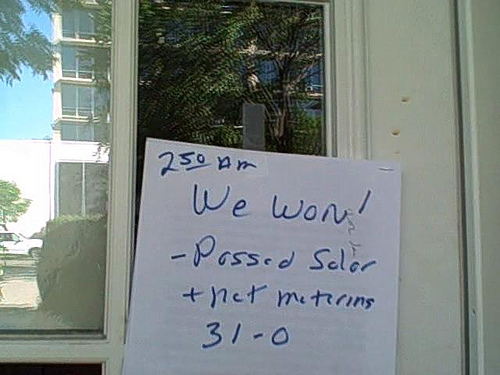 Last night at 11:58 pm (wink, wink), just as we suspected would happen, the Texas Senate unanimously passed through the net metering bill, HB 1243, with solar SB 545 amended on as a bonus. This is great news for Texas consumers, the environment, and solar power.
As you may recall, HB 1243 will ensure that owners of solar installations, small wind turbines, or biogas generators get paid a fair price for the excess power they produce. SB 545 — which after the Voter ID slowdown, we thought was dead — increases incentives for distributed solar power generation by creating a pool of $500 million in solar rebates over the next 5 years. It also calls for a pilot program with a minimum funding of $4 million to put solar on schools (nudge: the State Energy Conservation Office could potentially spend considerably more of their pending stimulus funds to further these projects) and will create thousands of green, local jobs across the state of Texas.
Another amendment to the bill added on SB 2349. This provision would allow oil wells that create natural gas, but not enough to justify paying for collection, to build a generator to run the gas through, make electricity, and sell it back into the grid. The bill would limit production to 2 MW so that they can provide distributed generation. As of right now, they’re just flaring that gas off, so this is definitely a good thing.
According to our friends at Environment Texas (via the Houston Chronicle’s NewsWatch: Energy blog), the amended HB 1243 also
• Requires home builders to offer solar as a standard option in developments with 50 homes or more.
• Prevents homeowners associations from blocking solar panel installations
• Allows up to 70% of incentive funds to be used for utility-scale solar projects
• Allows the Public Utility Commission to extend the program for an additional five years and another $500 million if it determined that a “substantial” amount of manufacturing of solar generation products located in Texas after the initial five-year program
• Requires electric co-ops to allow consumers to interconnect solar to the grid
• Clarifies that consumers will not have to register as a utility and that third party ownership of solar is allowed
• For the next two years, requires retail electric providers to pay at least five cents per kilowatt hour for surplus solar and four cents for other renewable technologies and directs the PUC to determine a fair market price that will become a new “floor” following the two years
• Creates a “Made in Texas” program to certify and encourage Texans to buy locally manufactured solar panels and other energy products. As a result, locally produced products qualify for a 20% larger rebate than imports.
Now that HB 1243 has successfully passed through both chambers of the legislature, we’ve just got to wait and see what comes out of conference committee, where bill authors from both sides will smooth out the differences between their bills. Many thanks to all of you that wrote e-mails and made phone calls in support of these bills. This is a tremendous victory for Texas solar. Keep your fingers crossed that we can send this bill to Governor Perry’s desk!
Posted in Energy, Renewables | Tagged distributed solar, electric coops, environment texas, governor perry, green jobs, HB, hb 1243, houston chronicle, made in texas, Passes Texas Senate, pec scandal, public citizen texas, retail electric providers, sb 545, sb 921, solar, solar rebates, Texas, texas consumers, texas senate, transparency |
Posted in Energy, Renewables | Tagged good day sunshine, green jobs, hb 1243, net metering, sb 545, solar energy, solar in schools, solar power, Texas, Texas Legislature |

Inside a Hog Confinement
I would like to discuss an issue that has been important to me for several years, but does not get much attention outside the Midwest or agriculture heavy states like North Carolina. In these states much of the landscape is covered by large indoor animal feeding units. These confinements, or Confined Animal Feeding Operations (CAFOS), hold thousands of hogs or turkeys and are typically disliked by the people living near them.
Unfortunately, CAFOs are also common here in Texas. The last several years have seen an increase in the number of CAFOs in Texas. McLennan and Erath counties are home to many CAFOs that house cattle and chickens, and their is a major hog confinement industry in much of the panhandle.
Regardless of what kind of animals are produced in CAFOs they inevitably generate several tons of animal waste, which is accompanied by persistent and strong foul odors that are easily detectable miles away. This also generates spills and runoff that contribute heavily to water pollution, making local rivers and lakes undesirable for fishing, swimming and most other purposes. The confinements are often owned by absentee land owners, including some of America’s largest corporations, who are frequent recipients of government money which is used to expand their operations.
Here are some of the facts:
1. A typical hog confinement can hold up to 10,000 pigs.
2. Confined livestock produce an estimated 500 million tons of excrement per year.
3. CAFOs release Hydrogen Sulfide, Ammonia, particulate matter and other highly toxic pollutants into the air and water.
4. These pollutants are detrimental to human health and individuals living near these have high levels of: diarrhea, excessive coughing, sore throats, fatigue and depression.
5. Workers in CAFOs are found to be at high risk for respiratory diseases: asthma, acute bronchitis, sinusitis, rhinitis, and pulmonary endema.
 6. Manure from these is stored liquid forms in lagoons that spill and leak into soil and water.
7. A spill from a single lagoon in North Carolina once released 25 million gallons of liquid hog waste into local water ways. Hundreds of smaller spills of thousands of gallons occur each year. EPA estimates: 35,000 miles of contaminated rivers. Continue Reading »
Posted in Global Warming, Toxics | Tagged Agriculture, antibiotics, CAFO, Confined Animal Feeding Operation, Confinements, environment, Factory Farm, FarM Bill, Hog Factory, Manure, Pfisteria, Pigs, pollution, Runoff, Subsidies, Texas, Water Pollution, Water Quality |
Earlier this morning, I offered the consolation that bills which died due to the Voter ID debacle could be revived as amendments to other bills. This afternoon, I’m keeping an eye on the Senate to see if my solar dreams will come true.
 This afternoon, the Senate has HB 1243 on their intent calendar. HB 1243 is a “net metering” bill which would ensure that owners of solar installations, small wind turbines, or biogas generators get paid a fair price for the excess power they produce. As HB 1243 is a solar-related bill, it can be deemed germane, or related, to solar SB 545, which “died” last night (as a reference, I’d also recommend this Houston Chronicle article).
Which means that SB 545 can (maybe, possibly) be amended to HB 1243. Tentative huzzah!
It gets better. HB 1243 is co-authored by Senator Troy Fraser — the same fellow who sponsored SB 545. As both of these bills are Fraser’s babies, the chances of SB 545 living on as an amendment are looking pretty good.
Senator Fraser has yet another opportunity with this bill to fix a gaping hole in the 500 MW non-wind renewable portfolio standard (RPS) passed last session. When this bill was passed, the RPS was described as a “goal” rather than a “target” — which due to a rather frustrating determination by the PUC, means that it can be interpreted as a recommendation rather than a requirement. Fraser was heard in committee calling this determination “the most ridiculous thing he’d ever heard.” Translation: PUC has decided they don’t actually have to do anything to work toward that 500 MW of non-wind renewables.
 During these dark, cloudy times at the Texas legislature, Senator Fraser can shine a ray of hope into the Senate chamber. He can create a pool of $500 million in solar rebates over the next 5 years, start a pilot program to put solar on schools, and create as many as thousands of green, local jobs in one fell swoop. He can fix net metering so that individuals get a fair buy-back for the excess electricity they produce and actually have an incentive to shell out the cash for a new solar installation. He can also ensure that Texas ends up with an additional 500 MW of non-wind renewables.
So cross your fingers, cross your toes… cross your arms and legs if you think it will help. If Senator Fraser is your representative, give him a nudge — but otherwise, I’d stick to chanting.
Posted in Energy, Renewables | Tagged bio gas, buy back rates, HB, hb 1243, net metering, non wind rps, rps, sb 545, senator fraser, senator troy fraser, small wind, solar, solar installations, Texas, texas senate, troy fraser, voter id |
If you’ve been following the Texas Legislature at all over the weekend, you’ve probably heard the term “chubbing” at least once. Yesterday marked the deadline for all bills that originated in the Senate to pass second reading — which means that any bills that didn’t make it through the House by midnight last night are dead for the session. One of the bills on that list was the contentious Voter ID bill, which would have required Texas voters to present a valid driver’s license to vote. In order to block this bill, which would have suppressed voter turnout across the state, House democrats adopted the “chubbing” tactic — talking bills to death — to avoid getting far enough down the bill list to have to vote on Voter ID.
Unfortunately, this stalling technique killed a tragically long laundry list of bills that were scheduled after Voter ID. Among these were many of the bills we have been pushing hard this session to improve air quality in Texas, increase our energy efficiency standards, reform electric coops, and encourage solar development.
Missing Tuesday’s deadline is an enormous set-back, but not all hope is lost. Bills that died last night can still be revived as amendments, which can be tacked on to House bills that are alive in the Senate. As the Austin American Statesman reports,
Legislators now have two ways of bringing proposals back to life. The first option is for senators to tack dying proposals onto other related bills that did not fall victim to the voter ID fight in the House. For example, Sen. Kip Averitt, R-Waco, said Tuesday that he may be able to salvage some, but not all, of a comprehensive air quality bill that he has worked on for two years.
“I’ve come to expect tragedy at the end of the session, and tragedy always appears,” Averitt said.
The other option is for the House to take a two-thirds vote to bring up bills.
The two-thirds vote is a pretty enormous step, and highly unlikely for most of the bills we’ve been working one, but the amendment strategy is tried and true. We’ll be scrambling this week to salvage what we can — it ain’t over til its over, and you can bet we’ll be doing everything we can to fight for what matters for Texas.
Thanks to all you citizens for all your hard work, e-mails, and phone calls to representatives this session. In the next few days, we’ll be needing your help more than ever. Stay posted, and we’ll let you know what you can do to help save solar power, air quality, and energy efficiency.
Posted in Global Warming | Tagged Air Quality, amendments, austin american stateman, chubbing, driver's license, electric coops, Energy Efficiency, kip averitt, solar energy, solar power, stalling, Texas, texas house, texas senate, voter id, Waco |
« Newer Posts - Older Posts »


