And so it begins….
We knew as soon as there was a draft climate bill that it would be falsely attacked and derided disingenuously as “an energy tax.” But we had no idea to what extent the truth-stretchers would go to make their rhetorical points.
Did I say stretch the truth? I meant break, beat, spit upon and then toss it into a cesspool to be feasted upon by worms and vermin, for as little as truth means to these lying liars.
Wednesday, Keith Olbermann named John Boehner his “Worst Person in the World” for his exaggeration lie about the costs of tackling carbon. Watch this video for yourself:
[youtube=http://www.youtube.com/watch?v=7lJWX_xmxco]
This is just the tip of the iceberg. At least some people are willing to check their facts and talk about climate in a rational manner. Look, a Press Release! (emphasis added is mine, not in original)
‘Energy Tax’ Rhetoric Ill Serves Debate on Climate Legislation
Republican members of Congress have taken to calling cap-and-trade legislation an “energy tax” or a “light switch tax” on American families and businesses.
Most recently, congressional Republicans misrepresented a Massachusetts Institute of Technology study analyzing cap-and-trade proposals. They distorted the study’s conclusions to exaggerate the costs of cap-and-trade legislation on individual households, by making faulty calculations based on erroneous assumptions and by ignoring a basic principle of economics – the time value of money.
Conservatives, of all people, should not ignore basic principles of economics. Continue Reading »
Posted in Global Warming | Tagged Carbon Dioxide, climate change, Congress, Global Warming, John Boehner, Kieth Olbermann, not an energy tax, propoganda, Texas, Waxman-Markey bill, Worst Person in the World |
Greg Harman at the San Antonio Current broke this story a few days back and I just feel like we have to comment:
As Washington strains under the weight of industry and environmental lobbyists seeking to influence the outcome of what would be our first national climate bill, CPS Energy has been quietly working the angles on Capitol Hill to keep the coal power the city has come to rely on cheap for consumers in the short term. So-called “cheap” power is the mandate the utility operates under, after all.
Too bad that mandate is now at odds with the survival of the earth as we know it and, quite possibly, our survival as a city and a nation.
…
Responding to an Open Records request submitted by the Current, a CPS Energy legal staffer wrote that the City-owned utility has spent $91,700 lobbying in the past year “in the attempt to influence U.S. climate policy.”
According to Zandra Pulis, senior legal counsel at CPS, the utility has also spent about $67,657 in membership dues to the Climate Policy Group, an industry group it joined in September of 2006 that lobbies Congress against limiting carbon emissions under cap-and-trade legislation. An effort that, to this point, has been remarkably successful.
…
All told, CPS has spent $2.56 million on lobbyists (since 1999) working the statehouse and the Capitol, according to Pulis.
That’s right — CPS has spent millions of YOUR dollars on lobbying, much of which has gone to try to argue climate change isn’t happening.
Look, I understand that CPS has a mission to produce inexpensive electricity for San Antonio residents and business. That’s a good thing. But the facts are these:
1- Climate change is happening. But even if it wasn’t, everything we need to do to solve it is something that we would want to be to doing anyway. We need to start living with the fact that political consensus has developed in Washington. Sooner or later, we’re going to have to start paying for our greenhouse gas pollution, so we’d better start figuring out how to get our energy from non-polluting sources. Continue Reading »
Posted in Global Warming | Tagged Austin, capitol hill, central texas, climate change, climate policy group, coal power, CPS Energy, david spade, eco-friendliness, Global Warming, green jobs, greenhouse gasses, Greg Harman, kilowatt, lobbying, mission verde, Nuclear Power, public utility, San Antonio, san antonio current, sandra pulis, South Texas Project, Texas, tommy boy, washington, windtricity |
Original post found on the Coal Block blog.
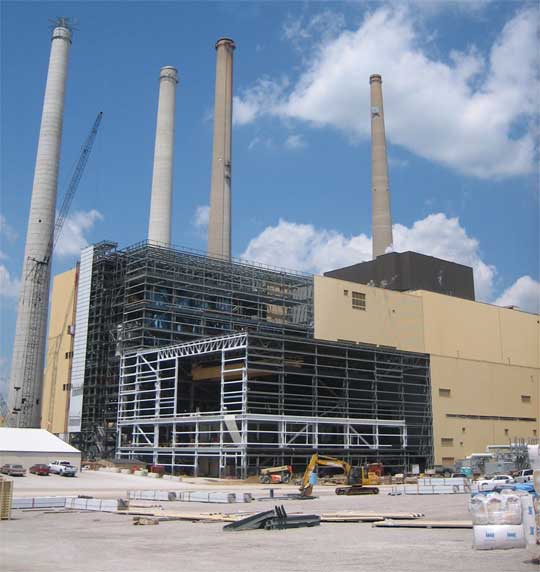 This past Monday there was a public meeting to give the local community a chance to voice their opinion about the proposed White Stallion Power Plant near Bay City, Texas. The plant would be approximately a mile south of Bay City off of FM 2668, and construction is scheduled to begin next year.
At the meeting the people of the community took advantage of the opportunity to stand up in opposition to the plant.
“The vast majority of questions and comments were stressing concern about emissions from the plant and the effect it will have on the health of the people, the environment and the wildlife of Matagorda County,” said Public Citizen”s own Ryan Rittenhouse. “Many of the closest folks living near the proposed site were there and all were very concerned at the prospect of the plant.”
The health hazards resulting from burning coal are staggering.
“Old, coal-fired power plants are among the biggest industrial contributors to unhealthful air, especially particle pollution in the eastern United States,” said the American Lung Association’s State of the Air 2007 report. “The toll of death, disease and environmental destruction caused by coal-fired power plant pollution continues to mount.”
As of now, nothing will be addressed in regards to the CO2 emissions of the White Stallion plant, which was a top priority of all the opposition at the meeting. The plant would emit approximately 10 million tons of CO2, about 100 pounds of mercury, and about 5,000 tons of sulfur dioxide every year. This undoubtedly would move Matagorda County and Bay City closer to federal air quality non-attainment status, and contribute to the already high levels of mercury in the Gulf Coast region.
Unfortunately though, those concerns were not able to be addressed as thoroughly as we are accustomed to in these public meetings. The questioning was cut short before everyone in the meeting had a chance to have their questions answered. A number of people who gave comments during the official comment period remarked on this and expressed displeasure at not being allowed to ask all their questions.
A request was made by Public Citizen to have another public meeting so that everyone’s questions could be answered. There is no indication as to whether or not this request will be granted.
Posted in Coal, Global Warming | Tagged american lung association, bay city, Coal, coal block, coal plant, gulf coast, matagorda county, Public Citizen, public meeting, ryan rittenhouse, Texas, white stallion |
President Obama has voiced that two of his top priorities will be climate change and energy. Earlier this month he  announced an energy plan that would call for 14% reduction in emissions from the 2005 levels by 2020, and an 83% reduction by 2050.
But House Democrats Henry a. Waxman (California) and Edward J. Markey (Massachussettes) want more! They drafted a bill with even more gusto to capture greenhouse gases—a 20% reduction in emissions by 2020!
Remember that this power team was also responsible for the bill to put a moratorium on coal plants introduced a year ago. The new Waxman-Markey bill will require every region of the country to produce 25% from renewable sources such as wind, solar, and geothermal. This could be a huge factor to increase the demand for sustainable energy to spur wide-range development and adoption of energy technology.
Mr. Waxman, the chairman of the Energy and Commerce committee said regarding his bill:
This legislation will create millions of clean energy jobs, put America on the path to energy independence, and cut global warming pollution. Our goal is to strengthen our economy by making America the world leader in new clean energy and energy efficiency technologies.
However, the bill also makes some concessions to the states whose economy rests upon coal and energy-related industries, with the hope that it will smooth the transition to cleaner forms of energy. To read more, check out this press release from Tyson Slocum at our D.C. office.
EDITOR’S NOTE: This bill is a really great start. Obama started the bid at a 14% cut, the House upped the ante to 20%, but according to the Nobel-prize winning Intergovernmental Panel on Climate Change, the real target we should be shooting for is about 35%. Unfortunately, none of the bills in the House or Senate is shooting for this target. The good news is, according to an analysis by McKinsey and Company, almost all of that 35% can be achieved at a net cost savings through things like energy efficiency. And realistically, that’s only 3.5% per year for the next decade. ~~Citizen Andy
Posted in Efficiency, Energy, Global Warming, Good Government | Tagged air pollution, Bill, capture, conservation, Energy, energy emissions, energy technology, greenhouse gases, house of representatives, Markey, obama, reduction, renewable, Texas, Waxman, Waxman-Markey bill |
March 31, 2009 by Citizen Carol
In addition to Lon Burnam’s HB 3423, there are five other good bills that will be heard in the House Environmental Regulation Committee this Wednesday, April 1, 2009 at 10:30 am or upon adjournment of the House in the Capital extension – Hearing room E1.014. We are incouraging everyone who has a few minutes to stop by the committee room and put in cards supporting these six bills. The five bill numbers are listed below, followed by a brief description of the bill and why your support is important. Please send this message along to anyone else you think might be interested!
HB 1450, Rep. Rodriguez. Relating to the disposal and reuse of coal combustion waste. HB 1450 establishes the disposal and reuse of coal combustion waste as a class I industrial waste and prohibits use as mine backfill. In addition, it requires groundwater and soil monitoring that must be made publically available. We’ve been over this one before. Texas tops the list of states at risk from toxic coal ash waste, remember? No bueno.
HB 557, Rep. Hernandez. Relating to the establishment of an air pollutant watch list and associated reports for the purpose of controlling the emissions of air contaminants under the Texas Clean Air Act. HB 557 establishes an air pollutant watch list and associated reports for the purpose of controlling the emissions of air contaminants under the Texas Clean Air Act to protect against adverse effects related to :
(1) acid deposition;
(2) stratospheric changes, including depletion of ozone; [and]
(3) climatic changes, including global warming; and
(4) air pollution.
HB 769, Rep. Hernandez. Relating to standards for measuring the emission of air contaminants under the Texas Clean Air Act. HB 769 requires TCEQ to set standards for measuring the emission of air contaminants under the Texas Clean Air Act that takes into consideration acute and chronic health effects on a person resulting from exposure to an air contaminant; the lifetime exposure of a person to the highest concentration of the air contaminant from an emission source; and does not increase the risk of cancer in a person exposed to the air contaminant by greater than one chance in 100,000.
HB 3428, Rep. Hernandez. Relating to measuring, monitoring, and reporting emissions. HB 3428 requires TCEQ to establish and maintain an air pollutant watch list available online to the public.
HB 3422, Rep. Burnam. Relating to the establishment of a program for the collection, transportation, recycling, and disposal of mercury-containing lights. HB 3422 establishes a program to safely dispose of and recycle mercury containing lights. It requires manufacturers to provide collection bins, to collect the bulbs and cover the costs of shipping to an appropriate facility. Mercury containing lightbulbs would have to be removed before buildings are demolished. The bill also has an important educational component.
You can register comment on all of these good bills in one fell swoop by visiting the House Environmental Regulation Committee hearing in E1.014 this morning. Committee hearings are open to the public, and you can put your official stance on the record by just dropping a card. If you can’t visit the Capitol today, why not give one of the fine legislators on this committee a call?
Posted in Coal, Global Warming, Toxics | Tagged air pollution, capitol, clean air act, coal combustion waste, committee hearing, Global Warming, hb 1450, hb 3422, hb 3428, hb 557, hb 769, house environmental regulation, industrial waste, lon burnam, mercury, ozone, Public Citizen, rep. burnam, rep. hernandez, rep. rodriguez, Texas, texas state capitol |

Rep. Lon Burnam’s bill, HB 3423, will be heard on Wednesday, April 1st, in the House Committee on Environmental Regulation hearing at 10:30 AM or upon adjournment, in E1.014. If you are able to come, we’re trying to get as many people as possible to register their support of this bill (by filling out a witness affirmation form). That’s right, officially registering your opinion on a bill is as simple as filling out a card. The bill closes the Compact Loophole, and requires other states who want to send radioactive waste here to get legislative approval first.
The Compact Agreement was originally between Texas, Maine and Vermont. Maine pulled out of the Compact, and now Texas and Vermont are able to send their radioactive so-called “low-level” waste to be stored at the Andrews County dump in West Texas. A loophole in the Compact Agreement allows any state to send radioactive waste to Texas. We don’t need to be the nation’s nuclear dump!
The license for that dump was recently issued by the TCEQ, and the agency wrongly denied the opportunity for a contested case hearing (read: locals were not allowed to voice their opposition in any formal environment). Three long-term scientists at TCEQ recommended denying the permit — and actually left their jobs for ethical reasons once the permit was approved. The science is NOT solid for the Andrews County radioactive waste dump – and there are concerns that radionuclides could come in contact with underground water. It is possible that contamination could spread to the Ogallala Aquifer, which underlies eight states, including the nation’s wheat growing region.
96% of the radioactive waste slated for the site would be from nuclear reactors — everything except the fuel rods. Radionuclides in the waste are dangerous today and remain dangerous for thousands of years. A recent Nuclear Regulatory Commission ruling reclassified depleted uranium from reprocessing, putting it into a less hazardous (Class A) category. Now up to 1.4 million tons of depleted uranium could go to the West Texas site and/or Clive, Utah sites.
If you can’t make it in person, calls to the Environmental Regulation committee in support of Burnam’s bill are needed! If you are a constituent, please let them know that.
Rep. Byron Cook (Chair) – 512-463-0646, Byron.Cook@house.state.tx.us
Rep. Warren Chisum (Vice-Chair) – 512-463-0736, Warren.Chisum@house.state.tx.us
Rep. Lon Burnam – 512-463-0740, (it’s his bill, give him a call to say thanks.)
Rep. Jim Dunnam – 512-463-0508, Jim.Dunnam@house.state.tx.us
Rep. Jessica Farrar – 512-463-0620, Jessica.Farrar@house.state.tx.us
Rep. Kelly Hancock – 512-463-0599, Kelly.Hancock@house.state.tx.us
Rep. Ken Legler – 512-463-0460, Ken.Legler@house.state.tx.us
Rep Marc Veasey – 512-463-0716, Marc.Veasey@house.state.tx.us
Rep. Randy Weber – 512-463-0707, Randy.Weber@house.state.tx.us
For further background on the Andrews County dump, check out Forrest Wilder’s article from the last Texas Observer, Waste Texas: Why Andrews County is so eager to get dumped on. Or if you’re more the auditory type, listen to the podcast.
Check out the press release after the jump.
Continue Reading »
Posted in Nuclear | Tagged andrews county, byron cook, compact loophole, environmental regulation, jessica farrar, jim dunnam, kelly hancock, ken legler, lon burnam, maine, marc veasey, NRC, Nuclear Power, Nuclear Regulatory Commission, nuclear waste, ogallala aquifer, radioactive waste, radionuclides, randy weber, Texas, vermont, warren chisum, waste dump |
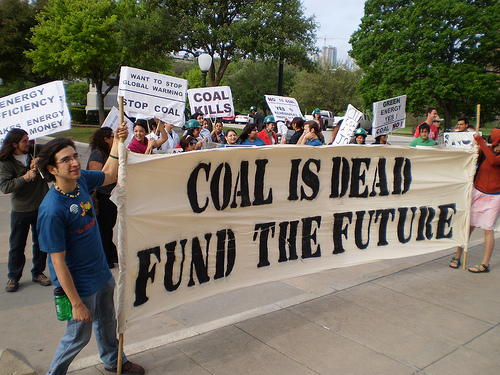 We’re already getting push-back from coal industry on account of the ReEnergize Texas Rally at the capitol Monday morning. When the coal industry’s “clean coal” PR machine is running scared and feels the need to release official press releases… you’re doin’ it right.
Original post found at Burnt Orange Report:
This weekend 170+ students from more than 25 colleges and five high schools descended on Austin for the ReEnergize Texas Summit to demand bold clean energy solutions.
The students held a rally at the Texas Capitol Monday morning and followed up with more than 50 visits to their legislators. Students rallied behind calls to end dependence on coal and nuclear power and to create new green jobs with investments in wind, solar and energy efficiency.
While the event went largely unnoticed by the media, the coal industry was apparently watching. The American Coalition for Clean Coal Electricity issued a statement following the event:
“The Re-energize Texas Summit rallies behind laudable goals including the continued development of renewable energy sources and increased energy efficiency measures; however the group’s support of legislation to place a moratorium on new coal plants in Texas is misguided, economically unfeasible and environmentally unnecessary,” said Joe Lucas, Senior Vice President of Communications at ACCCE.
The ACCCE statement appears to come in response to the students’ support of legislation placing a temporary moratorium on coal-fired power plants without carbon capture and sequestration (SB 126, sponsored by state Sen. Rodney Ellis and its companion bill HB 4384, sponsored by Rep. Allen Vaught).
According to the National Wildlife Federation’s Praween Dayananda:
“Halting the construction of proposed coal plants will help curb climate change and protect local communities from dangerous health impacts. Texas has incredible potential to produce renewable energy, clean up its skies, and become a leader in the new energy economy.”
Speakers at the rally that scared the coal industry were Senator Leticia Van de Putte, Representative Tara Rios Ybarra, Doug Lewin from Senator Ellis’ office and Public Citizen’s own Director Tom “Smitty” Smith.
For more information about the summit, visit www.reenergizetexas.org.
Check out more photos from the rally and more from the ReEnergize Texas Flickr photo pool.
Posted in Coal, Global Warming | Tagged american coalition for clean coal electricity, Austin, burnt orange report, coal industry, coal power, doug lewin, leticia van de putte, Nuclear Power, reenergize texas, ReEnergize Texas Rally, senator ellis, tara rios ybarra, Texas, texas state capitol, Tom "Smitty" Smith |
This was too funny not to share.
Courtesy of Gardner Selby at the Austin American Statesman’s Postcards blog:
Rep. Jim Dunnam of Waco, leader of the House Democratic Caucus, stunned observers at a hearing this afternoon by lining up what looked like shots of whiskey on the members’ dais in the hearing room and then gulping down several to buttress a point about the cumulative impact of air pollution.
But rest easy, Temperance League.
Dunnam said after shot three that the brownish liquid in the shot glasses was iced tea.

This is such a beautiful analogy. Chairman Dunnam made this point while explaining HB 2495, “AN ACT relating to the consideration of the cumulative effects of emissions from proposed facilities in actions by the Texas Commission on Environmental Quality on applications for certain air contaminant emissions permits or permit amendments.” With a total of 9 lines and less than 200 words, this was very simple.
When permitting new coal-fired power plants, current TCEQ policy does not consider the cumulative effects of the emissions from those plants. That means that if eight coal stacks were to be built within one county, as they were in McLennan county in 2007, then TCEQ can consider each of the proposals only as an individual entity and its potential to cause harm to health and quality of life. As Rep. Dunnam illustrated, the effects are cumulative, whether you drink one shot in Waco, one in Houston, one in San Antonio, etc. Continue Reading »
Posted in Global Warming | Tagged Air Quality, Chairman Dunnam, Coal, coal plant, EPA, House Democratic Caucus, jim dunnam, Rep. Jim Dunnam, Rep. Lon Burnam, TCEQ, Texas, Texas Legislature |
 The EPA in the last day or so has assumed the dreaded playground title of “taker backer”. Tuesday, Lisa Jackson announced that they would be putting a moratorium on all mountain top removal mining permits, which could delay 150-200 surface coal mines. Yay for the environment right? Well, not so fast. Later that day the announcement was made that they weren’t actually putting any type of hold on mining permits, and that they were simply reviewing two of them.
Check out the EPA’s official, and somewhat grumpy, statement:
The Environmental Protection Agency is not halting, holding or placing a moratorium on any of the mining permit applications. Plain and simple. EPA has issued comments on two pending permit applications to the U.S. Army Corps of Engineers expressing serious concerns about the need to reduce the potential harmful impacts on water quality. EPA will take a close look at other permits that have been held back because of the 4th Circuit litigation. We fully anticipate that the bulk of these pending permit applications will not raise environmental concerns. In cases where a permit does raise environmental concerns, we will work expeditiously with the Army Corps of Engineers to determine how these concerns can be addressed. EPA’s submission of comments to the Corps on draft permits is a well-established procedure under the Clean Water Act to assure that environmental considerations are addressed in the permitting process.
So put away the champagne; the fight’s not over yet. But we are moving forward in the battle. At least they are finally looking at these mining permits permits seriously, as opposed to the flat denial of potential harm we heard from the Bush administration. Additional good news is that last week, in conjunction with a week-long lobbying campaign against mountain top removal, Senators Lamar Alexander and Benjamin Cardin sponsored a ban on the dumping of mine waste into streams.
While it is a little upsetting to have fallen victim to the one of the most severe cases of environmental Taker Backering in history, there is still hope for the future. We may not be getting the silver bullet we thought, but if the current EPA is even willing to address these types of problems, we’re still in a better place than we were a year ago.
Posted in Coal | Tagged army corps of engineers, bush administration, clean water act, coal mines, environment, Environmental Protection Agency, EPA, lamar alexander, Lisa Jackson, mountain top removal, Texas |
Sponsored by ReEnergize Texas, the event will feature speeches by leaders in the student climate change movement, as well as a diverse group of Texas Representatives and Senators.
 When: Monday, March 30th
Rally: 9:30am-10:30am
Lobby Appointments: 10:30am-2:30pm
Where: Texas Capitol (north of 11th and Congress)
Register at ReEnergizeTexas.org
Hundreds of youth from all over Texas will converge at a rally and a lobby day at the State Capitol for clean energy and climate justice! We will lobby for:
* Increasing distributed solar to 2,000MW of generation
* Stopping all new coal-fired power plants
* Creating programs that help disadvantaged youth stay on track to complete high school while improving energy efficiency in low-income homes
This promises to be a powerful moment in Texas grassroots politics. Join us 9:30am-10:30am for great speakers from the movement and the State Legislature including Senator Rodney Ellis, Representative Tara Rios Ybarra, and Public Citizen Director Tom “Smitty” Smith.
Lobby Day training will happen on Sunday, March 29th, 3:45pm-6:00pm. This training is crucial for those who want to play speaking roles during lobby visits. We will have materials, Q&A, and role play exercises.
The Texas Legislature only meets every 2 years. If we want a clean and just energy future for Texas, we have to go to the Capitol and make our voices heard. Join us!
Posted in Global Warming | Tagged Clean Energy, climate change, climate justice, coal moratorium, Coal Plants, distributed solar, Energy Efficiency, grassroots politics, rally and lobby day, reenergize texas, student climate change movement, Texas, texas capitol, Texas Legislature, Texas Representatives and Senators |
Here are some interesting articles I’ve read this week, which I think are well worth reading in full.
 Texas is taking a greater interest in global warming by Randy Lee Loftis at the Dallas Morning News
The Fight Plan for Clean Air by Kate Galbraith and Felicity Barringer, New York Times (word on the street that EPA will declare heat-trapping gases dangerous pollutants, keep your fingers crossed)
Solar’s time to shine in Texas? by Bill Dawson at Texas Climate News
The Fresh Prince of Clean Air: Prince Charles says financial crisis is ‘nothing’ compared to climate change, at Grist
Last chance for a slow dance? All the world fiddles as we near global warming’s point of no return by Greg Harman at the San Antonio Current — digg it up
Posted in Energy, Global Warming | Tagged bill dawson, clean air, Dallas Morning News, felicity barringer, Global Warming, Greg Harman, kate g, Kate Galbraith, New York Times, randy lee loftis, san antonio current, solar, Texas, texas climate news |
Breaking, wicked-sweet news from the U.S. Department of Energy:
FOR IMMEDIATE RELEASE
Thursday, March 26, 2009
Obama Administration Announces Additional $208,759,900 for Local Energy Efficiency Improvements in Texas
Block Grants to Support Jobs, Cut Energy Bills, and Increase Energy Independence
WASHINGTON – Vice President Joe Biden and Energy Secretary Steven Chu today announced plans to invest $3.2 billion in energy efficiency and conservation projects in U.S. cities, counties, states, territories, and Native American tribes. This includes $208,759,900 for state, county and city efforts in Texas. A detailed breakdown is below.
Today’s announcement builds on an investment of $545,757,732 in Texas weatherization and energy funding announced by the Administration on March 12th and detailed at energy.gov/recovery.
“These investments will save taxpayer dollars and create jobs in communities around the country,” said Vice President Biden. “Local leaders will have the flexibility in how they put these resources to work – but we will hold them accountable for making the investments quickly and wisely to spur the local economy and cut energy use.”
The Energy Efficiency and Conservation Block Grant program, funded by President Obama’s American Recovery and Reinvestment Act, will provide formula grants for projects that reduce total energy use and fossil fuel emissions, and improve energy efficiency.
The funding will support energy audits and energy efficiency retrofits in residential and commercial buildings, the development and implementation of advanced building codes and inspections, and the creation of financial incentive programs for energy efficiency improvements. Other activities eligible for use of grant funds include transportation programs that conserve energy, projects to reduce and capture methane and other greenhouse gas emissions from landfills, renewable energy installations on government buildings, energy efficient traffic signals and street lights, deployment of Combined Heat and Power and district heating and cooling systems, and others.
Of that sum, the City of Austin would get $7,492,70, Dallas $12,787,300, Houston $22,765,100, San Antonio $12,897,00, Georgetown $201,900, New Braunsfels $498,200, and San Marcos $498,100. The State Energy Office would also get $45,638,100.
That’s a lot of weather stripping and double panes:
[youtube=http://www.youtube.com/watch?v=pezKEkBIhqA]
A detailed breakdown of funding to state, city, and county governments after the jump.
Continue Reading »
Posted in Efficiency | Tagged Austin, dallas, doe, double panes, energy audits, Energy Efficiency, energy efficiency and conservation block grant program, houston, Obama administration, recovery and reinvestment act, retrofits, San Antonio, state energy office, Texas |
 Over the past three years, our country has experienced a paradigm shift. All across the nation, diverse voices are beginning to rise to the climate challenge, and they are all calling for action. At this moment our generation has the opportunity to offer a bold new vision of our energy future.
On March 28-30 2009, at Huston-Tillotson University, one of the oldest Historically Black Universities in the state, will host the second-ever ReEnergize Texas Summit. Young people from across the state of Texas will converge in Austin for the largest youth climate conference ever held in Texas.
In the first two days of the summit hundreds of young people will be engaged by speakers, workshops, and panels addressing the many aspects of climate change. They will meet in regional groups to network for future actions, and they will hear political leaders discuss their positions on climate change. On Monday, March 30th, these young people will march from Huston-Tillotson in East Austin across Interstate 35, a long-recognized racial barrier in the city of Austin, and will walk to the Capitol Building where they will lobby the State Legislature for climate change legislation.
Keynote speakers include:
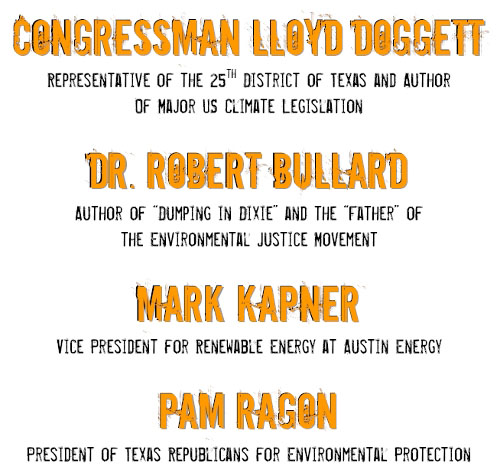
The summit is a primarily youth-focused event, but people from all walks of life are welcome — especially to the Lobby Day Monday! For more information on ReEnergize Texas, the conference agenda, and to register, visit http://www.reenergizetexas.org/
Posted in Global Warming | Tagged Austin, Austin Energy, climate change, congressman lloyd doggett, dr. robert bullard, dumping in dixie, environmental justice, Huston-Tillotson University, mark kapner, pam ragon, reenergize texas, ReEnergize Texas Summit, renewable energy, state legislature, Texas, texas republicans for environmental protection |
 Yesterday morning we held a press conference to highlight the importance of the proposed coal moratorium bill, SB 126, sponsored by State Sen. Rodney Ellis, and its companion bill in the house, HB 4384, sponsored by Rep. Allen Vaught.
SB 126 , which went into committee late Tuesday night, would put a temporary moratorium on authorizations for new coal-fired power plants that do not capture and sequester their carbon emissions. If all of Texas’ 12 proposed coal plants were built, they would emit an additional 77 million tons of carbon dioxide into the atmosphere. Top climate scientists, most notably James Hansen, have advocated for a coal moratorium as one of the top priorities to address climate change.
This legislation would also give Texas time to take a breath, see what federal carbon legislation will come down from Washington, and re-evaluate our energy plan. We expect carbon emissions to be given a price as a result of a federal climate change bill, and this would make the energy from coal considerably more expensive.
Floor Pass, the Texas Observer’s legislative blog, reports:
Environmentalists support these bills, but some feel they could be stronger. Both bills grant exceptions to facilities that capture and sequester some of the carbon dioxide they produce. Vaught’s bill mandates that a minimum of at least 60 percent of the carbon dioxide must be captured and sequestered in order for the exemption to apply. Ellis’ bill does not specify the amount.
“We definitely would support 100 percent reduction of carbon dioxide,” says Karen Hadden, director of Sustainable Energy and Economic Development Coalition. “We should not be adding carbon dioxide to our air at this point in time. It’s too risky in terms of climate change. Companies can do it, and they should.”
Representatives from communities currently fighting coal plants were on hand to discuss how this legislation will protect their families from dangerous health effects such as asthma and increased autism rates and improve local air quality. It was really moving to hear community members telling their own stories of how proposed coal plants would affect their lives. If you’re interested in hearing their stories, check out the video feed from the press conference. Look for March 25, Press Conference: Senator Rodney Ellis. That’s us!
The story got picked up in a couple other media outlets. All the news that’s fit to link:
“Foes take power plant fight to Austin” by Denise Malan, Corpus Christi Caller Times
“Texas coal opponents call for a temporary moratorium on new plants” by Barbara Kessler, Green Right Now
And if you STILL WANT MORE, check out our press release after the jump.
Continue Reading »
Posted in Coal | Tagged carbon capture, carbon legislation, clean economy coalition, climate change, Coal, coal moratorium, coal plant, corpus christi bay, Corpus Christi Caller-Times, floor pass, hb 4383, Karen Hadden, las brisas, mulit county coalition, patricia broadwell, Public Citizen, public citizen texas, representative allen vaught, roger landress, sb 126, SEED Coalition, senator rodney ellis, sequestration, sweetwater, Texas, texas medical association, texas observer, Tom "Smitty" Smith, white stallion |
 Good mooooooorning Texas! Just woke up, haven’t even gotten out of my pajamas or had my coffee (okay, I’m running a little late), but I couldn’t wait a moment longer to spread the good news. We’ve hit the big Times.
Yes, that Times. The New York Times.
Check out the following post from Kate Galbraith at the New York Times Green, Inc blog. Look for cameos by our very own David Power, Rep. Mark Strama, and the Austin Solar Plant.
TEXAS AIMS FOR SOLAR DOMINANCE
The Lone Star State leads the country in wind-power. Now Texas aims to ramp up its solar production too.
This week the state senate is considering an avalanche of bills that would boost state incentives for solar power, and the entire legislative session has become known as the “solar session.”
Altogether, according to David Power, the deputy director of Public Citizen Texas, a consumer and environmental advocacy group, there are 69 renewable energy bills before the legislature, and over 50 of them promote solar power – far more than ever before.
“There are senators and representatives that are talking about solar that have never mentioned the word probably in their lives,” he said. “We’ve actually heard the term ‘global warming,’ and two years ago that was called ‘the G word’ – you didn’t talk about it.”
Mark Strama, a state representative who is a leading promoter of renewable energy, has introduced at least five green bills this year (including a measure that would allow local governments to create a property tax financing program for solar, along the lines of several California cities).
“It just seems like everybody recognizes our leadership in wind, and that government policy got us where we are today in wind,” he told me last month.
In solar, he added, “We need to catch up.”
Some businesses, concerned about higher energy prices, urge caution.
“The state should avoid picking economic winners and losers in our economy through subsidizing solar – or any energy source – at the expense of the residential, commercial and industrial consumers who contribute significantly to the Texas economy,” said Luke Bellsynder, the executive director of the Texas Association of Manufacturers, in an e-mail message.
He also said, however, that his group supported incentives and tax abatements for solar, and broadening the state’s energy portfolio.
Earlier this month, the city of Austin, which is aggressively pursuing renewable power, unanimously gave a go-ahead to a private company to build the largest photovoltaic plant in the country, so that the local utility, Austin Energy, can buy the electricity produced.
However, the city met fierce opposition from struggling local technology firms and other groups, who complained about the prospect of higher electric bills.
Posted in Energy, Renewables | Tagged austin solar plant, david power, Global Warming, green, inc, Kate Galbraith, luke bellsynder, mark strama, New York Times, Public Citizen, public citizen texas, renewable energy, solar, solar power, Texas, texas association of manufacturers |
« Newer Posts - Older Posts »


