February 20, 2014 by Citizen Carol
On Wednesday, February 19, 2014, Nebraska’s recently passed law allowing TransCanada Keystone XL Pipeline Co. to proceed with construction across Nebraska was declared unconstitutional and void.
The ruling came from Lancaster County District Court Judge Stephanie Stacy. The Court ruled for three Nebraska landowners who challenged the law. The ruling includes a permanent injunction preventing Gov. Dave Heineman, and the Nebraska Department of Environmental Quality from taking any further action to authorize or advance the pipeline under the unconstitutional law.
Judge Stacy concluded the law unconstitutionally conferred upon the Governor of Nebraska the authority to approve a crude oil pipeline route, and to authorize the crude oil pipeline company to exercise the power of eminent domain against Nebraska landowners.
Siding with three landowner plaintiffs, the District Court concluded that under Nebraska’s State Constitution, exclusive regulatory control over pipeline companies like TransCanada Keystone XL must be exercised by the Nebraska Public Service Commission, and cannot be given to the Governor.
Judge Stacy also concluded that TransCanada was not empowered to take land from Nebraska property owners.
The court’s action effectively rescinds Gov. Heineman’s notification to Pres. Barack Obama that Nebraska legal procedures had been satisfied.
Dave Domina, the lawyer who handled the case for the landowners summarized the Ruling: “Under the Court’s ruling, TransCanada has no approved route in Nebraska. TransCanada is not authorized to condemn the property against Nebraska landowners. The pipeline project is at standstill in this State.”
A copy of the Court’s Opinion is found HERE: http://www.dominalaw.com/documents/LB-1161-Court-Order-Feb-19-2014.pdf
Posted in pipelines, Property Rights, Tarsands | Tagged #nokxl, Eminent Domain, keystone xl, nebraska, Nebraska Department of Environmental Quality, Texas, TransCanada Keystone XL Pipeline Co. |
February 19, 2014 by Adrian Shelley
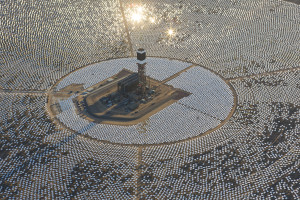
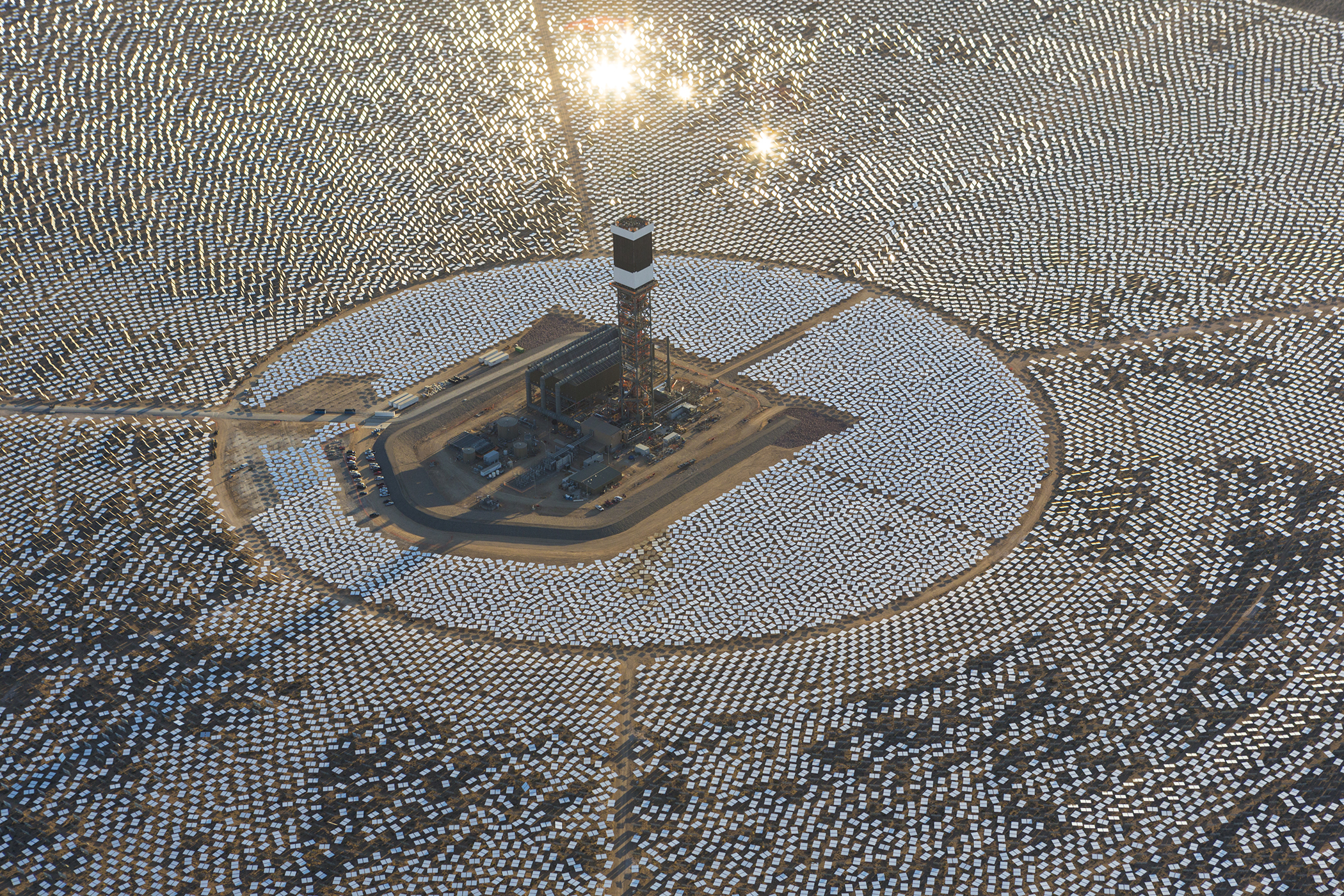
1 of 3 Power Towers at the 392 MW Ivanpah Solar Electric Generating System in California
Late last week, NRG Energy, Inc. announced that Ivanpah Solar Electric Generating System is in operation after six years of construction. Located in the Mojave Desert, 300,000 software-controlled mirrors and three 450-foot towers at full capacity can produce up to 392 megawatts of solar power. That will provide solar electricity for 140,000 California homes and will avoid 400,000 metric tons of carbon dioxide per year. The Ivanpah project received a guaranteed loan of $1.6billion from the US department of Energy’s Loan Programs Office, which became a joint investment made up of NRG Solar, Google and BrightSource Energy.
“Cleantech innovations such as Ivanpah are critical to establishing America’s leadership in large-scale, clean-energy technology that will keep our economy globally competitive over the next several decades,” said Tom Doyle, president, NRG Solar. Ivanpah accounts for nearly 30 percent of all thermal energy currently operational in the US and is the largest solar project in the world. This solar power tower technology is the first Ivanpah project to be used to produce electricity for company’s signed contracts with PG&E and Southern California Edison.

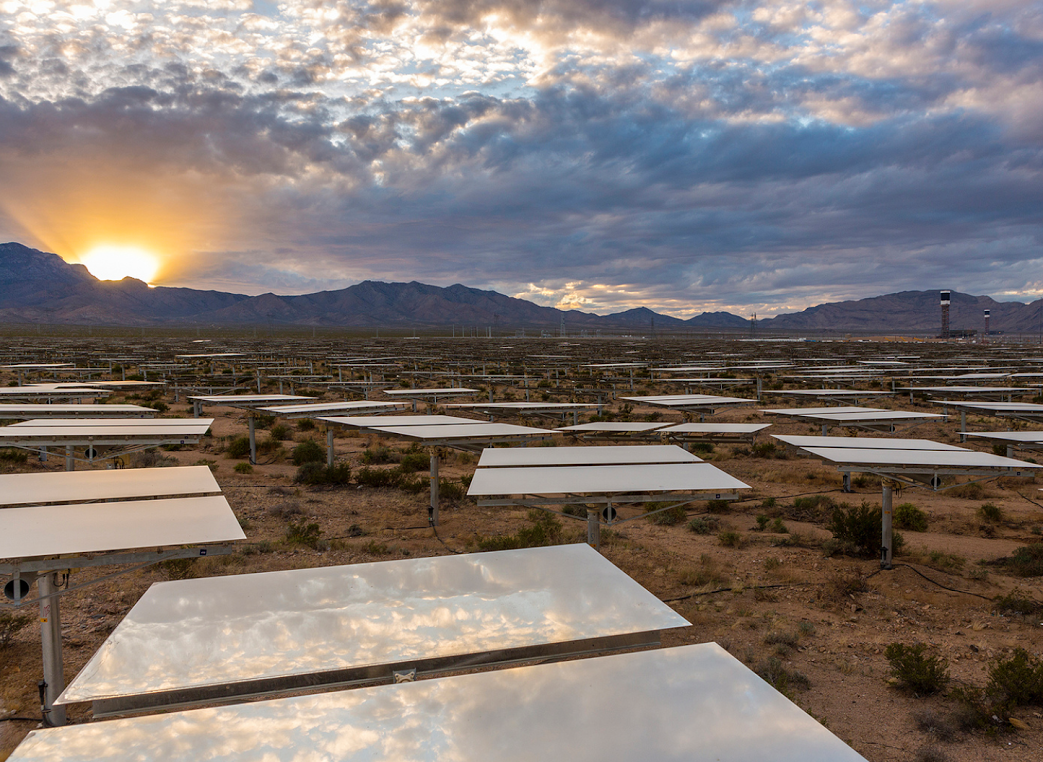
Heliostats at Ivanpah Solar Electric Generating System
Photo from BrightSource Energy Flickr
Solar thermal power plants use solar mirrors to heat water in boilers thus produce steam to turn the electricity generating turbines. This creates usable electricity by using large-scale magnification. The technology used in the Ivanpah plant comes from Bright Source and includes 173,500 heliostats that follow the sun’s trajectory, solar field integration software and a solar receiver steam generator.
Although solar thermal plants do require the use of water, as opposed to solar photovoltaic panels, this project utilizes dry cooling technology, which vastly reduces the amount of water needed. As Energy Secretary, Ernest Moniz says, “This entire facility will use roughly the same amount of water as two holes at the nearby golf course.”
Ivanpah produces solar power on a large scale rather than on rooftops. While some solar thermal power plants can store the sun’s thermal energy in the form of molten salt to produce energy when the sun isn’t out this project does not store energy after dark. BrightSource does plan to incorporate thermal storage in future next-generation designs.
Posted in Energy, Renewables, solar | Tagged BrightSource, BrightSource Energy, Ivanpah, Ivanpah Solar Electric Generating System, NRG Solar, Solar Thermal Energy, Texas |
February 18, 2014 by Citizen Carol
Less than two weeks ago, we reported on a fire at the New Mexico Waste Isolation Pilot Plant (WIPP) in our blog about a Texas interim charge to “study the rules, laws, and regulations pertaining to the disposal of high-level radioactive waste in Texas and determine the potential economic impact of permitting a facility in Texas. Make specific recommendations on the state and federal actions necessary to permit a high-level radioactive waste disposal or interim storage facility in Texas“.
WIPP is an underground low-level radioactive waste disposal site that began operations in 1999 and is the nation’s first repository for the permanent disposal of defense-generated transuranic radioactive waste left from research and production of nuclear weapons. On February 5th, WIPP entered emergency status, after a vehicle used to transport salt in the north area of the underground (not an area where radioactive waste was stored) caught fire. Several employees were taken to the hospital with smoke inhalation and WIPP’s underground operations have been suspended since the incident.
This weekend, airborne radiation was detected around 11:30 p.m. on Friday near Panel 7, Room 7, in the south salt mine., according to officials with the Department of Energy. No injuries were reported and no personnel were underground when the facility’s continuous air monitors, or CAMs, detected radiation downstream of where nuclear waste is disposed. The Department of Energy has told the public that:
- this incident is the first time in WIPP’s 15-year history that the facility has had a CAM alarm detect this level of radiation underground,
- they have not detected any above normal radiation levels above ground, and
- that the radiation leak is not related to last week’s fire.
I hardly feel reassured that there have been two, not insignificant (related or not) incidents at a 15-year-old facility that was designed to contain the waste for 10,000 years. And I am truly concerned that Texas thinks it can manage a high-level radioactive waste site in West Texas that will need to be designed to contain waste for 100’s of thousands of years.
Posted in Nuclear, Radiation, Radioactive Waste | Tagged radioactive leak, Texas, Waste Isolation Pilot Plant, WIPP |
February 12, 2014 by Adrian Shelley
 With the release of the State Department’s Final Environmental Impact Statement (FEIS) on the Keystone XL tar sands pipeline, there has been a lot of buzz about the project. The report concluded that Keystone XL could create carbon pollution equivalent to nearly six million cars, or eight coal-fired power plants. Last Week the State Department began accepting comments from the public, and with only a few weeks (until Mar 07, 2014 11:59 PM ET) left the need for citizens to weigh in has never been more urgent. Now is the time to tell Secretary of State John Kerry that this dirty pipeline is not in our national interest.
This is our final opportunity to officially weigh in on the decision. Submit a comment right now to tell the Obama Administration that the “game over for the climate” Keystone XL pipeline is NOT in our national interest.
Here are some facts to consider including in your comment to Secretary Kerry and the State Department:
- The evidence is clear that Keystone XL could increase production levels of tar sands oil in Alberta, and therefore significantly add to carbon emissions. The massive investment would lock us into dependence on this dirty fuel for decades, exacerbating carbon pollution just when we need to go in the other direction.
- Beyond the effects on our climate, this dangerous pipeline would also put the water supply of millions of Americans at risk, including the precious Ogallala Aquifer, Platte and Niobrara rivers, and hundreds of individual families’ wells. After a year in which many communities were harmed by spills from existing pipelines, we cannot allow any more of the dirtiest, most toxic oil on earth to spill into our lands and waterways.
- The jobs numbers touted by industry are exaggerated. Oil industry lobbyist and pro-pipeline politicians claim that the Keystone XL would create 20,000 to half a million jobs, but these jobs numbers are grossly exaggerated. Construction of the Keystone XL pipeline will only create about 3,900 jobs over a two year period, and after that the project would only provide jobs for 35 permanent employees and 15 temporary contractors.
- The Keystone XL is an export pipeline. According to presentations to investors, Gulf Coast refiners plan to refine the cheap Canadian crude supplied by the pipeline into diesel and other products for export to Europe and Latin America. Proceeds from these exports are earned tax-free. Much of the fuel refined from the pipeline’s heavy crude oil will never reach U.S. drivers’ tanks. Therefore, not reducing gas prices for Americans.
This is our last chance to voice concerns to the State Department before the public comment period ends on March 7. We need to get our message across to Secretary Kerry, because what he says could be one of the biggest determining factors in President Obama’s decision.
Submit your comment: Keystone XL is NOT in our national interest.
In addition to submitting your comment electronically, comments may also be mailed directly to:
U.S. Department of State
Bureau of Energy Resources, Room 4843
Attn: Keystone XL Public Comments
2201 C Street, NW
Washington, DC 20520
#NoKXL
Posted in Climate Change, Diesel, Energy, Global Warming, green jobs, Gulf Coast Ports, Jobs, pipelines, Property Rights, Safety, Tarsands | Tagged Final Environmental Impact Statement, john kerry, keystone xl, Keystone XL pipeline, nebraska, president obama, state department, Tar Sands, Texas, transcanada |
February 10, 2014 by Adrian Shelley
“CREZ will turn out to be the most visionary thing this state has ever done electricity-wise,” predicts Jeff Clark, executive director at the Wind Coalition, a regional partner of the American Wind Energy Association (AWEA).
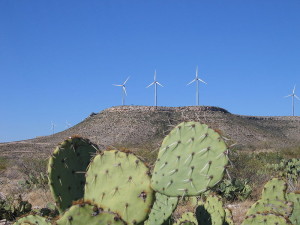
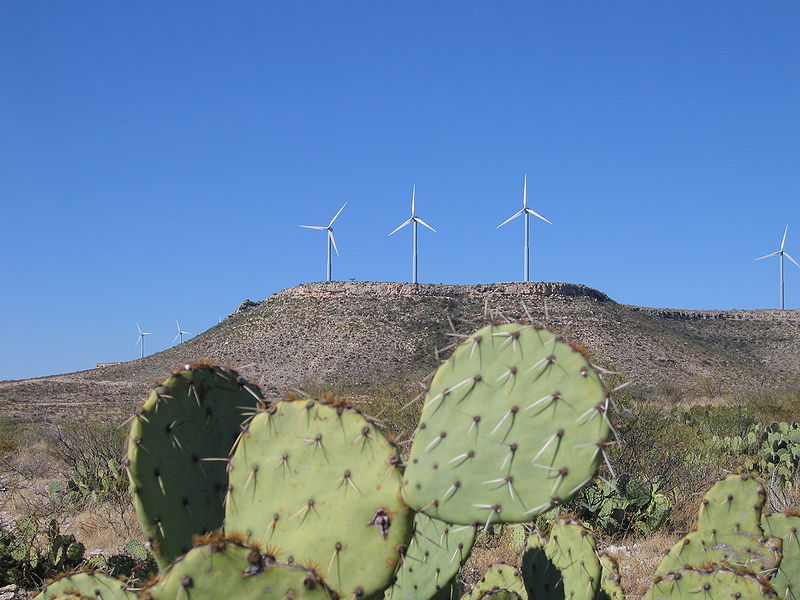
Wind turbines in west Texas
Only a few days ago, the final segment of Texas’s $6.8 billion, 3,600 mile Competitive Renewable Energy Zone (CREZ) transmission build-out was completed. The project, which has been in the works for over eight years, could signal the beginning of another era of wind power development in Texas.
In 2008, the Public Utility Commission of Texas (PUCT) identified five competitive renewable energy zones (CREZs) – geographic areas ideal for wind farms – in the Lonestar State . However, in order to get the energy generated in these CREZs to the areas that need energy most (Dallas-Fort Worth, Austin, Houston and San Antonio), transmission lines needed to be built. Instead of waiting for wind developers to come to Texas, and then begin the multi-year, multi-billion dollar project, the PUCT decided to put in the lines beforehand to entice developers to take advantage of the already existing infrastructure.
The new transmission lines, which will be able to transmit up to 18,500 megawatts of power across the state, will increase the wind capacity in Texas by over 50%, which will be three times as much as any other state in the nation. The large amount of potential wind energy in Texas, along with the new infrastructure, has already resulted in more wind developers coming to Texas, including a project in the panhandle by Pattern Energy Group that broke ground back in October.
All in all, the completion of the Texas CREZ Project is a huge step forward to moving our state towards absolutely clean, renewable energy. Instead of waiting for developers, PUCT has been proactive in creating a better future for our state.
Continue Reading »
Posted in Energy, Renewables, wind | Tagged American Wind Energy Association, CREZ, ercot, renewable energy, Texas, Texas CREZ Project, transmission lines, wind energy, Wind Energy Development |
February 8, 2014 by Adrian Shelley
 United Students Against Sweatshops (USAS) is holding a national conference at the University of Texas in Austin. It began yesterday, despite the campus being closed, and continues today, Saturday, February 8th. Hundreds of students from USAS joined with UT Save Our Community Coalition to rally against UT’s plan to outsource jobs to the global firm Accenture. The plan would cut 500 jobs and displace hundreds of community members.
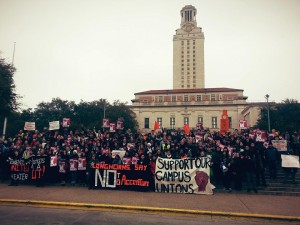
USAS & UT Save Our Community Coalition rallied against outsourcing jobs to Accenture on the UT Austin campus on Friday, Feb 7.
According to USAS’ website, “USAS member voted to hold the conference at UT …where the weather is as unpredictable as its citizens. Here in the birthplace of right to work (for less), women’s health care is under attack, our immigrant community is under attack and minorities are being attacked left and right.” UT students are taking action with the community and campus workers to stop privatization of the University of Texas and the outsourcing of hundreds of jobs. These jobs include on-campus positions and workers abroad who make the collegiate apparel for the university.

Students from USAS marched to the UT Austin campus with UT Save Our Community Coalition to rally against outsourcing jobs to Accenture on Friday, Feb 7.
Students at the conference are learning to plan national USAS campaigns, sharpen organizing skills, get new ideas, and work to build a student-labor movement. Workshops are lead by labor organizers and veteran student organizers.
USAS is the nation’s largest youth-led, student labor campaign organization. The organization has won precedent-setting campaigns and works to educate students of the dominance corporations have in a globalized economy. Successful and significant campaigns include organizing rights, fair contracts and living wage policies across campuses, communities and the United States. The organization also supports ensuring university support of good employment standards in local economies.
Posted in Jobs | Tagged Accenture, Texas, United Students Against Sweatshops, USAS, UT Save Our Community Coalition, workers rights |
February 7, 2014 by Adrian Shelley
After years in the making, this past Tuesday the Senate voted 68-32 in favor of the new Farm Bill, which is expected to be signed into law by President Obama in the next few days. While the nearly trillion dollar bill has received a lot of media attention on its relation to its cut of the Supplemental Nutrition Assistance Program (SNAP) which composes 80% of the bill’s budget, it’s crucial to look at the other 20% of the bill and its environmental implications.

Senate votes on 2014 Farm Bill
Photo by Alex Wong, Getty Images
The bill, for the most part, has drawn a lot of praise in regards to its environmental provisions . So-called ‘highlights’ of the bill include :
• Provisions for farmers to meet certain standards of environmental protection if they wish to be eligible to receive federal crop insurance
• Funding for farmers to create wildlife habitats on their land
• Funding for on-farm renewable energy
• Removal of so-called ‘anti-environmental’ riders
However, it is possible that one of the non-environmental provisions of the bill will have an unintended consequence – stripping soils of their nutrients and increasing runoff . Perhaps the most popular provision of the bill is the fact that it cuts ‘direct payments’ to farmers, or what many people have called “welfare for farmers” . These payments are subsidies for farmers based on how many acres of land they have, regardless of whether or not that land is farmed.
To cease what many see as handouts, the government as slashed this program and expanded its crop insurance program, one where the government pays the difference to farmers when slips in revenue and/or crop yield occur. While this is particularly useful in ensuring that there is ‘stable’ agricultural production, it also continues to incentivize producers (including many mega ‘agribusiness’ conglomerates) to produce as much as possible. Such large scale agricultural production can and has led to increased fertilizer runoff (causing aquatic ‘dead zones’ and contaminated drinking water ), nutrient-depleted soil and increased greenhouse gas emissions , due to insufficient environmental protection requirements.
Continue Reading »
Posted in Budget, Climate Change, Global Warming | Tagged Agriculture, climate change, environmental protection, environmental provisions, Farm Bill 2014, Global Warming, president obama, Runoff, SNAP, Supplemental Nutrition Assistance Program, Texas |
February 6, 2014 by Adrian Shelley
Duke Energy said on Monday afternoon that between 50,000 to 82,000 tons of coal ash and up to 27 million gallons of water were released from a pond at its retired coal fired power plant in Eden, NC, and spilled into the Dan River.
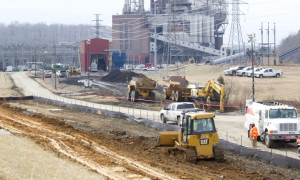
Re-enforcing and patching the berm to the ash basin at the Duke Energy Dan River Steam Station in Eden, N.C.
Photo by Joseph Rodriquez, News & Record
Duke said a 48-inch stormwater pipe beneath the unlined 27-acre ash pond broke Sunday afternoon, and tens of thousands of tons of coal ash and water drained into the pipe before spilling into the Dan River. Duke Energy says that the dam along the river remains secure and has not been affected.
Duke did not issue a press release to inform the public until Monday afternoon, more than 24 hours after the spill occurred. Duke said it notified local emergency managers and the N.C. Department of Environment and Natural Resources on Sunday afternoon. Duke says the leak has been temporarily stopped and they are working on a permanent solution. Duke has 14 coal fired power plants in the state, seven of which have been retired.
The closest community downstream from the spill is Danville, VA, which takes its water from the Dan River only six miles from the pond. Officials are saying that water samples confirm that the water leaving the city’s treatment facility meets public health standards.
“All water leaving our treatment facility has met public health standards,” said Barry Dunkley, division director of water and wastewater treatment for Danville Utilities. “We do not anticipate any problems going forward in treating the water we draw from the Dan River.”
Coal ash, the toxic waste material left after coal is burned, contains arsenic, mercury, lead, and more than a dozen other heavy metals. Studies from the EPA have found that people living within one mile of unlined coal ash ponds can have a 1 in 50 risk of cancer.
This coal ash spill is the third-largest in U.S. history. In 2008, more than a billion gallons of coal ash slurry spilled at the Tennessee Valley Authority’s Kingston coal plant in Tennessee.
The Dan River coal ash spill is the latest in a string of industrial accidents that have jeopardized the environment and health of citizens downstream.
Posted in Climate Change, Coal, Coal Plants, Energy, Global Warming, Health, Right to know, Safety, Toxics, Water | Tagged coal ash, coal fired power plant, coal-fired power plants, Dan River, duke energy, Duke Energy Dan River Steam Station, Texas |
February 5, 2014 by Citizen Carol
Between legislative sessions, the Texas Lieutenant Governor and Speaker of the House of Representatives appoint Interim Committees to study important issues that help guide the Texas Legislature’s decisions in the future. These interim committees hold hearings and take public testimony. Their findings will affect actions taken during the next regular session. Public Citizen will be closely following several interim charges during the coming year. After each charge, we have included a brief explanation about why we consider these important charges about which you should be concerned. The interim charges include, but are not limited to:
House Committee on Environmental Regulation Interim Charges
# 1. Study the environmental permitting processes at the Texas Commission on Environmental Quality (TCEQ), specifically the contested case hearing process at the State Office of Administrative Hearings (SOAH) and the timelines associated with the process. Study the economic impact that the state’s permitting processes have on Texas manufacturing sectors and how neighboring states’ and the federal permitting processes and timelines compare to those in Texas.
(Why are contested case hearings important for Texas citizens? This is the only opportunity that neighbors of proposed facilities have to contest an air or water quality permit before a license is approved. Once approved, any contentions must go through the Texas court system, which can cost a citizen or group of citizens thousands of dollars to litigate and the likelihood of getting a license revoked is extremely minimal. You will note that the only concerns voice about this process has to do with economic impact and the impact on industry – NOT on how it would impact you and your family if you ended up with a facility next door that had to be permitted because it impacts on air and water quality.)
# 2. Study the rules, laws, and regulations pertaining to the disposal of high-level radioactive waste in Texas and determine the potential economic impact of permitting a facility in Texas. Make specific recommendations on the state and federal actions necessary to permit a high-level radioactive waste disposal or interim storage facility in Texas
(Can you say Yucca Mountain? Yucca Mountain, a ridge of volcanic rock about 100 miles northwest of Las Vegas, has been the leading candidate site for a high-level radioactive repository since the 1980s, but Nevada has fought the project bitterly in court and in Congress. The spent fuel that emerges from nuclear power plants has been accumulating for decades in steel-lined pools or giant steel-and-concrete casks near the reactors. A final decision to abandon the repository would leave the nation with no solution to a problem it has struggled with for half a century, but some in Texas seem determined to take on the task of making west Texas the new home for this nuclear waste. While you may not be concerned about all that radioactivity sitting on land near Big Spring, TX, halfway between Midland and Sweetwater, you may want to consider the impact of all that waste being transported across the state on our highways, possibly through your neighborhood. We will be following this charge and will post when we know about hearings.)
Consider this story that broke as I was writing this post. The Waste Isolation Pilot Plant (WIPP), an underground radioactive waste disposal site that began operations in 1999 and is the nation’s first repository for the permanent disposal of defense-generated transuranic radioactive waste left from research and production of nuclear weapons, was evacuated this morning when an underground salt truck used to haul mining debris caught fire. Two WIPP rescue teams were activated and an unconfirmed number of WIPP employees were transported to a hospital for potential smoke inhalation. Operations at WIPP have been suspended until further notice. According to WIPP, none of the nuclear waste was disrupted during the incident, but emergency crews were still battling the fire at this writing.
House Committee on State Affairs Interim Charge
# 3. Study the different financial assurance options used by state agencies to ensure compliance with environmental clean-up or remediation costs. Determine whether the methods utilized by state agencies are appropriate to ensure sufficient funds will be available when called upon.
(An example of how this can affect you – Currently, mines associated with a coal-fired plant can disposed of toxic coal ash waste from the burning of that coal in the depleted mines – click here to read more about coal ash waste . Federal law requires those facility to post a bond for cleanup and remediation of the land where coal ash waste is disposed of. In Texas, we allow a financially solvent company to pledge existing assets against future reclamation claims related to mine operations and seem to have no recourse to require changes if the company no longer meets financial health benchmarks. This is a practice that leaves Texas tax payers at risk of having to bail failing companies out from this obligation if those companies are unable to meet it.)
Click here to see all the Texas House Interim Charges. We will keep you updated as hearings for these charges are announced. Your input can have significant impact on what our legislature does regarding these issues.
Posted in Air Quality, Coal, Nuclear, Radioactive Waste, Toxics, Transportation, Water | Tagged Big Spring, Contested Case Hearings, energy future holdings, House Interim Charges Public Citizen, Interim Committees, Mine Reclamation Bonds, radioactive waste, Texas, Texas Commission on Environmental Quality, Texas House Interim Charges, Texas Lieutenant Governor, tx, yucca mountain |
February 4, 2014 by Citizen Carol
UPDATE: Last night’s film screening and panel discussion was well attended with between 200 and 250 filling the auditorium. Technical difficulties meant the last 10 minutes of the film, “Pandora’s Promise”, could not be seen, but the panel discussion was balanced, informative and lively yet respectful (more than can be said of SXSW Eco’s panel and screening of this same film). Our thanks to the Texas Advanced Computing Center and the UT Energy Institute for providing this opportunity to discuss issues around nuclear power.
“Pandora’s Promise” film screening / panel discussion tonight, but before coming you might want to read this peer reviewed response to the myths and propaganda in Pandora’s Promise produced by Beyond Nuclear –
Reception: 5:30 p.m. – 6:00 p.m.
Screening / panel discussion and Q&A: 6:00 p.m. – 8:00 p.m.
The Energy Institute will host a screening of “Pandora’s Promise,” a controversial new film that is a high-dollar pro-nuclear propaganda piece. The Breakthrough Institute has been promoting the film, and Ted Norhaus and Michael Shellenberger are involved – authors of Death of Environmentalism.
The screening, which is free and open to the public, will be held at the AT&T Center on the UT Austin campus Tuesday evening, February 4, 2014. The event is part of the Austin Forum, a monthly speaker series organized by UT Austin’s Texas Advanced Computing Center.
The screening will be preceded by a networking reception and followed by a Q&A session and panel discussion moderated by Energy Institute Assistant Director Dr. Fred Beach. Former Nuclear Regulatory Commission Chair Dr. Dale Klein, an associate director at the Energy Institute, and Karen Hadden, executive director of the SEED Coalition, will participate in the discussion and answer questions from the audience.
Lessons should be learned following the disaster in Fukushima. This multiple reactor meltdown in a technologically advanced nation continues to poison our planet.
Austin still has 16% of South Texas Project (STP) 1 & 2 Nuclear Reactors, which are currently being considered for relicensing, which would give them another 20 years past their retirement dates of 2027 and 2028! These existing units were shut down for 8.5 months over the last several years, costing Austin $27 million in replacement power costs. (We get 200 MW from each reactor.) Repair costs of about $98 million will mostly be covered by insurance.
The latest? On January 18, 2014 there was a fire in the control room of STP Reactor 1, causing an emergency to be declared.
There are increased risks as reactors age due to metal fatigue and pipes being worn down. When you consider the risks and expense of disposing of radioactive waste, the lack of a solution for high level waste (fuel rods) and the immense amount of water nuclear reactors use – it’s hard to see how anyone can still support this outdated and dangerous technology.
We encourage you to attend and add your voice to those who are concerned about the push to increase nuclear power in the United States.
And keep in mind the film’s name hardly evokes a tale with a happy ending. In the Hesiodic myth of Pandora, who is also known as “she who sends up gifts”, Pandora is not a bearer of bountiful gifts. Rather, Pandora opened a jar, known today as “Pandora’s box”, releasing all the evils of humanity—leaving only Hope inside once she had closed it again.
Posted in Nuclear, Radiation, Radioactive Waste | Tagged Energy Institute, Pandora's Box, panel discussion, Texas |
February 4, 2014 by Citizen Carol

Bill Sinkin, Founder of Solar Austin
William R. “Bill” Sinkin, the founder of Solar San Antonio who celebrated his 100th birthday with the organization this past spring, has passed away. Solar San Antonio will be celebrating Bill’s life at 1:30 p.m. on Friday, February 7, 2014 at the Temple Beth-el, located at 211 Belknap Pl, San Antonio, TX 78212. A reception will immediately follow at the Temple. Arrive early to find parking and a seat.
In lieu of flowers, please consider making a donation to Solar San Antonio, Bill’s legacy, by clicking here. Donations can also be made by mailing a check to 118 Broadway, #621, San Antonio, TX 78205 or by calling their office at 210-354-0236.
Posted in Renewables, solar | Tagged bill sinkin, solar san antonio, Texas |
February 3, 2014 by Adrian Shelley
 Now is the time to stand up and tell President Obama that the Keystone XL pipeline fails his climate test and he must reject it. People from across the country have mobilized to plan more than 230 vigils in 47 states to protest Keystone XL. Join us tonight, Feb. 3rd, in Austin.
With the release of the State Department’s final environmental impact statement last Friday, this is a vital moment to speak out against the Keystone XL pipeline. A 30-day public comment period begins on February 5, 2014 and will close on March 7, 2014. Let’s do all we can to make our voices heard.
What: Tell President Obama to reject Keystone XL
Where: Pickle Federal Building, 300 East 8th Street, Austin, TX (click here for MAP)
When: Tonight – Monday, February 3rd, 6 PM
RSVP
If we do not stop it, Keystone XL pipeline will cut through the breadbasket of America and transport 830,000 barrels of tar sands diluted bitumen (tar sands) everyday for 50 years or more. In addition to the climate impact it will have, the pipeline will ruin some of the last habitat for endangered species like the whooping crane and swift fox. It will cross the Ogallala Aquifer, which provides water to farms in eight states, accounting for a quarter of the nation’s cropland, as well as drinking water for millions of people. For the people living along the route of the pipeline it is all risk and no reward.
This is our moment to say “No Keystone XL.” Please join us tonight. Be sure to bring candles, signs and noise-makers.
The No KXL protest vigils are organized by CREDO, Rainforest Action Network, and the Sierra Club, and supported by 350.org, The Other 98%, Center for Biological Diversity, Oil Change International, Bold Nebraska, Energy Action Coalition, Natural Resources Defense Council, The Hip Hop Caucus, Overpass Light Brigade, Environmental Action, League of Conservation Voters, Waterkeeper Alliance, Friends of the Earth, Forest Ethics, Forecast the Facts, Public Citizen, Environmental Texas and others.
#NoKXL
Posted in Climate Change, Energy, Global Warming, pipelines, Property Rights, Tarsands | Tagged Keystone XL pipeline, Keystone XL vigil, president obama, Texas |
February 2, 2014 by Adrian Shelley
Most of us, when watching “the big game” do not really stop to think about the enormous amount of energy it takes to power such an event. This year, the Super Bowl, as well as the parties and events surrounding it, are going to use about 18 megawatts of energy, enough to power about 12,000 homes, according to the San Francisco Gate.
That article also points to efforts that the National Football League has been making efforts over the years to “green” the big game. The league has even gone as far as to hire an environmental communications firm to oversee the process of reducing the footprint of the game. This year they will be using several different innovative solutions to reduce the footprint of the game. A couple of the big efforts are biodiesel and composting. The biodiesel will be used to power the events around the game, and the composting will be for the food waste in the stadium.

Solar panels on an NFL stadium
(Sports Business Daily)
This is not the only step the NFL has taken towards becoming greener. There are at least five NFL stadiums that use solar power in some capacity. The San Francisco 49er’s new stadium will be the first net-zero professional sports arena in the United States. Net zero means that its power generation will offset its consumption over a year.
So, while watching the big game this year, keep in mind the efforts the NFL and its teams are making to reduce their carbon footprint and reduce waste.
Posted in Climate Change, Global Warming, Renewables, solar | Tagged biofuel, compost, Energy Efficiency, green, net zero, NFL, solar, Texas |
February 1, 2014 by Adrian Shelley
During Tuesday’s State of the Union address, President Obama pledged to have it both ways on climate change and energy – taking action on climate change while touting an “all of the above” energy strategy.

President Barack Obama delivers the State of Union address before a joint session of Congress in the House chamber Tuesday, Jan. 28, 2014.
Larry Downing/AP
On the one hand, President Obama renewed his commitment to reducing carbon emissions and battling climate change. But on the other hand, he pushed for the expansion of domestic fossil fuel extraction and pledged his support for natural gas as part of his “all of the above” energy plan. He said, “The ‘all the above’ energy strategy I announced a few years ago is working, and today America is closer to energy independence than we have been in decades.”
The president threw his weight behind natural gas, saying, “If extracted safely, it’s the bridge fuel that can power our economy with less of the carbon pollution that causes climate change.” He promised to “cut red tape” to spur the construction of natural gas fired factories and fueling stations for cars and trucks.
Even though natural gas emits half as much carbon dioxide as coal when combusted, the primary component, methane, is also released into the atmosphere during production. Methane is a potent greenhouse gas and traps significantly more heat in the short term than carbon dioxide. New reports are concluding that fugitive methane emissions from extraction, processing and transportation could be much worse than previously thought. An article from OilPrice.com says, “If the latest figures are accurate, it could mean that the greenhouse gas advantage that natural gas has over coal could be a mirage.”
The president also gave a shout-out to solar energy, saying, “It’s not just oil and natural gas production that’s booming; we’re becoming a global leader in solar, too.” “The shift to a cleaner energy economy won’t happen overnight, and it will require tough choices along the way,” said Obama. “But the debate is settled. Climate change is a fact. And when our children’s children look us in the eye and ask if we did all we could to leave them a safer, more stable world, with new sources of energy, I want us to be able to say yes, we did.”
Although the president has made tremendous strides to address climate change, his administration is still encouraging the extraction of coal, oil and natural gas from our public lands and water. (Click here to see a report from the EIA: Sales of fossil fuels from Federal and Indian Lands) Fossil fuel industries are also looking to expand coal and liquid natural gas (LNG) export terminals. All of this on top of recent proposals to end a 40 year ban on crude exports extracted in America.
Sometime this year the proposed Keystone XL pipeline will come across the president’s desk. If approved, the Keystone XL pipeline will provide tar sands producers in Canada a supply line to refineries on the Texas Gulf Coast and an export strategy. Although the president made no mention of the pipeline in his speech, he will have to make a decision on the project later this year. He has said his decision will be based on whether or not the Keystone XL pipeline “significantly exacerbates” carbon pollution and is in the national interest. On Friday, the State Department released its environmental assessment that says the Keystone XL pipeline would cause minimal climate impact because the tar sands would get to market some other way without the Keystone XL pipeline – a strikingly fatalist position.
Both sides of the president showed up on Tuesday to address the nation. His “all of the above” energy side showed up to cheerlead the fossil fuel industry, while at the same time tossing a bone to environmentalists, pulling from his Georgetown Speech he made last summer. President Obama’s climate legacy still has yet to be shaped, and if wants be viewed by future generations as the president that made a firm commitment to fighting climate change, then he needs to quit talking out of both sides of his mouth.
Continue Reading »
Posted in Climate Change, Coal, Energy, Fracking, Global Warming, natural gas, pipelines, Renewables, solar, Tarsands | Tagged climate change, keystone xl, methane leakage, President Barack Obama, president obama, SOTU, State of the Union, Texas |
January 28, 2014 by Adrian Shelley
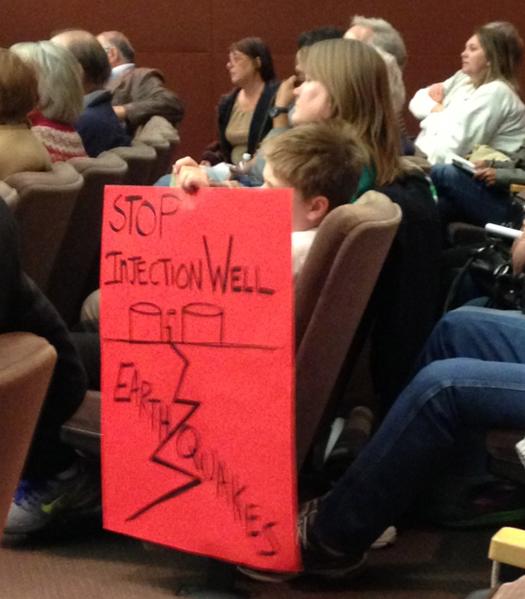
Small towns like Azle and Springtown, in the North Texas area have experienced about 32 earthquakes over the past two months leaving citizens concerned about what is happening to their home.
According to a recent study from the University of Texas, most earthquakes that are coming from the area are a few miles from the Barnett Shale region. The study also found correlation between injection wells and small earthquakes. These disposal wells contain chemical contaminated wastewater from oil and gas drilling.. This is part of the process of hydraulic fracturing or “fracking”.
The Railroad Commission has not publicly acknowledge the link between disposal wells and quakes, even with evidence from several studies from Duke University, Cornel University, University of Texas, Texas Christian University, Southern Methodist University and other universities.
According to a story on NPR StateImpact, studies found that oil and gas wastewater disposal wells are a reason for the Eagle Mountain Lake quakes. Disposal wells that inject at higher rates are likely causing quakes. Studies show that these large amounts of wastewater can cause inactive faults to slip, which causes an earthquake to occur.
In another NPR StateImpact story by Terrence Henry, he writes that under state law, the Commission cannot suspend a disposal well permit unless the operator is in violation of commission rules. There are currently no rules on seismicity, and without this rule the commission has no authority to shut it down. The article also goes on to say that the Railroad Commission is aware of such studies and research linking disposal wells and other drilling activity to man-made quakes, but publicly calls this evidence “theories.”
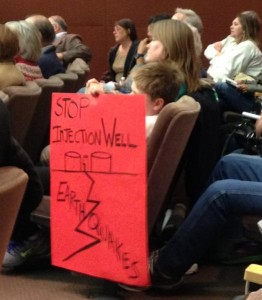
Young witness at RRC Hearing on Seismic Activity in North Texas – Photo by Sierra Club
A town hall meeting in Azle, Texas hosted by the Texas Railroad Commission on January 2nd drew 850 residents. The residents had concerns about cracks in their property, sinkholes, earthquake insurance, and possibly having their ground water affected. They wanted the commission to explain what was happening and asked if disposal wells were the reason for the recent problems. Click here to read more.
The Commission told attendees it would further study the issue of injection wells and quakes, but residents felt they were getting a runaround. Days after this first meeting the Commission announced it would hire a seismologist to investigate local drill sites.
Continue Reading »
Posted in Fracking, natural gas | Tagged disposal wells, Earthquakes, fracking, Railroad Commission, Subcommittee on Seismic Activity, Texas, Texas House Energy Resources Committee |
« Newer Posts - Older Posts »