Feeds:
Posts
Comments

The South-central Partnership for Energy Efficiency as a Resource (SPEER) enters its second year with an exciting Summit, designed to explore, further develop, and prioritize policies and strategies needed to push energy efficiency forward in new buildings, existing buildings, and electric markets in Texas and Oklahoma.

Ed Mazria, founder and CEO of Architecture 2030, will deliver the keynote address to kick off the Summit in Austin on February 25. Mr. Mazria is an international leader on efforts to make buildings dramatically more energy and water efficient, leading the movement to establish 2030 districts in cities with goals to reach carbon neutrality by 2030. These districts have been established so far in Los Angeles, Seattle, Cleveland, and Pittsburgh.

Public Citizen members can receive a $50 discount off the registration. On the registration page, select “Early Registration- Supporting Organization” and then select “Public Citizen” from the drop down menu.

Sponsors of the SPEER Summit include Dow Chemical, CCRD Partners, Mitsubishi, Environments for Living, TexEnergy Solutions, BASF, the Texas Home Energy Raters Organization, and the CleanTX Foundation.

To learn more about the Energy Efficiency Summit, please visit: www.eepartnership.org/summit


Today, Energy and Commerce Committee Ranking Member Henry A. Waxman issued the following statement on new research from the Pembina Institute and Oil Change International, indicating that the Keystone XL pipeline will accelerate the reckless expansion of the tar sands industry and the climate impact of tar sands and the pipeline will be significantly worse than anticipated:

“The new reports show that TransCanada’s Keystone XL pipeline is the key that will unlock the tar sands.  If the pipeline is approved, the world will face millions more tons of carbon pollution each year for decades to come.  After Hurricane Sandy, devastating drought, unprecedented wildfires, and the warmest year on record in the United States, we know that climate change is happening now, we have to fight it now, and we must say no to this pollution pipeline now.”

To access the report released at the event, please visit:
Petroleum Coke: The Coal Hiding in the Tar Sands – Oil Change International
The climate implications of the proposed Keystone XL pipeline – The Pembina Institute

Tuesday, a fire erupted in the Unit 2 main transformer that feeds power from the reactor to the public power grid of the South Texas Project Electric Generating Station near Bay City and about 85 miles southwest of Houston.  The unit 2 was automatically taken offline and STP officials say unit 1 is still operational, but STP officials say they don’t know when unit 2 will be restarted.

The fire broke out at 4:42 p.m. was extinguished within 15 minutes, but the plant had to declare that an “unusual event” had taken place and notified county, state and federal officials. Managers declared the event over at 7:47 p.m.  No injuries were reported and STP is claiming that the incident poses no hazard to the public or to plant workers.

The two 1,350-megawatt generators, owned by NRG Energy, CPS Energy and Austin Energy, serve 2 million users. each reactor at the plant produces 1,280 megawatts of electricity. One megawatt is enough to power 500 homes during mild winter conditions, but if your remember the Texas rolling blackouts during a severe winter event in February of 2011 you might also remember that the electricity shortage during that unusual high demand time was due to unexpected plant outages.  Let’s hope we don’t have one of those before unit 2 comes back online.

Interestingly enough, this incident happened just before the Nuclear Regulatory Commission begins seeking public comment on a draft supplemental environmental impact statement for the proposed renewal of the South Texas Project nuclear power plant’s operating licenses for an additional 20 years.

NRC staff will hold two public meetings in Bay City, Texas, on Jan. 15, 2013 to present the findings of the draft report and accept public comments. The meetings will be held at the Bay City Civic Center, 201 Seventh St., from 2-5 p.m. and 7-10 p.m. NRC staff members will be available for one hour prior to each session to meet informally with members of the public.

The South Texas Project nuclear plant has two pressurized-water reactors. The plant operator, STP Nuclear Operating Co., submitted its license renewal application on Oct. 25, 2010. The current operating licenses expire Aug. 20, 2027, for Unit 1 and Dec. 15, 2028, for Unit 2.  The original license was issued based on the expected life of the plant.  Most of our aging nuclear power fleet is nearing the end of their life expectancy and since most energy companies have not been successful in securing funding for building new plants, the strategy is to just extend the life of the current facilities by renewing their licenses.

The draft supplemental environmental impact statement contains the NRC staff’s analysis of potential impacts specific to the South Texas Project site. In preparing the report, the staff held a public meeting in Bay City on March 2, 2011, as part of the public “scoping” process for the report. The staff also conducted site audits at the plant in May and July 2011 and consulted with other agencies while analyzing the applicant’s environmental report submitted with the application.

The draft NRC report does not discuss potential environmental impacts of extended storage of spent nuclear fuel after the plant eventually ceases operation. That issue will be addressed in the NRC’s waste confidence environmental impact statement and rule, expected by September 2014. In August 2012, the Commission decided that the agency will not issue final licensing decisions for reactors, including license renewal, until the waste confidence rule is completed. If at that time, site-specific issues relating to spent fuel storage at South Texas Project remain unresolved, they will be addressed separately.

Public comments on the draft environmental impact statement for the South Texas Project license renewal will be accepted through Feb. 22, 2013. They may be submitted online via the federal government’s rulemaking website at www.regulations.gov using Docket ID NRC-2010-0375. They may also be mailed to Cindy Bladey, Chief, Rules, Announcements and Directives Branch (RADB), Division of Administrative Services, Office of Administration, Mail Stop: TWB-05-B01M, U.S. Nuclear Regulatory Commission, Washington, D.C., 20555-0001. Comments may also be faxed to 301-492-3446.

The South Texas Project draft supplemental environmental impact statement is available for public inspection in the NRC Public Document Room at NRC headquarters, 11555 Rockville Pike, Rockville, Md. Copies will also be available at the Bay City Public Library, 1100 7th St., Bay City, Texas.

Well, it’s official.  According to scientists with The National Oceanic and Atmospheric Administration, 2012 was the warmest year on record in the contiguous United States with an average temperature of 55.3 degrees Farenheit.  That’s 3.2 degrees above normal and a full degree higher than the previous warmest year recorded — 1998.  All 48 states in the contiguous U.S. had above-average annual temperatures last year, including 19 that broke annual records, from Connecticut through Utah.

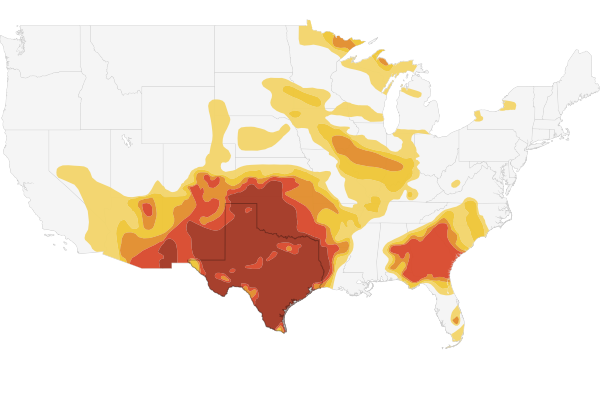
2012 was also a historic year for “extreme” weather, according to NOAA. With 11 disasters that surpassed $1 billion in losses, including Superstorm Sandy, Hurricane Isaac, and tornadoes across the Great Plains, Texas, and the Southeast and Ohio Valley, 2012 was second only to 1998 in the agency’s “extreme” weather index.  2012 was also the driest year on record for the U.S., with 26.57 inches of average precipitation — 2.57 inches below average. Those dry conditions created an ideal environment for wildfires in the West, which charred 9.2 million acres — the third highest amount ever recorded.  At this writing, more than 60% of the country is still in drought, and while down from over 95% at the height of the 2011 drought, nearly 12% of Texas still remains in “exceptional” drought, the highest drought category on the US Drought Monitor scale.

Each year since 2001 has been among the warmest on record worldwide, with 2012 likely to be no exception despite the cooling influence of La Niña early in the year.  If this warming trend continues, extreme weather events and major impacts on agriculture will probably continue to have an effect on the U.S. economy.

As we close in on the end of 2012 with a winter front keeping temperatures low, Texas achieved a new wind power integration record of 8.638 GW on Dec. 25 at 3:11 p.m according to the Texas grid operator, the Electric Reliability Council of Texas (ERCOT).

Electricity from wind accounted for 25.71% of power being generated and used at that point in time, as the peak demand was 39.847 GW.  Of the 8.638 GW being generated by Texas wind farms, over 84% came from wind farms in West Texas, and 16% came from sites on the Texas coast.

More details can be found in ERCOT’s wind integration report for Dec. 25.

According to Bloomberg, with four days left in 2012, wind-turbine installations are expected to exceed natural gas-fueled power plants in the U.S. for the first time as wind farm developers race to complete projects before a renewable energy tax credit expires.

New wind capacity reached 6,519 megawatts by Nov. 30th of this year, beating the 6,335 megawatts of gas additions and more than double that of coal, according to data from Ventyx Incm which plans to release final tallies in January.

Congress has yet to renew the production tax credit, which provides incentives for wind farms completed before Dec. 31, 2012. Efforts to take advantage of the subsidy trumped interest in gas-fired stations, which are supported by a plunge in prices for the commodity resulting from added production through hydraulic fracturing.

To qualify for the tax credit, which pays wind farm owners 2.2 cents per kilowatt-hour of power they produce over 10 years, projects must be online and producing power by Jan. 1.

A bill to extend the wind production tax credit was approved by the Senate Finance Committee in August.  Unless Congress extends the incentive, wind turbine installations are predicted to fall 88 percent next year according to a forecast by New Energy Finance.  Earlier this month, in an effort to head off opposition to an extension, the American Wind Energy Association proposed a six-year phase-out of the credit, ending the subsidy at the start of 2019.  They claim 37,000 jobs will be lost if the credit lapses now.

An increase in gas prices may make wind even more competitive. Gas futures saw their first annual increase since 2007, rising almost 15 percent this year.  And, utilities in 29 states are required to get an increasing amount of their supplies from renewable resources such as wind and solar, whether or not Congress renews the tax credits.

Fine particles in the air (particularly those smaller than 2.5 micrometers in diameter) cause a multitude of health problems, ranging from difficulty kid with asthma inhalerbreathing and asthma to heart attacks and premature death in people with heart or lung disease.  The question has been whether or not cleaning the air any further makes a difference.  This type of air pollution has decreased substantially since 1980, but only smaller gains have been made since 2000.

A new study by researchers at the Harvard School of Public Health shows that even the modest gains made in reducing particulate matter between 2000 and 2007 are adding years to people’s lives.  Life expectancies were shown to increase .35 years in 545 US counties.

Not everyone is equally impacted, so some demographics are reaping larger benefits through cleaner air.  The young, the old and those who exercise outdoors are most likely to be negatively impacted by fine particles in the air.

In Texas, our port communities endure especially high concentrations of particulate matter.  Public Citizen is working to force the Port of Houston clean up.  Replacing or retrofitting the old, highly polluting trucks that haul goods from the port to nearby warehouses would do a lot to improve the health of surrounding communities.  The Texas Emissions Reduction Plan (TERP) provides funds for just this purpose.  Those investments are saving lives, but are often underutilized by truck owners.

The Solar Energy Industries Association (SEIA) has taken a step that any self-respecting supporter of renewable energy should do – ditched the American Legislative Exchange Council (ALEC).  This relationship looked a lot like the fabled one between the scorpion and tortoise.

Despite members such as the SEIA and the American Wind Energy Association (AWEA), ALEC has decided to make a nationwide push to roll back renewable energy portfolio standards (RPS) that have been enacted in many states.  The RPS sets a percentage of electricity consumed that must be derived from renewable energy sources, such as wind or solar.  The Texas RPS, passed in 1999, has helped propel the state into its role and a wind industry leader.  At one point last month, the ERCOT electric grid (which encompasses most of Texas) was getting 26% of its power from wind turbines.

congratulationsIt pleases me to see good organizations such as SEIA leaving the backward notions of ALEC behind and I hope that other well-meaning organizations, businesses and elected officials will take a hard look at the facts and do the same.  ALEC has perverted the legislative process to suit its needs.  Model bills are developed behind closed doors to fit certain member industry desires and are then pushed for adoption in as many states as possible.  Of course, as SEIA has likely discovered, not all members are equal and its the big boys that get to make the rules of the game.

Numerous polls and studies show widespread support for renewable energy, but nothing speaks so loud as money.  Only when the coffers at ALEC dry up will they stop pushing this kind of backward legislation.

It remains to be seen whether ALEC’s effort to repeal the RPS will gain any traction in Texas.  Here’s to hoping that saner heads prevail and send ALEC packing.

Our partners at Progress Texas are hosting a special screening of the documentary Koch Brothers Exposed at the Alamo Drafthouse on South Lamar on Monday, December 3rd at 6:30 PM.  They have already sold out more than half the theater – be sure to reserve your seats now before they sell out!

From director Robert Greenwald (Outfoxed, WalMart: the High Cost of Low Price), comes a terrific documentary film on Charles and David Koch—two billionaire brothers who have bankrolled a vast network of organizations that work to undermine middle class interests on issues ranging from Social Security to the environment to civil rights. This film uncovers the Kochs’ corruption—and points the way to how Americans can reclaim their democracy.

After the screening, Progress Texas will host a 30-minute discussion and Q/A with invited speakers Texas State Representative Garnet Coleman, Austin Chronicle Political Reporter Richard Whittaker, and others.

Purchase Ticket

The price per ticket for a non-sustaining donor is $20. This includes entry for the movie AND a $10 credit towards the purchase of any food or drinks.

As always, Progress Texas sustaining donors get in free, but space is limited. To make sure you have a seat you will need to reserve your ticket for $10. That $10 will be put directly to a food and drink credit. If you are a current sustaining donor and interested in attending this event or have questions, please contact mark@progresstexas.org for more information.

Check out the trailer below and make sure to get your reserved seat ticket today!

Koch Brothers Exposed

In a new peer-reviewed scientific study, experts said satellite data show sea levels rose by 3.2 millimeters a year from 1993 to 2011 — 60 percent faster than the 2 mm annual rise projected by the U.N.’s Intergovernmental Panel on Climate Change (IPCC) for that period, however  the IPCC was just about spot on with its predictions for warming temperatures.

The IPCC has estimated that seas rose by about 7 inches over the last century, and estimates a range of between 7 and 23 inches this century.  This is enough to worsen coastal flooding and erosion during storm surges and if the impacts of Hurricane Sandy is any indication, will dramatically impact the dense coastal populations around the world.

The most recent IPCC report did not factor in a possible acceleration of the melt of the Greenland and Antarctic ice sheets and “assumed that Antarctica will gain enough (ice) mass” to compensate for Greenland ice loss, the new study’s authors noted, but more recent studies have shown that “the ice sheets in Greenland and Antarctica are increasingly losing mass.”

When the next IPCC report comes out in March 2014, we should expect a more quantitative understanding of ongoing sea level rise — and an entire chapter on the topic —given the impacts on the densely populated coastal regions of the world.

I want to alert you to a unique opportunity this December.  It’s a special conference and video-taping called Renewable Energy and The Unified Energy System. And it’s going to be at the Lost Pines Resort just outside of Austin on the way to Bastrop.

Renewable Energy has truly come of age.

Solar modules are below a dollar/watt and distributed solar is about to blast through the proverbial roof.  Texas Coastal wind now competes with base load fossil plants in price, yet performs like a more expensive gas peaking plant.  Just as important, large scale solar plants can now compete with natural gas peaking units in price.  Plug-ins and all-electric cars are becoming commonplace on our streets.  Rules for storage facilities are finally written.  Advanced thermostats and controls and other smart grid developments  are providing new avenues in demand side energy management for both homeowners and utilities.

Our cars, buildings and the electric grid are becoming unified and Renewable Energy will be the big winner in an energy horizon where energy sellers become buyers, buyers become sellers, and renewable energy competes with oil in the transportation sector.

Texas Renewables 2012 is designed to address this transition and highlight the accomplishments of the Pecan Street Project where 200 of the 600 energy efficient smart homes are fitted with solar PV and 100 of the homes will support a plug in vehicle. The conference will provide a solid understanding of the forces at play to further the vision of a “Unified Energy System” and discuss strategies to sustain continued growth for the renewable energy sector.

You may even want your company or agency to be an exhibitor.

Click here to register.

There is only room for about 500 folks, so be sure and act now to reserve your place. We can’t think of a better place to be on 12/12/12.

Submit a comment to the Nebraska Department of Environmental Quality (DEQ) on how risky the Keystone XL pipeline route is for the Nebraska Sandhills and the Ogallala Aquifer. Help us get over 1,000 comments submitted.  Click here to send a comment to the Nebraska DEQ.  If you are not from Nebraska, change the comment and let them know how this affects you.

The Ogallala Aquifer is part of the High Plains Aquifer System.  It is a vast, yet shallow, underground water table aquifer located beneath the Great Plains in the United States. One of the world’s largest aquifers, it covers an area of approximately 174,000 square miles in portions of eight states.  These include South Dakota, Nebraska, Wyoming, Colorado, Kansas, Oklahoma, New Mexico, and Texas.


Update:  The U.S. Nuclear Regulatory Commission said an alert at the Oyster Creek plant in Forked River, N.J., ended early Wednesday, October 31.

According to an NRC press release, three reactors (Nine Mile Point 1 in Scriba, N.Y., Indian Point 3 in Buchanan, N.Y.; and Salem Unit 1 in Hancocks Bridge, N.J.) experienced shutdowns as Hurricane Sandy pounded the East Coast.  Another plant, Oyster Creek in New Jersey, remains in an “Alert” due to high water levels in its water intake structure.

NRC says, “Nine Mile Point 1 underwent an automatic shutdown at about 9 p.m. Monday when an electrical fault occurred on power lines used to send power to the grid. It is likely a storm-related event, but the plant’s operators are still evaluating the cause. All plant safety systems responded as designed and the shutdown was safely carried out. Meanwhile, Nine Mile Point 2 experienced a loss of one of two incoming off-site power lines as a result of the fault. One of the plant’s emergency diesel generators started in response to generate power usually provided by the line. Nine Mile Point 2 remained at full power.”

NRC continued, “Indian Point 3 automatically shut down at about 10:40 p.m. Monday in response to electrical grid disturbances caused by the storm. . . the unit was placed in a safe shutdown condition.” And, “Salem Unit 1 was manually shut down by plant operators at about 1:10 a.m. Tuesday as a result of circulating-water pumps being affected by high river level and debris in the waterway.”

Finally, but perhaps of most concern, Oyster Creek had an declared an “Alert” at approximately 8:45 p.m. on October 29th  preceded by an “Unusual Event” at about 7 p.m. when the water level first reached a minimum high water level criteria. The water level rose due to a combination of a rising tide, wind direction and storm surge. While the water level has dropped since peaking earlier today, the Alert remains in place until the level is below the specific criteria for the intake structure, which is where water from an intake canal is pumped into the plant for cooling purposes.

The alert came after water levels at the plant rose more than 6.5 feet above normal, potentially affecting the “water intake structure” that pumps cooling water through the plant.

Those pumps are not essential to keep the reactor cool since the plant has been shut for planned refueling since October 22. Exelon however was concerned that if the water rose over 7 feet it could submerge the service water pump motor that is used to cool the water in the spent fuel pool, potentially forcing it to use emergency water supplies from the in-house fire suppression system to keep the rods from overheating.

Exelon also moved a portable pump to the intake structure as a precaution in case it was needed to pump cooling water.  The water levels reached a peak of 7.4 feet — apparently above the threshold — but the pump motors did not flood.  As of 11 a.m. EDT Tuesday the water level was down to 5.8 feet, but they will need the water level to stay below 6 feet for a while before the alert status is taken off.  When the water level falls below 4.5 feet, the plant could then be taken off the unusual event status.

Fortunately for everyone, Oyster Creek, the oldest nuclear plant in the nation, was shut down for a refueling and maintenance outage prior to the storm and the reactor remains out of service.

Even Support from Businesses Like IKEA Is Not Enough for PUC

AUSTIN, TX – The Public Utility Commission delivered a slap in the face to the more than 6,000 Texans and 70 businesses and organizations  who have actively called on the Commission to implement and expand the non-wind renewable portfolio standard (RPS).  The non-wind RPS would establish a market for electricity from solar and other renewable energy resources in Texas, just as the State’s overall RPS did for wind energy.  The non-wind RPS was passed into law in 2005, but has yet to be implemented by the PUC.

Democracy and the rule of law may be important tenants of our society, but they are utterly lacking at the PUC, where Commissioners refused to engage in even a single minute of public discussion on the matter before striking it down today.

Instead of gathering current information on the price of solar photovoltaic (PV) panels and other renewable energy technologies, the PUC staff recommended denial based on data that is more than two years old.  This illustrates a shocking lack of due diligence, given that solar prices have plummeted over the past two years and are now competitive with traditional energy sources, especially when demand is high.  David Crane, CEO of NRG Energy, told participants at the Bloomberg New Energy Finance Summit, “Solar is so cheap today that unless you tell me that you did a solar analysis yesterday, not last year or last month, then your analysis is out of date.

The Commission appears to be committed to willful ignorance on this issue, but we’re not giving up.  This is too important to the future of our state. The solar industry is going to continue to grow regardless of what the PUC does; it’s just a matter of whether it will grow in Texas and bring good jobs to Texans or if we will let other states and other countries leave us behind.

While misconceptions about the cost of solar energy persist, businesses and individuals who look at current prices have found an opportunity for energy savings by investing in solar.  IKEA, a major international retailer, supports implementing and expanding the non-wind RPS in Texas.  “While utilizing renewable resources for generating energy allows us to reduce our carbon footprint, it[s] also is good business since it significantly reduces operational costs,” states the company in its comments that they filed with the PUC.

Advocates fault PUC for turning a blind eye to industry as Texas falls behind

Solar energy backers rallied outside the Texas Public Utility Commission [last] week seeking enforcement of a seven-year-old law that would boost electric generation from geothermal, biomass and the state’s ample supply of sunshine.

Public comment [ended Friday]on proposed rulemaking at the PUC, which has been reluctant to embrace the non-wind portion of the so-called renewable portfolio standards passed by the Texas Legislature in 2005. With those standards calling for generation of about 500 megawatts of renewable power from non-wind sources by 2015 and 3,000 megawatts by 2025, the Clean Energy Works for Texas Campaign sent petitions to the PUC urging it to carry out the law’s provisions. The group estimates that more than 6,000 individuals across Texas and 50 businesses or organizations lent their signatures in support.

“Why aren’t we seeing the clean energy we’ve demanded from our legislators? Why aren’t we seeing the thousands of new green jobs, new energy businesses and new tax revenues for our underfunded schools?” asked activist Dave Cortez of the Texas BlueGreen Apollo Alliance. “Four words: The Texas Public Utility Commission – a government agency run by unelected commissioners who have the power to take state law and misinterpret it, sit on it, lambast it, everything but implement it and ultimately say, ‘No, sorry. We don’t like it.’”

The PUC’s stand, as articulated by Chairman Donna Nelson, stresses the fact that wind power’s success has eclipsed the minimum renewable standards set in the law many times over. And, she argues that the law’s instructions on non-wind energy are not mandatory, a point of contention with solar backers. Moreover, she has said propping up solar power would increase electric bills and that the commission is not in the business of favoring one type of energy generation over another.

Executives from two Austin-based solar companies who attended the rally said each had respectively grown from only two employees to at least 25. And, with the business climate unfriendly to solar in Texas, they said, both companies are making upcoming expansions in a state more hospitable to their interests.

“The bad news is we’re in the process of opening a second office, and the second office will be in California,” said Tim Padden, founder of Revolve Solar. “I would rather be in Dallas, San Antonio or Houston, but the reality is California has taken a stand to support the development of the solar industry seriously by setting statewide goals and local support for their solar companies. I want to see this happen here in my home state. These could be Texas jobs.”

Stan Pipkin of Lighthouse Solar, an Austin-based solar design integration firm said his own company has shown an almost identical job growth and will also be opening offices in California.

“I’m deeply concerned that Texas is not taking advantage of the energy resource we have in most abundance,” he said. “Texas is currently 10th in solar capacity. This is absolutely confounding given our solar resource, our electric demand and our shortage of reserve capacity. It just doesn’t make sense.”

By Polly Ross Hughes

Copyright September 14, 2012, Harvey Kronberg, www.texasenergyreport.com, All rights are reserved.  Reposted by TexasVox.org with permission of the Texas Energy Report.

The PUC has put the non-wind RPS on the agenda for its open meeting this Thursday.  We need you to be there to show your support for moving forward with the rulemaking process.  Please email kwhite@citizen.org if you are interested in attending.  The meeting will be in the Commissioners’ Hearing Room on the 7th Floor of the William B. Travis building at 1701 N. Congress Ave, Austin.