Feeds:
Posts
Comments

The worst drought in more than 50 years in Texas is expected to continue as a weak La Nina weather pattern is predicted to strengthen this winter.  Drought has already reduced cooling water needed by coal-fired power plants and may limit electric output from power plants next summer, an official from the Electric Reliability Council of Texas (ERCOT – the grid operator)  reported.

At this time, only one small generating unit is currently curtailed due to a lack of adequate cooling water, however a continuation of the severe drought in Texas could result in as much as 3,000 MW being unavailable next summer, Kent Saathoff, vice president of ERCOT grid operations told the board last week.

The drought has lowered the water level at nearly every reservoir in the state, according to the Texas Water Development Board. A lack of cooling water limits the ability of a power plant to operate at full capacity.

Texas’ hottest summer on record pushed power consumption to record levels, straining the state’s electric resources on many days in August.

Grid officials and lawmakers are worried that the drought will compound existing issues that impact the state’s power supply: looming environmental regulations that will curtail output from coal-fired power plants and a lack of new power-plant investment.

ERCOT predicts about 434 megawatts would be unavailable next summer if Texas gets about half its normal rainfall over the winter and spring months and if there is no significant rainfall, as much as 3,000 MW could be unavailable by May.

Power plant owners are taking steps to increase access to cooling water by increasing pumping capacity, adding pipelines to alternate water sources and securing additional water rights.  Some water authorities have already curtailed new “firm” water contracts, so it may be harder for plants to secure additional water.

Right now, the Public Utility Commission of Texas (PUC) is working to implement new energy efficiency legislation.  If we just used our energy more efficiently, we wouldn’t have come so close to a grid crisis even under the extreme circumstances of this past summer.  Other states have used energy efficiency to keep the lights on for their families and businesses when they were having problems by cutting energy demand by 20% or more on the hottest days of the summer.
Studies have shown that Texas could cut 23% of our peak energy use on the hottest days and it would be cheaper than generating electricity.
To prevent rolling blackouts next summer, the governor and the PUC could improve the energy efficiency and market-based conservation programs that will keep our air conditioning running on hot summer days and keep our local  businesses operating . 

The Texas Public Utility Commission should:

  • Reward utilities that exceed their energy efficiency goals.
  • Use the money from a program set up to provide utility assistance for eligible Texans that is funded by fee Texans pay on their electric bills every month for the weatherization of low-income homes.

And the governor can issue an executive order that requires all state agencies, schools, municipal and county governments to reduce energy use by 5% next summer and report their savings to the state.

You can email the governor and express your opinion by clicking here.

Below is an article from the New York Times in its entirety showing the power for change renewable energy is having in third world countries.  I think articles like this are a good argument for subscribing to papers like the New York Times.

African Huts Far From the Grid Glow With Renewable Power Beyond Fossil Fuels

by Ed Ou of The New York Times

Thanks to this solar panel, Sara Ruto no longer takes a three-hour taxi ride to a town with electricity to recharge her cellphone.  Click here to check out the slide show – Sustainable Energy Transforms Lives

KIPTUSURI, Kenya — For Sara Ruto, the desperate yearning for electricity began last year with the purchase of her first cellphone, a lifeline for receiving small money transfers, contacting relatives in the city or checking chicken prices at the nearest market.

Solar power for Ms. Ruto’s hut in Kiptusuri, Kenya, means her toddlers no longer risk burns from a smoky kerosene lamp.

Charging the phone was no simple matter in this farming village far from Kenya’s electric grid.

Every week, Ms. Ruto walked two miles to hire a motorcycle taxi for the three-hour ride to Mogotio, the nearest town with electricity. There, she dropped off her cellphone at a store that recharges phones for 30 cents. Yet the service was in such demand that she had to leave it behind for three full days before returning.

That wearying routine ended in February when the family sold some animals to buy a small Chinese-made solar power system for about $80. Now balanced precariously atop their tin roof, a lone solar panel provides enough electricity to charge the phone and run four bright overhead lights with switches.

“My main motivation was the phone, but this has changed so many other things,” Ms. Ruto said on a recent evening as she relaxed on a bench in the mud-walled shack she shares with her husband and six children.

As small-scale renewable energy becomes cheaper, more reliable and more efficient, it is providing the first drops of modern power to people who live far from slow-growing electricity grids and fuel pipelines in developing countries. Although dwarfed by the big renewable energy projects that many industrialized countries are embracing to rein in greenhouse gas emissions, these tiny systems are playing an epic, transformative role.

Since Ms. Ruto hooked up the system, her teenagers’ grades have improved because they have light for studying. The toddlers no longer risk burns from the smoky kerosene lamp. And each month, she saves $15 in kerosene and battery costs — and the $20 she used to spend on travel.

In fact, neighbors now pay her 20 cents to charge their phones, although that business may soon evaporate: 63 families in Kiptusuri have recently installed their own solar power systems.

“You leapfrog over the need for fixed lines,” said Adam Kendall, head of the sub-Saharan Africa power practice for McKinsey & Company, the global consulting firm. “Renewable energy becomes more and more important in less and less developed markets.”

The United Nations estimates that 1.5 billion people across the globe still live without electricity, including 85 percent of Kenyans, and that three billion still cook and heat with primitive fuels like wood or charcoal.

There is no reliable data on the spread of off-grid renewable energy on a small scale, in part because the projects are often installed by individuals or tiny nongovernmental organizations.

But Dana Younger, senior renewable energy adviser at the International Finance Corporation, the World Bank Group’s private lending arm, said there was no question that the trend was accelerating. “It’s a phenomenon that’s sweeping the world; a huge number of these systems are being installed,” Mr. Younger said.

With the advent of cheap solar panels and high-efficiency LED lights, which can light a room with just 4 watts of power instead of 60, these small solar systems now deliver useful electricity at a price that even the poor can afford, he noted. “You’re seeing herders in Inner Mongolia with solar cells on top of their yurts,” Mr. Younger said.

In Africa, nascent markets for the systems have sprung up in Ethiopia, Uganda, Malawi and Ghana as well as in Kenya, said Francis Hillman, an energy entrepreneur who recently shifted his Eritrea-based business, Phaesun Asmara, from large solar projects financed by nongovernmental organizations to a greater emphasis on tiny rooftop systems.

In addition to these small solar projects, renewable energy technologies designed for the poor include simple subterranean biogas chambers that make fuel and electricity from the manure of a few cows, and “mini” hydroelectric dams that can harness the power of a local river for an entire village.

Yet while these off-grid systems have proved their worth, the lack of an effective distribution network or a reliable way of financing the start-up costs has prevented them from becoming more widespread.

“The big problem for us now is there is no business model yet,” said John Maina, executive coordinator of Sustainable Community Development Services, or Scode, a nongovernmental organization based in Nakuru, Kenya, that is devoted to bringing power to rural areas.

Just a few years ago, Mr. Maina said, “solar lights” were merely basic lanterns, dim and unreliable.

“Finally, these products exist, people are asking for them and are willing to pay,” he said. “But we can’t get supply.” He said small African organizations like his do not have the purchasing power or connections to place bulk orders themselves from distant manufacturers, forcing them to scramble for items each time a shipment happens to come into the country.

Part of the problem is that the new systems buck the traditional mold, in which power is generated by a very small number of huge government-owned companies that gradually extend the grid into rural areas. Investors are reluctant to pour money into products that serve a dispersed market of poor rural consumers because they see the risk as too high.

Beyond Fossil Fuels

Starting Small

Articles in this series examine innovative attempts to reduce the world’s dependence on coal, oil and other carbon-intensive fuels, and the challenges faced.

On a Small Scale, Sustainable Energy Transforms Lives

“There are many small islands of success, but they need to go to scale,” said Minoru Takada, chief of the United Nations Development Program’s sustainable energy program. “Off-grid is the answer for the poor. But people who control funding need to see this as a viable option.”

Even United Nations programs and United States government funds that promote climate-friendly energy in developing countries hew to large projects like giant wind farms or industrial-scale solar plants that feed into the grid. A $300 million solar project is much easier to finance and monitor than 10 million home-scale solar systems in mud huts spread across a continent.

As a result, money does not flow to the poorest areas. Of the $162 billion invested in renewable energy last year, according to the United Nations, experts estimate that $44 billion was spent in China, India and Brazil collectively, and $7.5 billion in the many poorer countries.

Only 6 to 7 percent of solar panels are manufactured to produce electricity that does not feed into the grid; that includes systems like Ms. Ruto’s and solar panels that light American parking lots and football stadiums.

Still, some new models are emerging. Husk Power Systems, a young company supported by a mix of private investment and nonprofit funds, has built 60 village power plants in rural India that make electricity from rice husks for 250 hamlets since 2007.

In Nepal and Indonesia, the United Nations Development Program has helped finance the construction of very small hydroelectric plants that have brought electricity to remote mountain communities. Morocco provides subsidized solar home systems at a cost of $100 each to remote rural areas where expanding the national grid is not cost-effective.

What has most surprised some experts in the field is the recent emergence of a true market in Africa for home-scale renewable energy and for appliances that consume less energy. As the cost of reliable equipment decreases, families have proved ever more willing to buy it by selling a goat or borrowing money from a relative overseas, for example.

The explosion of cellphone use in rural Africa has been an enormous motivating factor. Because rural regions of many African countries lack banks, the cellphone has been embraced as a tool for commercial transactions as well as personal communications, adding an incentive to electrify for the sake of recharging.

M-Pesa, Kenya’s largest mobile phone money transfer service, handles an annual cash flow equivalent to more than 10 percent of the country’s gross domestic product, most in tiny transactions that rarely exceed $20.

The cheap renewable energy systems also allow the rural poor to save money on candles, charcoal, batteries, wood and kerosene. “So there is an ability to pay and a willingness to pay,” said Mr. Younger of the International Finance Corporation.

In another Kenyan village, Lochorai, Alice Wangui, 45, and Agnes Mwaforo, 35, formerly subsistence farmers, now operate a booming business selling and installing energy-efficient wood-burning cooking stoves made of clay and metal for a cost of $5. Wearing matching bright orange tops and skirts, they walk down rutted dirt paths with cellphones ever at their ears, edging past goats and dogs to visit customers and to calm those on the waiting list.

Hunched over her new stove as she stirred a stew of potatoes and beans, Naomi Muriuki, 58, volunteered that the appliance had more than halved her use of firewood. Wood has become harder to find and expensive to buy as the government tries to limit deforestation, she added.

In Tumsifu, a slightly more prosperous village of dairy farmers, Virginia Wairimu, 35, is benefiting from an underground tank in which the manure from her three cows is converted to biogas, which is then pumped through a rubber tube to a gas burner.

“I can just get up and make breakfast,” Ms. Wairimu said. The system was financed with a $400 loan from a demonstration project that has since expired.

In Kiptusuri, the Firefly LED system purchased by Ms. Ruto is this year’s must-have item. The smallest one, which costs $12, consists of a solar panel that can be placed in a window or on a roof and is connected to a desk lamp and a phone charger. Slightly larger units can run radios and black-and-white television sets.

Of course, such systems cannot compare with a grid connection in the industrialized world. A week of rain can mean no lights. And items like refrigerators need more, and more consistent, power than a panel provides.

Still, in Kenya, even grid-based electricity is intermittent and expensive: families must pay more than $350 just to have their homes hooked up.

“With this system, you get a real light for what you spend on kerosene in a few months,” said Mr. Maina, of Sustainable Community Development Services. “When you can light your home and charge your phone, that is very valuable.”

America is fed up and starting to make some noise about it.  The rise of the Tea Party was about politics, this new 99% movement is about greed.

Thursday, I got an email about ABC News’ followed up on a story about the more than 150,000 people who signed Molly Katchpole’s (change.org) petition against Bank of America’s new $5 monthly fee to use a debit card.

The network tracked down CEO, Brian Moynihan, and forced him to respond to the petition.

The CEO was flustered and couldn’t give a coherent explanation — an embarrassing moment on national TV for the big bank (and the second night in a row that Molly’s petition was a featured story on the newscast).

Bank of America is feeling the pressure from consumers.  The hope is that as more people speak out, Bank of America will be forced to cancel its new fee — and other banks will be too scared to create their own new fees.

Add your name to Molly’s petition demanding Bank of America cancel its new $5 debit card fee.

While you’re signing, check out the amazing video from ABC News. It’s inspiring to see one person’s petition can make a bank CEO squirm on TV! Watch it here:

http://www.change.org/petitions/tell-bank-of-america-no-5-debit-card-fees

An Atomic Safety and Licensing Board (ASLB) panel will conduct an evidentiary hearing Oct. 31 in Rockville, Md., in the South Texas Project Combined License (COL) proceeding. The ASLB is the independent body within the Nuclear Regulatory Commission that presides over proceedings involving the licensing of civilian nuclear facilities, such as nuclear power plants.

This evidentiary hearing will consider a contention (or challenge) originally scheduled to be heard in August but deferred due to the unavoidable absence of an expert witness. The Board has also asked all the parties’ attorneys to be prepared for oral argument on a new proposed contention related to the Fukushima Dai-ichi accident in Japan, although the Board is not certain if such oral argument will be necessary. The hearing will begin at 9:30 a.m. EDT in the Atomic Safety and Licensing Board Panel Hearing Facility, Room T-3B45 in the NRC’s Two White Flint North Building, 11545 Rockville Pike in Rockville.

The session is open for public observation, but participation will be limited to the parties admitted to the proceeding (several public interest groups, the applicant – Nuclear Innovation North America (NINA) – and NRC staff). Early arrival at the NRC’s main visitor entrance in the One White Flint North Building is suggested to allow for security screening for all members of the public interested in attending. NRC policy prohibits signs, banners, posters or displays in the hearing room at any time during the proceeding.

The South Texas Project COL application was submitted Sept. 20, 2007, seeking permission to construct and operate two new nuclear reactors at an existing site near Bay City, Texas. The ASLB granted intervenor standing to the Sustainable Energy and Economic Development (SEED) Coalition, the South Texas Association for Responsible Energy, and Public Citizen, and found they had submitted admissible contentions that challenge the COL application. The contention that will be addressed on Oct. 31 involves the question of whether the application and NRC review properly accounts for energy efficient building code rules in assessing the need for power.

Individuals or groups not admitted to the proceeding can submit “written limited appearance statements” to the ASLB. Anyone wishing to submit a written statement may do so by email to hearingdocket@nrc.gov, by fax to 301-415-1101, or by mail to: Office of the Secretary, Attn. Rulemaking and Adjudications Staff, U.S. Nuclear Regulatory Commission, Washington, DC 20555-0001. In addition, copies of written statements should be sent to the Chairman of the Licensing Board by e-mail to Michael.Gibson@nrc.gov and Jonathan.Eser@nrc.gov; by fax to 301-415-5599, or by mail to: Administrative Judge Michael M. Gibson, Atomic Safety and Licensing Board Panel, Mail Stop: T-3F23, U.S. Nuclear Regulatory Commission, Washington, D.C. 20555-0001.

Documents related to the South Texas Project COL application are available on the NRC website. Documents pertaining to the ASLB proceeding are available in the agency’s electronic hearing docket. More information about the ASLB can be found at the NRC website.

Public Citizen, Sierra Club and SEED Coalition are calling on Luminant to come clean and retire, rather than idle, the old dirty coal plant, Monticello 1 and 2.

After receiving notice that Luminant Generation Company, LLC, has filed a Notification of Suspension of Operations for Monticello Units 1 and 2 with the Electric Reliability Council of Texas (ERCOT), these environmental groups called on Luminant to retire the units rather than idle them and be more forthcoming with long-term plans that will affect workers.  While Luminant and Texas have been in the headlines repeatedly for their opposition to the Cross State Air Pollution Rule, the rule would effectively help Dallas/Fort Worth meet the minimum public health air quality standards for the first time in years. Yet, if Luminant only idles the plants, then chooses to run them at full capacity next summer, the implications for Dallas/Ft Worth’s air quality remain unclear.

“Luminant has been frightening Texans with claims that power will become scarce if the company is not allowed to continue polluting unabated.  But other Texas utilities are cleaning up their act without difficulty, and this summer’s successful growth of coastal wind demonstrates there are multiple ways to meet Texas’ electricity needs.” said Jen Powis, representative of Sierra Club’s Beyond Coal Campaign.   “Indeed, the Public Utilities Commission and ERCOT both have multiple tools in their arsenal that can be used to ensure grid reliability as Texas moves beyond coal.”

Luminant states that the rule unfairly targets their existing generation, yet a review of the 2009 self-reported emissions inventory maintained by the Texas Commission on Environmental Quality demonstrates that the three Luminant coal plants (Big Brown, Monticello, and Martin Lake) are the top 3 industrial polluters in Texas among nearly 2,000 industrial plants. They are exceptionally dirty plants:

  • Combined they emit 25.5% of state industrial air pollution
  • Combined they emit 33.8% of state industrial SO2 air pollution
  • Combined they emit 11.4% of state industrial PM10 air pollution
  • Combined they emit 10% of state industrial NOx air pollution
  • Combined they emit 37.6% of state industrial CO air pollution

Comparing Luminant’s three coal plants only to other coal plants, however, shows an even more problematic tale.  Luminant’s Big Brown, Monticello, and Martin Lake are:

  •  46.8% of all Texas coal plant emissions (19 existing coal plants)
  • 41.5% of all Texas coal plant SO2 emissions
  • 36.0% of all Texas coal plant PM10 emissions
  • 30.6% of all Texas coal plant NOx emissions
  • 71.7% of all Texas coal plant CO emissions

“We call on Luminant to move beyond posturing and sit down at the negotiating table with EPA in good faith to discuss responsible retirement plans for these plants, like CPS Energy in San Antonio is doing. This approach would be good for consumers, our health and the environment,” said Tom “Smitty” Smith of Public Citizen’s Texas office.

“In order to protect the health of Texans, Luminant must plan now to retire these old coal plants. Monticello has often been the worst emitter of toxic mercury pollution in the nation,” said Karen Hadden, Executive Director of the Sustainable Energy and Economic Development (SEED) Coalition. “We don’t believe Luminant’s plans to retrofit these plants are economically feasible given the company’s poor financial health. Their plans rely on multiple expensive changes, any of which could simply fail to materialize. Luminant should commit to retire Monticello Units 1 and 2, and work with ERCOT, EPA, and public interest groups to prioritize clean energy generation.”

Public Citizen, Sierra Club and SEED Coalition call on Luminant to cease the use of scare tactics, and commit to a plan to retire its Monticello Units 1 and 2, paving the way for clean energy in North Texas. All three groups also call on ERCOT and the PUC to move forward by implementing new rules for energy storage, distributed renewable energy like onsite solar, energy efficiency, demand response, and a restructuring of the Emergency Interruptible Load System to assure there are maximum options available next summer.

“The Legislature has already granted broad authority to ERCOT and PUC to expand our use of these tools,” noted Cyrus Reed, with Sierra Club. “Now it’s time for them to step up to the plate, begin implementing these measures, and using their time to create solutions rather than fight clean air protections.”

Tar Sands Cronyism

In a New York Times op-ed by Bill McKibbens, he talks about the cronyism of the TransCanada tar sands play.  He makes reference to e-mails, made available by the environmental group Friends of the Earth, that show the State Department working with lobbyists to advance the interests of TransCanada, the company trying to build the Keystone XL pipeline from the tar sands of Canada through the heartland of the United States to the refineries of Texas capable of refining this highly polluting form of crude oil.

McKibbens goes on about other evidence that show, even as the State Department was supposedly carrying out a neutral evaluation of the pipeline’s environmental impact, key players were undermining the process. And when the State Department picked a consulting firm to help carry out the environmental impact statement on the Keystone pipeline, it chose a company called Cardno Entrix that listed among its chief clients …TransCanada.   It is no wonder that the final report that came out in late August, stated the pipeline would have “no significant impact” on the nearby land and water resources.

At local hearings along the pipeline route, Cardno Entrix again appeared front and center as the “facilitators” of those “public hearings.”   Click here to read our earlier blog about the Austin hearing.

Click here to read the entire New York Times Op-ed by Bill McKibben.

The expansion of the South Texas Nuclear Project (STP) from 2 units to 4 units has had an interesting financing history.  Initially Austin Energy chose to not pursue a financial partnership with NRG, Toshiba and San Antonio’s municipally owned utility – CPS.  That left CPS with a 50% ownership, which they later dropped to 40% and then, during an upset at the utility when the city of San Antonio discovered that CPS had withheld information about a 4 billion dollar increase in the estimated cost of building the new plant just before the City Council was to vote on a bond issue for the plant, the city and CPS backpedaled and in a final settlement became 7.6% owners with the understanding that they would put no further funding into the project.

CPS’s substantial exit from the NRG/NINA partnership left the project  searching for additional partners and power purchase agreements (PPAs) to keep its expansion alive.  Opponents of the plant were focusing efforts on preventing central Texas public power providers from signing PPAs and had made some progress when the Japanese earthquake and subsequent tsunami triggered the nuclear disaster at Fukushima.

Within two days after the Japanese earthquake, Public Citizen was linking the financial death of the STP expansion project with NRG’s remaining financial partners – Japanese companies Toshiba, TEPCO (the operators of the doomed Fukushima plant) and the Bank of Japan. On May 1, NRG announced it was writing off its financial investment in the STP expansion, effectively killing the project for the foreseeable future.

Most people thought this was the end of this expansion move, but Toshiba, the sole remaining financial partner did not pull the application and at the end of August, Public Citizen, the SEED Coalition and the local opposition group went before an Atomic Safety and Licensing Board (ASLB) panel–an independent body within the Nuclear Regulatory Commission (NRC)–to present oral arguments.

These opponents of two proposed South Texas Project nuclear reactors received a favorable order from ASLB judges allowing a full hearing to proceed regarding the project’s foreign ownership. Licensing efforts may be impacted as a result. In April, the Nuclear Regulatory Commission told Unistar Nuclear Energy it could not get an operating license for its planned reactor at Calvert Cliffs in Maryland because it was fully owned by France’s electricite de France (EDF)—a foreign entity.

“Federal law is clear that foreign controlled corporations are not eligible to apply for a license to build and operate nuclear power plants. The evidence is that Toshiba is in control of the project and this precludes obtaining an NRC license for South Texas Project 3 & 4,” said Brett Jarmer, a lawyer for the Intervenors; SEED Coalition, Public Citizen and South Texas Association for Responsible Energy. “Foreign investment in U.S. nuclear projects is not per se prohibited; but Toshiba is paying all the bills for the STP 3 & 4 project. This makes it difficult to accept that Toshiba doesn’t control the project,” said attorney Robert Eye. “National security and safety concerns justify NRC’s limits on foreign ownership and control of nuclear reactors,” said Karen Hadden, Director of the Sustainable Energy and Economic Development (SEED) Coalition. “What if a foreign company runs a U.S. reactor carelessly? What if a nation that’s friendly today becomes hostile toward the U.S. in the future and tries threaten us with our own reactors?” “Even if the reactors are operated by the South Texas Nuclear Operating Company, they will get their orders from foreign owners. What if their concerns are more about costcutting and less about safety?” asked Susan Dancer, President of South Texas Association for Responsible Energy. “Japanese investors would have us believe that they can come to America and safely build, own and operate nuclear plants, and that we should not concern ourselves with passe laws and regulations, but the Fukushima disaster has demonstrated the flawed Japanese model of nuclear safety. Our nuclear reactors should be controlled by the people most concerned about our country: fellow Americans.” The judges’ order is online at www.NukeFreeTexas.org.

[polldaddy poll=5554454]

Punxsutawney Phil is a groundhog resident of Punxsutawney, Pennsylvania. On February 2 (Groundhog Day) of each year, Phil emerges from his temporary home – if he sees his shadow and returns to his hole, he has predicted six more weeks of winter, if he does not see his shadow, he has predicted an early spring.  In Texas we have State Climatologist John Nielson-Gammon who emerged, saw his shadow and told Reuters, “It is possible that we could be looking at another of these multiyear droughts like we saw in the 1950s, and like the tree rings have shown that the state has experienced over the last several centuries.”

Some 95 percent of the state is listed as being in either “severe” or “exceptional” drought by the U.S. Department of Agriculture’s Drought Monitor, and Nielson-Gammon said the last 12 months have been the driest one-year period on record in the Lone Star State.

The state’s worst recorded drought lasted from 1950 through 1957 and prompted the creation of artificial lakes all across Texas to supply water to a state that at the time had a population of 15 million.  Those lakes are in place but after the worst one year drought on record and a population over 25 million, a multi year drought like the one we had in the 50s could be devastating for the state..

The long-term weather patterns, including La Nina currents in the oceans, mirror records from the early 1950s, Nielsen-Gammon said. The current drought, which he said began in earnest in 2005, could wind up being a 15-year stretch if patterns hold, he said.

“We’re very lucky that we had 2007 and 2010, which were years of plentiful rain,” he said. “2010 was the wettest year in record. Were it not for last year, we would be in much worse shape even than we are today.”

Conditions in Texas now are far from good. The drought has dried up many lakes built after the drought of the 1950s, and more than 23,000 separate wildfires fueled by dried brush and trees have destroyed 3.8 million acres and with that 2,800 homes, according to the Texas Forest Service.

Nielson-Gammon said Texas was now 10 to 20 inches of rainfall behind where it should be at the end of September and that rather than being the exception, severe drought could become the rule in Texas going forward, with wet years being more noteworthy.

“We’ve had five of the last seven years in drought, and it looks like it is going to be six out of eight,” he said.

The month is going out the same way it came in, with Texas firefighters on edge.   On September 4, a gust of wind blew a dead pine tree into power lines east of Austin, sparking the deadly Bastrop Complex Fire. That blaze killed two people, destroyed 1,600 homes, and is now the costliest fire in terms of lost property in Texas history.

The Forest Service this week called in two air tankers from Canada to fight wildfires that continue to burn around Texas, citing a shortage of enough planes to fight the state’s fires.

MoveToAmendDavid Cobb, a fiery speaker, and former Green Party presidential candidate, is touring Texas giving his talk “Creating Democracy & Challenging Corporate Rule.”  This presentation is part history lesson and part heart-felt call-to-action!

Cobb is an organizer and national spokesman for MoveToAmend.org, a coalition of over 130,000 people and organizations whose goal is to amend the United States Constitution to end corporate rule and legalize democracy.

Events are free and open to the general public, donations requested, no one turned away for lack of funds.

October 2, 2011
2:00pm – 4:00pm
 Bryan/College Station  Clara Monce Public Library
201 E 26th St, Bryan, TX
October 4, 201
7:00pm – 9:00pm
 Houston  1844 Kipling, Houston, TX
October 5, 2011
6:30pm – 8:30pm
 San Antonio The Radius Center
106 Auditorium Circle in the Gallery
San Antonio, TX 78201
October 10, 2011
7:00p.m. to 9:p.m.
 Corpus Christi  Unitarian Universalist Church
6901 Holly Road, Corpus Christi, TX

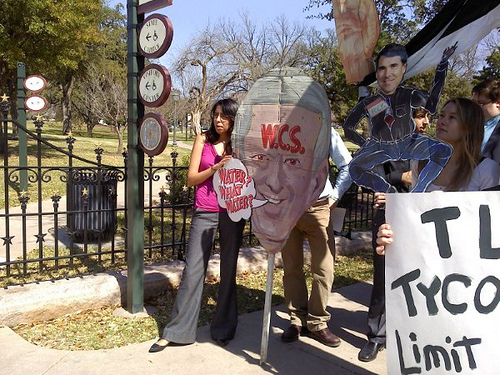
Hundreds of people turned out and many waited for hours yesterday in Austin, TX to testify against the dangerous Keystone XL tar sands pipeline, which is proposed by a foreign company and threatens the health, climate and water of those living along the proposed pipeline route.

Photo by Karen Hadden of man arrested for expressing concerns about the flawed hearing process.

This pipeline would be carrying the dirtiest of oil from Canada through the heartland of American to be refined here in Texas.  The State Department sent contract facilitators who abruptly halted testimony, turning away several dozen speakers.  Federal Security and UTPD then forced people out of the room.  One man expressed concerns about the flawed process and was arrested for “criminal trespass.”

According to Karen Hadden, the Executive Director of the Sustainable and Economic Development (SEED) Coalition, “This was not a hearing, this was a farce.”  Ms. Hadden arrived and had been waiting for a couple of hours to give comments when they cut the hearing off.  Later, when she was attempting to find out what her options were for providing comments to the State Department given she was unable to do so at the hearing, she was told she must leave the premises or she would be arrested.

According to Brad Johnson of ThinkProgress

In a stunning conflict of interest, public hearings on federal approval for a proposed tar sands pipeline are being run by a contractor for the pipeline company itself. The U.S. Department of State’s public hearings along the proposed route of the TransCanada Keystone XL tar sands pipeline this week are under the purview of Cardno Entrix, a “professional environmental consulting company” that specializes in “permitting and compliance.”

Cardno is not only running the State Department hearings, but also manages the department’s Keystone XL website and drafted the department’s environmental impact statement. Comments from the public about the pipeline go not to the government, but to a cardno.com email address.

Cardno Entrix was contracted by TransCanada Keystone XL LP (“Keystone”) to do the work for the Department of State, to assist DOS in preparing the EIS and to conduct the Section 106 consultation process.

Throughout the history of the DOS review of the Keystone pipeline, the work has been conducted not by civil servants but by representatives of the pipeline company. During the Bush administration, the Department of State appointed TransCanada “and its subcontractors to act as its designated non-federal representatives” to assess the potential impact of the Keystone pipeline on endangered species.

Cardno Entrix contractors are running the public hearings from Port Arthur, Texas, to Glendive, Montana. It is not clear from media reports whether the State Department “representatives” at the hearing were in fact Entrix employees. ThinkProgress Green is awaiting information from the State Department.

“All of this adds up to the old saying, the fox is guarding the hen house,” says Jane Kleeb, the Nebraska activist leading the fight to protect her state from the risks of the Keystone XL project.

We will also followup and let you know if there were, in fact, any actual employees of the State Department present at this hearing.

Tar Sands Pipeline Protest By Chip Somodevilla, Getty Images

As thousands rally against the 1,900-mile Keystone XL oil pipeline from the Alberta tar sands which would stretch through Montana, South Dakota, Nebraska, Kansas, and Oklahoma to Texas, Transcanada’s special access to State Department officials have some wondering if special influences will have more sway than concerns about human health and safety in the decision to permit this project – click here to read an update about the cost of cleaning up a tar sands spill into the Kalamazoo River in Michigan.  The Guardian writes about State Department concerns that mysteriously disappeared, possibly because of Transcanada’s (the proposed tar sands pipeline operator) special access to high level State Department officials.

In June of 2010, in the midst of the BP Gulf oil disaster, someone deep in the bowels of the U.S. State Department was considering a two-year delay in the Keystone XL pipeline project, according to documents released last week. Public concerns about the oil industry were peaking, and the $7 billion Canada-to-Texas oil sands pipeline, which had looked like a shoo-in at the beginning of 2010, was getting a closer look.

At one point, the State Department even asked a lawyer for TransCanada, the Alberta-based company that was trying to get a federal permit to build the pipeline, to provide an assessment of how such a delay would impact the company.

What happened to that request—or to the idea of possibly delaying federal approval of the pipeline—remains a mystery, crucial to understanding the decision-making process behind one of the biggest energy projects pending before the Obama administration. The pipeline would allow an enormous supply of a particularly dirty form of oil, locked up in Alberta’s tar sands, to reach refineries in the Gulf of Mexico and markets around the world.

Documents show that TransCanada had special access to key State Department officials during this delicate period, when the future of the company’s most important project hung in the balance.

To read the complete story, click here.

With the Austin City Council considering an electric rate increase that, as it is currently structured, would greatly impact low income wage earners, perhaps it would help if if we could see what it would be like to walk in a poor person’s shoes.  Most Americans know the facts about low-wage work, but many have been lucky enough to avoid actually having to live on $8 or $9 an hour.  A computer game called Spent gives you the opportunity to see what it would be like.

The game, by an advertising firm called McKinney and Urban Ministries of Durham, N.C., starts with a choice: Would you like to be a server, a warehouse worker or a temp?Spent

From there, the choices get more difficult.

  • Should you pay to get your pet medical care, or let the animal suffer?
  • Should you go to the dentist or suffer yourself and save some bucks?
  • Should you let your child and a friend get ice cream, or do you need that $5 for bills?

The game is interspersed with facts about the choices people with very little money are making every day, and the consequences of those choices.

Want to see how well you could manage your money on a very low wage?  And when you are done, add $20 to $30 on for a utility service fee increase.   Play it yourself.

NASA’s James Hansen, a leading climate scientist who rang the first alarm bells nearly 30 years ago, has called the Keystone XL tar sands pipeline “game over” for the climate. The pipeline cannot be allowed to go forward – it’s as simple as that.

The State Department is hosting an important public hearing on the proposed pipeline on Wednesday, 9/28 in the LBJ Auditorium on the UT campus (2313 Red River). Comments will be accepted from 12pm to 8pm and the environmental community will be there all day. But we need your help!

State Department Hearings on Tar Sands Pipeline from Canada to Texas

Wednesday, September 28, 2011
12:00 noon to 8:00 pm
LBJ Auditorium – 2313 Red River, Austin, TX

There are many ways you can help:

  • Join our prayer vigil – starting at 10:30 am, faith leaders will gather outside the LBJ Auditorium to set the tone for the day in hopes that the best interests of people and the planet will be served.
  • Go to the hearing and sign up to speak – starting at noon, there will be volunteers on hand to help you formulate your thoughts, or you can read letters submitted by people who could not attend
  • Attend our rally at 6pm – we will have a great line up of speakers and hundreds of people to get the momentum going and show our solidarity in opposition to this pipeline.
  • Bring a bike and a friend – our rally will end at 8pm as dozens of bicyclists take to the street and ride through downtown in t-shirts that spell out why this pipeline should be opposed

This is the first big step in Texas towards defeating this pipeline, and there are many more to come. Join us at these events to get plugged into one of the fastest growing environmental campaigns in US history!

Key Links:

RSVP for the hearing and/or rally – http://on.fb.me/nLQx13

RSVP for the bike ride – http://on.fb.me/qv93Kp

More information – texansagainsttarsands.org

The States Attorney general is leaping into the environmental fray once again with a filing with the federal appeals court to review the new EPA regulations while the Texas house state affairs hold hearings today, but Governors Perry’s attorney and chief is taking it one step farther filing against  four different rules according to the AGs web site:

“Specifically, Texas petitioned the U.S. Court of Appeals for the D.C. Circuit to stay the EPA’s greenhouse gas Endangerment Finding, the Light-Duty Vehicle Rule, the Prevention of Significant Deterioration (PSD) Interpretive Rule, and the Tailoring Rule.”

After a record-breaking heat wave it seems that its turning out to be better to litigate than try to find a solution (problem what problem), with all the state agencies now following lock step on message. It was back in Pres Bush’s administration that some of the rules were proposed and many of Texas’s and the rest of the countries industries have been gearing up and cleaning up to meet the new rules. After the White House caved on the ozone rules one can guess that they are expecting to get away with anything they want.

Reported shortages of different inhalers for the treatment of breathing difficulties by pharmacies,along with studies showing that Texas can meet the new cross state pollution rule and clean up the air don’t seem to carry any weight with this administration. Recent press releases on the loss of 500 jobs by Luminant (take a look at their stock market filings if you think this is just about federal intervention) and our previous post ,after the state just got done axing over 6000 jobs with its heavy-handed budget process, are making headlines. “Jobs for coal, but not for kids” might be a more appropriate  tag-line.

Its time to turn on the scrubbers, have the PUC come out with a strong energy efficiency rule to cut the load (a proven and cost-effective method) get a move on with the 500Mw non-wind renewable rule  that keeps getting tabled (and not paying companies to try to un-mothball old generation units). Just maybe we can get a little more fresh air and some non polluting peaking energy when we need it.

Leadership not lawyership is more of what we need.

###

By promoting cleaner energy, cleaner government, and cleaner air for all Texans, we hope to provide for a healthy place to live and prosper. We are Public Citizen Texas.

Consumer, low income and environmental groups say the low-income and low energy use customers will bear a disproportionate share of the proposed Austin Energy rate increase and are calling on Austin Energy customers to attend the second of four hearings of the Electric Utility Commission (EUC) on Monday night, September 19th at the Austin Energy Headquarters located at 721 Barton Springs Road, Austin, TX at 6PM.

At that hearing, the commission will be hearing customers’ thoughts on $113 million dollar rate increase proposal for Austin Energy (AE).

“Getting the rates right is critical to assuring that people can afford to live in this city and will continue to move here, said Tom “Smitty” Smith, the director of the Texas office of Public Citizen.  “We see five flaws to the current proposal:

  • they haven’t proven they need this much of a rate increase;
  • the proposed rates overcharge residential consumers almost 20% more than previous methods of allocating costs;
  • the proposed rates continue to be a corporate welfare program that subsidizes large industrial consumers and places the burden on average customers;
  • the proposed rates are unfair to low income users; and
  • the proposed rates discourage conservation and renewable energy use.”

The EUC will be hosting a series of hearings on the proposed rate increase. Monday’s hearing is the second of four and will focus on these issues.  Several consumer groups and low-income advocates will present their alternative proposals.

Josh Houston with Texas IMPACT said, “As an essential element of the city’s social safety net, the issue of electric rates intimately links the faith community and disadvantaged ratepayers.  Austin Energy’s proposed rate design adversely impacts both.  However, it is a false dichotomy that there has to be a choice between clean energy and affordable rates for disadvantaged ratepayers.  Austin Energy has always been an innovative leader and we are confident there’s a solution beneficial to both God’s creation and ‘the least of these’.”

There are numerous elements to the Austin Energy proposal that contributed to some residential customers paying more than their fair share of a rate increase.

“This is a case about subsidization:  Residential ratepayers subsidizing industrial ratepayers; and residential small (low energy) users subsidizing residential large (high energy – over 5,000 Wh per month) users,” said Lanetta Cooper, an attorney with Texas Legal Services Center.

Ms. Cooper elaborated saying, “Austin Energy used assumptions that unfairly shifted costs away from the large commercial and industrial customers onto residential customers and has admitted many of its large commercial and industrial customers are paying $20 million below AE’s cost of service.  If AE had followed the methodology that was consistent with City of Austin council’s precedent, residential customers would have had 20 million dollars in costs less allocated to them.  Unfairly, AE is seeking to raise residential rates twice as much as the increase it needs for the whole utility.”

Much of the huge disparity in rate increases for residential users is due to an increase in fixed customer charges that include economic development costs that benefit commercial customers and have nothing to do with the provision of electric service to residential customers and the addition of a new wires charge from $6 to $25. This results in raising residential small user rates 42%.

Cyrus Reed, the Conservation Director of the Lone Star Chapter of Sierra Club said of this, “Austin Energy’ s recommended rate increase puts too much of a burden on low energy users working families and the residential sector in general with these proposed new high fixed costs  Instead AE should adopt new rates that are a fairer balance between industrial and residential, support it’s generation plan to encourage energy efficiency and conservation solar and moving away from continuing to rely on burning coal at its Fayette power plant.”

Austin Energy customers are encouraged to attend and participate in the meetings in any of three ways:

  • speak during citizen communications (3 minute limit) at any meeting
  • submit written questions or comments at any time via the rate review website
  • request an opportunity to provide formal comments or a presentation during EUC rate review meetings.

Comments or questions on the rate proposals or a request to make formal comments at an EUC meeting may be submitted directly via email to ratereview@austinenergy.com.