In a three part series, Elizabeth McGowan of Solve Climate News writes how some U.S. landowners along the Keystone XL route say they are being ‘pushed around’ and ‘intimidated’ by TransCanada, an accusation the energy giant denies. To read Ms. McGowan’s story “Is Keystone XL Impervious to Lawsuits?” click on the parts below.
This should be of concern to Texans along the Keystone XL pipeline proposed route as Texas lawmakers this session are considering emergency legislation that would strengthen the position of private companies in eminent domain cases. If the legislation is passed (SB 18 – click here to read a copy of the legislation), we could see a whole network of new pipelines snaking across areas of northeast and east Texas as natural gas companies expand their fracking projects and the Canadian Keystone XL company pushes the tar sands pipeline from Western and Central Canada, down through the middle of the country on its way to crude refineries in the Houston area.
Rep. Ed Whitfield (R-Ky.), chairman of the panel’s Energy and Power subcommittee of the House Energy and Commerce Committee, agreed to schedule a hearing next Tuesday on two new studies that link climate change to severe weather at the request of Democrats.
Full committee ranking Democrat Henry Waxman (Calif.) and Rep. Bobby Rush (D-Ill.), who chairs the subcommittee, along with eight other Democrats, sent a letter to Whitfield Tuesday requesting a hearing on climate science, as the Republicans on the committee are moving legislation forward that would permanently block the Environmental Protection Agency from regulating greenhouse gas emissions.
Whitfield reluctantly agreed to hold the hearing Tuesday after Waxman criticized Republicans for not allowing more testimony from scientists at yesterday’s hearing, which boasted a witness list dominated by industry groups, while Republicans on the panel expressed frustration that Whitfield agreed to hold the hearing at the Democrats’ request.
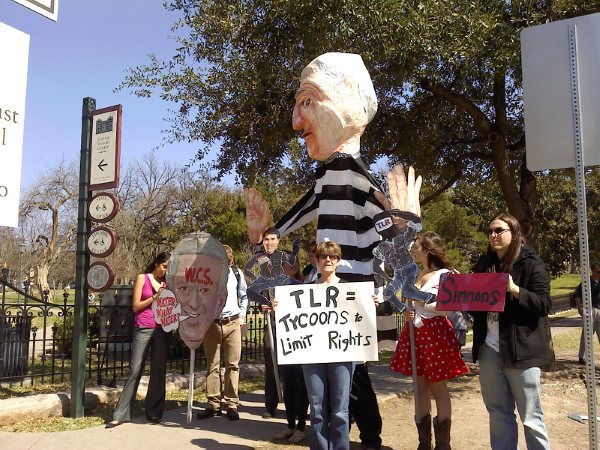
Texans for Lots of Radiation bring attention to Harold Simmons' donations to Texans for Lawsuit Reform
Texans for Lots of Radiation (TLR too) brought attention to the record donations raised by Texans for Lawsuit Reform (TLR) PAC ($6.9 million in the 2010 election cycle) with help from its No. 1 donor: nuclear-waste kingpin Harold Simmons. To reduce the cost of negligently harming other people, the PAC took 12 cents of every dollar it raised from Simmons. Not coincidentally, this billionaire is imposing unprecedented liabilities on Texans by importing staggering volumes of toxic and radioactive waste into West Texas.
TLR too is an ad hoc coalition of concerned organizations that include Texans for Public Justice, Public Citizen and the Sustainable Energy and Econimic Development (SEED) Coaliton.
Lobby Watch also finds that many of TLR’s biggest new donors are righteously litigious dudes. Click here to read the Lobby Watch report on this PAC’s contributions and its biggest contributor. You can also check out the TLR too website for more information.
The following post is a guest contribution by Citizen Richard of Audits in the Public Interest.
In late spring of 2010, Austin residents woke to the grand news their city had been selected as the host city for Formula One racing in the United States. Amidst the hype, and not immediately noticed, was the price tag hanging off the back of their new community award: an invoice in the amount of $250,000,000 to Formula One World Championship, Ltd, for the sanctioning fee.
A 25 followed by seven zeros is one quarter of a billion dollars and this was not all: the City of Austin would be on the hook for another $40,000,000. The incentive, from the Texas Major Events Trust Fund (METF), would supposedly be paid from increased retail taxes. The METF is administered by the Comptroller of Public Accounts, Susan Combs.
An extensive review by Audits in the Public Interest reveals a different picture about Formula One. Continue Reading »
In December of 2008 (interestingly the same month as the TVA Kingston Coal-Ash Disaster) a 27-year-old Tim DeChristopher repeatedly bid up 12,000 acres of land intended for oil and gas exploration to a nice, winning number of $1.79 million. The problem? He didn’t have $1.79 million.
Tim is now on trial in Utah – facing up to 10 years in prison for… raising a bid paddle. I couldn’t help but be reminded of the Hitchcock classic North By Northwest, where Cary Grant disrupts an auction specifically so that he would be arrested – getting placed in police custody to gain protection from the spies that were out to kill him. Continue Reading »
The Texas Progressive Alliance would like to thank the Academy for this week’s blog roundup.
Off the Kuff published an interview with Chris Barbic, founder and CEO of the YES Prep charter schools, which included a discussion of what the looming budget cuts will do to charter schools.
Redistricting endangers several Texas House representatives, Democratic as well as Republican. The mapmakers may need long knives instead of sharpened pencils (since we can all do maps online now). PDiddie at Brains and Eggs summarizes the opening of “negotiations”.
On March 15th, Texans from all corners of the state will be in Austin, visiting our elected officials and letting them know that we want them to protect our land, our water, and our health. Sign up now!Continue Reading »
I hope you’re going to have a great Oscar night, and while we may all have our favorites for best picture (True Grit was my favorite, but I think The Social Network and The King’s Speech are also very deserving), this year we have one of the most important issues of our time as the subject of one of the nominees for best documentary.
In Gasland, director Josh Fox travels across America to learn about the effects of hydraulic fracturing, or fracking, as a method to drill for natural gas. Despite the rhetoric about how clean natural gas is compared to other fossil fuels (kind of like saying it’s the least ugly stepsister), fracking is causing major problems across the US.
One of our favorite local bloggers in Texas, TXSharon, has been documenting these same problems living on top of the Barnett Shale. We don’t have a clip we can embed from Gasland, but I’ll use this as a placeholder:
Fox’s filmmaking is beautiful, frightening, humorous where possible, wry, and dismally depressing all at the same time. But he educates you on this terrible problem seeping up from the ground, and he makes you a little bit hopeful that we can find ways to get energy that don’t destroy our water supplies. That don’t ruin suburban neighborhoods or productive farmland.
Enjoy the Academy Awards, hopefully surrounded by some good, geeky friends and family. And even if “Exit Through the Gift Shop” wins for best documentary, make sure you see Gasland as soon as possible.
The Texas Supreme Court, the state’s highest civil court, will hear a controversial case over whether a company that plans to build pipeline to carry carbon dioxide and natural gas from Louisiana to site south of Houston qualifies as a “common carrier,” giving it the power of eminent domain. That means if they want to come through your property and you don’t want to sign the offer they make on your property, they can begin condemnation procedures to just take your property for what they think it is worth. And that just ain’t right.
The case is scheduled for oral arguments before the Texas Supreme Court on April 19th. At issue is whether the Jefferson County trial court ruled incorrectly when it said Denbury was a common carrier (meaning besides the company’s private, for-profit use, the line would be available for public use as well) and therefore could force private landowners to sell right-of-way so the 320-mile stretch of pipe could be built.
The appeals court upheld the trial court.
The industry is watching the case closely, and so should you, as lawmakers this session are considering emergency legislation that would strengthen the position of private property owners in eminent domain cases. If the Supreme Court rules in the company’s favor and the legislation is passed, we could see a whole network of new pipelines snaking across areas of northeast and east Texas as natural gas companies expand their fracking projects and with a Canadian company pushing the tar sands pipeline from Western and Central Canada, down through the middle of the country on its way to crude refineries in the Houston area. And they’ll be singing:
So Lord help the sister, who comes between me and my pipeline terminus.
To see the court documents filed in the case, click here.
###
By promoting cleaner energy, cleaner government, and cleaner air for all Texans, we hope to provide for a healthy place to live and prosper. We are Public Citizen Texas.
The funding bill the House of Representatives voted in favor of is an attack on climate change solutions and climate change science. The House cuts would:
Prohibit the EPA from setting limits on greenhouse gas pollution from power plants, factories and refineries, among the most significant sources of greenhouse gas pollution in the United States.
Prohibit the EPA from collecting information about the sources where greenhouse gas pollution is coming from.
Eliminate funding for a Climate Service at the National Oceanic and Atmospheric Administration. This program would efficiently supply scientific data and information about climate change and its impacts.
Slash the EPA’s total budget by about 29%.
Fortunately, both the Senate and the President still need to weigh in on the funding proposal. They must act before March 4. Your help is needed if you want to make sure they take the climate crisis more seriously than the House of Representatives did. Read Repower America’s summary here — and then spread the word among your friends and family.
###
By promoting cleaner energy, cleaner government, and cleaner air for all Texans, we hope to provide for a healthy place to live and prosper. We are Public Citizen Texas.
The Senate is about to hear legislation pertaining to coal ash waste regulation. There is an amendment proposed to slash EPA’s funding so that they cannot enforce safeguards at coal ash waste landfills. The following is a message from our friends with Environmental Integrity Project. Please take a few moments to contact your senator and let them know you want enforcement of regulations on these very hazardous and dangerous waste sites.
Dear Friends,
Thank you for helping to influence 183 Representatives in the US House to vote against Congressman McKinley’s amendment to eliminate EPA’s funding to regulate coal ash as a hazardous waste. Eighteen Representatives were Republicans switching ranks to vote against their party’s leadership and for safe water.
Within one week we MUST defeat this amendment likely to be proposed to the budget bill (Continuing Resolution) that is brought to the floor of the Senate, or this egregious proposal to slash EPA’s funding could become a reality – leaving EPA unable to enforce basic safeguards at toxic coal ash dumps such as liners, covers or monitoring and thousands of American communities nearby in harm’s way.
Nearly a half million Americans submitted comments on the EPA’s proposed coal ash rules with a majority of them in support of safeguards. More than a thousand concerned citizens who traveled to 8 day-long EPA hearings supported these safeguards. Clearly, Americans have voiced their support FOR protection of our drinking water and public health by the US EPA.
Please call your Senators today and urge them to vote NO to any amendments to cut the US EPA’s authority to protect our health from toxic coal ash. Use this link to find phone numbers for your Senators – you just need to type in your zip code:http://www.contactingthecongress.org/
1. Tell your Senators you want them to respect the rule-making process and the comments that their constituents submitted on the EPA coal ash regulation.
2. Tell them to let the US EPA to do its job and protect public health.
3. Ask them if you can count on their support for basic safeguards to protect public health from toxic coal ash.
After you make your call, please let us know you’ve made the calls and what their offices said. Send your responses to: lwidawsky@environmentalintegrity.org.
Please let your US Senators know today that Americans throughout the country want to be protected – call them immediately and tell them to uphold our right to safe drinking water.
Thanks for your continuing help and please spread the word.
###
By promoting cleaner energy, cleaner government, and cleaner air for all Texans, we hope to provide for a healthy place to live and prosper. We are Public Citizen Texas.
John Moritz and Patrick Graves covered the joint hearing of the House Energy Resources and Environmental Regulation committees for the Texas Energy Report, which they say continued the long-running theme at the Texas Capitol that the feds are unfairly targeting Texas industries while ignoring progress made over the decades on clean air matters.
But about a half-hour into the familiar thumping of the U.S. Environmental Protection Agency, two Democratic lawmakers offered a rare counter-veiling view on the on-running battle.
Shaw had repeated his oft-state concern that the EPA’s action last year effectively outlawing Texas’ flexible permit program will kill jobs in the refining and manufacturing sectors and that the feds were ignoring Texas’ efforts to lower pollution levels.
But Farrar argued that people in her working-class district that is also home to several manufacturing facilities are often frustrated that plants operating under the flexible permit program often make changes that appear to affect emission levels without allowing for public comment.
Shaw argued that any such changes would not increase pollution because flexible permits set caps on overall emissions. Farrar argued that her constituents don’t always know that. Further, she said, coming budget cuts will likely mean less money for programs aimed at providing incentives for polluters to adopt greener policies for their facilities.
Representative Lon Burnam (D-Fort Worth)
Those comments were followed by an observation from Fort Worth Democrat Lon Burnam that Republicans on the committee were suggesting that the EPA had acted in bad faith by declining an invitation to attend today’s joint hearing.
Burnam pointed out that the hearing was only called late last week, while Shaw had been given a month’s notice of an EPA hearing last year in Dallas that he decided to pass up.
Shaw acknowledged that he declined to attend, saying that he and his staff have had numerous meetings with EPA Regional Administrator Al Armendariz but have still been unable to resolve their difference.
“It was not an effort to snub anyone,” Shaw said. “It (the meeting) was just not a good use of our resources.”
While TCEQ decided that this public hearing was not a good use of their resources, they squandered any goodwill they had with the citizens of the DFW area who took time out of their busy schedules to attend the hearing and were probably hoping TCEQ would show up to tell them directly why they have taken the position they have.
Moritz and Graves go on to report:
It was unclear if the two committees are planning any legislative remedy to the EPA/TCEQ standoff over flexible permits and related issues, or whether Republican-controlled Legislature will wait for the outcome of court challenges the state has filed against the federal agency’s policies affecting Texas.
Representative Jim Keffer (R-Eastland)
It was clear, however, that neither Energy Resources Chairman Jim Keffer (R-Eastland) or Baytown Republican Wayne Smith, who chairs Environmental Regulation, intended the hearing to derail the state’s civil action that remains pending in the federal court system.
Representative Wayne Smith (R-Baytown)
“Tell us all you can,” Smith told Shaw as he sat down to testify, “but don’t jeopardize your case.”
Later in the hearing, Deputy Attorney General William Cobb III gave members a blow-by-blow account of the events leading up to the state’s lawsuit against EPA. He also said the case, which is still pending in a Washington, D.C., court is moving slowly, saying the parties have not even received a briefing schedule yet.
But, added, the state is committed to continuing the battle with the feds.
“It’s a fight worth fighting,” Cobb said, who described the back-and-forth over EPA‘s rule interpretations in detail without the benefit of notes. “We’re taking every measure to oppose these rules.”
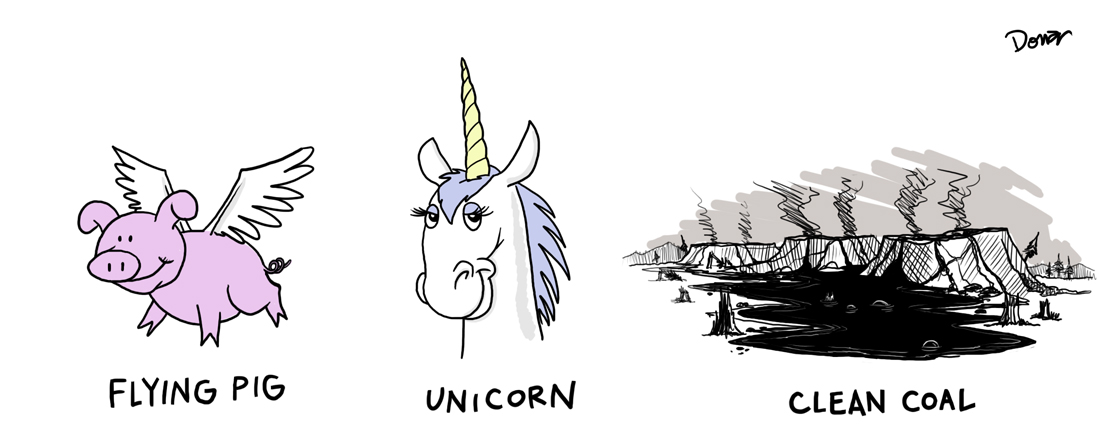
Great news from St. Louis! Students and other activists from “Green Action” (at Washington University in St. Louis) and Missourians Organized for Reform and Empowerment (MORE) entered the Hilton St. Louis at the Ballpark to disrupt a meeting of the National Coal Council – a federal advisory committee to the U.S. secretary of energy (see their extremely dramatic website here).
The meeting was to focus on carbon capture and sequestration technology, but was canceled do to the disruption and chants of “Coal is never clean” and, “Clean coal is a dirty lie.” The group was peacefully escorted out of the hotel by police.
The meeting was canceled, but members of the council stayed to enjoy the private lunch they had already ordered. I’d have a joke about that, but I’m not that funny.
See more details at Washington University’s independent newspaper: Student Life
###
By promoting cleaner energy, cleaner government, and cleaner air for all Texans, we hope to provide for a healthy place to live and prosper. We are Public Citizen Texas.
So now San Antonio is sitting back watching with a knowing eye as NRG/Toshiba (formally know together as NINA) approaches the City of Austin with the hope that Austin hasn’t been paying attention to what they put San Antonio through just a year ago.
Greg Harman of the San Antonio Current provides an update to his readers:
Though the nuclear discussion in city circles has cooled dramatically since CPS Energy extracted itself from a 50-percent share in the proposed doubling of the South Texas Project nuclear complex down to a mere 7 percent, the project’s key boosters have continued scrambling to make the project as attractive as possible to the U.S. Department of Energy and — more recently — the Japan Bank for International Cooperation. To pretty-up the massively expensive project (in the course of the local debate, it shot from around $8 billion to $18 billion), NRG and Toshiba have rounded back on Austin, hoping to win a change of heart from a newer mayor and council. Years back, the city, a 16-percent partner in STP’s Units 1 and 2, voted not to partner on the expansion, citing concerns for both likely cost overruns (how prescient) and the troubling question of how to dispose of the high-level radioactive waste that is left behind.
In a piece by John W. Schoen, senior producer at MSNBC, he leads with:
As the turmoil in the Middle East spreads to Libya, a major oil producer, the shockwaves of Arab unrest are reverberating through the global oil supply chain – and threatening to spill over into the global economy. Click here to read the full story.
Even if prices stabilize, the higher cost of energy comes as the global economy is already struggling to come back from the recession, with Texas just now seeming to enter that arena (as evidenced by the states’ significant budget shortfall this biennium).
You can be sure that a crisis in the oil industry will have an effect on the bills passed this session in the oil refining Mecca of the United States. Stay tuned as Public Citizen tracks the impacts on the regulatory industry in the State over the next year.
 In December of 2008 (interestingly the same month as the

 The Senate is about to hear legislation pertaining to coal ash waste regulation. There is an amendment proposed to slash EPA’s funding so that they cannot enforce safeguards at coal ash waste landfills. The following is a message from our friends with Environmental Integrity Project. Please take a few moments to contact your senator and let them know you want enforcement of regulations on these very hazardous and dangerous waste sites.