Feeds:
Posts
Comments

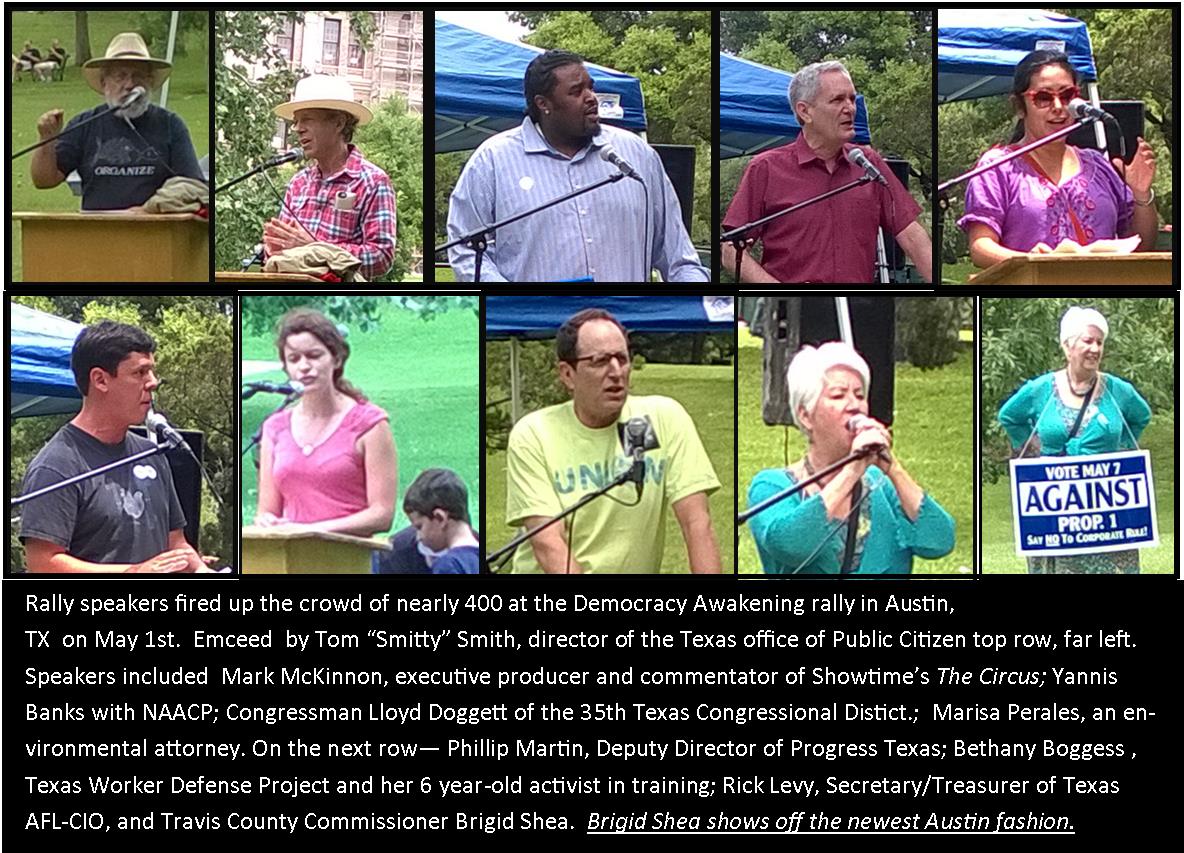
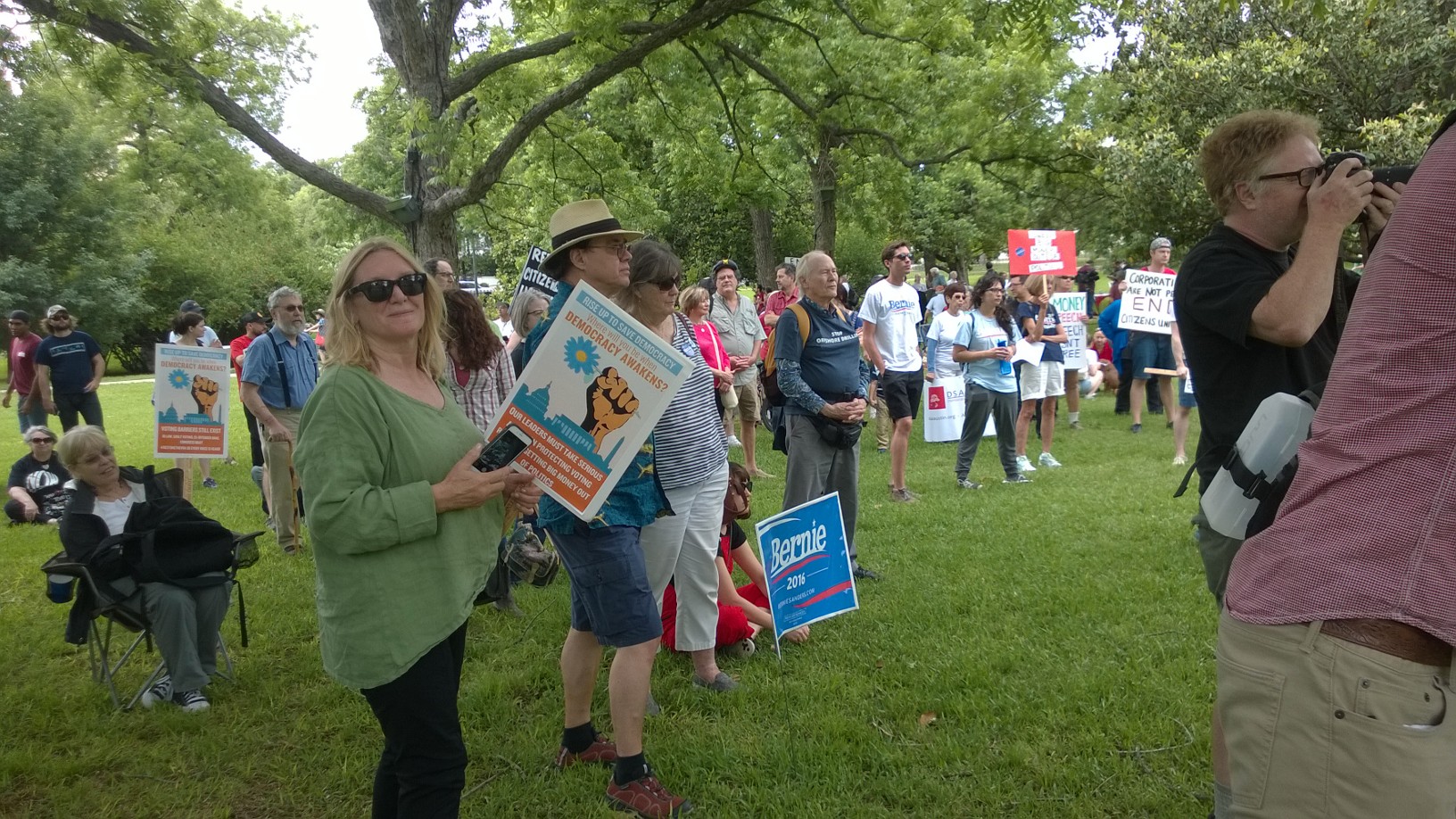
The crowd listens to speakerOn Sunday, May 1st – International Workers’ Day – nearly four hundred people gathered on the grounds of the Texas State Capitol for the postponed Democracy Awakening rally and march.  There was music by local band Talk Radio, and stirring speeches by progressives and conservatives followed by a short march down Congress Avenue led by the Walls of Jericho Marching Band.


collapsed scaffolding cnn

Collapsed construction scaffolding – CNN

May 1st is Workers’ Memorial Day, and we have much to remember here in Texas.  A new Report Finds Construction Injuries and Fatalities Cost Texas Nearly $900 Million Annually

Injuries and fatalities in the construction industry cost Texas an estimated $895.9 million in 2013 alone with workers and their families footing an estimated $447.9 million of the bill, a new Public Citizen and Workers Defense Project report (PDF) shows.

The report, “The Price of Inaction: The Cost of Construction Injuries in the Lone Star State,” quantifies the estimated costs of deaths, injuries and illnesses in the state’s construction industry. The release coincides with Workers’ Memorial Day, a time when labor advocates pause to commemorate those who lost their lives on the job and who suffer from debilitating work-related injuries or illnesses.

In 2013, Texas recorded approximately 5,600 construction industry injuries and illnesses, which required workers to take time off of work to recover. Additionally, 116 Texas construction workers lost their lives during that time.

The report also finds that people of color and immigrants experience disproportionate rates of work-related fatalities in Texas’ construction industry. In 2013, about two out of every three construction workers killed in Texas were Latino. In addition, from 2012 to 2013, fatalities among foreign-born construction workers in the state increased at a much higher rate (47 percent) than the total number of construction worker fatalities during that time (11 percent).

“Our research indicates a pervasive crisis in the Texas construction industry, which unduly burdens people of color, immigrant workers and their families,” said Emily Gardner, worker health and safety advocate for Public Citizen’s Congress Watch division. “Texas lawmakers should immediately enact safeguards protecting construction workers from unsafe worksites.”

“Texas’ construction industry is generating more than $74 billion a year,” said José P. Garza, executive director of Workers Defense Project. “There’s no excuse for the industry to shift the cost of dangerous worksites from employers to injured workers, their families and taxpayers.”

Texas’ misleadingly named “opt out” system, which does not require employers to purchase workers compensation insurance, shifts the costs of injuries and fatalities from employers onto workers. Without a basic social safety net that includes workers’ compensation, construction workers and their families are left without wages while they recover from injuries and struggle to pay high medical bills and other expenses.

To address this problem, Workers Defense Project and Public Citizen recommend Texas lawmakers make several reforms to increase safety for employees. The report calls on the Texas Legislature to:

  • Require that all construction employers purchase workers’ compensation coverage for all employees;
  • Require that all contractors on publicly funded or publicly subsidized construction sites complete a workplace health and safety prequalification process;
  • Establish a Texas Council on Construction Safety and Health;
  • Pass a statewide policy establishing a rest break standard for construction workers; and
  • Require or incentivize participation in respected third party certification programs like the Better Builder Program.

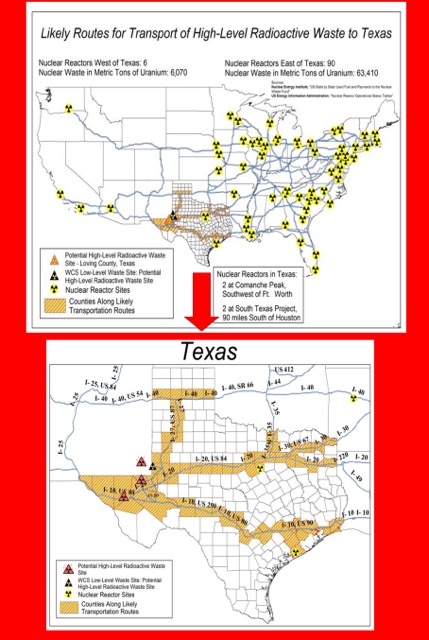
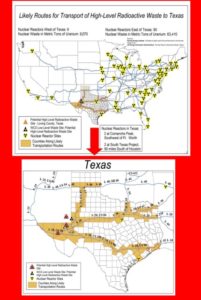
Rad Waste Transportation RoutesA high-level consolidated radioactive waste storage site has been proposed for Andrews County, Texas, by Waste Control Specialists (WCS). The company expects to submit a license application to the Nuclear Regulatory Commission (NRC) and to have licensing and construction completed by the end of 2020.

“This plan is all risk, not only for the states of Texas and New Mexico, but for the whole country and it should be halted immediately,” said Tom “Smitty” Smith, director of Public Citizen’s Texas Office. “Why is our region being targeted to become the nation’s dumping ground for high-risk high-level radioactive waste? Putting this waste on our highways and railways invites disaster. Radioactive waste moving through highly populated cities across the country could be targeted for sabotage by terrorists.” A state report, the Assessment of Texas’ High-Level Radioactive Waste Storage Options, says that “spent nuclear fuel is more vulnerable to sabotage or accidents during transport than in storage because there are fewer security guards and engineered barriers, and that the consequences could be higher since the waste could travel through large cities.“

“Counties along the potential transport routes for high-level radioactive waste should have a voice in whether there is consent for this plan,” said Dallas County Commissioner Dr. Theresa Daniel. “While a single county in West Texas might gain financially from bringing in the nation’s high-level radioactive waste, other counties would have increased risks of accidents and terrorist activity.  Counties need to assess their financial liability and the costs they could incur for expanded emergency preparedness. “

Bexar County Commissioner Tommy Calvert echoed Dr. Daniel’s concern. “Shipping this waste though our county is “ all risk and no reward”.   Our county and others along the way would have increased risks of accidents and given the concentration of military facilities in San Antonio we are potentially at higher risk of terrorist activity. Counties along the potential transport routes for high-level radioactive waste should be able to either consent to or deny the plan that would lead to waste being shipped though their communities.“

“Exposure to radioactivity can lead to cancers and genetic damage. Accidents could be deadly,” said SEED Coalition Director Karen Hadden. “An unshielded person exposed up close to high-level radioactive waste would die within a week according to the Department of Energy (DOE). There’s no need to risk health and safety across the country just to store radioactive waste in a different place, especially since no permanent repository has been developed. The least risky path is keeping the radioactive waste where it is.”

“We do not consent to the plan to dump dangerous radioactive waste on us,” said Rose Gardner of Eunice, New Mexico, a town of nearly 3000 people that is 40% Hispanic. It lies five miles west of the WCS site. “Andrews County officials say that we want this waste, but no one has ever asked me if I consent. I would definitely say no, and many others here feel the same way. We never got to vote on this issue. The Department of Energy (DOE) is saying that our community consents to having radioactive waste dumped in our backyard, but this isn’t true. The DOE scheduled eight hearings around the country, but not a single one for New Mexico or Texas, the targeted region. Clearly they don’t want to hear our voices.”

“If the Nuclear Regulatory Commission approves WCS’ application it could unleash the world’s largest and most dangerous campaign of nuclear transport on our roads, rails and waterways,” said Diane D’Arrigo, Radioactive Waste Project Director at Nuclear Information and Resource Service (NIRS).

We call this plan “Fukushima Freeways,” after the triple nuclear reactor meltdowns that started five years ago in Japan and continue to hemorrhage radioactive water into the oceans, fish and our food webs.”

Transporting radioactive waste for the purpose of consolidated storage isn’t necessary since the waste can remain secured in dry casks at the site where it was generated, or close nearby and most reactor sites are already licensed to do this.

The DOE previously analyzed accident risks for shipping high-level waste to Yucca Mountain and predicted at least one accident for every 10,000 train shipments. With 10,700 shipments, at least one train accident was anticipated.  Consolidated storage would involve thousands of radioactive waste shipments that would occur over 20 or more years across much of the United States. If transport is mainly by truck, 53,000 shipments with 53 accidents were expected.  They found that a radiation release could render 42 square miles uninhabitable and cost 9.5 billion dollars to raze and rebuild a downtown area.

“If this mass movement of radioactive waste begins, there will be accidents and some of those accidents could release enormous amounts of radioactivity,” said D’Arrigo. “This waste is the hottest, longest-lasting, most intensely radioactive, cancer-causing part of the whole nuclear power fuel chain. It is dangerous now and will still be dangerous in thousands to millions of years. The nuclear industry and government want to pretend there is an answer to the radioactive waste problem and move the waste around, at our peril.”

WCS’ application for consolidated “interim” storage is likely to be for 40 years. The site could easily become a de facto permanent disposal site, without the necessary research and rigorous standards needed to keep radioactive waste isolated for thousands of years.

Former State Representative from Fort Worth Lon Burnam is concerned about water contamination. “The WCS site is supposed to be dry, but their own monitoring well data frequently shows that water is present. The site is very close to the Ogallala (High Plains) Aquifer that provides drinking and irrigation water for eight states in the middle of the U.S. What if the nation’s largest aquifer became contaminated by radioactivity?”

Sources:

Note: The maps above show likely routes developed based on routes previously designated for shipments to Yucca Mountain.  Please note that AFCI’s project for Loving County is no longer under consideration, although the company may still be looking for a site in Culberson County.
As we’re all aware, weather is never static. Weather conditions and patterns are always changing and are difficult to predict. One very recent example of this is the El Niño Southern Oscillation (ENSO). ENSO is a cycle of warming and cooling events in the equatorial Pacific Ocean and the atmosphere above it. These periodic events take place over roughly 2-7 year intervals. The resulting variability in oceanic and atmospheric temperatures has a range of effects on seasonal precipitation and temperature patterns across the world.

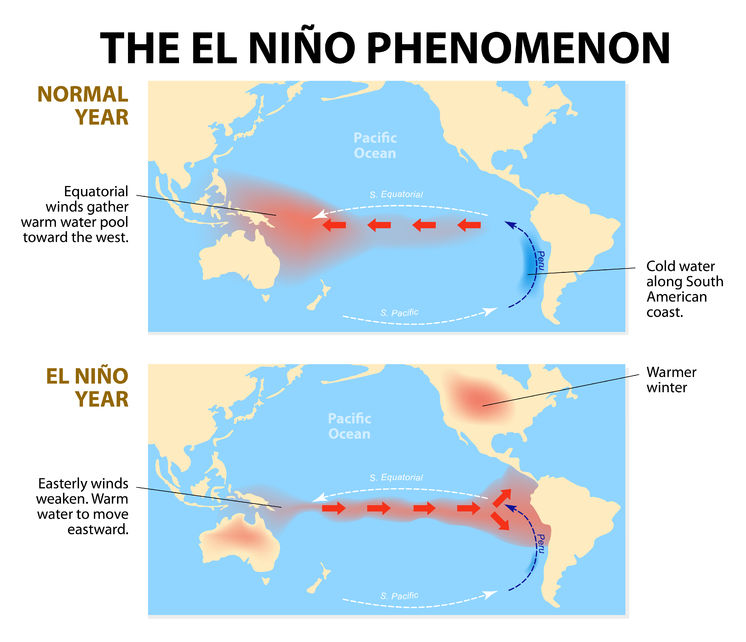
With ENSO, the cycle can shift form its neutral or normal state, to a warm phase – El Niño, or a cool phase – La Niña. We’ve been in one of the strongest El Niño phases on record for the last 2 years. During El Niño, the typical East-to-West winds weaken in the equatorial Pacific, which drives warm waters from the western Pacific to the eastern Pacific. This causes warm ocean surface temperatures and heavy precipitation in northern South America, and dry conditions in Australia and Indonesia.

El Nino

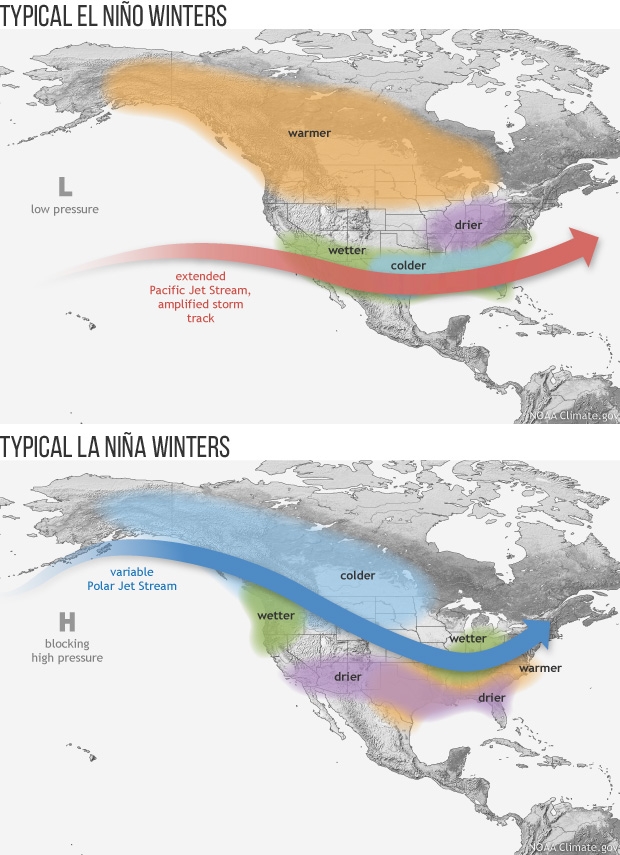
With the El Niño phase we’re currently in, there have been a lot of extreme weather phenomena. The monsoon rains weakened in India, resulting in food shortages, West Africa has been in a drought, Australia experienced record heat, Brazil experienced excessive rains, and the northern hemisphere winters were warmer than usual. For Texas specifically, there’s been increased precipitation events, making 2015 Texas’ wettest year on record.

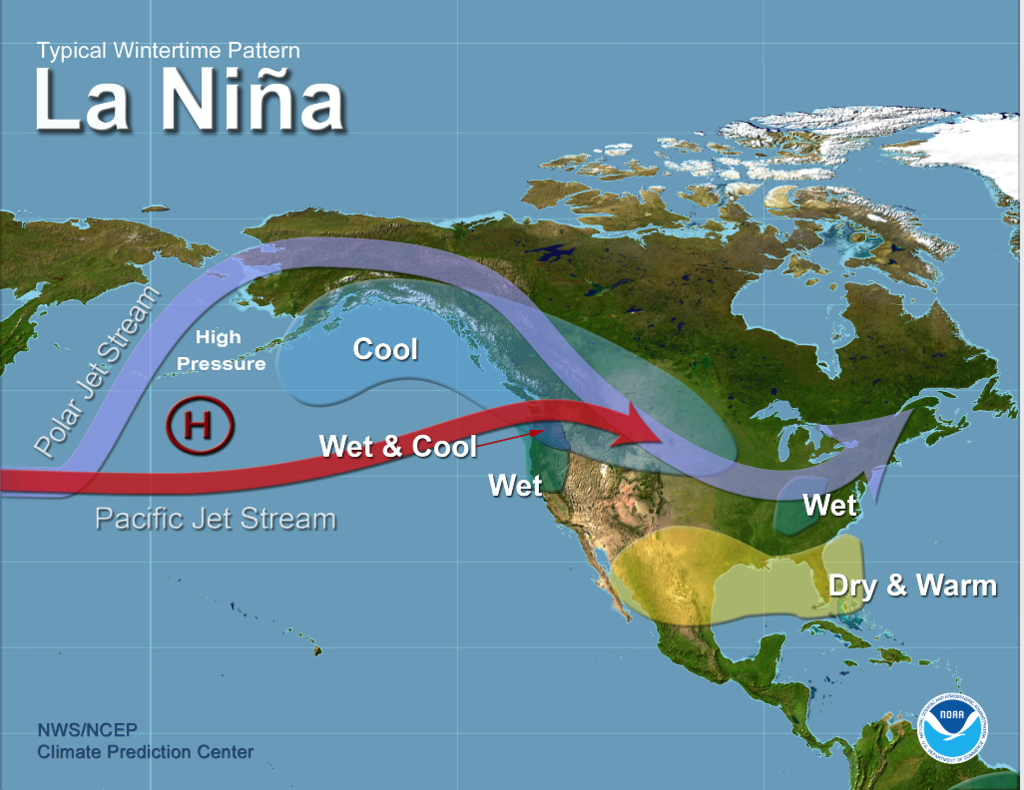
Winter Comparison - NOAA Climate.govThis month though, scientists from the National Oceanic and Atmospheric Administration (NOAA) have issued an official “La Niña Watch.” They predict that El Niño will phase out in late spring or early summer, and will shift to La Niña for the fall and winter. So we can soon expect to see generally opposite conditions than we have been experiencing with El Niño.

La Niña results when cool ocean water intensifies the East-to-West winds across the equatorial Pacific Ocean. This causes warm oceanic temperatures in the western Pacific, which means heavy rainfall for Australia and Indonesia. Conversely, it causes cool oceanic temperatures in the eastern Pacific, resulting in dry conditions in South America.

Nina Winter - Weather NetworkDuring La Niña winters, the U.S. experiences dry and warm conditions in the southern states, but wet and cool conditions in the Pacific Northwest and northern plains. We can expect there to be a lot of snow in the Pacific Northwest while there’s drought in California and Texas. In previous La Niña periods, the lack of rainfall negatively impacted Texas water supplies and crops. With La Niña, there’s also an increased chance of Atlantic hurricanes since the temperature and moisture flow associated with it creates ideal conditions for hurricane formation.

Even worse, research indicates that because of global climate change, El Niño and La Niña may hit twice as often as they did before. Climate models indicate that an extreme La Niña may hit every 13 years now instead of every 23 years, and an extreme El Niño may hit every 10 years now instead of every 20 years. Since a warmer atmosphere can hold more water and moisture, rainstorms can increase in intensity. For example, during a future El Niño, the West Coast may experience heavier downpours than usual. During a future La Niña, the added moisture in the air may make northeast snowstorms much stronger.

If the weather is always undergoing different cycles and is constantly changing, then why does an upcoming La Niña matter? Shifts in precipitation and temperature patterns alter crop production abilities, which will impact the prices of goods all over the world. Various commodities will be affected by the upcoming La Niña:
Continue Reading »

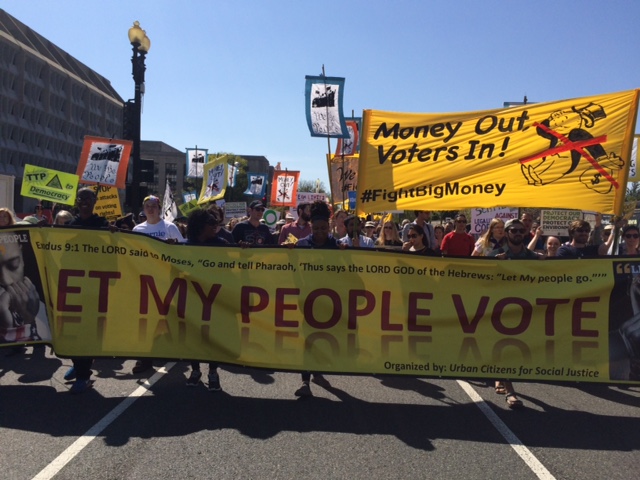
DC March 2Thousands of citizens converged on Washington DC for a week of action that culminated in a march on April 17th.  Part of a movement called Democracy Awakening, they mobilized in Washington, D.C. calling for the protection of voting rights, getting big money out of politics and demanding an up or down vote on President Obama’s Supreme Court nominee.  And that is just the start.


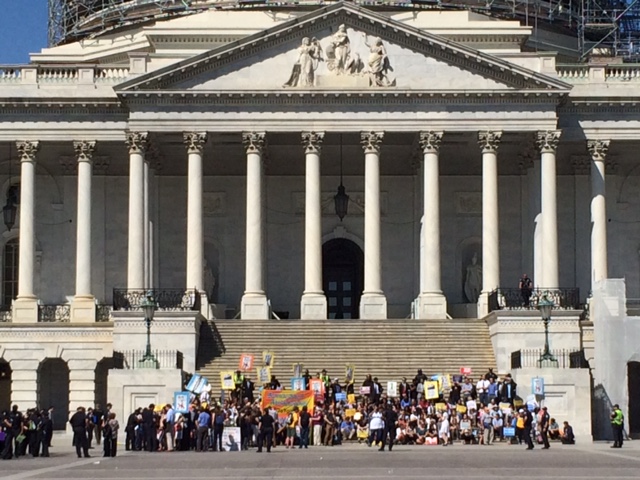
Protest in front of the Supreme Court resulted in hundreds of arrests.

Protest in front of the Supreme Court resulted in hundreds of arrests.


A planned rally in Austin that same day was postponed due to rain, but has been rescheduled for Sunday May 1st.  Come join us and show them how it is done.  Click here for more information.

The Uber/Lyft debate has been raging in Austin for months, but do you know what you’ll actually be voting on?  Voting is a right, but being an informed voter is a responsibility.

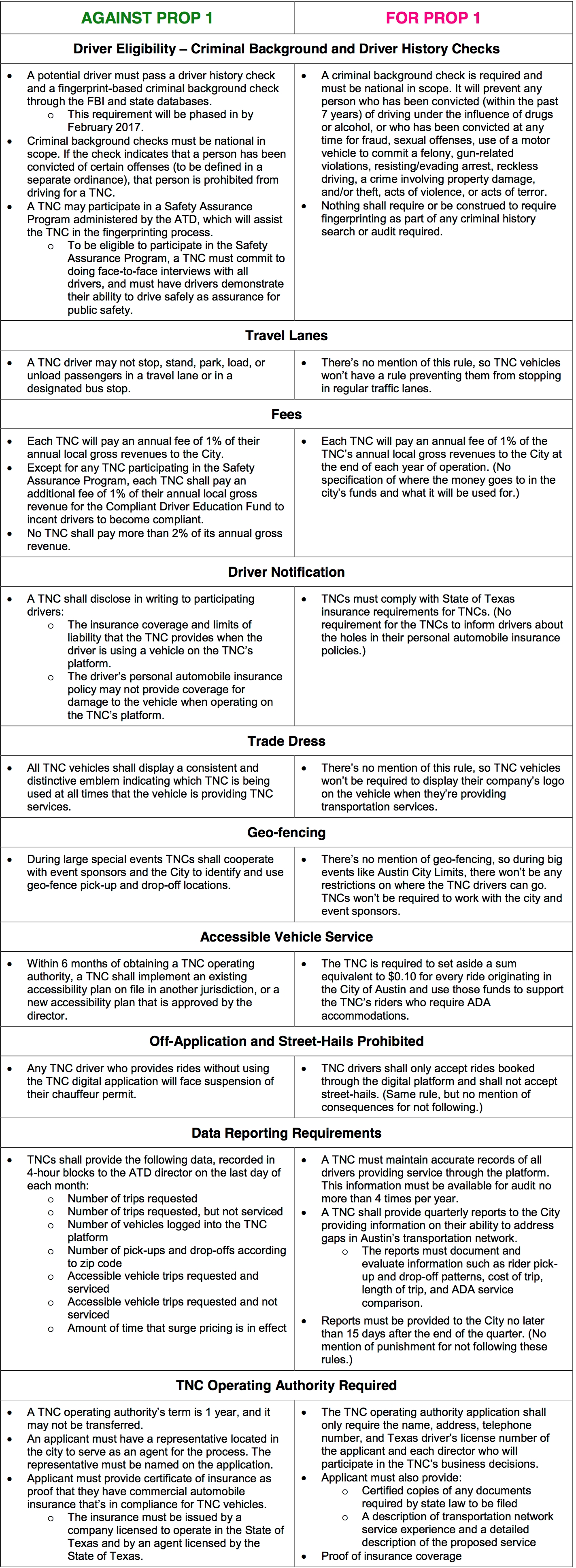
Proposition 1 is a vote on rules and regulations in Austin for transportation network companies like Uber and Lyft. If you vote AGAINST Prop. 1, you’re voting for the City of Austin’s proposed safety rules. If you vote FOR Prop. 1, you’re voting for Uber and Lyft’s proposed regulations that they personally drafted in retaliation to the Austin City Council’s ordinance. While a lot of the rules in the two ordinances are the same, there are some very important differences as well. To make it easier for voters to understand, we’ve highlighted the differences in the ordinances, and therefore what Austin residents are really voting on at the polls on May 7.

Key:

  • AGAINST PROP 1 – City of Austin’s regulations
  • FOR PROP 1 – Uber and Lyft’s regulations
  • TNC (Transportation Network Company) – an organization, whether a corporation, partnership, sole proprietor, or other form, which provides on-demand transportation services for compensation using an online-enabled application or platform to connect passengers with drivers.
  • ATD (Austin Transportation Department) – section of the Austin government that addresses transportation needs and challenges, as well as public safety.

Austin Proposition 1 Comparison Table

The regulations the City Council passed in December requiring stricter rules than currently in place for Uber and Lyft are not absurd. People who operate pedicabs or horse carriages in the city already have to get fingerprinted. Make no mistake; this is not an issue of keeping Uber and Lyft in Austin. That’s not what the vote is for on May 7. The City Council isn’t kicking anyone out; they’re just leveling the playing field for all TNCs by making sure they follow the same rules.  And if these particular companies choose not to do business here, Austin Uber and Lyft drivers will soon be provided with new transportation companies to drive for.

Uber and Lyft have already pumped $2.2 million into this campaign, which is evident in their abundant advertising. This is supposed to be a local issue, but it’s quickly becoming a perfect example of why Citizens United should be repealed. Vote “No” for Prop. 1 and show corporations that they can’t write their own rules and buy local politics in Austin.

ntulogoTexas is a beautiful state – full of unique landscapes from the rocky desert of Big Bend to the colorful, rolling Hill Country. With that said, it is essential we remember that before settlers staked claim to this region of America, it was already sacred land to the Native Nations. It can be seen that modern industry has exploited this bountiful and revered land for its natural resources to build the current civilization. Few are guiltier of this than the coal industry whose mines completely decimate the land they are built upon.

For this reason and more, members of the Native People of the Americas and community allies have united in opposition against the Dos Republicas coal mine in the area near Eagle Pass, Texas. Since being proposed in 2012, the Dos Republicas coal mine has faced continuous criticism by concerned citizens of Eagle Pass and outcry in on the southern side of the border in Mexico.  Despite united and continued opposition from local residents and local governments, the Texas Commission on Environmental Quality (TCEQ) and the Railroad Commission (RRC) granted Dos Republicas the permits needed to move forward with the mine.

Not only will this mine bring tremendous environmental damage on this sacred land, but it will also be used as the supplier of coal to be burned at plants in Mexico instead of the local energy grid. This is because the coal in this area is of such low quality that it can’t be burned in the United States. So this dirtiest of dirty coal will be shipped across the border and burned in plants with little or no air pollution controls. The subsequent pollution will harm local communities and blow across the border to impact Texans as well.

Projects such as these are last ditch efforts by the coal industry to remain profitable in an adapting energy market, and these attempts corner rural and native communities who will bear the burden of their desperation. Profit and energy aside, the extraction and production of coal puts neighboring communities at risk. The silt, pollution, and waste of such a mine all present toxic impacts to the region, which are especially relevant considering the rise of flooding in recent years.

With the climate crisis looming over us, as well as our right to live in a healthy and safe environment, it is entirely necessary to confront new coal mines head on.

A Native led rally and march to the Dos Republicas Coal Mine will be taking place this Saturday, April 16, 2016. For updates, go to the event page. Public Citizen stands in solidarity with their action and will continue to work towards a cleaner, more just Texas.

EarthShare TEXAS has once again been chosen for .@HEB April’s coupon promotion! Support the Texas environment when you shop at HEBs and Central Markets throughout Texas.  This campaign also supports Public Citizen’s Texas office directly.

DA general 6If you pay any attention to politics, you might often wonder if the decisions being made are really what people want.  The answer is often no.

Wealthy donors, including corporations and individuals, are able to contribute unlimited money to super PACs (political action committees) to support or oppose candidates for elected office.  Although this money is technically separate from donations directly to candidates, super PACs are clearly working in lock-step with candidates’ campaigns.  On top of that, the Supreme Court ruling in Citizens United v. Federal Election Commission opened the door for unlimited spending on campaigns by political nonprofit organizations, which don’t have to disclose their donors.  So, wealthy individuals and powerful business interests can secretly spend unlimited money on elections.  And they are.  This results in elected officials who are beholden to those wealthy donors, not the people.  Does that sound like democracy?

In addition to the corrupting influence of money on politics, the basic right to vote is under constant attack.  In 2013, the Supreme Court struck down a key provision of the Voting Rights Act, which required certain states, including Texas, to receive authorization from the federal government before changing how elections are conducted. That provision caused hundreds of proposed changes to be withdrawn or altered because the Justice Department was concerned that they may be discriminatory.  Now, those states can enact potentially discriminatory elections laws and they much be challenged through the court system by those who are harmed.  This adds expense and, much more importantly, results in the denying citizens their right to vote.  Another major blow to democracy.

Enter Democracy Awakening.  Over 200 organizations representing a broad array of interests – civil rights, the environment, labor, peace, students – are working together to bring national attention to the problems caused by the influence of money on politics and voter disenfranchisement.  There will be a large rally and other events in Washington D.C. and supporting events in cities across the country on Sunday, April 17.

Austin Rally: Sunday, April 17 at 1 p.m. in the southwest corner of the Capitol grounds in Austin.  There will be short speeches, music, tables with information and a march down Congress Ave.

Dallas Rally: Sunday, April 17 at 1 p.m. at the Reverchon Park Recreation Center (3505 Maple Ave).  The event will include speeches, activities, tables with information and a march to Lee Park.

Regardless of what issue you care about most, the degradation of our democracy by denying voters their rights and allowing unlimited sums of money to determine political outcomes is a serious threat.  I need look no further than my top priority, climate change, to see many examples of how money, not voters are determining policy decisions.  A large majority of Americans want action to stop climate change, and yet Congress has failed to place limits or a tax on greenhouse gas emissions.

Please join us to rise up and defend our democracy by demanding reforms.

  • Voting Rights Advancement Act (H.R. 2867, S. 1659)
  • Voting Rights Advancement Act (H.R. 2867, S. 1659)
  • Democracy For All Amendment (H.J.Res. 22, S.J.Res. 5)
  • Government By the People Act/Fair Elections Now Act (H.R. 20 and S. 1538)
  • Fair consideration of the nominee to fill the Supreme Court vacancy
For 46 years the Longannet power station in Scotland, the largest coal plant in Europe, burned coal for energy.  The plant, the last of its kind in Scotland, closed last Thursday, bringing an end, after 115 years, of coal for electricity.
Scotland, a country of some 5 million people, is on track to have enough renewable energy to power 100 percent of its electricity demand by 2020.Renewable electricity output has more than doubled since 2007 and is equivalent to half of the electricity consumed. This surge in renewables follows a massive investment in onshore and offshore wind, which has established Scotland as a renewable energy leader in the region.
 scottish coal minersEnvironmentalists welcomed the end of Longannet, which burned around 4.5 million metric tons of coal a year, and was responsible for a fifth of Scotland’s climate change emissions. For a country which virtually invented the Industrial Revolution and for which coal had been central to the country’s economy for the past two centuries, this is a hugely significant step, marking the end of coal and the beginning of the end for fossil fuels in Scotland.  With the closure of Longannet, the only major fossil fuel plant in Scotland is a gas plant at Peterhead, in the northeast.In the U.S. moving beyond coal continues with 232 plants announced for retirement.
While fossil fuels continue to have a role in the power sector, renewable energy is expected to continue the surge it has been enjoying.  A new United Nations-backed report found that coal and gas-fired electricity generation drew less than half the investment made in solar, wind, and other renewables in 2015.
So we say slàinte to Scotland, for its leadership in ending fossil fuel use.

Dylan Petrohilos - Gov Census

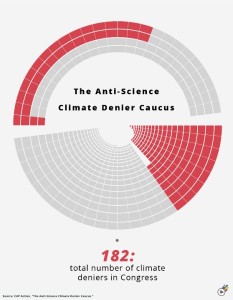
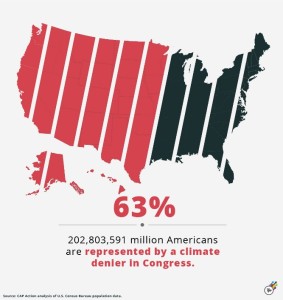
2014 and 2015 were back-to-back years that both earned the title for hottest year on record. and February 2016 was the warmest month, globally, ever recorded. And yet U.S. lawmakers continue to deny the facts.  Earlier this month, the Center for American Progress Action Fund (CAPAF) released an analysis of climate change denial in U.S. Congress called “The 2016 Anti-Science Climate Denier Caucus.” Their research found that more than 63% of Americans are represented by someone in Congress who denies that climate change exists.

Dylan Petrohilos - CAP182 members of Congress don’t believe the science behind climate change: 144 members in the House of Representatives and 38 members in the Senate. 67% of Americans want the U.S. to take action on climate change, but 202 million citizens are represented in Congress by a climate change denier. Since the Republican Party’s platform on environmental policy never mentions climate change, it’s no surprise that every single denier is a member of the Republican Party.
A recent poll revealed that 76% of Americans believe global climate change is occurring, including 59% of Republicans. According to a poll by NBC News and the Wall Street Journal, 67% of Americans support President Obama’s Clean Power Plan. The results of these polls don’t correlate with the fact that that the number of Congressional climate deniers has increased from previous years. From severe weather, wildfires, drought, and flooding, climate change is impacting Americans every day, and it’s evident that human activity is the dominant cause. Despite this evidence, 70% of the Senate GOP still denies climate change.

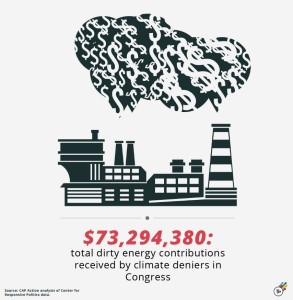
Dylan Petrohilos - Open SecretsIn the analysis, CAPAF also looked into dirty energy money’s influence over Congress members. They found that climate deniers in Congress received more than $73 million in contributions from coal, oil, and gas companies. This is an increase of nearly $10 million from last year. When asked about their views on climate change, many deniers dodge the question by saying “they aren’t scientists”.

According to Sondre Båtstrand, a Norwegian researcher, the U.S. Republican Party is the only conservative party in the world which denies the reality of climate change. Båtstrand believes the GOP’s denial is due to three factors: the fossil fuel industry’s political spending, a commitment to free-market ideology, and the intense political polarization that punishes moderate-minded party members.

In February 2016, over 200 lawmakers in U.S. Congress signed onto a court brief opposing the president’s Clean Power Plan. At the end of 2015, the House of Representatives passed two resolutions to kill the Clean Power Plan. The Plan would regulate power plants’ carbon emissions and 67% of Americans support it. So it’s clear that Congress isn’t working the way it’s intended to. Members of the House and Senate are elected to represent the interests of American citizens, not their own fat wallets and the interests of dirty energy companies.

Regarding the state of Texas specifically, the 2016 Anti-Science Climate Denier Caucus found that 17 out of 38 Texas Congressional members are climate change deniers. In 2016, this is not only unacceptable, but is dangerous for Texas families who depend on their elected leaders to protect their futures. When the impacts of climate change become more and more apparent each year – more severe storms, deadly wildfires, crippling drought, and rising sea level – it’s clear there’s no time to waste. Climate change deniers in Congress, like Ted Cruz, stand in the way of these common sense safeguards. Texans and Americans across the country deserve leaders who will stand up to face this threat head on – not those following the playbook of their largest campaign donors.

Please join Manage Austin Better and Change Austin next Thursday, March 24, for a citizens’ hearing to provide your views on how Austin’s city management is running our city. Unfortunately, the Austin City Council is not providing you an opportunity to speak at a public hearing on city management, so Manage Austin Better, Change Austin, and other groups are.

It is your city and you pay for the services – so your views matter. Please come and voice your opinions. The event will be recorded for Council viewing.

The Citizen’s Hearing on Why the 10-1 Council Needs New Management
Thursday, March 24, 2016 
6:30 to 8:30 pm
Austin Energy Community Room
721 Barton Springs Road

Please reserve a free seat at www.ChangeAustin.org. And please fill out our city manager evaluation form here, which Manage Austin Better will also deliver to council.

wind and solarWind knocked out nuclear to take third place as one of the major sources of energy in the Electric Reliability Council of Texas (ERCOT)’s system this year. ERCOT is the grid manager for the bulk of the state of Texas and stays on top of which power source is feeding into the grid at any given moment.  Nuclear power met 15.1% of demand last month, coming in fourth behind natural gas, wind and coal.

In February 2015, wind supplied only 11.8% of ERCOT’s demand, behind natural gas at 47.6%, coal at 26.5%, and nuclear energy at 13.7%.

Led by Texas, the U.S. wind industry is booming and is expected to continue record expansion into the early 2020s due to the recent 5 year extension and phase out of its $0.023/kWh production tax credit.

Texas added 3,615 MW of new capacity in 2015, more than twice of Oklahoma’s total of 1,402 MW, according to the American Wind Energy Association. Texas now has an installed capacity of more than 17,713 MW, more than twice of Iowa’s 6,212 MW. Texas also had 53% of all U.S. wind capacity under construction at the end of 2015.

Due to a mild winter in Texas, demand declined in February.  ERCOT’s system demand peaked on February 4 at 47,397 MW, down from the previous month’s demand peak of 49,250 MW on January 11 and  the demand peak around same time last year at 54,539 MW.

A quick recap of the above:

  • Electricity demand in the Electric Reliability Council of Texas (ERCOT) fell February, but wind energy increased to supply nearly one out of every 5 MW of energy.
  • Compared to February 2015, the ERCOT system used nearly 4.7 TWh of wind energy February, 14.3% more than the amount of wind energy generated at the same period last year, according to according to ERCOT’s monthly Demand and Energy report.
  • Wind composed 19.9% of total energy on ERCOT’s grid in February, behind natural gas, which led with 43.2% of February demand, and coal, which supplied 21.2%.

Solar is making some inroads into the state’s power portfolio, but has not had the policy boost that wind got in 2005 with the passage of the Renewable Portfolio Standard (RPS).  Nevertheless, with costs coming down and with investments nationwide in utility scale solar “farms”, yet another renewable source is becoming a viable option for replacing fossil fuel sources of electricity.  In another 10 years, Texas’ energy portfolio could look very different from that of 2015.

As a global industry, aviation produces 2% of the planet’s total carbon dioxide emissions. Its outlook isn’t good either, because it’s projected to grow by 3-4% each year as the industry expands. While air travel has become 70% more efficient per seat-mile than when jets first began operating in the 1960s, the industry’s growth has resulted in higher overall CO2 emissions.NASA Armstrong

NASA’s project LeapTech is in the process of testing a new approach to powering flight. The concept is called distributed propulsion, and it’s the future of low-carbon aviation. Paul J Willett - We Love The Stars Too Fondly (with truck)The project features a 30-foot airplane wing – the kind found on a small plane. The new wing design has 18 electric motors with small propellers along its leading edge.

Engineers attached the wing to steel supports on a Peterbilt truck, and have been simulating takeoff and landings at the Edwards Air Force Base in California. They have driven the wing-truck contraption down the runway at more than 70 miles-per-hour.

The idea behind distributed propulsion is to take the engines from their usual position hanging below the wings and put them elsewhere. Because jet engines are complex, heavy devices, distributed propulsion designs almost always involve simpler and smaller electric motors.

Paul J Willett - We Love The Stars Too Fondly (close-up)Distributing the motors around the plane (instead of in just one spot) has aerodynamic advantages. The position of the motors on the leading (front) edge of the LeapTech wing results in accelerated airflow over it, which increases lift at takeoff and landing. Because of this, the wing can be made narrower, which reduces drag and improves efficiency at cruising speeds.

In terms of reducing an airplane’s carbon footprint, the key is cutting down on the plane’s weight and drag, and reducing the engine’s excess fuel burn. Some planes have been partly redesigned. In the coming years, Boeing will introduce the 777x, a variant of their 777 model. However, the new design of the 777x features composite wings and more efficient engines than the traditional 777. But the basic design of airplanes still remains the same – a tube and wings.

Besides NASA’s LeapTech project, there have been other innovations in airplane technology. Engineers have made planes lighter by using composite materials, jet engines have become more efficient, and alternative biofuels are increasingly being used. Better management of airplane traffic at airports and in the air has also reduced emissions. Many of the aviation industry’s improvements involve changes to existing planes though – like replacing older engines with more efficient models, or adding winglets to wings to reduce drag and improve efficiency.

In the future, NASA thinks that planes could be powered by hybrid gas-electric systems or by batteries. Potential designs could have lighter wings that can quickly shape to handle turbulent air. Other concepts could eliminate the conventional tube and wing design for one that blends the two elements.

For NASA, the next step is modifying an actual aircraft to operate with batteries and wing motors. NASA’s LeapTech project uses batteries, but the modified aircraft will only be able to make short flights because of the current limitations of batteries. All-electric planes may never be a practical option, but a hybrid turbine-battery design could be a reality.

Despite these scientific advancements, emissions from the aviation industry are still growing at a rapid pace. The International Civil Aviation Organization, a United Nations agency, projects that the worldwide commercial fleet will double to 40,000 airliners in the next 15 years. A recent report from the European Parliament revealed that international aviation could be responsible for more than 20% of global CO2 emissions in the near future. Aviation emissions impact cloud formation, ozone generation, and methane reduction, so the report’s projection isn’t a good sign.

In order to deal with the rising growth of the aviation industry, we must make drastic changes to airplane design to protect the environment. NASA’s LeapTech project is a step in the right direction towards making airplanes more eco-friendly, and more airplane engineering companies should take note.

Today, Supreme Court Chief Justice John Roberts rejected a plea to stay or enjoin further operation of the Mercury and Air Toxics rule.  This is a big victory for the Obama administration, the EPA and environmentalists.

Roberts’s order came despite his court’s 5-4 decision last year ruling that the Environmental Protection Agency’s (EPA) regulation, known as the Mercury and Air Toxics Standards, is illegal, and he acted swiftly, waiting less than a day after the EPA’s response brief to side with the Obama administration. Furthermore, Roberts acted unilaterally, electing to reject the request himself rather than take it to the full court, which may have led to a 4-4 split following Justice Antonin Scalia’s death.

The mercury pollution standards, made final in 2012, are a separate regulation from the more controversial and costly carbon dioxide limits for power plants that are also being litigated in court.

The Supreme Court put an unprecedented halt to the carbon rule, known as the Clean Power Plan, last month by a 5-4 vote, when Roberts chose to let the full court vote on the matter. Thursday’s action by Roberts is completely separate from that case and the EPA says it plans to finalize a fix to the rule to retroactively apply its cost-benefit analysis in the way the Supreme Court said was necessary by next month which should move the rule forward toward protecting public health.