This just in from the Associated Press:
WASHINGTON – Author and activist Van Jones will be a special adviser for green jobs, enterprise and innovation in the Obama administration.
Nancy Sutley, chairwoman of the White House Council on Environmental Quality, said in a release Monday that Jones will start work next week to help direct the administration’s efforts to create jobs and help the environment. Sutley said Jones will work on “vulnerable communities.”
Jones founded Green for All, a national organization that promises environmentally friendly jobs to help lift people out of poverty. He wrote the New York Times best-seller “The Green Collar Economy.”
Anyone who heard Van Jones’ keynote address at our Texas Energy Future conference knows what fantastic news it is that this man now has the ear of the President and the White House Council on Environmental Quality. At the conference Van Jones gave an amazing speech to a packed house on the potential of the new green economy. For a taste of the kind of green jobs messaging the Obama Administration will hear from now on, check out this trailer — courtesy of Texas Impact.
[youtube=http://www.youtube.com/watch?v=nvGRWZDShPc]
For the full speech, check out the streaming google video after the jump. Continue Reading »
Posted in Consumers, Efficiency, Global Warming | Tagged ap, bush administration, dina cappiello, Energy Efficiency, green economy, green jobs, Obama administration, Public Citizen, solar, special advisor, Texas, texas energy future, Texas Impact, van jones, white house council on environmental quality, wind |
This Tuesday, March 10th starting at 9 am the entire Texas Senate will hold a massive hearing on SB 362, a voter suppression bill that would require voters to show multiple forms of photo identification in order to vote at the polls.
Don’t think having to show ID to vote sounds that bad? Think about how much more difficult it might be to keep current identification if you were elderly, or disabled, or homeless even. Or what about low-income individuals… if you had to use public transportation to get around and worked multiple jobs, how much more difficult would that trip to DPS become? What if you were a woman who had just gotten married, and still had a driver’s license with your old last name on it? Or were a student with an out-of-state license, or had moved to Texas recently? What if you had lived in Texas your whole life, but a hurricane hit your hometown just before the election — as happened with Hurricane Ike this fall. Didn’t think to grab your ID and several bills to prove who you were? Too bad, can’t vote.
Starting to sound like a problem, isn’t it? Studies show that this bill has the potential to disenfranchise as many as 2 million Texans.
Good thing there’s still time to do something about it.
You know the gig by now. Contact your Senator! Call, email or fax your Senator and tell them you are opposed to Voter Suppression Legislation, specifically SB 362 by Fraser and Estes. Don’t know who represents you? Problem solved.
Still mad? If you’re in Austin and have some free time tomorrow, you can do even more. Attend the hearing and register your opposition to the bill, testify if you can. There will also be a gathering at 10 a.m. on the south steps of the capitol of those in favor of the bill, which you are invited to attend with signs of your own voicing the opposite opinion.
More advice and details on action you can take after the jump, courtesy of Laurie Vanhoose, administrator of the Texans Against Voter Suppression Facebook group. Join it today, and contact your representatives about this reprehensible piece of legislation! The rest of this post is lifted from an action e-mail she sent out Monday evening.
Continue Reading »
Posted in Global Warming | Tagged committee hearing, facebook, laurie vanhoose, Texas, texas state senate, voter id, voter suppression |

The House Technology, Economic Development and Workforce Committee met today to discuss HB 516, a bill to establish and fund a green job skills training program under the Texas Workforce Commission. Representative Mark Strama (D-Austin) authored the bill, which specifies green jobs as being “jobs in the field of renewable energy or energy efficiency.” These include jobs in energy efficient building, construction, and retrofitting, renewable electric power, biofuels, deconstruction and reuse of materials, energy efficiency assessments, manufacturing of sustainable products, and manufacturing using sustainable processes and materials. Considering the fact that Texas unemployment rate has hit a 19-year high and is home to an increasingly environmentally-conscious public, creating green jobs simply makes sense. Austin City Council’s recent approval and the public’s support of the Webberville solar plant shows that there is local a push for a greener economy. The fact that $43 billion of the recently passed stimulus package is slated towards energy, especially green energy, speaks volumes about what direction the country would like to go towards its use of energy. If the bill does pass, federal funding will be the principal source of money. Continue Reading »
Posted in Efficiency, Energy, Renewables | Tagged 81st Texas Legislative Session, acc, austin city council, austin community college, green jobs, hb 516, mark strama, stimulus package, technology economic development and workforce committee, Texas, Texas Legislature, texas unemployment, texas workforce commission |
DON”T FORGET:
The general public townhall meeting regarding the release of this audit will be held tomorrow from 6:30 to 8:00 in the Sanchez Building on the UT Campus.
After a long and grueling wait, UT is finally set to release an audit of its carbon footprint today. UT is having a student only event tonight and is planning a full fledged town hall meeting tomorrow that will be open to the general public. The university plans to announce results and analysis from a carbon audit that was conducted in 2008 and then to open up the floor for questions.
The student event begins at 6:00 p.m. today in Wagner Hall and the town hall meeting is tomorrow at 6:30 p.m. in Sanchez Room 104.

The locations of both Sanchez and Waggener Hall can be seen below: Continue Reading »
Posted in Efficiency, Global Warming | Tagged carbon audit, Carbon Dioxide, carbon footprint, climate change, emission, Global Warming, Good Company, greenhouse gasses, Texas, University of Texas at Austin, UT |
 I have been remiss in my duties as Blog Lady because I haven’t told you anything about the slated Andrews County nuclear waste dump. Oh, you hadn’t heard? TCEQ approved a “low-level” radioactive dump out in the lower panhandle. There wasn’t a contested case hearing — and citizens of Eunice, New Mexico, the closest town to the dump, haven’t been able to officially voice their opposition because they don’t have standing under state law. The dump is also only licensed for 15 years, after which all that toxic waste will be the responsibility of the state. Aaaaand the dump will be accepting waste, not just from Texas, but from all over the United States.
Check out the press release below for more information. If you happen to live near Odessa, be sure to swing by Big Daddy’s Grill and Bar at 6 PM — D’Arrigo will be speaking there this evening. She will be joined by Dr. Terry Burns, with the Permian Basin Sierra Club, who will discuss health concerns, Rose Gardner – a concerned citizen from Eunice, New Mexico, the city nearest the radioactive waste dump, and SEED Coalition Director, Karen Hadden.
For a truly beautiful article on this issue, be sure to read Forrest Wilder’s Waste Texas: Why Andrews County is so eager to get dumped on in the newest Texas Observer. That boy can really write.
Vince Leibowitz over at Capitol Annex also has a really good post on the legislative history of the dump.
Radioactive Risks for West Texas
Odessa, Texas – Texas environmental organizations hosted speaker Diane D’Arrigo, Radioactive Waste Project Director for the Nuclear Information and Resource Service (NIRS) at a press conference today. She discussed the risks posed to Texans living near the so-called “low-level” radioactive waste dump in Andrews County.
“Low-level radioactive waste could remain dangerous for hundreds of thousands to over a million years,” said D’Arrigo. “Texas’ waste dump in Andrews County calls for a private company to manage a low-level dump, but the company would only be licensed to operate it for 15 years. They could then renew their license or decide to close the dump and walk away, leaving a toxic mess to the state of Texas. This could also happen if the company just folds up and vanishes into the night.” Continue Reading »
Posted in Nuclear, Toxics | Tagged andrews county, Capitol Annex, Cyrus Reed, diane d'arrigo, dump, forrest wilder, Karen Hadden, nirs, Nuclear, nuclear information and resource service, nuclear waste, Odessa, panhandle, rose gardner, SEED Coalition, Sierra Club, TCEQ, terry burns, Texas, texas observer, Vince Leibowitz, waste control specialists |
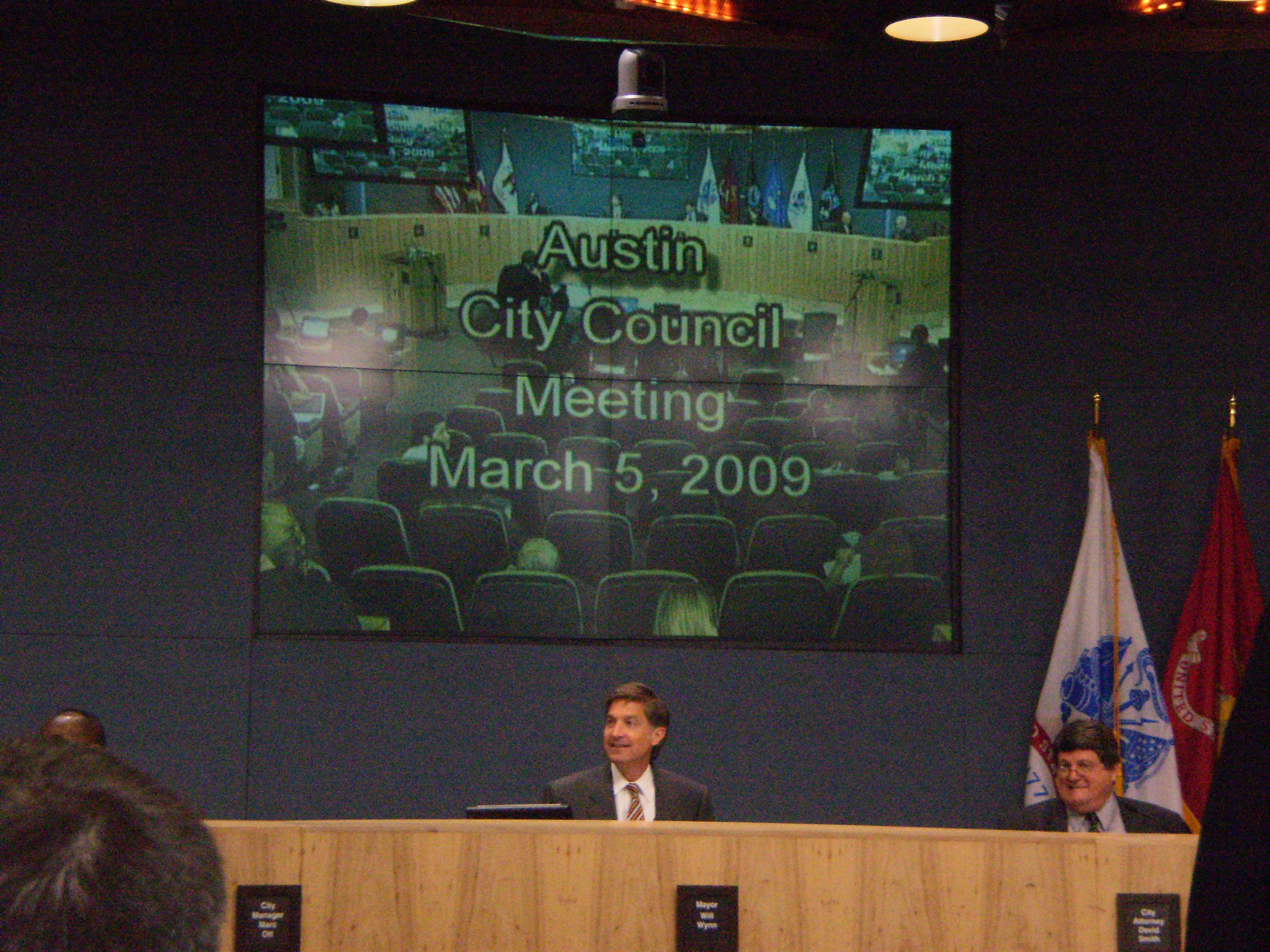 This afternoon the Austin City Council moved unanimously to approve Item 16 on the agenda, the purchasing power agreement with Gemini Solar Development Company to build a 30 MW solar plant at the Webberville tract. That means that by the end of 2011, Austin should be the proud home of the nation’s largest utility scale photovoltaic installation. This is a tremendous milestone for both the City and Austin Energy that will set us up as a leader in solar energy, create jobs, attract industry, and protect our citizens from volatile future energy prices while curbing our global warming emissions.
Lee Leffingwell made the motion to approve item 16 with three additional recommendations. The first direction was to include a provision that any federal stimulus funds, rebates, or incentives recovered would be passed on to Austin, rather than kept by Gemini. The second was to create a new task force to review future energy projects. The task force, he promised, would consist of diverse stakeholders and not be weighted in terms of energy usage. This is an important point, as several representatives from the city’s large scale industrial users such as Spansion and the Building Owners and Managers Association (BOMA) specifically requested that future stakeholder meetings be based upon the size of user consumption– meaning that in future energy projects, city council dialogue would be dominated even more than ever by large industrials. As David Power, Public Citizen’s Deputy Director, testified, that sounds a little too much like, “for every dollar I spend, I get a vote.” Cheers to Lee Leffingwell for insisting on a more inclusive process.
The third and final additional direction was, as expected, to roll the power purchase agreement into Green Choice, so that citizens would be able to voluntarily opt into a program to buy solar power at a locked-in price. Councilman Mike Martinez stated that he would be more than happy to be the first person to sign up for such a program, except that Leffingwell already called “shotgun” on that distinction.
Council members Sheryl Cole, Laura Morrison, and Randi Shade all made additional comments in support of the plant, stating that this was a tough decision to make in hard economic times but that this solar plant, far from a luxury item, was an important element of Austin’s long term energy goals.
The Austin City Council has earned Public Citizen’s most heartfelt appreciation for proving itself, once again, a renewable energy leader. We especially respect the time and effort that the Council and its staff put into this contentious process, and look forward to working with them on future projects.
We also encourage Austinites to express their thanks to the Mayor and City Council for approving this historic first step towards our renewable energy future.
Posted in Energy, Renewables | Tagged Austin, austin city council, Austin Energy, boma, building owners and managers association, david power, gemini solar, Gemini Solar Development Company, laura morrison, Lee Leffingwell, mike martinez, Public Citizen, randi shade, sheryl cole, solar plant, solar power, spansion, Texas, Webberville |
We caved. Public Citizen Texas is on Twitter. Follow us here!

Don’t worry though, we at PublicCitizenTX will be careful to use our Twitter powers for good, not evil. We’ll use tweets to keep you updated on new blog posts, legislative action alerts, and the occassional inside scoop from a city council meeting or committee hearing.
Speaking of which, be sure to check in tomorrow morning for updates from the much awaited Austin City Council meeting. You’ll be the first to know if Austin Energy gets the green light on the proposed Webberville Solar Plant.
No tweets on what we’re having for lunch, we promise. Old Man Stewart won’t be shaking his fist at us, I can guarantee you.
While you’re at it, be sure to follow our friends at Alliance for a Clean Texas, Texas League of Conservation Voters, and of course the big boys at Public Citizen in Washington, DC. Its okay, we know you like adding followers just like kids in the ’50s collecting baseball cards. No shame.
Posted in Uncategorized | Tagged ACT, alliance for a clean texas, austin city council meeting, Austin Energy, dc, old man stewart, Public Citizen, public citizen texas, PublicCitizenTX, Texas, texas league of conservation voters, tlcv, Twitter, washington, webberville solar plant |
 The Houston Chronicle ran an Op-Ed Sunday entitled An energy winner: Big savings are possible by upgrading efficiency goals. Authors: Public Citizen’s Tom “Smitty” Smith and Matthew Johnson. Check it out:
In the world of energy, there’s one clear winner when it comes to cost, cleanliness and speed: energy efficiency.
Although regulated utilities in Texas, with few exceptions, met or surpassed all energy efficiency goals set by the Legislature in 2007, this is not the time for Texans to get complacent.
Rather, it’s time to increase our energy efficiency goals and give utilities more tools to achieve new, more aggressive targets. In this time of economic uncertainty and out-of-control utility bills, homes and businesses across Texas deserve more action.
Last year, the Public Utility Commission of Texas completed a study of the state’s energy efficiency potential. Conducted by the independent firm Itron, it concluded that there’s room for Texas to reduce its energy use by 18 percent. We could save even more during times of peak demand. The study also reported that if the Texas Legislature sets higher goals for energy savings, consumers could save $4 billion to $12 billion on utility bills over the next 10 years. Continue Reading »
Posted in Efficiency, Energy | Tagged Energy Efficiency, green jobs, houston chronicle, matthew johnson, president obama, Public Citizen, public utility commission, PUC, Texas, Texas Legislature, Tom "Smitty" Smith |
 Yowza! Looks like the State Energy Conservation Office (SECO) won the stimulus dollars scratch off, big time. SECO, which usually has a budget of around $2 million, will get an additional $233.8 million of federal money due to the stimulus bill. That’s quite a sum that will be available to the state for energy efficiency and renewable energy projects, green jobs training programs, and building retrofits.
The Select Committee on Federal Economic Stabilization held a hearing last week to make sure that SECO could handle this influx of funds and spend it wisely.
SECO’s response, in a nutshell, was “No Sweat.” Which I certainly hope is true. This is an incredible amount of money, and should be used as efficiently (yuk yuk yuk) as possible.
Floor Pass reports,
The agencies didn’t ask for help making policy changes to draw the dollars down from Washington, and they generally reported they had programs already in place to administer the money.
Robert Wood, the director of local government assistance and economic development, said the State Energy Conservation Office would have no problem spending the $233 million expected to flow through the State Energy Program. While there were some strings attached, the strings would not require SECO to make any changes not already planned pre-stimulus. Continue Reading »
Posted in Efficiency | Tagged floor pass, hearing, seco, select committee on federal economic stabilization, state energy conservation office, state energy program, stimulus, stimulus bill, Texas |
The incredible snowstorm that swept across the east coast yesterday was a bit of a surprise to the thousands of people that flocked to Washington, DC for Powershift 2009. While it did not stop the enviro-activists from protesting dirty energy sources such as coal, some blog noise today indicates that the snowstorm may have blurred the whole message of Powershift. Several (shortsighted) bloggers wrote that the snow debunks the whole threat of global warming. This only demonstrates that some people still don’t truly understand the effects of global warming.

“Global Warming” has become a jazz word over the past decade, but it can misconstrue the environmental effects of the general “warming” of our atmosphere. If you’re reading this blog, you are probably familiar with the fact that an increase of greenhouse gases in our atmosphere (hacking cough, coal plants, cough) has caused an increase in the average temperature of the air and ocean. But don’t be fooled into thinking that this means that every day will get just a little bit hotter. The rise in temperature has drastic effects in the meteorological dynamics of the earth, and causes more storms and other abnormal weather events.
We don’t need science to tell us that this is occurring—we all remember the THREE major hurricanes that hit the Texas Coast in 2008 — and don’t need a radar to show that Texas (along with so many other parts of the world) is getter hotter and suffering from drought. So just remember, global warming is not just about heat, it’s about tornados and hurricanes and droughts…oh my!
Posted in Global Warming | Tagged atmosphere, climate change, extreme weather, Global Warming, greenhouse gas, meteorological, powershift, snowstorm, storm, temperature, Texas |
 Just a reminder that the Austin City Council will have its final vote on the proposed 30 MW Webberville Solar Plant at a meeting this Thursday, March 5. The Council meeting is of course open to the public, so please come by City Hall starting at 10 a.m. to show your support for the plant! There are kiosks in the main hall where you may sign in and register to testify if you so choose. Even if you cannot stay to observe the proceedings, you can still sign in at the kiosk to document your support for the solar plant, which will be Item 16 on the agenda. Remember “Item 16” because you must know the agenda item number to register your support at the kiosk.
For background information on the plant per the council’s February 13th meeting, jump back to the post City Delays on Solar Plant Vote.
Also, Burnt Orange Report has just run a really excellent series on the plant. I cannot recommend it enough. Phillip Martin at BOR provides analysis and a full overview of the project, as well as two full interviews with council members (and mayoral candidates) Lee Leffingwell and Brewster McCracken — both of whom have come out in support of the project!
And of course, stay tuned this Thursday for a full report from the City Council meeting — you know I’ll be there!
Posted in Energy, Renewables | Tagged austin city council, Brewster McCracken, burnt orange report, city hall, item 16, Lee Leffingwell, phillip martin, renewable energy, solar plant, Solar Plant Vote, solar power, Texas, webberville solar plant |
 Powershift 2009 officially begins today, and I am so jealous I can’t be there. If you haven’t heard of Powershift, here’s a brief description from their website:
In the middle of our new administration’s first 100 days, Power Shift 09 will bring 10,000 young people to Washington to hold our elected officials accountable for rebuilding our economy and reclaiming our future through bold climate and clean energy policy.
From February 27th to March 2nd, 2009 young people from across the country will converge on Washington D.C. to take a message of bold, comprehensive and immediate federal climate action to Capitol Hill.
This is an incredibly exciting event, and several of Public Citizen’s own will be there to experience Powershift in all its green glory. For a better idea of what will be going on, check out this video featuring Jessy Tolkan, executive director of the Energy Action Coalition (EAC) — the organizers of Power Shift 2009. In it, she explains why the White House has asked for daily updates from her, and how America’s youth are trying to bring about social justice through climate change action.
[youtube=http://www.youtube.com/watch?v=vFBZuYUihXQ]
I’ll be there in spirit.
Posted in Global Warming | Tagged brief description, climate change, energy action coalition, jessy tolkan, power shift, powershift, powershift 09, Public Citizen, public citizen texas, social justice, Texas, washington dc |
Corpus Christi residents stirred up quite a stink at the Las Brisas preliminary hearing last Tuesday. Four hundred residents showed up to make their feelings known about the coal plant, which if built will be clearly visible from Town Hall.

Originally the hearing was to be held in a 50 person capacity room, which was not expected to fill up. Little did they know that countless locals and a bus load of grade school kids from Smith, a nearby town, would show up to voice their opinions about the hearing.
“I don’t want this plant because I already live by six large refineries and I’ve been affected by the air pollution,” Jean Salone, who lives in the Hillcrest area, told KRIS-TV. “My concerns are air pollution, the effects on my health and dangerous situations like gas entering my home,” Salone said.
Public and environmental health issues were raised by several Corpus residents.
“I’m very concerned about my health. We are the 84th most polluted county in the country right now based on the tri data,” Dr. Melissa Jarrell said to KRIS.
“It might cause adverse affects to myself, to my neighbors, to wildlife, to fish in the bay,” local resident Bill Reeves told KRIS.
Having to balance the droves of fired up citizens and capacity issues, the State Office of Administrative Hearings (SOAH) judge who was presiding over the hearing decided to rotate the groups 50 people at a time in order to give everyone a chance to be heard.Apparently though, having so many people in one place with limited capacity is a fire hazard – or at least it is according to the Corpus Christi Fire Marshall, who required the hearing to be moved for safety reasons.
 The Judge heard the rest of the people that were in the room, and any individuals who could not come back at a later time. Then a recess was called until the afternoon to reconvene at the Del Mar College Center for Ecological Development.
Even with all the commotion, the hearing was still a great success. Several organizations were granted standing, including the Sierra Club, Environmental Defense Fund, Clean Economy Coalition, as well as many individuals form the local community. “Standing” means that individuals are uniquely affected parties and will actually have status in the hearing process.
The next hearing is expected to be held sometime in August. This meeting will give organizations and individuals who were granted standing the opportunity to present their case.
Posted in Coal, Energy, Global Warming, Toxics | Tagged clean economy coalition, coal plant, corpus christi, del mar, environmental defense fund, environmental health issues, fire marshall, Jean Salone, kris-tv, las brisas, preliminary hearing, Public Citizen, Sierra Club, smith, soah, state office of administrative hearings, state office of adminstrative hearings, Texas |
The Reality Coalition has a new ad up on their website directed by none other than Joel and Ethan Coen. Check it out, short and sweet:
[youtube=http://www.youtube.com/watch?v=uFJVbdiMgfM]
Also, according to the Reality Blog, a new spin ad by the coal industry tries to dress up a cartoon-y hunk of coal in sunglasses to make it seem “cool” as well as “clean”…. how very Joe Camel of them.
Posted in Global Warming | Tagged air freshener, clean coal, Coal, coen brothers, cool coal, joe camel, joel and ethan coen, reality coalition, Texas |
A federal appeals court yesterday ordered the EPA to reconsider its standards for pollutants, particularly particulate matter (PM). Fine particulates, such as soot, have been linked to premature death, asthma, lung cancer, and heart disease. Furthermore, black carbon soot is a major greenhouse player, as it absorbs and then radiates massive amounts of heat back to earth when it is in the air.
Reports the New York Times,
 Researchers have drawn direct and immediate links between ambient levels of fine particulates and hospital admissions and deaths. By some estimates, tens of thousands of Americans die each year from exposure to airborne particulates.
Among other sources, fine particulates come from diesel engines, power plants, certain industrial processes and even fireplaces. Perhaps one-thirtieth the diameter of a human hair, they can make their way deep into the lungs and in some cases even into the bloodstream.
The EPA last approved PM standards in 2006, when scientists from within the agency itself argued that they were too weak. Scientists argued that acceptable levels should be lowered to 12 to 14 micrograms per cubic meter of air instead of 15, but (surprise, surprise) then-chief administrator Steven Johnson said that not enough evidence linked PM to detrimental health effects.
The article continues,
The case decided on Tuesday also involved coarse particulates, like dust, and particulate contributions to haze… and it said the E.P.A. must act to reduce the role of particulates in haze.
The court’s ruling may mean that cities notorious for smog– such as Houston – will have to start doing even more to clean up the air. If pollutant standards are fixed at lower levels that will actually protect public health, these cities may find themselves even closer to non-attainment.
Reports the Houston Chronicle,
For Houston, which is already struggling to meet the EPA’s standards for smog-forming ozone, the designation would mean another deadline, another costly pollution-fighting plan and another threat that federal highway dollars will be withheld if the air doesn’t get cleaner.
“This comes at a really good time because there is concern that the state and federal agencies will take their eye off the ball when it comes to fine particulates,” said Matthew Tejada, executive director of the Galveston-Houston Association for Smog Prevention. “It will force use to look at this important issue in a timely manner.”
Its pretty nice to have an EPA that is serious about Environmental Protection Again.
Posted in Coal, Global Warming, Toxics | Tagged appeals court, diesel engines, EPA, federal appeals court, galveston-houston association for smog prevention, ghasp, houston chronicle, matthew tejada, New York Times, particulate matter, PM, power plants, soot, steven johnson, Texas |
« Newer Posts - Older Posts »


