Feeds:
Posts
Comments


CSI: Crime Scene Investigation - "Fracked"

Even CBS's CSI: Crime Scene Investigation is taking a look at "Fracking"

“FRACKED”

CSI: Crime Scene Investigation – FRACKED –  Click here to watch the episode as the CSI team investigates the murder of two men who were about to expose a natural gas conglomerate of poisoning residents in a farming town.

###

By promoting cleaner energy, cleaner government, and cleaner air for all Texans, we hope to provide for a healthy place to live and prosper. We are Public Citizen Texas.

The Energy Resources Committee of the Texas House of Representatives will meet to hear both invited and public testimony in the Fort Worth, Texas City Hall  located at 1000 Throckmorton St. at 9:00 AM on Thursday, November 18, 2010 to discuss interim charge #1. 

The 81st legislature charged the committee with surveying current local ordinances governing surface use of property in oil and gas development and recommending changes to the 82nd legislature, if any, to the authority of the Railroad Commission to regulate the operation of oil and gas industries in urban areas of the state, particularly the Barnett Shale.

If you have questions regarding the hearing, please contact the committee office and speak to Bernice Espinosa-Torres or Ky Ash at (512)463-0656.

The EPA said it issued the subpoena after Texas-based Halliburton refused to voluntarily disclose the a description of the chemical components used in a drilling technique called hydraulic fracturing, a drilling practice that has been at the center of a controversy in the DFW area.  Halliburton was the only one of nine major energy companies that refused the EPA’s request.

The agency said the information is important to its study of fracking, to see whether the practice affects drinking water and the public health. Continue Reading »

The list of TCEQ Sunset town halls continues to grow with the addition of town halls in Austin and Lubbock the week before Thanksgiving.  The Austin town hall will take place Wednesday, November 17th from 7:00 p.m. to 8:30 p.m. in the Bass Lecture Hall at the LBJ School of Public Affairs on University of Texas campus. (This auditorium is located in the basement level of Sid Richardson Hall.)

All are invited to attend these town halls to learn about the current TCEQ Sunset review, and to voice their recommendations for changes that will improve TCEQ. State representatives and senators from the Austin region have been invited to attend; these town halls provide an excellent opportunity for lawmakers to learn more about TCEQ’s impact in their community.

The Public Utility Commission (PUC) approved a controversial project to construct new power lines in the counties in the area around Hillsboro over the objections of numerous landowners from the area and several local elected officials.

The 3-0 vote came late yesterday afternoon after testimony from people likely to be affected by the $170 million project and a lengthy discussion among the three commissioners.

PUC Chairman Barry Smitherman announced to the room that he knew, “this is going to disappoint a lot of you, but I’m going to follow the ALJ’s (administrative law judge’s) recommendations.”

Most of the testimony revolved around the recommendations of the judges who presided over the detailed hearing on various possible routes for the segment of the Competitive Renewable Energy Zones, or CREZ, that would extend to several counties, including Hill, Bosque, Navarro, Shackelford and Scurry.

Commissioner Donna Nelson explained that the panel is tasked with balancing a wide range of competing interests to ensure that the state has the power it needs to keep up with ever-growing demand. and went on to note that everybody wants electricity, but nobody wants transmission lines.

The hearing room, along with two overflow rooms, was packed with people who came to Austin from the area where the power lines are planned.  To view the archived video of the hearing, click here.

The Public Utility Commission (PUC) has named one of Gov. Rick Perry’s chief energy advisers to take over as executive director of the agency that oversees the much of the electric industry in the state as well as the Electric Reliability Council of Texas.

Brian Lloyd, spent 10 years at PUC before joining governor’s office where he currently serves as Perry’s deputy director of budget and planning.  Lloyd is also the Governor’s liaison with the PUC and will take over on December 1st  for Lane Lanford, who left to become compliance director for the Texas Reliability Entity, which monitors and enforces reliability standards in the electricity sector.

OMG, how excited are Texas Republicans to file their own Arizona-style immigration reform? You’d think this was the line for Justin Bieber tickets . . . NOT. . . Saturday afternoon, State Rep. Debbie Riddle pitched a make-shift campsite outside the floor of the Texas House of Representatives to make sure she was the first in line when the chief clerk’s office opened for early filing Tueday morning, spending Saturday and Sunday night sleeping on the lobby floor.

Instead of the much coveted Justin Bieber ticket, all Representative Riddle got was HB 17, (lower bill numbers are reserved for such mundane items like the budget) which is similar to Arizona’s SB 1070 and would allow police to check the immigration status of anyone they pull over for a traffic stop.  Another early filing bill requires parents of public school children to provide proof of citizenship and/or immigration status, which would then be relayed to the state, as part of an effort to “identify and analyze any impact on the standard or quality of education” from illegal immigration. Yet another bill seeks to crack down on “sanctuary cities.”

Riddle, who made a name for herself as the spokesperson for the “terror baby” menace, also introduced two other bills (one that would increase the penalty for driving without a license, and one requiring valid ID in order to vote) whose intent seems to be to take on immmigration indirectly.

After a landslide election (the GOP gained 44 seats in the Texas house) and with the base so fired up that its leaders are literally squatting on the floors of the legislature, we can expect this to be an interesting session.

Come one, come all.  The House Committee on Redistricting is taking public testimony at hearings around the state regarding redistricting that will help shape the districts for both the house and senate of the Texas legislature, Texas congressional districts, and districts for the election of judicial officers or of governing bodies or representatives of political subdivisions or state agencies as required by law, including state board of education districts for the next ten years.  After this mid-cycle election, we can expect a pretty draconian effort on the part of the Republicans to stack the redistricting disproportionately in their favor. 

The AUSTIN REDISTRICTING HEARING will be held on November 17, 2010 at 10:00 A.M. at the Texas State Capitol, Underground Extension, Hearing Room E1.030, in Austin, TX.

For more information on redistricting, including links to video of earlier hearings in other communities around the state, see our earlier blog by clicking here

Citizens and environmental groups concerned about possible air and water pollution from the Barnett Shale spoke out last night in Arlington.  Nearly 140 people gathered to express concerns about the Texas Commission on Environment Quality (TCEQ) and the Railroad Commission (RRC).

Rita Beving, with Public citizen, says both face the Sunset Advisory Commission next month to see if they should change, or even continue to exist.  She went on to say “Our state has failed in many ways to respond to the public. That’s why the EPA has stepped in to pull authority away from the TCEQ.  Some of the people we’ve talked to have had horrible experiences including having their tap water catch fire.” Continue Reading »

PLEASE HELP  GENERATE 200,000 COMMENTS BY NOVEMBER 19th


If you have not already sent your comment to the EPA. simply send it using the links below.  We can win this!

If you have been affected by coal ash contamination and have a personal or family story to tell, click here.

If you do not have your own story to tell, please click here.

The Texas Progressive Alliance remains committed to moving forward as it brings you this week’s blog roundup.

CouldBeTrue of South Texas Chisme is still reeling from the republican blowout. Say goodbye to your Social Security and hello to Warren Chisum in your bedroom.

Off the Kuff starts to discuss a way forward from this election.

There was some good, some bad, and some ugly in last Tuesday’s election returns. PDiddie at Brains and Eggs has the deets.

After Tuesday’s Demageddon, Mean Rachel offers some advice as to what political candidates should do with their social media accounts after losing an election.

Len Hart at BlueBloggin has a few words on Election Postmortem: A Picture of Dorian Gray It is said that insanity is repeating a failed strategy in the expectation of one day getting a different result. Because that never happens, the nation is nuts! Just enough people always vote against their own interests to guarantee that wealth will continue to ‘trickle up’…

Andy Wilson over at Public Citizen’s TexasVox wants to point out that members of Congress who lost their re-election in Texas all had one thing in common: Opposition to climate change legislation.

TXsharon who blogs at Bluedaze recently flew to EPA headquarters in North Carolina to present four case studies of health impacts caused by natural gas extraction in the Barnett Shale. She met with the top rule makers in the Office of Air Quality Planning and Standards who are working on new rules for the oil and gas industry. They said it was “incredibly strong evidence.”

A day after the election, Letters From Texas identified dark clouds on the horizon for victorious Republicans. Later in the week, he detailed the first cloud up to bat: the state budget.

Lightseeker, over at TexasKaos tries to figure out where we are and where we go next, after the mid-terms. Check it out.

While things were rough at the ballot box in the northern hemisphere, in Brazil the political left won a third consecutive national victory. Even on the darkest days, there is always progress being made someplace in the world.

After a campaign-work related hiatus, Capitol Annex returns to active blogging with a new look, a new logo, and this post addressing the growth of food service jobs in Texas and why the growth of low wage jobs sill eventually cause the Texas economy to grind to a halt.

A new online film, the “Story of Electronics”, is available to watch today, Tues, November 9.

This is the newest in the series of the excellent, user-friendly Story of Stuff web-films about excessive consumerism and waste.

The Story of Electronics  tells the story of how electronics are really “designed for the dump” and not made to last or made for recycling.

Watch the film at www.storyofelectronics.org and tell your friends about it.

Last week we wrote a little about what was happening in the early days of Tom Delay’s criminal trial.  To recap and then sum up last week, in their opening statements, prosecutors said that Tom DeLay took part in a scheme to illegally channel corporate money into Texas legislative races in order to strengthen his power and influence. 

As a result of DeLay’s scheme, Republicans won a majority in the Texas House and then pushed through a congressional redistricting plan engineered by DeLay that would strengthen the Republican hold on Texas. Republicans won a majority in the Texas House in 2002 and congressional redistricting sent more Texas Republicans to Congress in 2004.

The 2003 redistricting was extremely controversial, particularly because of the role played by Delay. Texas had never undertaken redistricting mid-decade without it being ordered by a court. Legal challenges to the redistricting plan were mounted on several fronts. In 2006, the Supreme Court upheld the statewide redistricting as Constitutional, but struck down Congressional District 23 as being in violation of the Voting Rights Act’s prohibition of racial gerrymandering. Continue Reading »

Republican gains in Congress were the major stories for the national media, but it is the party’s gains in down-ballot local state house races that may have created the most lasting protection for the GOP‘s new majority in the House of Representatives.

Once every decade, state legislators begin the process of redrawing congressional districts to reflect changes in population.  A by-product of this process is that it can serve to insulate representatives from future difficult re-elections.

According to the nonpartisan National Conference of State Legislatures, Republicans will now hold about 53 percent of state legislative seats across the country, gaining at least 680 seats this election, the largest gain by either party since the mid 60s.

At issue are two different procedures:
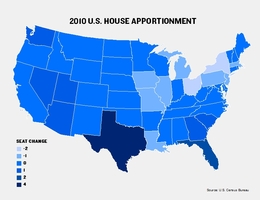
Reapportionment: The number of seats in the U.S. House is fixed by law at 435. Every 10 years, after the Census has counted the population, some states gain House seats, others lose them to reflect shifts in populations.

Redistricting: In most states, state legislators, with advice from expert demographers and lawyers, obligatory input from citizens and with the final say of the governor, draw the new congressional district lines. State legislators draw the maps for 383 of the 435 seats in the House.

In most cases, governors can veto remapping plans and sometimes force legislatures dominated by the opposing party to alter plans to help protect his party’s incumbents.  This will not be the case in Texas this go-round since the Republicans dominate both state houses and hold the governorship.

The remapping takes into account the population shifts within states, the desire to protect incumbents and, of course, partisan advantage. At the margins, partisan mapping, or gerrymandering, can help one party keep a seat or make the party competitive in a place where it hadn’t been before. (In a 2004 decision, the Supreme Court essentially ruled that the partisan gerrymandering doesn’t violate the Constitution.)

In eight states, bipartisan or nonpartisan commissions handle the task.  This is not the case in Texas.

Currently, the House Committee on Redistricting is taking public testimony at hearings around the state regarding redistricting that will help shape the districts for both the house and senate of the Texas legislature and Texas congressional districts.

TexasVox will post information about hearings in your area as the information becomes available.  Click here to read an earlier blog about hearings with links to archived video of hearing around the state that have already happened.  If you are concerned about the impacts of redistricting on your state and congressional representation, plan on attending and testifying.

###

By promoting cleaner energy, cleaner government, and cleaner air for all Texans, we hope to provide for a healthy place to live and prosper. We are Public Citizen Texas.

We use more electricity now than ever, and since 2007 our energy usage in Texas is outpacing population growth.  How many of us charge our cell phones or laptops all night so they’re ready for use in the morning?  Or perhaps run the AC 24 hours a day during the blazing Texas summers?   Several years ago the Legislature passed a bill to bring down our consumption, but there’s still much to be done.  On one hand, legislation can continue to push down the maximum levels of energy consumption, thereby compelling energy companies to utilize more efficient forms of energy.  On the other, consumers and business owners can decide to individually pursue energy efficient technology, such as light bulbs, solar panels, and more efficient appliances.

Both suppliers and consumers must pursue energy efficiency to push it into the mainstream.  It’s the simple market equation of supply and demand—but who is going to push first?  Will energy companies supply more efficient forms of energy, or will consumers demand it until it really catches on?

While trolling the halls of Legislature during the last session and passing around information on efficient energy, I was pulled into a conversation between two gentlemen in one of the offices.  We discussed a slew of topics, including the Austin rodent problem of Fall 2008, the general usefulness of cats, and (prompted by my flier) light bulbs.   One gentleman was insistent that LEDs do not provide near the quality of incandescent bulbs, and therefore refused to use them in his home.  I was not exactly sure how to respond to that (I’m no bulb expert) but in my research I found the video posted below.

[youtube=http://www.youtube.com/watch?v=pv-mr3VLW34]

So why aren’t these alien light bulbs everywhere?  Some are too expensive for the average consumer, but I had no idea that so many varieties exist.   Since they save so much on energy usage, why aren’t they more popular? Continue Reading »