Feeds:
Posts
Comments

While Texas Legislators are furiously looking under every couch cushion to find more revenue this bienium, the Alliance for Clean Texas today highlighted a half dozen strategies that could help Texas close its $27 billion budget deficit.
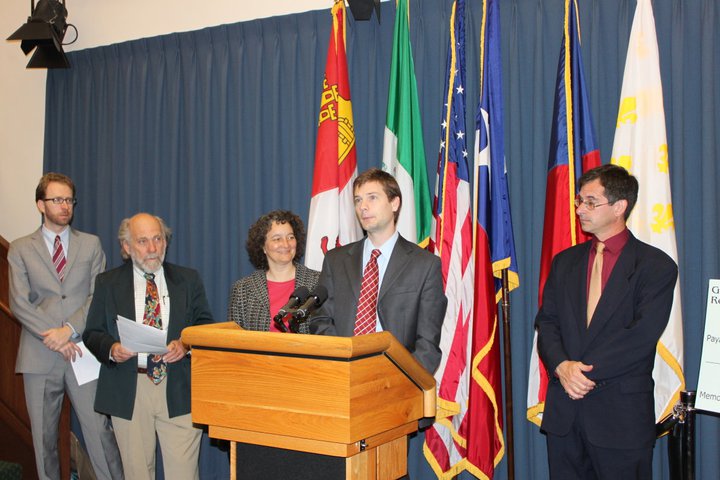
Texas League of Conservation Voters Press Conference on Green Revenue March 29, 2011

Alliance for Clean Texas Members (l to r) Luke Metzger, Environment Texas; Tom "Smitty" Smith, Public Citizen Texas; Robin Schnieder, Texas Campaign for the Environment; David Weinberg, Texas League of Conservation Voters; Cyrus Reed, Lone Star Chapter Sierra Club - photo courtesy TLCV

As lawmakers are loathe to talk about the dreaded “T” word (tax),  groups like Public Citizen, Sierra Club, Texas Impact, Texas Campaign for the Environment, and Texas League of Conservation Voters, who sponsored this morning’s press conference, are offered alternative solutions to cutting needed education and health care services by raising $1 billion in revenue, while also protecting the environment.

These ideas include a severance tax, like oil and gas currently pay, for coal mined in the state and an import duty from out of state coal. Imported coal creates zero Texas jobs and pollutes the environment. If we’re going to ask oil and gas to pay a severance tax, we ought to ask coal to do the same.

Other ideas include making polluters pay the value they get from breaking clean air and water laws (ie, if by polluting you increase your profit by $15 million, you pay $15 million in fines), a surcharge on inefficient gas guzzlers and heavily polluting vehicles, and a recycling refund on bottles and cans (just clap your hands, just clap your hands!).

Cutting pollution would also mean fewer sick kids, fewer sick people in general.  Children and the elderly are most at risk for pollution-caused or -aggravated disease AND they are the most likely to receive assistance from government health care services, so cutting pollution will save the state untold millions, if not billions. AND, since sick children are less likely to attend and be successful in school, cutting pollution also improves the quality of our schools– a triple value for our pollution-cutting dollar!

Combine this with former Lt. Governor Hobby calling on the state to end the tax credit on high-cost drilling operations (read: fracking) valued at $7.4 billion between 2004 and 2009.  We had previously pointed out the hypocrisy of making the oil and gas industry’s culture of corporate welfare the only sacred cow in the budget due to their protected status resulting from all their campaign contributions.

Well, between the billions from the fracking exemption, the billion of Green revenue the ACT coalition mentioned… as they say in Washington, “A billion here, a billion there– pretty soon you’re talking about real money.”
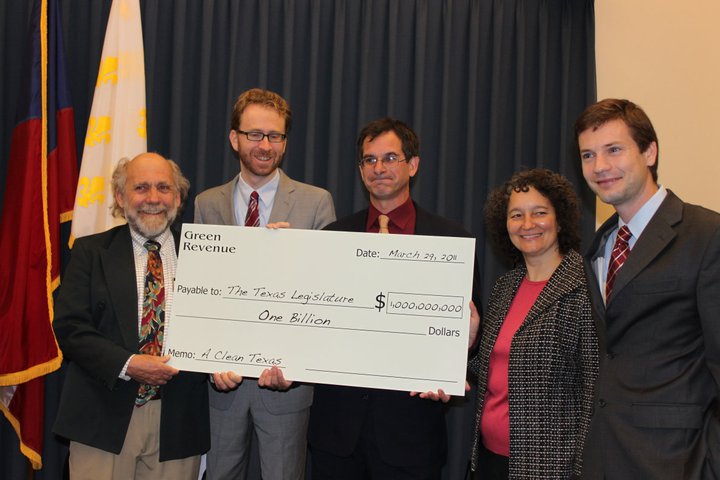
Alliance for Clean Texas has a $1 billion check for the Texas Legislature

Alliance for Clean Texas has a $1 billion check for the Texas Legislature

State lawmakers who are serious about balancing the budget without brutalizing our schools, nursing homes, and hospitals ought to look carefully at these proposals and implement them.  Even in the coldest, darkest winter, a farmer cannot start eating his own seed, as it will impact his ability to plant in the spring. Cutting necessary services to the bone and then sucking out the marrow will leave Texas cupboards bare, both literally and figuratively, as we struggle out of this recession.

The answer is simple- cut pollution, not teachers, doctors, and nursing home beds. Don’t let big polluters get their way, forcing grandma out onto the street and your kids into overcrowded classrooms.

The Texas House will be taking up HB 1, the budget, this Friday, and debate is expected to last all day and into the night. Texas Impact, one of our colleagues in ACT, along with several other groups are organizing a vigil for Texas’ future during the debate. RSVP on Facebook and we’ll see you there!

Look! A press release! From today’s press conference! Continue Reading »

HB 3110 – Bad

by Craddick – Relating to air permitting requirements for certain oil and gas facilities. Continue Reading »

Today is the 32nd anniversary of the worst U.S. nuclear accident, a partial meltdown at the Three Mile Island power plant outside Harrisburg, Pennsylvania. Although no deaths or injuries resulted, many of the concerns the public is expressing about the ultimate fate of the doomed Fukushima Dai-ichi plant were played out over five days in 1979 in the North East.  Then, as now, it is difficult for the public to discern what the real status of the situation is.

Today a spokesperson for the Japanese government announced that the containment structure surrounding the No. 2 reactor at the nuclear power plant is damaged and may be leaking radioactive material.  Tepco, the plant’s owner, then disclosed that small amounts of plutonium had been found among contaminants around the facility later today as Japanese authorities explained that how radioactive water was leaking into maintenance tunnels and possibly, into the Pacific Ocean.

The radiation level near the No 2 reactor is four times the top dose Japan’s Health Ministry has set for emergency workers struggling to control the further emission of radioactive material from the damaged plant and it is unclear what the status of ongoing efforts are, given the increased radiation levels. 

Greenpeace is organizing vigils around the country to show support for the victims of the Japan disaster and ask for a nuclear-free world.  Click here to find out about an event in your area tonight.

News Roundup for March 30

The Texas Progressive Alliance is ready for another sports-related tourist infusion as it brings you this week’s blog roundup.

If the goal of the 81st Texas Legislature and Governor Rick Perry is to stifle job creation in Texas for the next two years, then Off the Kuff says they’re knocking it out of the park.

Letters From Texas rolls its collective eyes about the word games played by the Republicans in charge, as they announce their Senate subcommittee to find “non-tax revenue.” Earth to Republicans: if we used to own it, but now the government owns it, it’s a tax.

Musings looks ahead to 2021 when the Texas economy is in the ditch and many thousands of children have had a substandard education. Do we solve the problem now, or wait until we go to the ballot box in Nov. 2012?

Lightseeker tries to put the present battle into perspective with his posting at TexasKaos, Connecting the dots: Killing Education, Killing Unions, Funding the Tea Partiers [revised]. Give it a look. The videos are worth the price of admission by themselves!

WCNews at Eye On Williamson has this to say about the austerity budget that the House passed out of committee this week, House Appropriations passes budget – tea party blamed for cuts.

In the latest post regarding the poll he’s conducting on the mortgage interest tax deduction, PDiddie at Brains and Eggs explains why he has never owned a home.

CouldBeTrue of South Texas Chisme warns that republicans are near their goal of killing public education for k-12 and at the university level.

Neil at Texas Liberal apologized for ever having voted for Houston City Councilmember C.O. Bradford for any public office. Neil feels that voting for Mr. Bradford was one of the worst ballot box mistakes he has ever made.

refinish69 is ever amazed by the stupidity of the Texas Ledge. It is the gift that keeps on giving. Case in point is Rep. David Simpson’s Don’t Touch My Junk Bill.

This week, McBlogger takes a look at what austerity will do to Texas.

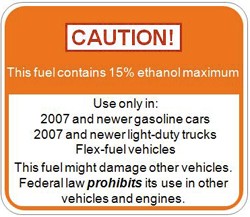
Over the past couple of years, there has been a heated debate involving the potential EPA implementation of allowing a greater percentage of ethanol in gasoline.  The current volume percentage of ethanol allowed is 10% for vehicles made between the years 2001 and 2006. Recently, the EPA has been discussing the approval of what is known as E15 (15 volume percent ethanol blended with gasoline), and in October of 2010, the request was waived for the implementation of E15 to be allowed in vehicles made in 2007 and later.  Taking these two decisions into consideration, this now allows for E15 use in vehicle makes 2001 and newer, lighter-make vehicles into the commerce division.  Studies have shown that E15 is likely to result in somewhat lower evaporative emissions compared to fuel currently sold in much of the country (E10) as a result of the lower volatility of E15 under the partial waiver conditions. There are currently two conditions that must be met.  These conditions take into consideration the concerns of the community.  One condition of the waiver involves the mitigation of the possibility of citizens misfueling E15 in the wrong vehicles.  The other condition addresses the fuel and quality of the ethanol.

Sign indicating ethanol at gas station

On January 21, 2011, the EPA did in fact grant a partial waiver for E15 for use in MY2001-2006 light-duty motor vehicles. These decisions were based on test results provided by the U.S. Department of Energy (DOE) and other information regarding the potential effect of E15 on vehicle emissions. Taken together, the two actions allow, but do not require, E15 to be introduced into commerce for use in MY2001 and newer light-duty motor vehicles if conditions for mitigating misfueling and ensuring fuel quality are met. The EPA is still in the process of completing work on regulations that would provide a more practical means of meeting the conditions.

These new waivers implemented earlier this year by the EPA have cattle ranchers in an uproar as well.  But what could the Texas livestock industry possibly have to do with the newest ethanol implementations? According to the Texas and Southwestern Cattle Raisers Association (TSCRA), the new 50% increase in ethanol-gasoline allowance, is detrimental to the costs of their livestock production.  The TSCRA claim that such a dramatic increase in ethanol permittance will have serious negative repercussions for their cattle ranches.  A statement made by TSCRA president and fellow rancher, Dave Scott, indicated that these high levels of corn based ethanol are one of the most influential factors in driving price increases in corn products, including the feed for cattle.  This is a clear indication of the dangers we create once we begin to place our food and fuel in competition against one another.  In 2008, according to the US Department of Agriculture, feed for livestock reached its record high at $45.2 billion.  This was an increase of more than $7 billion from 2007.  With the cost of feed for livestock and newer, higher levels of ethanol being so intertwined with each other, we will only be seeing an even more dramatic rise in the cost of feed for cattle production…and more unhappy ranchers.

Our nation’s food supply and methods of transportation must find a way to compromise and divert their routes of competition elsewhere because both are at serious risk in the future.

According to Bloomberg, U.S. Energy Secretary Steven Chu is calling for a national energy policy that will promote the use of clean-energy technologies.  This would include U.S. investment in advanced battery technologies, biofuels and efficient high-voltage transmission systems.  Secretary Chu went on to say they are expecting wind and solar power may be able to compete with fossil fuels, without aid from government subsidies, within the next decade, rather than the three decades the U.S. Department of Energy was projecting earlier.

The Texas Progressive Alliance’s brackets are still in good shape as it brings you this week’s blog roundup.
WhosPlayin has been focused on City Council elections and the criminal records of two of the candidates, each of whom has assault convictions, and each of whom lied on their ballot application.

Off the Kuff discusses the budget deal that allows for Rainy Day funds to be used to close the current biennium’s shortfall.

DosCentavos compares theMexican shootin’ Missouri legislator and the goings on at the Texas Capitol; and tell us what Dems should be doing.

Bay Area Houston notes When the Galveston County Republican Party Chair slept with teabaggers he woke up with a bad taste in his mouth…..and no job.

Are you in favor of preserving the mortgage interest income tax deduction, or do you favor phasing it out for larger, more expensive homes and/or wealthier taxpayers — or eliminating it altogether? PDiddie wants your opinion at Brains and Eggs.

Musings gives an update on the ground perspective of why schools need more support staff, not less, in order to ensure student success with the new, more rigorous curriculum and testing mandated by the Legislature and SBOE.

WCNews at Eye On Williamson makes clear that the recent “drama” surrounding whether to spend some of the Rainy Day Fund was done for political cover, better known as The Show.

This week, McBlogger takes a look at two crazy people who are, unbelievably, elected officials.

refinish69 is disgusted and dismayed at the stupidity that is the Texas Ledge. Nothing like a Clean Crapper Bill or protecting the ignorant to make the State of Texas proud.

CouldBeTrue of South Texas Chisme suspects that Republican hate against Muslims resulted in fires at a Houston Mosque. Republicans have sliced and diced the American public every which way – women, people of color, gays, teachers, nurses, Jews, Muslims and who knows what else. Wisconsin has woken up. Lets hope the rest of America soon follows.

At TexasKaos, lightseeker is Shocked! Shocked! at the new “edited” video that has hit the web. Check out The Media Fail Us Again- of NPR and Edited Videos.

Neil at Texas Liberal came across an example of extreme government direction of our lives.

The Nuclear Regulatory Commission (NRC) voted to launch a review of US nuclear power plant safety in response to the March 11th Japan earthquake and tsunami which resulted in the crisis at Japanese nuclear power plants.

The NRC plans to establish an agency task force, made up of current staff and former NRC experts that will conduct both short- and long-term analysis of the situation in Japan and implications for U.S. nuclear plants.  They also announced that the results of their work will be made public.

In addition to the NRC’s response to the events happening in Japan, investors are scaling back their investments in U.S. power companies that have the biggest exposure to nuclear plants because of regulatory uncertainty in reaction to the Japanese crisis.

Public and political scrutiny of the 104 U.S. nuclear reactors erupted as the world watched Japan racing to prevent a meltdown and contain radiation at Tokyo Electric Power’s (Tepco) Fukushima Dai-ichi reactors in the wake of the Japanese earthquake and tsunami. The ensuing sell-off in U.S. utilities with nuclear plants points to fears that these companies face greater regulatory hurdles and significant costs to keep their plants open.

Interestingly enough, NRG Energy (NRG) shares jumped 5.4%  on expectations that the power company will abandon its South Texas nuclear Project expansion, especially if its Japanese partners pull out, including Tepco who had announced they were going to partner with NRG and Toshiba for  a 10% share of the expansion, and possibly increase that to 20% if a U.S. loan guarantee was awarded to the project.

HB 2184 – BAD and moving forward
by Lewis Continue Reading »

Americans tend to think of climate change as a ‘down the road’ future phenomenon. But the fact of the matter is that although the world isn’t coming to an end tomorrow, we are being impacted by climate change, and much more than we may think.  We may feel like we don’t know anyone dealing with the repercussions of climate change, but the effects are closer than we think. In fact, think of that cattle ranch down the road, it’s probably dealing with the effects of climate change, like drought, and extreme heat waves, and most of us don’t even know it.

Climate change can affect livestock, especially here in Texas, aka the cattle country.  This occurs principally through variations in appetite, and distribution in energy between maintenance and growth.  The potential for disease incidence becomes increased as well. Does this become worth the cost for those who raise cattle? Speaking from personal experience, I can tell you that it is not.

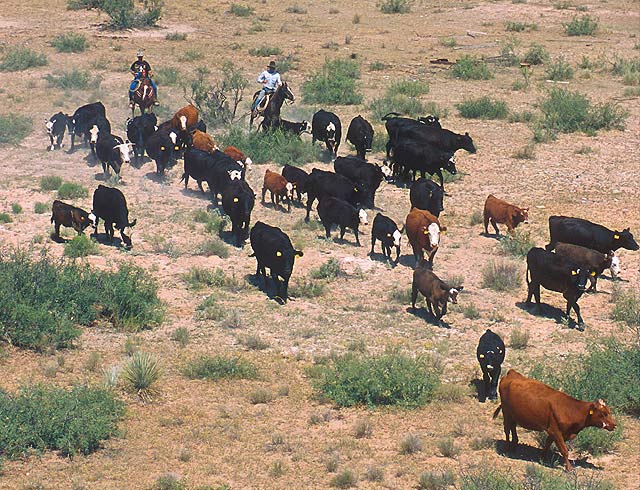
Cattle during a roundup session

My family has owned a working cattle ranch for as long as I can remember.  The cattle were left to openly graze through the pastures and wander about the ranch, to the fishing pond and beyond.  I can remember countless times driving in only to be stopped by a cow standing blatantly in the middle of the road munching on some mesquite.  A few months ago, the decision was made to slowly get rid of the cattle on the ranch.  Why you ask? For one, the expense it costs to maintain such a production is becoming more than the profit.  The cattle are eating everything in sight, not allowing the wild game to acquire enough to eat to reach their full mass potential.  This essentially decreases the amount of hunting leases the ranch receives, since the game isn’t at its full potential, size wise.  As long as the cows continue to eat, they’ll also continue to erode everything in sight, especially since they’ve been grazing for so long out in the pastures.  And specifically speaking of extreme heat waves, I can remember a few times in my lifetime when we’ve had cows die right in the pastures as a result of the brutal Texas heat.  That seems to be a pretty clear indicator of the serious catastrophic risks that the effects of warming have on the hard-working cattle ranchers. Continue Reading »

HB 2184BAD

by Lewis Continue Reading »

The emblem of the American Recovery and Reinve...

The American Recovery and Reinvestment Act of 2009 (ARRA), or "the stimulus" provided funds for a broad range of priorities, but did Texas spend the money wisely?

Public Citizen has been a member of a coalition that has attempted to bring more sunshine, more transparency, and more good government to the implementation on the American Recovery and Reinvestment Act, otherwise known as “The Stimulus.” Two years since its passage much of the funding appropriated has been spent, but there is still more to do. Our groups yesterday released a report “It Ain’t Over Till It’s Over: The Texas Legislature and the American Reinvestment and Recovery Act” which can be found at http://www.txstimulus.com.

It is worth noting that the txstimulus.com website was originally used by a select committee in the Texas Legislature charged with keeping an eye on how Texas spent ARRA funds.  Bee Moorhead in an interview with the Texas Tribune explained what happened to the website and all of that information the committee had been collecting:

During his days as select committee chairman, (Jim) Dunnam (chair of the select committee) set up a website — txstimulus.com — to provide documents and information on stimulus spending, culled from the committee’s hearings and correspondence with the Texas congressional delegation. In March, the domain, which was registered in Dunnam’s name, lapsed, taking all the information it contained therein.

Enter Bee Moorhead, executive director of Texas Impact, a statewide interfaith organization, and the new owner of txstimulus.com. “Legislative committees can use the internet really effectively, and there are great examples of committees doing that this year,” said Moorhead, citing efforts of the Senate Business and Commerce Committee, “but those websites contain government information, and they can’t just be handled like some individual’s blog.”

The coalition also released a set of recommendations to help Texas improve its transparency. #4 is my personal favorite and one of my pet issues, but all are important. These recommendations are explored more in depth in the press release accompanying this post, which is available in full after the jump.

1. Draw down the unemployment dollars.

2. Keep a legislative eye on the game till it’s over.

3. Move the low-income weatherization program from TDHCA to SECO.

4. Modernize Texas’ Freedom of Information Act.

5. Make the Texas Fusion Center’s budget transparent.

6. Require more project-specific information on TxDOT projects.

7. Be ready for more funding.

8. Target ARRA energy efficiency dollars to areas of greatest need.

9. Build on ARRA health infrastructure investment.

10. Protect the integrity of all state government-related websites.

Included in our report are in-depth analysis of spending on transportation, weatherization, energy efficiency, health care, and others. I highly recommend you read this important piece of research, or at least bookmark it for future reference.  Please to enjoy.

Continue Reading »

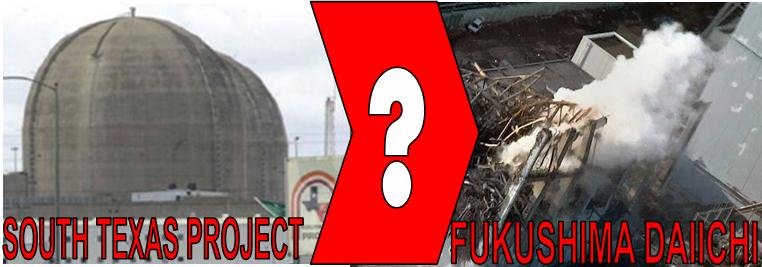
NRG has announced that they will back off of additional development of STP reactors 3 & 4, while awaiting federal guidance regarding safety issues resulting from the nuclear disaster in Japan. The reactor site in Bay City, Texas, is 100 miles from Houston.
Reactor safety has long been a concern of Public Citizen and the Sustainable Energy and Economic Development (SEED) Coalition. The disaster in Japan illustrates the danger of fires and explosions and of putting many nuclear reactors in the same location.  The SEED Coalition raised these concerns in legal opposition to the licensing of two additional South Texas Project reactors and anticipate an Atomic Safety and Licensing Board hearing this Fall. This case is likely to set important precedent as it will be the first in the nation to examine these safety issues in new reactor licenses.
The risks of nuclear power are real and apply to U.S. reactors as well as those in Japan. At the South Texas site, a hurricane could knock out power and flood diesel generators, leading to a loss of coolant and potentially a meltdown.  Human error or technological problems can lead to accident scenarios.  Drought conditions are expected to worsen so low river flows could threaten the ability to cool existing reactors. Hopefully, we’ll never see a terrorist attack, but that is a possibility too. We believe it is time to use safer, more affordable ways to generate electricity.
SEED Coalition recently raised safety issues in opposition to the re-licensing of reactors 1 and 2, which are set to retire in 2027 and 2028. The NRC is considering allowing them to operate another 20 years past their originally intended lifespan. Reactors become more risky as they age, and we do not believe another 20 years of operation is safe. We must prevent a serious accident from happening here.
There have been plenty of problems with the existing reactors, both of which were shut down for over a year in the 1993-94 timeframe due to problems with the auxiliary feedwater pumps and diesel generators. Houston Lighting and Power was fined $500,000 for safety violations.
Click here for a summary of historical problems at the site.
The public can comment on STP re-licensing until April 1st.  Click here for information on how to comment.

The Energy and Power Subcommittee of the U.S. House Energy and Commerce Committee plans to hold a hearing this Thursday on the clash between Texas officials and the EPA at the South Texas College of Law in Houston.  Click here for more information.

A coalition called the Texas EPA Task Force, made up of federal and state Republican officials, is backing proposed federal legislation that would stop the EPA from regulating greenhouse gases under the Clean Air Act. They also strongly disagree with a December EPA ruling that said Texas’ flexible permitting program for air emissions is not in compliance with the act.  They will be at the hearing in force to push their agenda.

Environmentalists response to the Texas EPA Task Force is that for 40 years the EPA has been working to make sure Texans have cleaner air and better health, and call for the citizens of Texas to not let industry insiders and their friends in Congress get in the way.

How close do you live to a nuclear plant? I got curious and this is what I found out.

If a crisis at a nuclear reactor happened in the U.S., could you be living in a danger zone? In a 10-mile radius, the Nuclear Regulatory Commission says the air could be unsafe to breathe in the event of a major catastrophe. In 50 miles, food and water supplies may be unsafe.  Click here to go to CNN.Money’s plant locator.

Don’t forget that radioactive particles can be carried on the wind and many of us in Texas know how far the wind can carry things – for example, every year, when we start coughing each time we walk outside, when Mexico is burning fields.