
Austin Energy will make a recommendation to City Council in August of their future generation plan through 2020. According to their website, “an important component of the planning process is input from the community” — but as of April, only about 300 people had filled out Austin Energy’s survey. Through the survey, you can give Austin Energy a quick gut reaction of what kind of an energy future you want: one with more coal and nuclear (boooo, hisssss, cough cough cough), or a non-smoking future fueled by renewable energy and efficiency (cheers, jubilation!). We need as many Austinites as possible to fill out this survey and send the message loud and clear: say goodbye to our dirty energy past and look to a brighter energy future!
For a quick background on Austin’s current energy mix, check out the following video from our friends at PowerSmack:
[youtube=http://www.youtube.com/watch?v=LqYd_AIpH8o&feature=player_profilepage]
According to Austin Energy’s survey, Austinites get about a third each of their power from coal, nuclear, and natural gas, and about 10% from renewables. Looking at their draft generation plan, they are looking to change that mix to 26% from coal and nuclear power, 44% from natural gas, 5% from biomass, 22% from wind, and 3% from solar by 2020.
That plan may be an improvement from what we’ve got now, but it doesn’t show near the vision and leadership that Austin Energy ought to provide. Imagine what kind of a message it would send if Austin Energy actually tried to divest itself completely from coal — and shut down the Fayette Coal Plant!
That’s right folks, Austin — that Central Texas shining star of wierdness, environmental stewardship, and progressive politics — has a dirty secret. We own half of a coal plant, along with LCRA. And 16% of the South Texas Nuclear Project!
GHASP! Skeletons in the closet.
Ghasp indeed — and skeletons in the closet for real. We all know how bad coal is, and the Fayette plant is spewing toxic emissions into the air every day on our behalf. A total of 44 people die early deaths as a result of these emissions every year.
But Austin Energy’s expected proposals don’t put a priority on shutting down Fayette. That’s why, along with our friends at PowerSmack, we’re launching a new campaign to try to convice Austin Energy and the City Council to shut down Fayette. Don’t sell it — don’t pawn those emissions off on someone else. Shut. It. Down.
James Hansen, one of the top climate scientists and greatest climate change advocates of our time, has said that the number one thing we can do to stop global warming is to stop using coal. Better, cleaner alternatives exist. We’re not looking for a silver bullet here, but through a mixture of aggressive solar, wind, geothermal, and energy efficiency — we can kick the habit.
But the first step is to admit we’ve got a problem. So fill out the survey, and tell Austin Energy you want your power to come from MUCH LESS coal and nuclear and MUCH MORE renewables and efficiency.
If a city as polluted as Los Angeles can commit to stop using coal by 2020, so can we. Let’s walk the walk.
Posted in Coal, Energy, Global Warming, Nuclear, Renewables | Tagged Austin Energy, austinites, city coucil, city of austin, Coal, Efficiency, fayette, generation plan, lcra, natural gas, Nuclear, powersmack, Public Citizen, shut down fayette, solar, survey, Texas, wind |
 The press conference marking the announcement of the formation the Energia Mia Coalition takes place today, Aug 5th at 4:30 at St. Paul’s Community Center, 1201 Donaldson – at Donaldson and St. Cloud Road. The media arrives at 5:00 and several people from local groups are scheduled to speak. For any questions contact Cindy Weehler, at, 210-367-8510 or Kat Swift 210-471-1791. We hope to see as many people there as we can get, thanks for your support.
Many concerned San Antonio citizens will speak including: Patti Radle, Former City Council Member
Diana Lopez, Southwest Workers Union
Charles Schirmer, Project Verde
Mariana Ornelas, AGUA – Aquifer Guardians in Urban Areas Christel Villareal, Highland Hills Neighborhood Association
John Carlos Garcia, District 7
Margarita Maldonado, District 8
David Wells, Alamo Group of the Sierra Club Charles English, Jefferson Heights Neighborhood Association
Alyssa Burgin, Texas Drought Project
Pedro Fernandez, Green Party
John Courage, San Antonio Area Progressive Action Coalition
Also the coalition would like to announce the opening of its website: http://www.energiamia.org/.
Posted in Energy, Nuclear | Tagged CPS, Energia Mia, Local Power, Nuclear, San Antonio, South Texas Nucler Project, Texas |
 After a rash of local and national press about the recent failure of Austin Energy’s GreenChoice program, Austin Energy has decided to re-evaluate their pricing structure. The city may be able to reduce the cost of the program by as much as 25%. Turns out Austin Energy was overly conservative in their estimate of how much it would cost to deliver wind power, so they can knock the price back down without taking a hit. Roger Duncan, AE’s General Manager, has also suggested spreading out remaining transmission costs to all customers.
Though some non-GreenChoice customers may object to being saddled with this slight extra cost, GreenChoice customers have to pay the same amount as traditional customers for upkeep and maintenence of dirty energy sources, so it evens out. The other option to make the who-pays-for-what game fair would be to charge GreenChoice customers a pro-rated maintenance fee for the percentage of fossil fuel and nuclear power they received — but in order to do that Austin Energy might have to go and raise everyone else’s maintenance fee to fill in the gap, so rates could go up anyway. Spreading transmission costs sounds like an easier way to accomplish the same goal, and is consistent with “the policy of all 850 American electric utilities with a program similar to GreenChoice,” according to a memo from Austin Energy to the City Council. Plus, the switch would add less than a cent to everyone’s bill.
Roger Duncan will go to the City Council August 20th to ask for the new rate change and cost distribution.
Posted in Energy | Tagged Austin Energy, City Council, green choice, greenchoice, maintenance fees, Roger Duncan, Texas, transmission |
Overturning Campaign Finance Restrictions Would Allow Corporations to Dominate Elections
WASHINGTON, D.C. – Public Citizen joined a team of other attorneys in submitting a friend-of-the-court brief to the U.S. Supreme Court today, urging the court to adhere to its precedents and reaffirm the longstanding principle that corporations may not engage in unfettered campaign spending.
The brief filed in Citizens United v. Federal Election Commission argues that if the Supreme Court overrules past decisions and strikes down portions of the Bipartisan Campaign Reform Act of 2002 (BCRA), corporations would be free to mobilize their vast assets as political “war chests” and could soon come to dominate electoral discourse.
Ruling against BCRA would not only condemn its electioneering provisions, but also the decades-old requirement that corporations make campaign expenditures only through political action committees (PACs) funded by individual donations, not from their corporate treasuries.
“This has become one of the most important campaign finance cases of our generation,” said Public Citizen attorney Scott Nelson, who coauthored the brief with former U.S. Solicitor General Seth Waxman and his partners Randy Moss and Roger Witten of the law firm Wilmer Cutler Pickering Hale & Dorr LLP, as well as former Public Citizen Litigation Group Director Alan Morrison, currently on the faculty of the George Washington University Law School.
The case involves the abortive plan of a right-wing group, Citizens United, to broadcast Hillary: The Movie, which a lower court found to be electioneering subject to BCRA. Among other things, BCRA prevents corporations from funding broadcasts containing candidate advocacy except through segregated funds, or PACs, with all money donated by individuals. Citizens United admittedly did not comply with those restrictions.
After hearing argument in the case in March, the Supreme Court announced that it wanted to hear additional argument on whether two of its key precedents allowing limitations on for-profit corporations’ ability to use corporate funds for electoral purposes should be overruled. The brief filed today on behalf of the principal congressional sponsors of BCRA (Sens. John McCain and Russ Feingold and former Reps. Chris Shays and Marty Meehan) strongly urges the court to uphold BCRA’s constitutionality.
Now at issue in the case is whether the court should overrule Austin v. Michigan Chamber of Commerce, which held that the government can limit for-profit corporations to the use of PACs to fund express electoral advocacy, and McConnell v. FEC, which applied that principle to uphold the constitutionality of BCRA’s “electioneering communications” provisions, which restrict corporate funding of election-eve broadcasts that mention candidates and convey unmistakable electoral messages.
The brief submitted on behalf of the BCRA sponsors urges that “[o]verruling Austin or McConnell in this case would be unwarranted and unseemly” and that the principle of respect for the court’s precedents requires a “special justification” – which is absent here – before the court may take such a drastic step. The decisions, the brief contends, “are vital cornerstones of modern campaign finance”and “[o]verruling them would severely jolt our political system.”
The case will be reargued on Sept. 9. A copy of the complete brief is available at http://www.citizen.org/documents/CitizensUnitedSuppAmicus.pdf.
###
Posted in Campaign Finance | Tagged austin v michigan chamber of commerce, bcra, bipartisan campaign reform act, Campaign Finance, citizens united, Elections, george washington university law school, hillary: the movie, litigation, mcconnell v FEC, political action committees, publi ctizen, randy moss, roger witten, scott nelson, seth waxman, supreme court, Texas, wilmer culter pickering & dorr llp |
 CPS has a meeting today at Firefighters Union Hall (8925-IH10 WEST) from 6:00-8:00 pm. Anyone from District 8 is encouraged to attend and speak for the cause. Each person gets three minutes of talk time and the Local Power/Energia Mia Coalition needs to have its concerns about the South Texas Projects Proposed expansion voiced by as many people as possible. This is especially true of our concerns about the proposed reactors’ heavy water consumption during times of drought (like this one), the proposal’s high cost and the high likelihood of costs over-runs, and the huge financial burden this means for San Antonio ratepayers.
Next week another CPS meeting will be held Tuesday, August 4 (District 2) from 6:00-8:00 pm at Freeman Coliseum, 3201 E. Houston St.
(Held in Auction Barn. Enter through west gate off W Houston near railroad tracks. Parking available in Lot #9)
Here are some other important Local Power/Energia Mia events:
August 10 – Mayor Castro’s Town Hall Meeting (Part 1) from 5:30-9:00 pm at the City Council Chambers (across street from City Hall). Questions that were given to the Mayor’s office from some environmental groups will be answered by CPS, who will have them a week ahead of time so they can’t “wuss out.”
August 12 – Town Hall Meeting (Part 2) from 3:00-5:00 pm, same place. This will be a chance for City Council members to ask their own questions of CPS.
We need as many people to turn out at both meetings as possible. City Council must know that we care about this issue and that we have numbers on our side. Get as many people as you can to go to this – we want people standing in the aisles. Invite those at your district meetings who spoke to oppose nuclear expansion.
August 12 – same night! – Texas Public Radio will have its own Town Hall Meeting on nuclear energy. They are requesting audience members to bring and ask questions of their panel. I will pass information on as it becomes available.
Future CPS presentations that need to be attended in force; plan the ones you will attend:
Tuesday, August 25 (District 9)
Alzafar Shrine Temple (Terrace Room)
901 North Loop 1604
Tuesday, September 1 (District 10)
My Father’s House
3131 Nacogdoches Road, Suite 105
Wednesday, September 2 (District 3)
Holy Name Activity Center
6618 Fairlawn
Tuesday, September 15 (District 4)
Knights of Columbus
5763 Ray Ellison Blvd.
September 16 – San Antonio Clean Technology Forum’s panel discussion/luncheon with guest speakers. It will cost, but we need to show a strong presence, as this is the clean energy investment business community we have to persuade to oppose nuclear. More when we know more 🙂
Posted in Global Warming | Tagged Budget, coalition, CPS Energy, Energia Mia, Energy, Grass roots, Local Power, Municiple utilities, NRG, Nuclear, nuclear waste, Organizing, Reactor, San Antonio, South Texas Project, Texas |
Power companies’ plans to pursue new nuclear projects are damaging their credit ratings, which may mean higher costs will be shifted onto ratepayers. In a new report by Moody’s Investors Service titled “New Nuclear Generation: Ratings Pressure Increasing”, the firm raises concerns about investing in new nuclear plants with great risks and capitol costs at a time when national energy policy is uncertain.
Of the 17 proposed reactor projects Moody’s analyzed, two already have obligations rated as speculative or “junk”, and both are in Texas: NRG’s South Texas Project (“questionable credit quality”) and Energy Future Holding’s Comanche Peak (“generally poor credit quality”).
Exelon’s proposed two unit reactor in Victoria was rated as one step above junk status (between Baa1 and Baa3).
“If these guys are already having trouble with their credit ratings, why should Texans mortgage their future building new plants that even the builders can’t finance?,” asks Tom “Smitty” Smith, director of Public Citizen’s Texas Office.
Good question.
Posted in Global Warming | Tagged comanche peak, credit ratings, energy future holdings, Exelon, Moody's, NRG, Nuclear Power, South Texas Project, Texas, Victoria |
If you missed Tuesday night’s episode of The Daily Show, you did not get to see John Stewart and guest Steven Chu (Obama’s Nobel Prize winning Secretary of Energy) discuss the Waxman-Markey climate bill and America’s energy future. For those who missed it here are some highlights:
I couldn’t agree more with point made by Jon Stewart in the first clip. The best intentions of the original bill were radically altered to accommodate the financial interests of big energy corporations. This highlights the need to strengthen the bill in the Senate. I also enjoyed Jon Stewart’s discussion of global warming denial with Secretary Chu. Its amazing how misinformed our population can be, and unfortunately this includes many of our Representatives in Congress.
Posted in Global Warming | Tagged cap and trade, cap'n trade, climate bill, john stewart, steven chu, Texas, the daily show, waxman-markey |

Time again for the Texas Progressive Alliance weekly blog roundup.
Off the Kuff takes closer look at that story about Texas turnout in last year’s election.
WCNews at Eye On Williamson adds some context to what’s being said in Texas about Unemployment insurance, the stimulus, and Gov. Perry.
This week at McBlogger, Krispy Kreme takes a moment to tell of her personal experiences with folks desperately in need of adequate health care.
John Coby at Bay Area Houston thinks Clear Lake Hospital has a heart of Cold.
No matter what Governor Rick Perry says or hopes for, Texas is part of the federal union. Neil at Texas Liberal offers a video this week of him reading Federalist Paper #9 on the site of the San Jacinto battlefield. Federalist #9 talks about the need for a strong union and San Jacinto is where Texas won independence from Mexico.
CouldBeTrue of South Texas Chisme notes that John Cornyn chooses to be an a**hole over Sonia Sotomayor’s confirmation.
TXsharon is combining Principles of Community Organizing (POCO) training with a vacation in Colorado so several of her posting this week contained pictures of the Durango & Silverton train ride, clean air, huge deer and breathtaking beauty. But, be sure to check out the progress made from working on the Railroad in regards to land farming toxic drilling waste.
Over at TexasKaos, lightseeker explains why the language we use in defending Health Care Reform matters more than we may think. Hint: They want to have a discussion of Government takeover of health care. We should want to discuss the necessity and fundamental fairness of publicly assisted health care for all. We can win one of these debates, but probably not the other. Check it out…
Miss Hypocrisy, meet Mr. Ignorant. Kay Bailey pricked Rick Perry for snubbing stimulus money she voted against. PDiddie at Brains and Eggs serves.
WhosPlayin was on vacation all week, but still ended up spending some time reading the Health Care Bill and has written a summary of the ‘Public Option’ part of the bill, noting that it looks an awful lot like a PPO.
This week Teddy from Left of College Station covers the Bryan-College Station Chamber of Commerce resolution to oppose any national health care, and reviews what the resolution says and what the resolution means. Left of College Station also covers the week in headlines.
Posted in Global Warming | Tagged bay area houston, bryan-college station, clear lake hospital, eye on williamson, governor rick perry, health care, john cornyn, mcblogger, mexico, off the kuff, principles of community organising, san jacinto battlefield, sonia soto, sonia sotomayor, south texas chisme, stimulus, Texas, texas kaos, texas progressive alliance, txsharon, unemployment insurance, wcnews |

Dont Nuke The Alamo: Local Power Coalition, opposes new Nuclear Reactors
Don’t Nuke The Alamo! As we all know, San Antonio’s CPS energy is on the verge of investing in a third and fourth reactor for the South Texas Nuclear project in Bay City. In addition to the environmental and social concerns we have about nuclear power at Public Citizen, we also want to make it known that these reactors are a huge financial gamble. Our best independent studies on the topic show that it will likely be well over budget (possibly 100% over budget) and there is every reason to expect unplanned time delays and hidden costs.
Fortunately the citizens of San Antonio are working to voice their concerns about the project and encourage CPS to reconsider this investment. I recently attended the first meeting of Local Power (or Energía Mia), a coalition of various environmental and social organizations from the San Antonio area, to talk about ways we can voice our concerns about the proposal and get our Mayor and City Council to take action. For anyone interested, the next local power meeting will take place on July 28th at the San Antonio Progress Action Coaltion (SAAPAC) office. Plans were made to target local council members by participating in and producing Public Service Announcements, Forums, District Meetings, Right-wing talk radio interviews and radios ads, and letters to churches and neighborhood associations.
Anyone concerned about these issues is welcome to help and attend any events. SAAPAC head Cindy Wheeler expressed plans for the group to make a concentrated effort to identify the San Antonio residents who will experience a 5% or more rate hike on their electric bills if the reactors are built and help them voice their opposition.
The attendees made plans to attend the CPS Neighbors Night meeting series which will take place all around San Antonio on the designated nights at 6:00pm. At these meetings any interested person can sign up to speak. Here is the schedule for the remaining meetings:
Thursday, July 23 (District 1)
Tripoint Center (YMCA)
3233 N. St. Marys St.
Tuesday, August 4 (District 2)
Freeman Coliseum
3201 E. Houston St.
(Held in Auction Barn. Enter through west gate off W Houston near railroad tracks. Parking available in Lot #9)
Wednesday, August 5 (District 7)
St. Paul’s Community Center
1201 Donaldson
Tuesday, August 25 (District 9)
Alzafar Shrine Temple (Terrace Room)
901 North Loop 1604
Tuesday, September 1 (District 10)
My Father’s House
3131 Nacogdoches Road, Suite 105
Wednesday, September 2 (District 3)
Holy Name Activity Center
6618 Fairlawn
Thursday, July 23 (District 1)
Tripoint Center (YMCA)
3233 N. St. Marys St.
Thursday, July 30 (District 8 )
Firefighters Union Hall
8925 IH-10 West
Tuesday, August 4 (District 2)
Freeman Coliseum
3201 E. Houston St.
(Held in Auction Barn. Enter through west gate off W Houston near railroad tracks. Parking available in Lot #9)
Wednesday, August 5 (District 7)
St. Paul’s Community Center
1201 Donaldson
Tuesday, August 25 (District 9)
Alzafar Shrine Temple (Terrace Room)
901 North Loop 1604
Tuesday, September 1 (District 10)
My Father’s House
3131 Nacogdoches Road, Suite 105
Wednesday, September 2 (District 3)
Holy Name Activity Center
6618 Fairlawn
Tuesday, September 15 (District 4)
Knights of Columbus
5763 Ray Ellison Blvd.
Posted in Energy, Global Warming, Nuclear | Tagged CPS, Energy, Engergía Mia, Local, NRG, Nuclear, nuke, Power, SAAPAC, south texas nuclear project, STP, Texas |
 Since the Austin American Statesman published a couple of articles on the less-than-stellar sales of Austin Energy’s Green Choice program, many media outlets have picked up the story and the takeaway message is something like “liberal Austin finds out the hard way that renewable energy is too expensive”. It’s really regrettable that this message is permeating throughout the country because it’s just not true.
Austin Energy’s sales of the most recent GreenChoice batch have been low, but I hope that folks will understand that the blame lies not with wind energy itself but some serious underlying problems with the rate structure of this program and the way the energy market is regulated in Texas (hint: it isn’t).
The high cost of GreenChoice highlights the failure of the deregulated market. Consumers are now unfairly burdened with the transmission costs to get wind energy from West Texas to the center of the state. Wind has to pay a toll to drive the power transmission highway, but coal, gas, and nuclear get a free ride. Not all utilities charge similar transmission costs, and in many places that would be factored into the simple cost of doing business, but in Austin consumers are asked to foot that bill. Then there’s the fact that coal, gas, and nuclear power currently have priority on the transmission grid. If the wind can provide 300 MW of energy at a given time and coal can dispatch 300 MW, but there is only room for 400 MW of power to run through the lines, coal gets to move 300 MW and wind can only move 100 MW.
Another problem with Green Choice is that in addition to paying for 100% wind, customers are forced to pay the maintenance and capitol costs to upkeep Austin’s dirty power sources. That just isn’t fair – folks shouldn’t have to pay a premium for clean energy and then be asked to foot the bill for polluters too. Folks argue that GreenChoice customers should pay a portion of the upkeep for traditional dirty power sources when the wind isn’t blowing, but they shouldn’t pay the same *full* capital and maintenance costs that average customers pay. If anything, GreenChoice customers should be offered a pro-rated charge for those costs, so that they only pay the maintenance costs for when they are actually getting power from those dirty sources. Right now, Austin Energy is asking GreenChoice customers to pay an Equal share of maintenance and upkeep for an Unequal share of power – not fair.
Then there’s the fact that Austin Energy got a bad deal on this contract. They bought into a ten year power purchase agreement when natural gas prices, and energy prices in general, were at an all time high (remember $4/gallon gas?).
Austin Energy could easily restructure this program so that it is more affordable. GreenChoice wouldn’t be so expensive if wind was operating on a level playing field with fossil fuels. Austin Energy can make that happen.
Posted in Energy | Tagged Austin American-Statesman, Austin Energy, Clean Energy, Coal, contract, electricity deregulation, Energy, energy grid, Gas, green choice, greenchoice, Myths, natural gas, Power, Renewables, Texas, transmission lines, wind |
Yo Austin! The City of Austin’s Water Conservation Office is GIVING AWAY free water efficient toilets, but the program ends July 31st. Single family, multi-family, and commercial buildings all apply! You can either get a $200 rebate for an efficient toilet of your choosing, or get a totally free toilet and $60 rebate for installation.
Replacing your old toilet with a new, water efficient model could cut your home water consumption by 25% — which means you’ll save that much every month on your water bill! Depending on how much water your current toilet uses, you could save 2 – 5 gallons for every stinking flush (hehe).

But to take advantage of the program, you’ll have to submit an application before the July 31st deadline (or before they run out, whichever comes first). Download your application and send it in today, no need to wait!
Posted in Uncategorized | Tagged city of austin, Texas, toilet, water conservatino, Water Conservation Office, water consumption, water efficient toilet |

I’ve been thinking (and worrying) about water a lot lately. I suppose that the drought has brought all this concern along. Just a few months ago, folks were comparing this drought to the one that devastated Texas agriculture in the ’50s (when crop yields dropped by as much as 50%, all but one county in Texas was declared a federal drought disaster area, and grasslands were scorched and ranchers that couldn’t afford high hay prices resorted to a mixture of prickly pear cactus and molasses), but now folks are saying that this drought is well on its way to being worse, and certainly more costly, than any other dry spell in Texas history.
We’re already seeing ranching and agriculture suffer substantially from this drought. Agricultural officials are now pinning crop and livestock losses at $3.6 billion. Just 12% of the cotton acreage planted this year will be harvested, and many gins won’t open up this season because there isn’t enought work to justify it. Ranchers are also buying high priced hay and feed supplements because their own pastures haven’t produced enough to feed their herds. Ranchers are selling off calves younger and thinner than usual, and even letting go of the mature females that sustain their herds. In the last week, Bastrop County alone lost 12,000 cattle from the drought. As Roy Wheeler, an Atascosa County rancher told the San Antonio Express-News, “We’re selling the factory, so they say.”
So why worry about the weather, you may ask. Haven’t farmers and ranchers been scraping by and beaten by the weather since the first man stuck a seed in the ground? Perhaps, but during the dust bowl and in this last great drought in the ’50s, we could still shake our fists at the sky and vow never to go hungry again — but now we can only shake our fists at ourselves. There’s not a doubt in my mind that this drought is a result of human interference. I’m no scientist, just an educated girl with a blog, but I’d bet the farm that we’re seeing global warming in action.
But you don’t have take my word for it. Take the word of Dr. Gerald North, a climate scientist at that notorious liberal holdout Texas A&M, who says that this drought is the beginning of a permanent trend for Texas. He cites the 2007 IPCC report, which shows trends toward hotter and drier summers. In reference to this weather pattern, North told the Environment News Service that, “It could be just a fluke that persists for a decade… But my guess is that it’s here to stay, but with fluctuations up and down.”
Of course we can’t point at any one weather event and say that it is a direct result of global warming, but we can take events as indicative of what is to come as global warming progresses. Just as Hurricane Katrina woke up the world to the devastation that will ensue as storms of increase in frequency and severity from climate change, this current drought can give Texans a hint of what the future of Texas weather will look like.
There’s a terrible element of irony here. Our current trajectory of unsustainable growth and energy consumption increase the likelihood that drought in Texas will become the new norm. AND those same industries and energy sources which have poisoned our atmosphere and raised global temperatures… use enormous amounts of water. Coal, natural gas, and nuclear — which propents are trying to sell as “the low-carbon cure we need” — are incredibly, enormously, despicably water intensive. Continue Reading »
Posted in Uncategorized | Tagged Agriculture, atascosa county, bastrop county, cinderella, clean water act, coal block, coal power, comanche peak, contaminated water, crop and livestock losses, drought, Exelon, federal disaster, fossil fuels, gerald north, Glen Rose, Global Warming, halliburton loophole, hay prices, hurrican katrina, hydraulic fracturing, ipcc, kerrville, lake buchanana, lake travis, matagorda bay, natural gas, Nuclear, safe drinking water act, San Antonio, Texas, texas a&m, Victoria, water, waxo, white stallion |
Tomorrow from 8am till noon, Public Citizen and ReEnergize Texas will be at the Rosewood Zaragoza Community Center in East Austin handing out free compact fluorescent focos and registering community residents for free energy efficiency upgrades. ¡Gratis! Free low flush toilets, insulation and windows and doors to keep your hogar cool in the summer and calientito in the winter. Si habla español no se preocupe, Public Citizen estará ahí para ayudarle llenar las formas necesarias. All of these efforts will result in you owning a low flush toilet que conservara agua y su dinero. Also, a house with good insulation will save you money on your facturas de electricidad.
Public Citizen and ReEnergize Texas want y’all to know that there are programs out there right now. Que usted puede ser la diferencia in whether or not we conserve our resources and survive the current economic environment. So come on down bright and early mañana en la mañana and let us help you sign up for these amazing programs.
[youtube=http://www.youtube.com/watch?v=Tt-PJayE8vw]
[youtube=http://www.youtube.com/watch?v=ySeOw4j_dJA]
Posted in Consumers, Efficiency | Tagged Austin Energy, Energy Efficiency, Public Citizen, reenergize texas, Texas |
July 21, 2009 by Adrian Shelley
One type of wind that is being developed extensively and contributing to Texas’ renewable generation assets is coastal wind.
In 2009, several new wind projects have been brought online and are continuing to be developed. This was after an extensive, multi-year long study to minimize the risk of environmental impact in the area. Numerous concerns had been raised about migratory bird issues, wetland protection, and interference with any possible endangered species that might be in the area. Good engineering and construction practices by the developers and innovative use of new technologies help bring these generators safely online.
At Babcock & Brown’s wind farm on King Ranch, which we toured this spring, access roads twist and turn like a crazed snake trail through the brush to avoid any interruption of the natural water flow. The wind tower bases were also completely buried to allow normal water flow and a radar system developed for the military to track birds was put in place.
DeTect, Inc is the company that makes the “avian avoidance systems.” They installed the radar and collected data for over three years to profile the migratory bird habits and further developed the software for this application. The project developers then hooked the radar tracker into the wind farm control system and allows it to shut down the turbines if approaching migrating bird flocks are at risk.
So now we have a new clean, well engineered source of energy in the south part of Texas.
This is important for several reasons. The transmission problems that have occurred in the north Texas wind areas which require the build out of large amounts of transmission lines (CREZ) is avoided, but more important is the time of day that the wind blows on the coast. In Texas there is a large increase in the consumption of electricity that starts around noon and peaks between 5 and 6 pm. North Texas wind blows mostly at night, but the coastal wind starts going strong around 2 and peaks right at the same time that the demand is the highest. (See geeky chart supplied by Babcock and Brown).
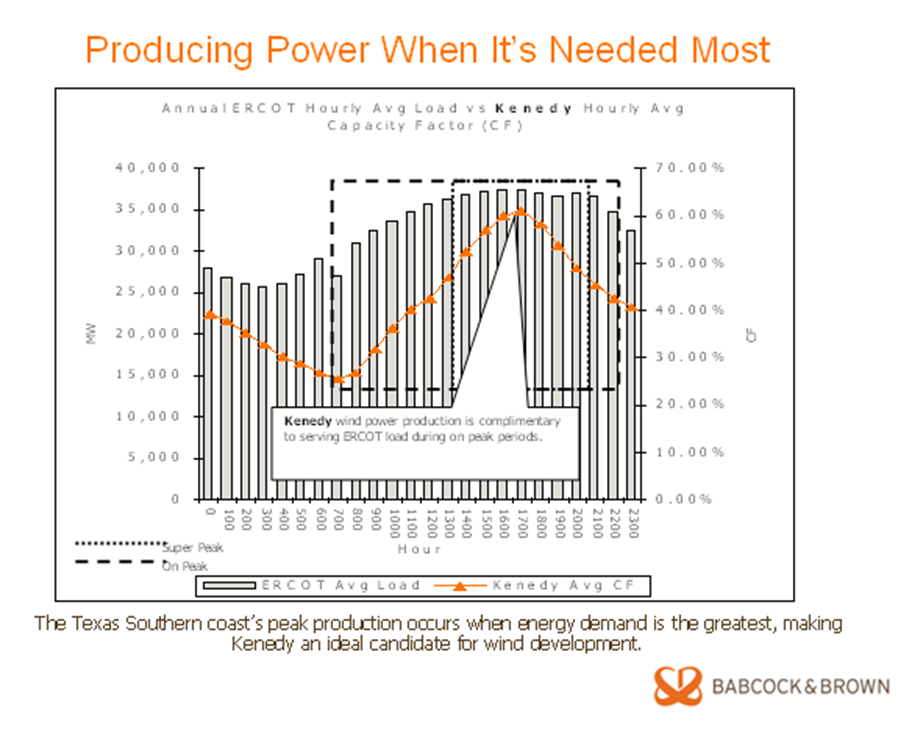
There is still opposition to situating wind farms in the coastal areas and offshore in Texas but it’s an energy resource that matches our use and is too valuable to waste. With good planning and proper site controls and installation, this will be a major factor in Texas’ clean energy future.
Posted in Energy, Renewables | Tagged avian avoidance system, coastal wind, CREZ, detect, endangered species, migrating birds, Texas, transmission lines, wind power |
 Austin Energy is holding a Public Advisory Meeting today, Monday 20, at 6 o’clock to discuss the City’s electric generation plan. This is your opportunity to tell our utility what kind of an energy future you want — smoking, or non-smoking? Word on the street is that the majority of their planning options so far continue to rely on dirty fossil fuel energy. If Austin is to be a leader on global warming solutions and environmental stewardship, we’ve got to switch to clean energy and pursue energy efficiency aggressively, now.
But you knew that already. Join us at the meeting today at 6 pm!
MONDAY – July 20, 2009, 6PM
Town Lake Center
721 Barton Springs Road
The Shudde Fath Conference Room
Posted in Energy | Tagged Austin Energy, austin texas, Clean Energy, electric generation, Energy Efficiency, energy future, global warming solutions, public meeting, Texas |
« Newer Posts - Older Posts »


