 CPS has a meeting today at Firefighters Union Hall (8925-IH10 WEST) from 6:00-8:00 pm. Anyone from District 8 is encouraged to attend and speak for the cause. Each person gets three minutes of talk time and the Local Power/Energia Mia Coalition needs to have its concerns about the South Texas Projects Proposed expansion voiced by as many people as possible. This is especially true of our concerns about the proposed reactors’ heavy water consumption during times of drought (like this one), the proposal’s high cost and the high likelihood of costs over-runs, and the huge financial burden this means for San Antonio ratepayers.
Next week another CPS meeting will be held Tuesday, August 4 (District 2) from 6:00-8:00 pm at Freeman Coliseum, 3201 E. Houston St.
(Held in Auction Barn. Enter through west gate off W Houston near railroad tracks. Parking available in Lot #9)
Here are some other important Local Power/Energia Mia events:
August 10 – Mayor Castro’s Town Hall Meeting (Part 1) from 5:30-9:00 pm at the City Council Chambers (across street from City Hall). Questions that were given to the Mayor’s office from some environmental groups will be answered by CPS, who will have them a week ahead of time so they can’t “wuss out.”
August 12 – Town Hall Meeting (Part 2) from 3:00-5:00 pm, same place. This will be a chance for City Council members to ask their own questions of CPS.
We need as many people to turn out at both meetings as possible. City Council must know that we care about this issue and that we have numbers on our side. Get as many people as you can to go to this – we want people standing in the aisles. Invite those at your district meetings who spoke to oppose nuclear expansion.
August 12 – same night! – Texas Public Radio will have its own Town Hall Meeting on nuclear energy. They are requesting audience members to bring and ask questions of their panel. I will pass information on as it becomes available.
Future CPS presentations that need to be attended in force; plan the ones you will attend:
Tuesday, August 25 (District 9)
Alzafar Shrine Temple (Terrace Room)
901 North Loop 1604
Tuesday, September 1 (District 10)
My Father’s House
3131 Nacogdoches Road, Suite 105
Wednesday, September 2 (District 3)
Holy Name Activity Center
6618 Fairlawn
Tuesday, September 15 (District 4)
Knights of Columbus
5763 Ray Ellison Blvd.
September 16 – San Antonio Clean Technology Forum’s panel discussion/luncheon with guest speakers. It will cost, but we need to show a strong presence, as this is the clean energy investment business community we have to persuade to oppose nuclear. More when we know more 🙂
Posted in Global Warming | Tagged Budget, coalition, CPS Energy, Energia Mia, Energy, Grass roots, Local Power, Municiple utilities, NRG, Nuclear, nuclear waste, Organizing, Reactor, San Antonio, South Texas Project, Texas |
Power companies’ plans to pursue new nuclear projects are damaging their credit ratings, which may mean higher costs will be shifted onto ratepayers. In a new report by Moody’s Investors Service titled “New Nuclear Generation: Ratings Pressure Increasing”, the firm raises concerns about investing in new nuclear plants with great risks and capitol costs at a time when national energy policy is uncertain.
Of the 17 proposed reactor projects Moody’s analyzed, two already have obligations rated as speculative or “junk”, and both are in Texas: NRG’s South Texas Project (“questionable credit quality”) and Energy Future Holding’s Comanche Peak (“generally poor credit quality”).
Exelon’s proposed two unit reactor in Victoria was rated as one step above junk status (between Baa1 and Baa3).
“If these guys are already having trouble with their credit ratings, why should Texans mortgage their future building new plants that even the builders can’t finance?,” asks Tom “Smitty” Smith, director of Public Citizen’s Texas Office.
Good question.
Posted in Global Warming | Tagged comanche peak, credit ratings, energy future holdings, Exelon, Moody's, NRG, Nuclear Power, South Texas Project, Texas, Victoria |
If you missed Tuesday night’s episode of The Daily Show, you did not get to see John Stewart and guest Steven Chu (Obama’s Nobel Prize winning Secretary of Energy) discuss the Waxman-Markey climate bill and America’s energy future. For those who missed it here are some highlights:
I couldn’t agree more with point made by Jon Stewart in the first clip. The best intentions of the original bill were radically altered to accommodate the financial interests of big energy corporations. This highlights the need to strengthen the bill in the Senate. I also enjoyed Jon Stewart’s discussion of global warming denial with Secretary Chu. Its amazing how misinformed our population can be, and unfortunately this includes many of our Representatives in Congress.
Posted in Global Warming | Tagged cap and trade, cap'n trade, climate bill, john stewart, steven chu, Texas, the daily show, waxman-markey |

Time again for the Texas Progressive Alliance weekly blog roundup.
Off the Kuff takes closer look at that story about Texas turnout in last year’s election.
WCNews at Eye On Williamson adds some context to what’s being said in Texas about Unemployment insurance, the stimulus, and Gov. Perry.
This week at McBlogger, Krispy Kreme takes a moment to tell of her personal experiences with folks desperately in need of adequate health care.
John Coby at Bay Area Houston thinks Clear Lake Hospital has a heart of Cold.
No matter what Governor Rick Perry says or hopes for, Texas is part of the federal union. Neil at Texas Liberal offers a video this week of him reading Federalist Paper #9 on the site of the San Jacinto battlefield. Federalist #9 talks about the need for a strong union and San Jacinto is where Texas won independence from Mexico.
CouldBeTrue of South Texas Chisme notes that John Cornyn chooses to be an a**hole over Sonia Sotomayor’s confirmation.
TXsharon is combining Principles of Community Organizing (POCO) training with a vacation in Colorado so several of her posting this week contained pictures of the Durango & Silverton train ride, clean air, huge deer and breathtaking beauty. But, be sure to check out the progress made from working on the Railroad in regards to land farming toxic drilling waste.
Over at TexasKaos, lightseeker explains why the language we use in defending Health Care Reform matters more than we may think. Hint: They want to have a discussion of Government takeover of health care. We should want to discuss the necessity and fundamental fairness of publicly assisted health care for all. We can win one of these debates, but probably not the other. Check it out…
Miss Hypocrisy, meet Mr. Ignorant. Kay Bailey pricked Rick Perry for snubbing stimulus money she voted against. PDiddie at Brains and Eggs serves.
WhosPlayin was on vacation all week, but still ended up spending some time reading the Health Care Bill and has written a summary of the ‘Public Option’ part of the bill, noting that it looks an awful lot like a PPO.
This week Teddy from Left of College Station covers the Bryan-College Station Chamber of Commerce resolution to oppose any national health care, and reviews what the resolution says and what the resolution means. Left of College Station also covers the week in headlines.
Posted in Global Warming | Tagged bay area houston, bryan-college station, clear lake hospital, eye on williamson, governor rick perry, health care, john cornyn, mcblogger, mexico, off the kuff, principles of community organising, san jacinto battlefield, sonia soto, sonia sotomayor, south texas chisme, stimulus, Texas, texas kaos, texas progressive alliance, txsharon, unemployment insurance, wcnews |

Dont Nuke The Alamo: Local Power Coalition, opposes new Nuclear Reactors
Don’t Nuke The Alamo! As we all know, San Antonio’s CPS energy is on the verge of investing in a third and fourth reactor for the South Texas Nuclear project in Bay City. In addition to the environmental and social concerns we have about nuclear power at Public Citizen, we also want to make it known that these reactors are a huge financial gamble. Our best independent studies on the topic show that it will likely be well over budget (possibly 100% over budget) and there is every reason to expect unplanned time delays and hidden costs.
Fortunately the citizens of San Antonio are working to voice their concerns about the project and encourage CPS to reconsider this investment. I recently attended the first meeting of Local Power (or Energía Mia), a coalition of various environmental and social organizations from the San Antonio area, to talk about ways we can voice our concerns about the proposal and get our Mayor and City Council to take action. For anyone interested, the next local power meeting will take place on July 28th at the San Antonio Progress Action Coaltion (SAAPAC) office. Plans were made to target local council members by participating in and producing Public Service Announcements, Forums, District Meetings, Right-wing talk radio interviews and radios ads, and letters to churches and neighborhood associations.
Anyone concerned about these issues is welcome to help and attend any events. SAAPAC head Cindy Wheeler expressed plans for the group to make a concentrated effort to identify the San Antonio residents who will experience a 5% or more rate hike on their electric bills if the reactors are built and help them voice their opposition.
The attendees made plans to attend the CPS Neighbors Night meeting series which will take place all around San Antonio on the designated nights at 6:00pm. At these meetings any interested person can sign up to speak. Here is the schedule for the remaining meetings:
Thursday, July 23 (District 1)
Tripoint Center (YMCA)
3233 N. St. Marys St.
Tuesday, August 4 (District 2)
Freeman Coliseum
3201 E. Houston St.
(Held in Auction Barn. Enter through west gate off W Houston near railroad tracks. Parking available in Lot #9)
Wednesday, August 5 (District 7)
St. Paul’s Community Center
1201 Donaldson
Tuesday, August 25 (District 9)
Alzafar Shrine Temple (Terrace Room)
901 North Loop 1604
Tuesday, September 1 (District 10)
My Father’s House
3131 Nacogdoches Road, Suite 105
Wednesday, September 2 (District 3)
Holy Name Activity Center
6618 Fairlawn
Thursday, July 23 (District 1)
Tripoint Center (YMCA)
3233 N. St. Marys St.
Thursday, July 30 (District 8 )
Firefighters Union Hall
8925 IH-10 West
Tuesday, August 4 (District 2)
Freeman Coliseum
3201 E. Houston St.
(Held in Auction Barn. Enter through west gate off W Houston near railroad tracks. Parking available in Lot #9)
Wednesday, August 5 (District 7)
St. Paul’s Community Center
1201 Donaldson
Tuesday, August 25 (District 9)
Alzafar Shrine Temple (Terrace Room)
901 North Loop 1604
Tuesday, September 1 (District 10)
My Father’s House
3131 Nacogdoches Road, Suite 105
Wednesday, September 2 (District 3)
Holy Name Activity Center
6618 Fairlawn
Tuesday, September 15 (District 4)
Knights of Columbus
5763 Ray Ellison Blvd.
Posted in Energy, Global Warming, Nuclear | Tagged CPS, Energy, Engergía Mia, Local, NRG, Nuclear, nuke, Power, SAAPAC, south texas nuclear project, STP, Texas |
 Since the Austin American Statesman published a couple of articles on the less-than-stellar sales of Austin Energy’s Green Choice program, many media outlets have picked up the story and the takeaway message is something like “liberal Austin finds out the hard way that renewable energy is too expensive”. It’s really regrettable that this message is permeating throughout the country because it’s just not true.
Austin Energy’s sales of the most recent GreenChoice batch have been low, but I hope that folks will understand that the blame lies not with wind energy itself but some serious underlying problems with the rate structure of this program and the way the energy market is regulated in Texas (hint: it isn’t).
The high cost of GreenChoice highlights the failure of the deregulated market. Consumers are now unfairly burdened with the transmission costs to get wind energy from West Texas to the center of the state. Wind has to pay a toll to drive the power transmission highway, but coal, gas, and nuclear get a free ride. Not all utilities charge similar transmission costs, and in many places that would be factored into the simple cost of doing business, but in Austin consumers are asked to foot that bill. Then there’s the fact that coal, gas, and nuclear power currently have priority on the transmission grid. If the wind can provide 300 MW of energy at a given time and coal can dispatch 300 MW, but there is only room for 400 MW of power to run through the lines, coal gets to move 300 MW and wind can only move 100 MW.
Another problem with Green Choice is that in addition to paying for 100% wind, customers are forced to pay the maintenance and capitol costs to upkeep Austin’s dirty power sources. That just isn’t fair – folks shouldn’t have to pay a premium for clean energy and then be asked to foot the bill for polluters too. Folks argue that GreenChoice customers should pay a portion of the upkeep for traditional dirty power sources when the wind isn’t blowing, but they shouldn’t pay the same *full* capital and maintenance costs that average customers pay. If anything, GreenChoice customers should be offered a pro-rated charge for those costs, so that they only pay the maintenance costs for when they are actually getting power from those dirty sources. Right now, Austin Energy is asking GreenChoice customers to pay an Equal share of maintenance and upkeep for an Unequal share of power – not fair.
Then there’s the fact that Austin Energy got a bad deal on this contract. They bought into a ten year power purchase agreement when natural gas prices, and energy prices in general, were at an all time high (remember $4/gallon gas?).
Austin Energy could easily restructure this program so that it is more affordable. GreenChoice wouldn’t be so expensive if wind was operating on a level playing field with fossil fuels. Austin Energy can make that happen.
Posted in Energy | Tagged Austin American-Statesman, Austin Energy, Clean Energy, Coal, contract, electricity deregulation, Energy, energy grid, Gas, green choice, greenchoice, Myths, natural gas, Power, Renewables, Texas, transmission lines, wind |
Yo Austin! The City of Austin’s Water Conservation Office is GIVING AWAY free water efficient toilets, but the program ends July 31st. Single family, multi-family, and commercial buildings all apply! You can either get a $200 rebate for an efficient toilet of your choosing, or get a totally free toilet and $60 rebate for installation.
Replacing your old toilet with a new, water efficient model could cut your home water consumption by 25% — which means you’ll save that much every month on your water bill! Depending on how much water your current toilet uses, you could save 2 – 5 gallons for every stinking flush (hehe).

But to take advantage of the program, you’ll have to submit an application before the July 31st deadline (or before they run out, whichever comes first). Download your application and send it in today, no need to wait!
Posted in Uncategorized | Tagged city of austin, Texas, toilet, water conservatino, Water Conservation Office, water consumption, water efficient toilet |

I’ve been thinking (and worrying) about water a lot lately. I suppose that the drought has brought all this concern along. Just a few months ago, folks were comparing this drought to the one that devastated Texas agriculture in the ’50s (when crop yields dropped by as much as 50%, all but one county in Texas was declared a federal drought disaster area, and grasslands were scorched and ranchers that couldn’t afford high hay prices resorted to a mixture of prickly pear cactus and molasses), but now folks are saying that this drought is well on its way to being worse, and certainly more costly, than any other dry spell in Texas history.
We’re already seeing ranching and agriculture suffer substantially from this drought. Agricultural officials are now pinning crop and livestock losses at $3.6 billion. Just 12% of the cotton acreage planted this year will be harvested, and many gins won’t open up this season because there isn’t enought work to justify it. Ranchers are also buying high priced hay and feed supplements because their own pastures haven’t produced enough to feed their herds. Ranchers are selling off calves younger and thinner than usual, and even letting go of the mature females that sustain their herds. In the last week, Bastrop County alone lost 12,000 cattle from the drought. As Roy Wheeler, an Atascosa County rancher told the San Antonio Express-News, “We’re selling the factory, so they say.”
So why worry about the weather, you may ask. Haven’t farmers and ranchers been scraping by and beaten by the weather since the first man stuck a seed in the ground? Perhaps, but during the dust bowl and in this last great drought in the ’50s, we could still shake our fists at the sky and vow never to go hungry again — but now we can only shake our fists at ourselves. There’s not a doubt in my mind that this drought is a result of human interference. I’m no scientist, just an educated girl with a blog, but I’d bet the farm that we’re seeing global warming in action.
But you don’t have take my word for it. Take the word of Dr. Gerald North, a climate scientist at that notorious liberal holdout Texas A&M, who says that this drought is the beginning of a permanent trend for Texas. He cites the 2007 IPCC report, which shows trends toward hotter and drier summers. In reference to this weather pattern, North told the Environment News Service that, “It could be just a fluke that persists for a decade… But my guess is that it’s here to stay, but with fluctuations up and down.”
Of course we can’t point at any one weather event and say that it is a direct result of global warming, but we can take events as indicative of what is to come as global warming progresses. Just as Hurricane Katrina woke up the world to the devastation that will ensue as storms of increase in frequency and severity from climate change, this current drought can give Texans a hint of what the future of Texas weather will look like.
There’s a terrible element of irony here. Our current trajectory of unsustainable growth and energy consumption increase the likelihood that drought in Texas will become the new norm. AND those same industries and energy sources which have poisoned our atmosphere and raised global temperatures… use enormous amounts of water. Coal, natural gas, and nuclear — which propents are trying to sell as “the low-carbon cure we need” — are incredibly, enormously, despicably water intensive. Continue Reading »
Posted in Uncategorized | Tagged Agriculture, atascosa county, bastrop county, cinderella, clean water act, coal block, coal power, comanche peak, contaminated water, crop and livestock losses, drought, Exelon, federal disaster, fossil fuels, gerald north, Glen Rose, Global Warming, halliburton loophole, hay prices, hurrican katrina, hydraulic fracturing, ipcc, kerrville, lake buchanana, lake travis, matagorda bay, natural gas, Nuclear, safe drinking water act, San Antonio, Texas, texas a&m, Victoria, water, waxo, white stallion |
Tomorrow from 8am till noon, Public Citizen and ReEnergize Texas will be at the Rosewood Zaragoza Community Center in East Austin handing out free compact fluorescent focos and registering community residents for free energy efficiency upgrades. ¡Gratis! Free low flush toilets, insulation and windows and doors to keep your hogar cool in the summer and calientito in the winter. Si habla español no se preocupe, Public Citizen estará ahí para ayudarle llenar las formas necesarias. All of these efforts will result in you owning a low flush toilet que conservara agua y su dinero. Also, a house with good insulation will save you money on your facturas de electricidad.
Public Citizen and ReEnergize Texas want y’all to know that there are programs out there right now. Que usted puede ser la diferencia in whether or not we conserve our resources and survive the current economic environment. So come on down bright and early mañana en la mañana and let us help you sign up for these amazing programs.
[youtube=http://www.youtube.com/watch?v=Tt-PJayE8vw]
[youtube=http://www.youtube.com/watch?v=ySeOw4j_dJA]
Posted in Consumers, Efficiency | Tagged Austin Energy, Energy Efficiency, Public Citizen, reenergize texas, Texas |
July 21, 2009 by Adrian Shelley
One type of wind that is being developed extensively and contributing to Texas’ renewable generation assets is coastal wind.
In 2009, several new wind projects have been brought online and are continuing to be developed. This was after an extensive, multi-year long study to minimize the risk of environmental impact in the area. Numerous concerns had been raised about migratory bird issues, wetland protection, and interference with any possible endangered species that might be in the area. Good engineering and construction practices by the developers and innovative use of new technologies help bring these generators safely online.
At Babcock & Brown’s wind farm on King Ranch, which we toured this spring, access roads twist and turn like a crazed snake trail through the brush to avoid any interruption of the natural water flow. The wind tower bases were also completely buried to allow normal water flow and a radar system developed for the military to track birds was put in place.
DeTect, Inc is the company that makes the “avian avoidance systems.” They installed the radar and collected data for over three years to profile the migratory bird habits and further developed the software for this application. The project developers then hooked the radar tracker into the wind farm control system and allows it to shut down the turbines if approaching migrating bird flocks are at risk.
So now we have a new clean, well engineered source of energy in the south part of Texas.
This is important for several reasons. The transmission problems that have occurred in the north Texas wind areas which require the build out of large amounts of transmission lines (CREZ) is avoided, but more important is the time of day that the wind blows on the coast. In Texas there is a large increase in the consumption of electricity that starts around noon and peaks between 5 and 6 pm. North Texas wind blows mostly at night, but the coastal wind starts going strong around 2 and peaks right at the same time that the demand is the highest. (See geeky chart supplied by Babcock and Brown).
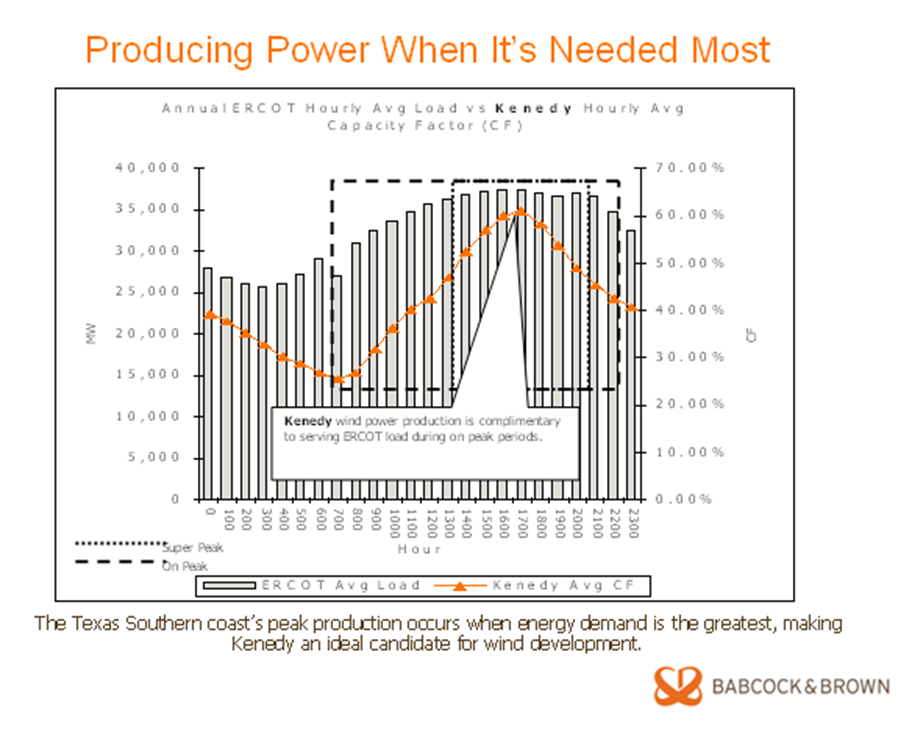
There is still opposition to situating wind farms in the coastal areas and offshore in Texas but it’s an energy resource that matches our use and is too valuable to waste. With good planning and proper site controls and installation, this will be a major factor in Texas’ clean energy future.
Posted in Energy, Renewables | Tagged avian avoidance system, coastal wind, CREZ, detect, endangered species, migrating birds, Texas, transmission lines, wind power |
 Austin Energy is holding a Public Advisory Meeting today, Monday 20, at 6 o’clock to discuss the City’s electric generation plan. This is your opportunity to tell our utility what kind of an energy future you want — smoking, or non-smoking? Word on the street is that the majority of their planning options so far continue to rely on dirty fossil fuel energy. If Austin is to be a leader on global warming solutions and environmental stewardship, we’ve got to switch to clean energy and pursue energy efficiency aggressively, now.
But you knew that already. Join us at the meeting today at 6 pm!
MONDAY – July 20, 2009, 6PM
Town Lake Center
721 Barton Springs Road
The Shudde Fath Conference Room
Posted in Energy | Tagged Austin Energy, austin texas, Clean Energy, electric generation, Energy Efficiency, energy future, global warming solutions, public meeting, Texas |
 Dear readers, the Austin Chronicle’s yearly “Best Of Austin” voting ends tomorrow. If you haven’t filled out a ballot yet, you should! There are all kinds of categories that your friends here at Public Citizen’s Texas Vox could fit into… Local Blog/ger, Local Politics Blog/ger, Nonprofit/Activist Group, Environmentalist.
Don’t make us beg. Vote today!
Posted in Uncategorized | Tagged austin chronicle, best of austin, Public Citizen, Texas, texas vox |
 It’s Monday and it’s time for another Texas Progressive Alliance blog roundup.
CouldBeTrue of South Texas Chisme is sick of cronies running our cities our state and our country!
WCNews at Eye On Williamson on more GOP shenanigans – Republicans, hypocrisy, the stimulus, and more Carter “nuttiness”.
Off the Kuff notes that as Texas’ unemployment rate continues to rise, we are now in the position of having to borrow hundreds of millions of dollars from the federal government to fulfill our unemployment insurance obligations. Heckuva job, Governor Perry!
John Coby at Bay Area Houston has posted a A How to Guide for Illegal Immigrants to Vote in Texas Elections.
Xanthippas takes on more disability-as-diversity nonsense. Also, on a side note, our blog Three Wise Men‘s 5th anniversary is this coming Tuesday. We’ll be putting up a special post in commemoration.
The Texas Cloverleaf looks at how the NTTA will be raising rates because volume is down. So much for supply and demand theory.
This week, an old author returns to McBlogger with a true story about dogs. Completely unrelated to politics and nothing but funny.
Neil at Texas Liberal posted a video of him reciting the words the 1848 Shaker hymn Simple Gifts as a ship passes behind him on Galveston Island. Coming up this week at Texas Liberal will be a video shot at the San Jacinto battlefield.
Upon the arrival of Fashion Week in Austin, Mean Rachel wants to know “Does this city make my butt look hot?”
Teddy at the fourth estate, will be able to survive the economic recession and into the new digital age. Left of College Station also reviews the week in headlines.
The Texas Tribune, a new media project headed up by soon-to-be-former Texas Monthly editor Evan Smith, is an idea that shows lots of promise. PDiddie at Brains and Eggs has more details about it.
Just as during the campaign, malicious emails are being sent, especially to the elderly. One paticularly nasty one is entitled: SENIOR DEATH WARRANTS. Over at TexasKaos, lightseeker takes on piece of electronic hit mail and offers some ideas on fighting back in his diary, Healthcare Scare Mail and what You Can Do To Help.
Posted in Uncategorized | Tagged bay area houston, brains and eggs, evan smith, eye on williamson, galveston island, left of college station, mcblogger, mean rachel, off the kuff, south texas chisme, Texas, texas cloverleaf, texas liberal, texas progressive alliance, texas tribune, texaskaos, three wise men, wcnews |
The following editorial from the San Antonio Express News is an excellent take on the issue of the South Texas Project nuclear expansion. Kudos to Carlos Guerra!
Carlos Guerra – San Antonio Express News
With a Ph.D. in nuclear engineering from UC-Berkeley, Arjun Makhijani has followed energy issues and innovations for decades. But with his uncanny understanding of economics, and a willingness to put a pencil to what comes along, when he says something, you listen.
Or, at least, you should.
Makhijani’s most recent book, “Carbon-Free and Nuclear-Free” is now a must-read on emerging energy solutions. And last fall, he studied CPS Energy’s plans to participate in the doubling of the South Texas Project.
Among other things, the engineer concluded that the two new reactors would cost more than twice what was projected.
CPS’ latest forecasts now almost echo Makhijani’s.
And Wednesday, he advised CPS to closely re-examine its drive to expand the STP and, especially, its latest twist in the deal: to sell excess electricity on the wholesale market to offset the regular rate increases that would be made necessary to pay for the new reactors.
“Especially in a deep recession, when demand for electricity is going down throughout the country, and nobody has any idea when it will recover,” he said, “for San Antonio to say they are going to sell electricity on the open market at rates that will benefit ratepayers is gambling with public money.”
Makhijani did compliment our utility’s newfound commitment to promoting greater efficiencies and relying more heavily on wind energy. But he also offered alternatives to the pricey investment in nuclear power that he says would be better and safer — economically and environmentally — and yield better results more quickly.
“The combination of efficiency, storage and wind, and concentrating solar thermal energy would be the right mix,” he said. “And the pace at which you do that should depend on the economic circumstances. You shouldn’t be overbuilding anything, not wind, solar or whatever.
“In San Antonio, the first thing to do is to start making money on efficiencies so bills don’t go up for consumers,” he continued.
“That will lay the foundation for a solid electricity sector that will be modern and that can accommodate changes.”
And since CPS leads Texas in its commitment to buying wind energy, it should incorporate storage strategies so it can purchase excess electricity when it is cheapest, and distribute it to augment other electricity sources when demand — and other electricity prices — soar.
The Japanese, Makhijani noted, are already using large industrial sodium-sulfur batteries to do just that with wind energy.
But in Texas, storing energy as compressed air in massive underground caverns — as is done with natural gas — might make more sense. And it is a proven technology.
Then, when energy demand peaks, the compressed air is heated with small amounts of natural gas and used to drive turbines to generate electricity that can help meet the peak-load demands.
When you think about it, that would be a perfectly Texan solution. When temperatures soar and air conditioners are cranked up, we could solve our peak demand problems with natural gas and a lot of hot air.
Posted in Energy, Global Warming, Nuclear | Tagged Arjun Makhijani, CPS Energy, electricity, energy storage, Nuclear, renewable energy, San Antonio, san antonio express news, solar, South Texas Project, Texas, wind |
Reports are beginning to roll in as to how funds from the American Recovery and Reinvestment Act of 2009 (aka “the stimulus”) are being used in various communities, and as promised, many of the projects are an economically friendly shade of green.
Just yesterday, the EPA announced that it would dole out $10.7 million to Texas to clean up leaks from underground petroleum tanks. That’s good news for our soil and groundwater, which become contaminated by petrol and other hazardous substances when these tanks leak. Don’t want that in your morning coffee.
This next one isn’t a direct result of the stimulus bill, but still represents how we can transition to a cleaner, greener economy even as we lift people out of economic hardship. Earlier this week, we heard that the U.S. Labor Department’s Veterans Workforce Investment Program is passing on $7.5 million to veterans organizations in several states (including Texas) for green jobs training programs. Programs to train vets to install solar panels and repair solar hot water heaters can provide well paying, in-demand jobs to a segment of the population that well deserves a place in the new green economy.
Anybody heard of any other examples of great green investments or your stimulus dollars at work?
Posted in Uncategorized | Tagged clean economy, clean up, EPA, green economy, green jobs training, petroleum tanks, solar hot water heaters, solar panels, stimulus, Texas |
« Newer Posts - Older Posts »


