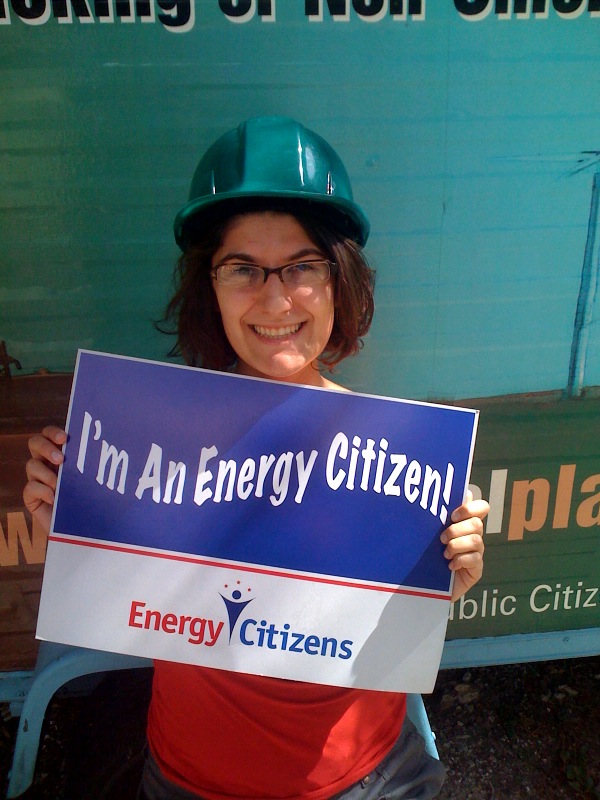
 Yesterday the Public Citizen Texas team drove down to Houston to crash the American Petroleum Institute’s Energy Citizen event. Billed as a “grassroots” rally against the cap and trade bill currently before Congress, this event was nothing more than a company picnic.
About 2500 energy employees were brought by charter bus to the Verizon Wireless Theater, a private location that could be easily secured to keep undesirables out. David, Ryan, and Andy were all denied access, but stealthily dressed in Banana Republic and spectator pumps, I was able to blend in with the crowd and slip into the hot dog line.
Inside the theater it became evident quickly what a polished, professional event this was. Right at the door you could pick up a bright yellow t-shirt with a clever slogan on it like “I’ll pass on $4 gas”, “I’m an Energy Citizen!”, and “Congress, Don’t Take Away My Job!” The same lines could also be found on bumper stickers and the same kinds of cardboard signs you would wave at a football game.
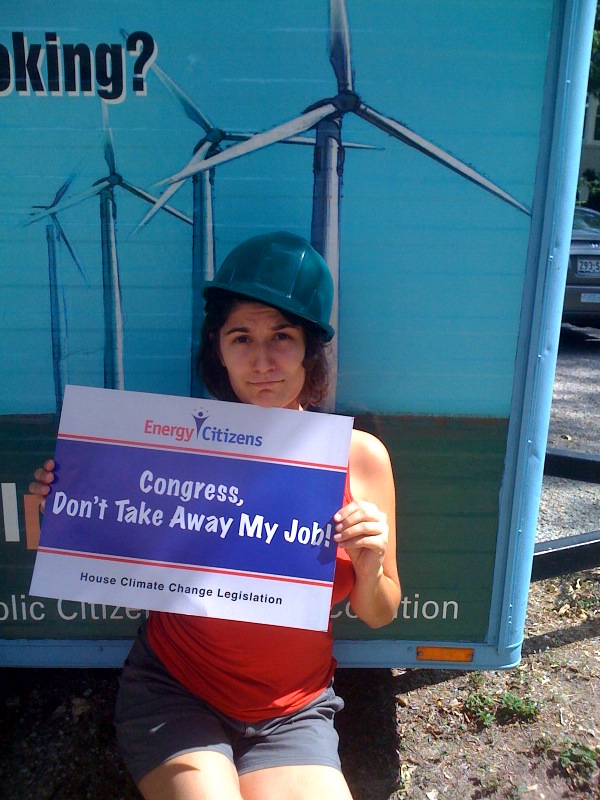
In the middle of the arena was a giant action center where employees could voice their disapproval of climate change legislation through a variety of mechanisms. Six or seven computers were cued up with petitions to Sens. Hutchison and Cornyn, and attendees were invited to text JOBS to 363749(ENERGY) to get involved. Drop boxes for postcards were also positioned in the corners of the room, and “activists” could sharpie their signatures to 8 foot tall “shame on you” or “thank you” letters to Congressmen that voted for or against the American Clean Energy and Security Act.
My favorite aspect of the rally by far, however, was the high school marching band and star spangled dance team. When I asked one of the teenage dancers what she thought the rally was about, she told me she thought that it was about conserving energy.
I was able to interview several rally attendees, but the majority of folks regarded me with suspicion or didn’t want to talk to me. Others clearly didn’t have much of an opinion on the bill other than what they’d been told, but one gentleman I spoke to was actually concerned about the special interest carve-outs in the bill for dirty coal. Stay posted for the video of these interviews later today, with the working title “Energy Workers Say the Darndest Things.” Teaser:
[youtube=http://www.youtube.com/watch?v=bEXFt8fwh_0]
After about an hour I started to run out out of room on my camera, so I moved toward the front doors to see if I could trade off cameras with Andy, who was still stationed outside. Big mistake. Once the chief security guard saw me make eye contact with a marked man, I was out of there. He grabbed my shoulder and asked “what energy company do you work for?” When I said I wasn’t with an energy company but was a member of the media, he said I was misrepresenting myself and summarily kicked me out.
I was a little disappointed to miss out on the great list of speakers, especially rodeo man Bill Bailey, who was master of ceremonies (irony, irony, irony, seeing as this rally was all hat and no cattle). But speaking to other individuals who had been denied access was even more enlightening than listening to Big Oil preach their sermon.
This was such a fake, Astroturf event that they didn’t know how to handle legitimate grassroots support. A couple of women who had been to some of the teabagger events and townhalls came down, armed with American flags and excited to protest “crap and tax” — but even THEY weren’t allowed in. Several others who had heard about the rally through Freedom Works, on right wing radio, or in the paper were also locked out.
Yesterday’s rally was the first of about twenty rallies that will be staged nationwide over the next few weeks. Thanks to Greenpeace, we already knew Big Oil’s game plan: rally up a bunch of Astroturf support to kill cap and trade. But now we know the full story — they don’t even want to hear the voices of their real grassroots. These events are by invitation only, and all other members of the public — for or against climate legislation — will be shut out. If you don’t work for the company, you’re not invited to the picnic.
Posted in Global Warming | Tagged ACES, API, astroturf, Big Oil, cap and tax, cap and trade, citizen sarah, climate change, crap and trade, Energy Citizens, Global Warming, Public Citizen, Texas, waxman-markey |
Your intrepid friends at Public Citizen tried to attend the astroturf “Energy Citizens” rally yesterday in Houston. We’re busy pulling together our bloggings and all the footage we shot, but keep checking back here for updates throughout the day.
We were not allowed in the meeting, as we did not work for an energy company, but we managed to sneak some great footage before being escorted out and being told to leave the premises.
We have:
Footage of the 34 busses used to bring people into the rally from different energy companies.
Normal Citizens who weren”t good enough to be “Energy Citizens”– people who weren’t allowed in the meeting, as this was for energy company employees only! Interviews include lots of crazy conservative teabaggers who hate cap and trade (I understand why Public Citizen and Sierra Club might not be allowed in– why weren’t even they allowed?), nice ladies who were escorted out of the building because they dared to bring American flags to the rally (why does Big Oil hate America?), and lots of people angry at oil companies because they’re hiding this from the public.
“Energy Company Employees Say the Darndest Things” — watch as your friends in the oil and gas industry display ignorance as to the salient details of the ACES bill and spout misinformation about it, or, the people who do know a lot about the bill talk about how it’s a bad piece of legislation because of corporate giveaways to the coal industry! Here’s one quick tidbit:
[youtube=http://www.youtube.com/watch?v=bEXFt8fwh_0]
Want more? Read my full press statement after the jump:
Continue Reading »
Posted in Campaign Finance, Energy, Global Warming, Good Government | Tagged ACES, API, astroturf, Carbon Dioxide, climate change, Coal, Energy, Energy Citizens, Global Warming, green jobs, houston, Public Citizen, public citizen texas, Texas, waxman-markey |
 It has been less than 24 hours since I received a copy of Austin Energy’s Generation Plan recommendation and there’s a lot here to like. Before I get to the highlights, let me just say that those of you who spoke up, filled out the survey, played the sim game and demanded more renewable energy, energy efficiency, less dependence on coal, your voice was heard!
Here are the highlights:
Energy Efficiency: Goal increases from 700 megawatts to 800 megawatts by 2020, a new study on energy efficiency potential will be conducted and AE will target “baseload” efficiency more (previously they had really gone after peak reduction with an emphasis on load-shifting).
Renewable Energy: Goal increases from 30% to 35%. Doesn’t seem like a lot but it is. By 2020 Austin Energy will have 1001 megawatts of wind, 200 megawatts of solar (double what the previous goal was) and 162 megawatts of biomass. They had originally thought to seek an additional 100 MW of biomass on top of what AE already has coming from Nagocdoches in 2012, but decided to scale that back to 50 MW. Not a bad idea considering the limited resource in Texas.
Gas: An additional 200 MW of combined cycle at Sand Hill. The expansion of the plant will provide balancing services to variable renewable resources.
Nuclear: Keep STP 1 & 2. Still saying no to 3 & 4 (woo-hoo!). If someone makes them an offer to contract for the power (we hope it never gets built), they’ll evaluate it.
Coal: The increase in energy efficiency and renewable energy should enable AE to reduce the capacity factor of their share of Fayette coal plant to around 60%, “setting the stage for eventual sale or other disposition of Austin’s share of the plant” (from the AE recommendation). At last night’s Electric Utility Commission meeting, Duncan said currently it’s at about 85-90%.
CO2 plan: Emissions would be 20% below 2005 levels by 2020 (Waxman, Markey, you got that?).
Water use: Water use intensity of the utility’s generation sources reduces by 20% from 724 gallons/kWh to 574 gallons/kWh. Most of that would come from running Fayette smaller.
Other notes: AE will heavily go after solar resources within the city. Duncan estimated that there is roughly 3,000-4,000 MW of solar potential in the city (both for electricity and solar water heating). AE also would work to develop energy storage like compressed air energy storage-aka CAES (case).
We have tons of questions and we’re still analyzing the plan. But our first impression is: this is a pretty good plan but it can be improved. Roger Duncan and his staff deserve recognition. At a time when other utilities in Texas are actually still building new coal plants (CPS Energy, LCRA), Austin Energy recognizes the need to get out of coal. To hear this acknowledged by the utility publicly is very positive, but City Council needs to make this a commitment. The goal should be to see Fayette closed… sooner rather than later.
Obviously, this plan comes with a price tag. Once we get the chance to ask more questions and analyze the plan and possible variations of it we’ll do a more in depth post.
We look forward to a healthy debate on this plan over the next few months. To all you Austinites who want a clean and more sustainable utility, keep urging city council to go beyond coal!
-Matt
Posted in Global Warming | Tagged Austin, austin city council, Austin Energy, Carbon Dioxide, Clean Energy, Coal, coal plant, CPS Energy, Energy Efficiency, Global Warming, lcra, Lee Leffingwell, Nuclear Power, renewable energy, Renewables, Roger Duncan, solar power, Texas, wind |
UPDATE: Greenpeace has just obtained an internal API memo detailing their astroturf plans. You can read the memo and Greenpeace’s reply here. Job “whale” done, Greenpeace!
***
Most people have a good general conception of what a real grassroots movement looks like: citizens get outraged over some injustice or inequity and get organized and get active. These campaigns are built from the bottom up.

Astroturfing a Texas Highway
And what happens when you don’t have a grassroots movement but want to make it look like you do? Well, then you Astro-turf a movement in, paying hired guns to pretend to be “activists” who then show up to townhall meetings and other public forums. Fake grass- sent from top down, rather than something grown naturally from the ground up. A lot of these protesters have been either astroturfed in or given specific instructions on how to disrupt these townhalls in an attempt to shout down opinions other than their own.
We in Texas know a thing about Astroturf, the name having originated as the name of the artificial turf used in the Houston Astrodome. (Coincidentally, the first ever Super Bowl played on astroturf was also in Houston at SuperBowl VIII in 1974.)
Many have criticized recent astroturf campaigns on healthcare, climate change, and the infamous tea-baggers because of their coordination by Washington lobbyists and special interests. In fact, Senator Dick Durbin (IL), the #2 Democrat in the Senate, Sunday told CNN’s John King,
“We have these screaming groups on either side. That isn’t helpful. Let’s be honest about this. . . this is clearly being orchestrated, and these folks have instructions. They come down from a Texas lobbyist in Washington.”
So what’s the difference between what Public Citizen does (educate, activate and organize citizens) and what the astroturfers do (hired guns, fomenting support based on misinformation for the purpose of financial gain)? Many groups engage in grassroots organizing, from Public Citizen to the League of Conservation Voters to the NRA, and use their membership to engage in activism, and some of this leadership comes from our paid staff in DC or Austin, etc. However, Public Citizen has a long history of never accepting donations from corporations or government grants, meaning we can always clearly represent only the interests of our membership without any conflicts of interest.
On the complete opposite side of the spectrum, these atroturf campaigns are actually schilling for major corporate interests who have a financial stake in climate change, health insurance, etc. The most glaring example is ACCCE, the coal industry group that represents 48 of the largest coal electricty utilities in the US with a combined net revenues last year of nearly $200 billion. ACCCE’s mission is to sell their false claims of clean coal technology. Haven’t heard of ACCCE? Well, maybe it’s because they used to be called “Americans for Balanced Energy Choices” but decided to “rebrand” since it became obvious that “balanced” energy choices meant all coal all the time.
Their ads became so ridiculous they became parodied like this, in this commercial from Oscar Winners Joel and Ethan Coen:
[youtube=http://www.youtube.com/watch?v=W-_U1Z0vezw]
Anyway, they’re up to their old Orwellian tricks again.
In the weeks before the House voted on the American Clean Energy and Security Act (ACES), ACCCE’s lobbyists forged letters to Congress, claiming to be representatives of minority and environmental justice groups such as NAACP. (A huge tip of the hat to to Kate Sheppard at Grist who has been following this very closely– also follow Kate on Twitter for the best enviro updates this side of @ClimateHaiku)
Even more amazing was that these letters claimed that enacting climate legislation would hurt low-income communities, even though the national NAACP (and many, many other social justice groups) had come down in support of ACES. No word yet how many fake letters they sent to members of Congress pretending to be average constituents, rather than important community members who could be easily verified, and we will probably never know the extent of the fraud they have perpetrated.
That is Astroturfing, my friends.
Another egregious example, coming soon to the theater near you, is that the American Petroleum Institute and National Association of Manufacturers along with other flat-earth anti-climate change legislation groups are teaming up to host townhall-style meetings in 20 key states to attempt to influence the passage of the climate bill in the Senate (see articles here and here). So, the deep, deep pockets of big oil and big business are trying to buy themselves a grassroots movement. Will they have any luck?
And then, as a corollary to astroturfing, we have the local example of Austin’s Congressman Lloyd Doggett, who has gained a lot of media attention because of the angry throngs showing up to mob him and yell “Just Say No!” to health care reform.
Depending on your view of Doggett, 
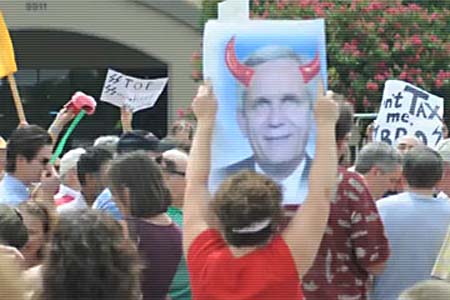 you may have shown up to his previous townhalls to lambaste, lampoon, or lavish praise on him. I have been to these neighborhood office hours before to speak with Congressman Doggett (he is, after all, my Representative in Washington) and I have never seen anything like what happened two weeks ago. Most people show up to politely engage the Congressman about a Continue Reading »
Posted in Campaign Finance, Global Warming, Good Government | Tagged ACCCE, ACES, API, astroturf, Balanced Energy choices, Big Oil, Campaign Finance, Citizen Power, climate change, Congressman Doggett, Global Warming, Grass roots, grassroots politics, greenpeace, Lloyd Doggett, Public Citizen, Texas, Waxman-Markey bill |

I came across this article recently in the Express-News’ Northwest Daily and had to share.
Boerne, population c. 9,400, located about 30 miles northwest of San Antonio, will soon establish a framework for the development of distributed generation.
Under the terms of an ordinance that passed a first reading on July 28, each single-family residence or business could generate solar or wind power for its own use, then send excess energy back to the electric grid, ultimately saving the amount of electricity the city would have to buy from wholesalers.
“This is an opportunity to add renewable power to the electric utility,” said Don Burger, assistant director of Public Works.
Sounds good to me. Several questions remain though.
- What, if any, will the buyback rate be for electricity put back onto the grid from someone’s rooftop solar system or small wind turbine, for example?
- Boerne currently buys all of its electricity from LCRA, which gets most of its power from coal and gas, and is also contracted for 200 MW of the new Sandy Creek coal plant under construction near Waco. Will Boerne adopt a progressive power provision similar to the one adopted by Pedernales Electric that allows PEC to generate up to 35% of its electricity from local sources like energy efficiency and renewable energy?
- Will Boerne set up energy financing districts? HB 1937 (Villareal) passed the Legislature earlier this year. It allows cities to set up districts wherein the city may issue bonds to cover the costs of major energy efficiency improvements or renewable energy projects for homes and/or businesses. The loan would then be repaid by a special voluntary tax assessment on the property.
Boerne is a publicly-owned utility, which means it is accountable to the people of Boerne, not some power company who may not have residents’ interest at heart when making decisions on power. If you live in Boerne, take a moment to express your support for local renewable energy development to mayor Dan Heckler and city council.
Posted in Coal, Efficiency, Energy, Renewables | Tagged Boerne, Dan Heckler, Don Burger, energy district, HB 1937, lcra, pec, progressive power, public power, Texas, Villareal |
Being an environmentalist in Texas, sometimes it feels like the whole world is against you. There’s a common assumption that folks around here just don’t care as much about the environment as elsewhere, and that people don’t see climate change as all that much of a threat. When I tell people that I work to protect the environment and combat climate change, the reaction is often “whew, in Texas? Good luck.”
But surprisingly, polls show that people in Texas are just as concerned about climate change as in the rest of the U.S. Two recently conducted 2009 polls — Lyceum Poll and the Houston Area Survey — show that Texans not only share similar views on climate change with the rest of the nation, but that there is just as strong a desire for regulation here as anywhere else. Who’da thunk?
Results from the Lyceum Poll show that a slightly higher percentage of Texans actually supported a cap and trade mechanism than opposed it. When asked the following question,
There’s a proposed system called “cap and trade.” The government would issue permits limiting the amount of greenhouse gases companies can put out. Companies that did not use all their permits could sell them to other companies. Supporters argue that many companies would find ways to put out less greenhouse gases, because that would be cheaper than buying permits. Opponents argue that this amounts to a huge tax on large companies. Would you support or oppose this system?
… 47% said they would still support cap and trade, while 44% were opposed. The other 11% either didn’t know or didn’t want to say. These results are pretty close to that of a national poll for the Washington Post and ABC News, which had a slightly higher margin of support for cap and trade.
When asked, “What about requiring utilities to reduce their emissions of greenhouse gases, even if this means that electricity rates will rise?”, respondents to the Houston Area Survey were 49% for and 45% against — pretty close to the results of the Lyceum Poll. The Houston numbers dropped significantly from the last time that the survey was completed in 2007, when 66% were for and just 25% against. Considering the current economic climate however, this isn’t particularly shocking.
Both Texas and national polls are showing, however, that the split between the “fors” and the “againsts” is increasingly falling along party lines.
So take heart, my fellow enviros. You may think that you’re alone out there — but chances are, at least half of the state is probably on your side. Our representatives might not be acting like it, but that’s probably because 9 times out of 10, they aren’t hearing from everyday citizens. They’re hearing from business, industry, and the special interests that have a vested interest in keeping the status quo. Might be worth your while to drop them a line, tell them how you feel. What’ve you got to lose?
Posted in Global Warming | Tagged abc news, climate change, Global Warming, houston area survey, lyceum poll, opinion polls, survey results, Texas, texas climate news, Washington Post |
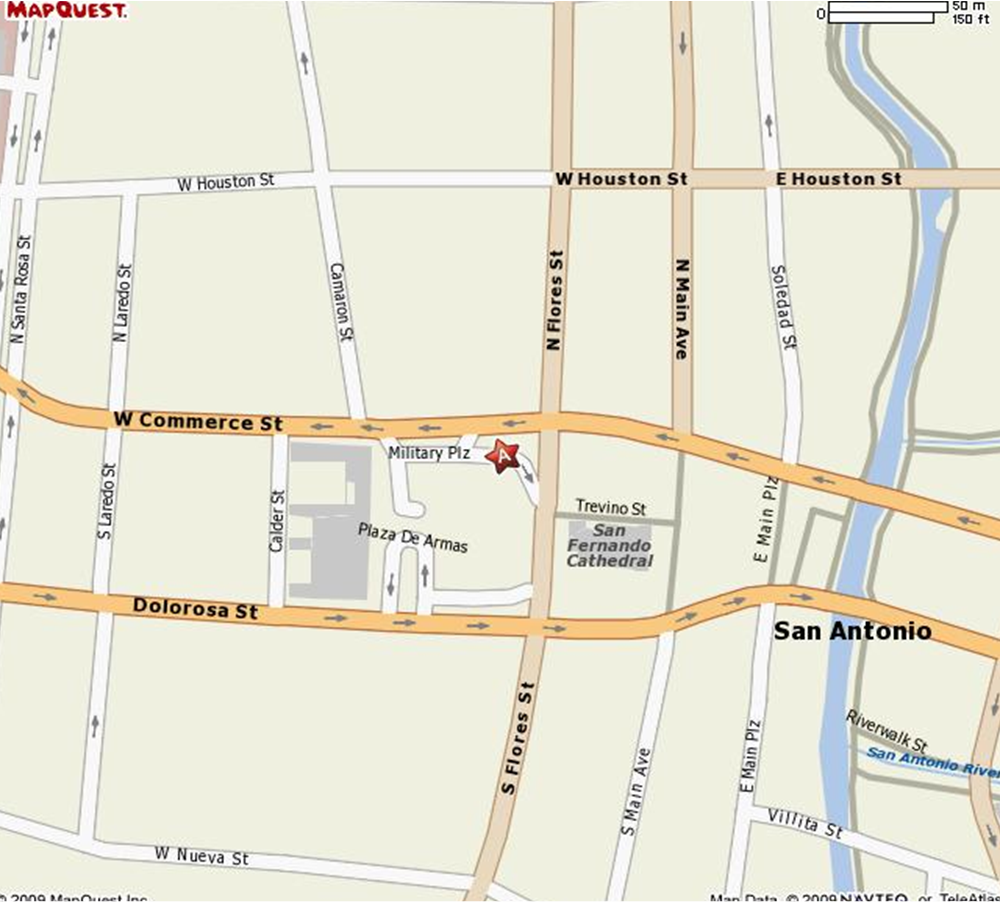
Tonight, August 10, is Mayor Castro’s Town Hall Meeting, where he wants to allow the community to tell city council and himself what they think about going the nuclear route. This is so important to attend. It will be at the City Council Chambers downtown where Flores and Commerce meet (map below).
Sign-up to speak is 5:00-6:00 pm, meeting is 6:00-9:00 pm. Castro has already burst CPS’ bubble by saying he does not want to be a 40% owner in the project — he would prefer a 20% share. It is highly likely that the mayor has made this compromise in response to citizen’s protest.
But local activists are saying (and I would agree) that any nuclear is too much. Even if San Antonio only goes with 20%, the environmental damage will be done, the water will be stressed, and the national “nuclear renaissance” will have begun. It still doesn’t make economic sense for SA, will bring no jobs here, and wastes city resources that could go to energy solutions which are lighter on the environment.
Energía Mía‘s message is, “We don’t want any part of nuclear for San Antonio; we don’t want 40%, we don’t want 20%, we don’t want any percent. If the project’s a bad one at 50%, it’s still a bad one at 20%. It’s just 30% less bad.”
Plus, if San Antonio only buys in at 20%, who are they going to get to cover the rest of the project? Everyone knows how risky this investment is — that’s why Austin took a look at the numbers and said: No, thank you. NRG certainly can’t foot the bill for this themselves — especially not with “junk” bond ratings!
Various community groups have entered their questions in advance and will have an opportunity to respond to CPS’ answers. Tonight the mayor will hear from: Sierra Club, Public Citizen Texas, SEED Coalition, Consumer Energy Coalition, COPS/METRO, members of the business community, and the Hispanic, Chinese, and Greater San Antonio Chambers of Commerce. Each city council person will also have a chance to ask a question, and the public will have a short period of time at the meeting’s close to make a short statement.
Posted in Nuclear | Tagged City Council, city public service, Consumer Energy Coalition, COPS/METRO, CPS, Energia Mia, mayor julian castro, Nuclear Power, nuclear renaissance, Nuclear Town Hall Tonight Tonight, public citizen texas, San Antonio, SEED Coalition, Sierra Club, South Texas Project, STP, Texas, town hall |
 The Congress may be in recess, but the Texas Progressive Alliance is always in session. Here’s the weekly roundup of blog highlights.
Off the Kuff takes a closer look at the crimefighting plan of Houston Mayoral candidate Annise Parker.
WCNews at Eye On Williamson encourages everyone to get involved in lobbying their elected officials and engaging in the political process in You get out of it, what you put into it.
CouldBeTrue of South Texas Chisme says John Cornyn is full of sh*t!
Neil at Texas Liberal is in Chicago. He has no notion of how to insert a link in an e-mail with the WordPress iPhone application. Neil hopes you and yours are having a nice summer. Neil will be visiting the Indiana State Fair this week. He’ll be the guy in a Houston Astros hat. (Note: link to Neil’s site inserted by link roundup editor.)
The Texas Cloverleaf looks at why whitey in Denton County is scared of ACORN.
Over at McBlogger, Mayor McSleaze is having some issues with churches that closely resemble Vegas casinos.
Following his return from North Korea with two American journalists, PDiddie at Brains and Eggs came to the realization that Bill Clinton is The Most Interesting Man in the World.
Over at TexasKaos, Libby Shaw gives us chapter and verse on the “Obstructionist Politicians on the Take and Corporate Teabaggers who are attempting to sabotage Health care reform. Well worth the read and viewing…..
WhosPlayin reports on an eventful week in North Texas: Drafted Congressional Candidate Jennifer Giles attended a town hall meeting for Rep. Michael Burgess and asked a question that earned her some air time on CNN.
Posted in Uncategorized | Tagged acorn, annise parker, bill clinton, chicago, cnn, Congress, denton county, houston astros, jennifer giles, michael burgess, politicians, recess, teabaggers, Texas, texas progressive alliance |
 As many of you already know, the nuclear battle is getting pretty heated in San Antonio these days. That’s why a new citizen’s group, Energía Mía, has recently formed. But they can tell you their intentions better than I can:
Citizens are uniting in efforts to halt CPS’ spending for more nuclear reactors. Speakers from many diverse organizations and businesses relayed their concerns about nuclear power as part of the newly formed Energia Mia network and are working to increase visibility and awareness of the problems of nuclear power.
“Energía Mía urges all citizens in San Antonio to get involved now and contact the mayor and city council. The rate hikes that would come from more nuclear power are unacceptable. They would create a severe economic hardship on many people and local businesses” said Cindy Weehler. “We have set up a new web site, www.EnergiaMia.org to provide information to the public and let people know how to get involved.”
According to the San Antonio Express-News, their membership includes representatives from
…the Southwest Workers Union, Project Verde, Alamo Group of the Sierra Club, Highland Hills Neighborhood Association, Jefferson Heights Neighborhood Association, Texas Drought Project, Green Party and the San Antonio Area Progressive Action Coalition.
Alongside fundamental concerns about water, security, radioactive waste, and health and safety risks, the group is concerned about the financial effect the project could have on the city and the rate hikes that CPS has said will accompany STP’s expansion. CPS has already said that 5-8% rate hikes will be needed every two years for the next ten years to pay for this project, and that electric rates could increase nearly 50% as a result.
The good news is that all the noise these activists are making is starting to have an impact. Already, Mayor Julian Castro is having doubts. And apparently, “at every public meeting, city and CPS officials have run into a buzz saw of objections from ratepayers and business owners concerned about higher energy costs.” Some folks are even calling for a referendum on the issue — or at the very least, an honest debate and presentation of viable alternatives (that won’t cost $100 dollars a head).
Way to rouse that rabble, San Antonio. You deserve answers, and for your concerns to be heard in a meaningful way. If you agree with these folks (and if you’re a regular reader I bet you do!), sign their petition!
Posted in Nuclear | Tagged cindy weehler, CPS, Energia Mia, green pary, julian casto, nuclear energy, nuclear reactors, Public Citizen, San Antonio, san antonio area progressive action coalitioin, san antonio express news, SEED Coalition, Sierra Club, South Texas Project, southwest workers union, STP, Texas, texas drought project |
 Dear readers: We need fall interns for our Austin office. Think you’ve got what it takes to make me coffee contribute in a meaningful way to our team? Want to be the next Citizen X? Check out the following infos and apply today! Feel free to ask questions about the internship in the comments section, and I’ll respond if your wordpress avatar looks impressive right away!
Public Citizen, a national non-profit consumer advocacy and watchdog group, seeks motivated interns in our office in Austin. For over 25 years, the Texas office of Public Citizen has worked on protecting consumers and standing up for the common citizen in the halls of power. When corporate interests send in their high-priced lobbyists, the public can rely on Public Citizen to advocate for what is in their interest.
PC Texas currently works on mostly energy issues, as energy usually represents the second or third largest household expense for most families. We are currently involved in working on federal climate change policy, increasing the use of renewable energy and efficiency as new power resources, and stopping proposed coal and nuclear plant expansions across Texas. We also have a vibrant communications team which specializes in both traditional and “new” media outreach.
QUALIFICATIONS: An intense desire to work in the public’s interest, excellent writing and verbal skills, organized, ability to work under pressure, team player, self-motivated. Background in energy, environmental issues, politics, economics, public policy, etc helpful. Desire to learn a MUST. Interns interested in communications work should have some background in media/communications/PR, etc.
All internships are 20 hrs/week and unpaid and will take place at our office in downtown Austin at the corner of 13th and San Antonio (3 blocks East of the Capitol).
If interested please email Melissa Sanchez msanchez@citizen.org with a resume and a short writing sample.
Posted in Uncategorized | Tagged advocacy, Austin, Efficiency, Energy, environment, interns, internship, Public Citizen, public citizen texas, Renewables, Texas, Texas office, Texas office of Public Citizen |
 Here we are in August, and like every other week it’s time for another Texas Progressive Alliance blog roundup.
TXsharon needs your help to Expose This Dirty Video.
CouldBeTrue of South Texas Chisme calls out KBH and the GOP for using racism and the NRA to get out the vote in 2010. Having a competent, experienced Latina judge? Not important.
Off the Kuff reminds us that Governor Perry’s consistently wrong decisions regarding unemployment insurance will cost the state two billion dollars, maybe more.
McBlogger takes a look at a lawsuit against TRS and discovers losses, possible corruption and a nightmarish problem for the Republicans in 2010.
John Coby says you better think before you trust a republican with your family’s health care.
Mean Rachel decides that Democratic gubernatorial candidate is still too Bush League for her tastes.
Our governor is living the life of the rich and famous. It does so on our dime and on the “dimes” of his fat cat contributors. Libby Shaw gives us the ulgy details over at TexasKaos, Our Kept Governor to the Unemployed: Eat Cake.
Why did Ciro Rodriguez vote against the Waxman-Markey climate change bill and then suddenly flee the House? And why is he taking grip-and-grin meetings with David Dewhurst? PDiddie at Brains and Eggs would really like to know.
Vince at Capitol Annex tells why he believes that the smart money is on Texas Governor Rick Perry picking Lt. Governor David Dewhurst to replace U.S. Senator Kay Bailey Hutchison if she resigns before the end of the year.
Neil at Texas Liberal posted a video he made that will take only 39 seconds your life to watch. Also, Neil made a post marking the third anniversary of Texas Liberal. Texas Liberal has run 1500 page views a day so far this year and had racked-up over 725,000 views since it began. Thank you blog reading public!!
WhosPlayin notes that the City of Lewisville is cancelling its Cinco de Mayo celebration for 2010 due to budgetary concerns.
Dembones at Eye On Williamson points out Rep. John Carter’s latest nuttiness, Franking Commission draws the line on Rep. Carter.
Mike Thomas at Rhetoric & Rhythm reviews Debra Medina’s campaign video and deems her the Sarah Palin of South Texas.
Teddy of Left of College Station was forced to evacuate his home in Bryan due to a warehouse fire that was burning toxic materials, but was able to return to his home the next day. Before the evacuation Teddy was able to write about Michael Vick’s return to the NFL, and whether or not he deserves a second chance. Left of College Station also covers the local and progressive events in the Bryan-College Station this month.
Posted in Uncategorized | Tagged bryan, ciro rodriguez, climate bill, climate change, college station, david dewhurst, debra medina, democrats, fire, gas drilling, gop, governor perry, john carter, kay bailey hutchison, kbh, lewisville, michael vick, nra, racism, republicans, sarah palin, south texas, Texas, texas progressive alliance, toxic materials, unemployment insurance, waxman-markey |

Austin Energy will make a recommendation to City Council in August of their future generation plan through 2020. According to their website, “an important component of the planning process is input from the community” — but as of April, only about 300 people had filled out Austin Energy’s survey. Through the survey, you can give Austin Energy a quick gut reaction of what kind of an energy future you want: one with more coal and nuclear (boooo, hisssss, cough cough cough), or a non-smoking future fueled by renewable energy and efficiency (cheers, jubilation!). We need as many Austinites as possible to fill out this survey and send the message loud and clear: say goodbye to our dirty energy past and look to a brighter energy future!
For a quick background on Austin’s current energy mix, check out the following video from our friends at PowerSmack:
[youtube=http://www.youtube.com/watch?v=LqYd_AIpH8o&feature=player_profilepage]
According to Austin Energy’s survey, Austinites get about a third each of their power from coal, nuclear, and natural gas, and about 10% from renewables. Looking at their draft generation plan, they are looking to change that mix to 26% from coal and nuclear power, 44% from natural gas, 5% from biomass, 22% from wind, and 3% from solar by 2020.
That plan may be an improvement from what we’ve got now, but it doesn’t show near the vision and leadership that Austin Energy ought to provide. Imagine what kind of a message it would send if Austin Energy actually tried to divest itself completely from coal — and shut down the Fayette Coal Plant!
That’s right folks, Austin — that Central Texas shining star of wierdness, environmental stewardship, and progressive politics — has a dirty secret. We own half of a coal plant, along with LCRA. And 16% of the South Texas Nuclear Project!
GHASP! Skeletons in the closet.
Ghasp indeed — and skeletons in the closet for real. We all know how bad coal is, and the Fayette plant is spewing toxic emissions into the air every day on our behalf. A total of 44 people die early deaths as a result of these emissions every year.
But Austin Energy’s expected proposals don’t put a priority on shutting down Fayette. That’s why, along with our friends at PowerSmack, we’re launching a new campaign to try to convice Austin Energy and the City Council to shut down Fayette. Don’t sell it — don’t pawn those emissions off on someone else. Shut. It. Down.
James Hansen, one of the top climate scientists and greatest climate change advocates of our time, has said that the number one thing we can do to stop global warming is to stop using coal. Better, cleaner alternatives exist. We’re not looking for a silver bullet here, but through a mixture of aggressive solar, wind, geothermal, and energy efficiency — we can kick the habit.
But the first step is to admit we’ve got a problem. So fill out the survey, and tell Austin Energy you want your power to come from MUCH LESS coal and nuclear and MUCH MORE renewables and efficiency.
If a city as polluted as Los Angeles can commit to stop using coal by 2020, so can we. Let’s walk the walk.
Posted in Coal, Energy, Global Warming, Nuclear, Renewables | Tagged Austin Energy, austinites, city coucil, city of austin, Coal, Efficiency, fayette, generation plan, lcra, natural gas, Nuclear, powersmack, Public Citizen, shut down fayette, solar, survey, Texas, wind |
 The press conference marking the announcement of the formation the Energia Mia Coalition takes place today, Aug 5th at 4:30 at St. Paul’s Community Center, 1201 Donaldson – at Donaldson and St. Cloud Road. The media arrives at 5:00 and several people from local groups are scheduled to speak. For any questions contact Cindy Weehler, at, 210-367-8510 or Kat Swift 210-471-1791. We hope to see as many people there as we can get, thanks for your support.
Many concerned San Antonio citizens will speak including: Patti Radle, Former City Council Member
Diana Lopez, Southwest Workers Union
Charles Schirmer, Project Verde
Mariana Ornelas, AGUA – Aquifer Guardians in Urban Areas Christel Villareal, Highland Hills Neighborhood Association
John Carlos Garcia, District 7
Margarita Maldonado, District 8
David Wells, Alamo Group of the Sierra Club Charles English, Jefferson Heights Neighborhood Association
Alyssa Burgin, Texas Drought Project
Pedro Fernandez, Green Party
John Courage, San Antonio Area Progressive Action Coalition
Also the coalition would like to announce the opening of its website: http://www.energiamia.org/.
Posted in Energy, Nuclear | Tagged CPS, Energia Mia, Local Power, Nuclear, San Antonio, South Texas Nucler Project, Texas |
 After a rash of local and national press about the recent failure of Austin Energy’s GreenChoice program, Austin Energy has decided to re-evaluate their pricing structure. The city may be able to reduce the cost of the program by as much as 25%. Turns out Austin Energy was overly conservative in their estimate of how much it would cost to deliver wind power, so they can knock the price back down without taking a hit. Roger Duncan, AE’s General Manager, has also suggested spreading out remaining transmission costs to all customers.
Though some non-GreenChoice customers may object to being saddled with this slight extra cost, GreenChoice customers have to pay the same amount as traditional customers for upkeep and maintenence of dirty energy sources, so it evens out. The other option to make the who-pays-for-what game fair would be to charge GreenChoice customers a pro-rated maintenance fee for the percentage of fossil fuel and nuclear power they received — but in order to do that Austin Energy might have to go and raise everyone else’s maintenance fee to fill in the gap, so rates could go up anyway. Spreading transmission costs sounds like an easier way to accomplish the same goal, and is consistent with “the policy of all 850 American electric utilities with a program similar to GreenChoice,” according to a memo from Austin Energy to the City Council. Plus, the switch would add less than a cent to everyone’s bill.
Roger Duncan will go to the City Council August 20th to ask for the new rate change and cost distribution.
Posted in Energy | Tagged Austin Energy, City Council, green choice, greenchoice, maintenance fees, Roger Duncan, Texas, transmission |
Overturning Campaign Finance Restrictions Would Allow Corporations to Dominate Elections
WASHINGTON, D.C. – Public Citizen joined a team of other attorneys in submitting a friend-of-the-court brief to the U.S. Supreme Court today, urging the court to adhere to its precedents and reaffirm the longstanding principle that corporations may not engage in unfettered campaign spending.
The brief filed in Citizens United v. Federal Election Commission argues that if the Supreme Court overrules past decisions and strikes down portions of the Bipartisan Campaign Reform Act of 2002 (BCRA), corporations would be free to mobilize their vast assets as political “war chests” and could soon come to dominate electoral discourse.
Ruling against BCRA would not only condemn its electioneering provisions, but also the decades-old requirement that corporations make campaign expenditures only through political action committees (PACs) funded by individual donations, not from their corporate treasuries.
“This has become one of the most important campaign finance cases of our generation,” said Public Citizen attorney Scott Nelson, who coauthored the brief with former U.S. Solicitor General Seth Waxman and his partners Randy Moss and Roger Witten of the law firm Wilmer Cutler Pickering Hale & Dorr LLP, as well as former Public Citizen Litigation Group Director Alan Morrison, currently on the faculty of the George Washington University Law School.
The case involves the abortive plan of a right-wing group, Citizens United, to broadcast Hillary: The Movie, which a lower court found to be electioneering subject to BCRA. Among other things, BCRA prevents corporations from funding broadcasts containing candidate advocacy except through segregated funds, or PACs, with all money donated by individuals. Citizens United admittedly did not comply with those restrictions.
After hearing argument in the case in March, the Supreme Court announced that it wanted to hear additional argument on whether two of its key precedents allowing limitations on for-profit corporations’ ability to use corporate funds for electoral purposes should be overruled. The brief filed today on behalf of the principal congressional sponsors of BCRA (Sens. John McCain and Russ Feingold and former Reps. Chris Shays and Marty Meehan) strongly urges the court to uphold BCRA’s constitutionality.
Now at issue in the case is whether the court should overrule Austin v. Michigan Chamber of Commerce, which held that the government can limit for-profit corporations to the use of PACs to fund express electoral advocacy, and McConnell v. FEC, which applied that principle to uphold the constitutionality of BCRA’s “electioneering communications” provisions, which restrict corporate funding of election-eve broadcasts that mention candidates and convey unmistakable electoral messages.
The brief submitted on behalf of the BCRA sponsors urges that “[o]verruling Austin or McConnell in this case would be unwarranted and unseemly” and that the principle of respect for the court’s precedents requires a “special justification” – which is absent here – before the court may take such a drastic step. The decisions, the brief contends, “are vital cornerstones of modern campaign finance”and “[o]verruling them would severely jolt our political system.”
The case will be reargued on Sept. 9. A copy of the complete brief is available at http://www.citizen.org/documents/CitizensUnitedSuppAmicus.pdf.
###
Posted in Campaign Finance | Tagged austin v michigan chamber of commerce, bcra, bipartisan campaign reform act, Campaign Finance, citizens united, Elections, george washington university law school, hillary: the movie, litigation, mcconnell v FEC, political action committees, publi ctizen, randy moss, roger witten, scott nelson, seth waxman, supreme court, Texas, wilmer culter pickering & dorr llp |
« Newer Posts - Older Posts »


